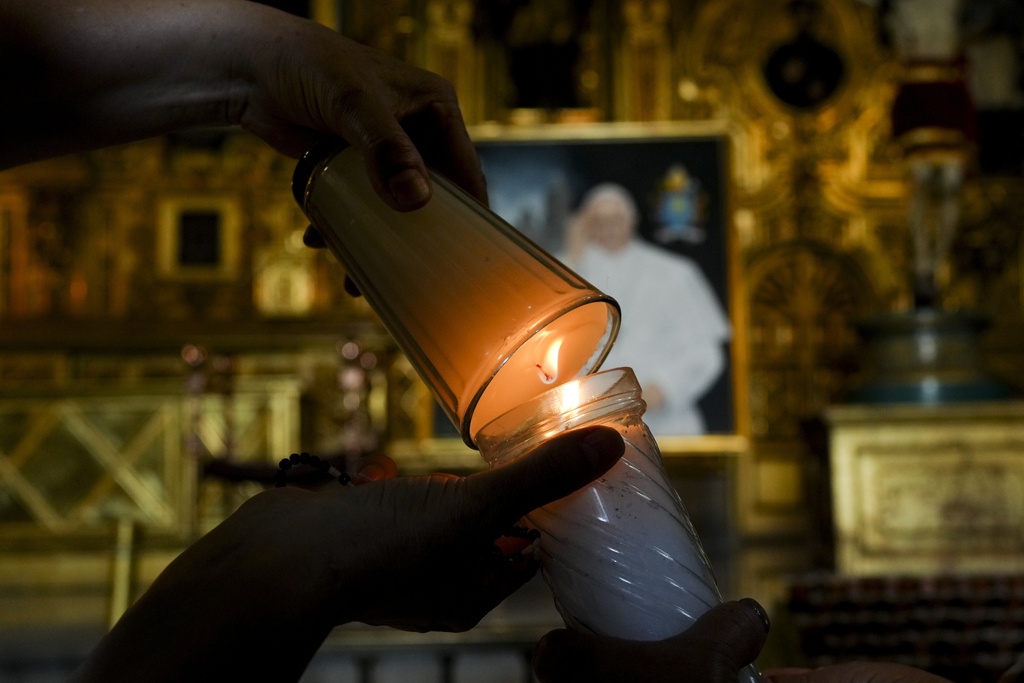
Feligreses encienden una vela por la salud del papa Francisco en la Catedral Metropolitana en Ciudad de México, el jueves 27 de febrero de 2025. (AP Foto/Marco Ugarte)
CIUDAD DE MÉXICO (AP) – Cuando Araceli Gutiérrez leyó en redes sociales que la Arquidiócesis de México convocaba a un oración para el papa Francisco, la mujer de 60 no lo pensó ni un segundo. Tomó su rosario, consiguió una veladora y se dirigió a la catedral capitalina.
“Él es como parte de la familia”, dijo tras el rosario del jueves por la tarde. “Por eso se siente esta preocupación por él».
Como ella, otras decenas de personas se dieron cita en el templo católico de Ciudad de México para pedir por la recuperación de Francisco, quien ha estado hospitalizado en Roma desde el 14 de febrero tras una infección respiratoria que derivó en neumonía y otras complicaciones.
El papa de 88 años, a quien se le extirpó parte de un pulmón cuando era joven, padece una enfermedad pulmonar crónica y el sábado sufrió una crisis respiratoria asmática que requirió altos flujos de oxígeno. Desde entonces, el Vaticano ha reportado mejorías leves y constantes, aunque los médicos indicaron el jueves que requiere más días de “estabilidad clínica”.
Gutiérrez, quien recuerda con nostalgia la visita que Francisco realizó a México en 2016, dice que ha rezado por él desde que se enteró de sus más recientes complicaciones de salud. “En muchos actos en los que yo lo veo en la tele, digo: ‘Es Dios; son los actos que hubiera hecho Jesús si estuviera aquí con nosotros’”.
Poco antes del inicio del rosario, las hermanas María Teresa y María Consuelo Sánchez guardaron unos minutos de silencio y se persignaron frente a una fotografía de Francisco.
María Teresa, de 72 años, contó que son colombianas y están de visita por México, pero decidieron unirse a la oración porque el papa siempre pide que recen por él. “Es el único papa que ha sido latinoamericano, que no es de tan lejos», dijo. “Eso es como tener un familiar en los altos mandos, con Dios”.
Tanto ella como su hermana, de 70 años, afirmaron que su pontificado se ha distinguido por su sencillez. “Es un papa humilde, como un amigo”, dijo María Consuelo.
A pocos metros de ella, hincado sobre el mármol de la catedral, José Carlos Zúñiga mantenía los ojos cerrados y las manos frente al pecho mientras el canónigo Manuel Corral repetía un Avemaría tras otra.
“He estado al pendiente de su salud”, dijo el mexicano de 56 años. “Me tocó conocerlo en Morelia en una visita que hizo y, para uno como católico, es algo que lo llena porque no es fácil que venga y no es fácil que uno vaya hasta el Vaticano».
El viaje que Francisco realizó por México en 2016 duró cinco días y recorrió territorios inexplorados por sus predecesores, como Michoacán y Chiapas, donde gran parte de la población se ha visto asolada por el narcotráfico, el crimen organizado y la corrupción.
En el país de 100 millones de católicos, el pontífice argentino se encontró con familiares de los 43 estudiantes desaparecidos en 2014 y rezó por los migrantes. En la última misa que ofreció en Ciudad Juárez antes de volver al Vaticano, pidió por todos aquellos que han muerto tratando de llegar a Estados Unidos.
Al finalizar el rosario del jueves, el padre Corral contó a periodistas que le entusiasmaba que los últimos reportes desde Roma refieren que la salud de Francisco ha mostrado ciertas mejoras.
“Lo queremos mucho porque es un papa que está cercano, que da vida», dijo». “Siempre está sonriente. Dicen que sigue con su gran humor y eso nos alegra mucho”.
____
La cobertura de noticias religiosas de The Associated Press recibe apoyo a través de una colaboración con The Conversation US, con fondos del Lilly Endowment Inc. La AP es la única responsable de todo el contenido.
MEXICO CITY (AP) – Legend has it the axolotl was not always an amphibian. Long before it became Mexico’s most beloved salamander and efforts to prevent its extinction flourished, it was a sneaky god.
“It’s an interesting little animal,” said Yanet Cruz, head of the Chinampaxóchitl Museum in Mexico City.
Its exhibitions focus on axolotl and chinampas, the pre-Hispanic agricultural systems resembling floating gardens that still function in Xochimilco, a neighborhood on Mexico City’s outskirts famed for its canals.
“Despite there being many varieties, the axolotl from the area is a symbol of identity for the native people,” said Cruz, who participated in activities hosted at the museum to celebrate “Axolotl Day” in early February.
While there are no official estimates of the current axolotl population, the species Ambystoma mexicanum — endemic of central Mexico— has been catalogued as “critically endangered” by the IUCN Red List of Threatened Species since 2019. And though biologists, historians and officials have led efforts to save the species and its habitat from extinction, a parallel, unexpected preservation phenomenon has emerged.
Axolotl attracted international attention after Minecraft added them to its game in 2021 and Mexicans went crazy about them that same year, following the Central Bank’s initiative to print it on the 50-peso bill. “That’s when the ‘axolotlmania’ thrived,” Cruz said.
All over Mexico, the peculiar, dragon-like amphibian can be spotted in murals, crafts and socks. Selected bakeries have caused a sensation with its axolotl-like bites. Even a local brewery — “Ajolote” in Spanish — took its name from the salamander to honor Mexican traditions.
Before the Spaniards conquered Mexico-Tenochtitlan in the 16th century, axolotl may not have had archeological representations as did Tláloc — god of rain in the Aztec worldview — or Coyolxauhqui — its lunar goddess — but it did appear in ancient Mesoamerican documents.
In the Nahua myth of the Fifth Sun, pre-Hispanic god Nanahuatzin threw himself into a fire, reemerged as the sun and commanded fellow gods to replicate his sacrifice to bring movement to the world. All complied but Xólotl, a deity associated with the evening star, who fled.
“He was hunted down and killed,” said Arturo Montero, archeologist of the National Commission of Protected Natural Areas. “And from his death came a creature: axolotl.”
According to Montero, the myth implies that, after a god’s passing, its essence gets imprisoned in a mundane creature, subject to the cycles of life and death. Axolotl then carries within itself the Xolotl deity, and when the animal dies and its divine substance transits to the underworld, it later resurfaces to the earth and a new axolotl is born.
“Axolotl is the twin of maize, agave and water,” Montero said.
Current fascination toward axolotl and its rise to sacred status in pre-Hispanic times is hardly a coincidence. It was most likely sparked by its exceptional biological features, Montero said.
Through the glass of a fish tank, where academic institutions preserve them and hatcheries put them up for sale, axolotl are hard to spot. Their skin is usually dark to mimic stones — though an albino, pinkish variety can be bred — and they can stay still for hours, buried in the muddy ground of their natural habitats or barely moving at the bottom of their tanks in captivity.
Aside from their lungs, they breathe through their gills and skin, which allows them to adapt to its aquatic environment. And they can regenerate parts of its heart, spinal cord and brain.
“This species is quite peculiar,” said biologist Arturo Vergara, who supervises axolotl preservation efforts in various institutions and cares after specimens for sale at a hatchery in Mexico City.
Depending on the species, color and size, Axolotl’s prices at Ambystomania — where Vergara works — start at 200 pesos ($10 US). Specimens are available for sale when they reach four inches in length and are easy pets to look after, Vergara said.
“While they regularly have a 15-years life span (in captivity), we’ve had animals that have lived up to 20,” he added. “They are very long-lived, though in their natural habitat they probably wouldn’t last more than three or four years.”
The species on display at the museum — one of 17 known varieties in Mexico — is endemic to lakes and canals that are currently polluted. A healthy population of axolotl would likely struggle to feed or reproduce.
“Just imagine the bottom of a canal in areas like Xochimilco, Tlahuac, Chalco, where there’s an enormous quantity of microbes,” Vergara said.
Under ideal conditions, an axolotl could heal itself from snake or heron biting and survive the dry season buried in the mud. But a proper aquatic environment is needed for that to happen.
“Efforts to preserve axolotl go hand in hand with preserving the chinampas,” Cruz said at the museum, next to a display featuring salamander-shaped dolls. “We work closely with the community to convince them that this is an important space.”
Chinampas are not only where axolotl lay its eggs, but areas where pre-Hispanic communities grew maize, chili, beans and zucchini, and some of Xochimilco’s current population grow vegetables despite environmental threats.
“Many chinampas are dry and don’t produce food anymore,” Cruz said. “And where some chinampas used to be, one can now see soccer camps.”
For her, like for Vergara, preserving axolotl is not an end, but a means for saving the place where the amphibian came to be.
“This great system (chinampas) is all that’s left from the lake city of Mexico-Tenochtitlan, so I always tell our visitors that Xochimilco is a living archeological zone,” Cruz said. “If we, as citizens, don’t take care of what’s ours, it will be lost.”
—-
Associated Press religion coverage receives support through the AP’s collaboration with The Conversation US, with funding from Lilly Endowment Inc. The AP is solely responsible for this content.
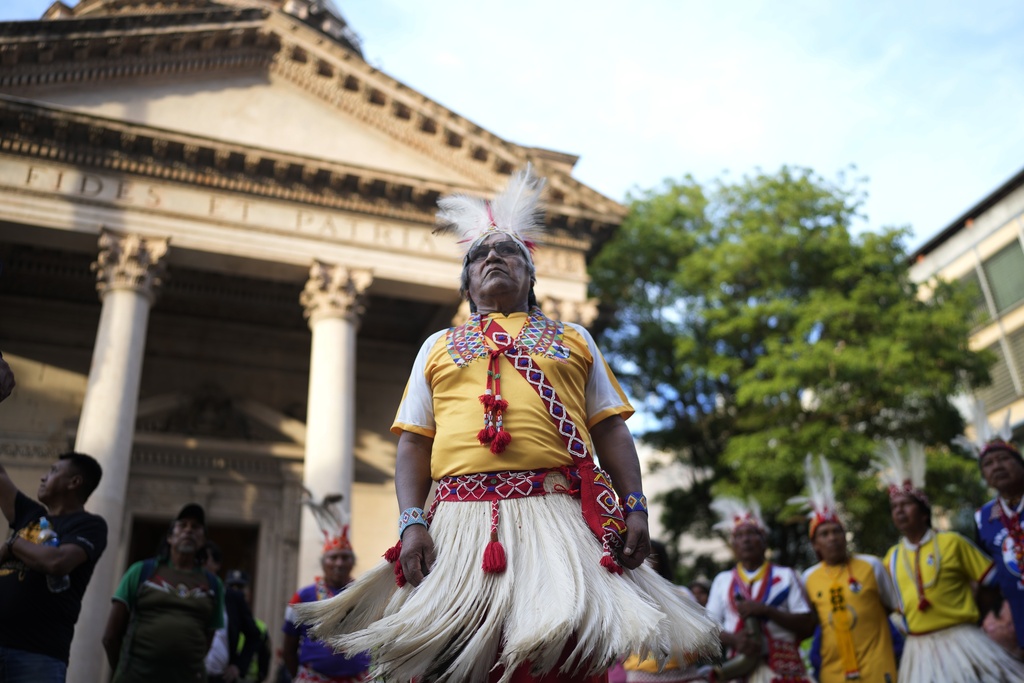
FILE – Maka Indigenous leader Mateo Martinez leads a protest for the recovery of ancestral lands in Asuncion, Paraguay, Feb. 28, 2024. (AP Photo/Jorge Saenz, File)
ASUNCIÓN (AP) – Many Maká traditions have slowly faded. Yet a few elders among these Paraguayan Indigenous people recall how their songs imitated birds.
“Men used to say that, as they sang, they travelled to Iguazu Falls or to the mountains,” said Gustavo Torres, a Maká teacher based near Paraguay’s capital, Asunción. “Their songs imitated nature.”
Next to him smiled Elodia Servín, who only speaks the Maká language but had Torres help as a translator. Her skin is covered in wrinkles and she has forgotten her age, but a memory sticks: A long time ago, when she was healthy and strong, she loved dancing in Fray Bartolomé de las Casas, a territory her people are now fighting to get back.
The land in dispute is an 828-acre (335 hectare) terrain that the Maká claim ownership over. Paraguay’s government has rejected most of their arguments, designating part of it to build a bridge connecting two cities across the Paraguay River.
Fray Bartolomé, as the Maká call it, was offered to them through a decree issued in 1944 by strongman Higinio Morínigo, then Paraguay’s president. It was meant as a present, the Maká have said, to acknowledge their courage and the role they played during the Chaco War against Bolivia in the 1930s.
“That place is sacred for us,” said Maká leader Mateo Martínez, 65. “It was a gift we thanked God for because it was given through people that loved us.”
His ancestors, Martínez said, guided soldiers through the mountains and quenched their hunger and thirst during the war.
“Only the Indigenous people knew where to find water,” he said. “If a Paraguayan soldier had gotten lost there alone, he would have died.”
Aside from the decree, details of the gift were never put on paper. The ownership titles were issued in the 2000s, and once they were, less than half of the promised acres were granted to the Maká.
Officials have said that a piece of land was indeed given to the community by Morínigo, but its size was never determined nor were its coordinates precise. Both sides meet on a regular basis to discuss a potential new agreement, though no consensus has been reached yet.
“We are open to talking,” Martínez said. “But the government won’t listen to us or tries to deceive us.”
The Maká are one of the 19 Indigenous communities of Paraguay. In the South American country of 6.8 million, more than 140,000 are Indigenous people. The latest census from 2022 estimates that around 2,600 Maká are distributed in both urban and rural areas.
Mariano Roque Alonso, where Servín and 1,600 other Maká live, is located across the Paraguay River, not too far from Fray Bartolomé. Floods forced them to relocate in the 1980s, and they haven’t been able to move back since.
Younger generations have learned Spanish, but their native language remains predominant. A few steps from the Baptist church most of the community attends, the prayers painted on a wall are in Maká.
“Our elders had other beliefs,” Martínez said. “They used to believe in the forces of nature. They prayed to the Venus star. To the moon for good health and crops.”
Among their most treasured traditions, the Maká still make a feast when a young woman transitions from puberty to adulthood. Men drink chicha, made of fermented corn, or fight as part of the celebrations. Women like Servín sing.
“Our songs come from our ancestors,” she said. “I now want to bequeath them to younger generations. To my daughters and granddaughters.”
Many like her — who sell bags and other embroidered products — make a living from craftsmanship.
Patricio Colman, 63, produces necklaces, bracelets, arrows and bows. He, too, grew up in Fray Bartolomé and recalls his people’s long-gone traditions.
“When hunters were still alive, they gathered to go hunting and stayed up to three months in the mountains,” Colman said. “But no one does that anymore.”
Back in the day, he said, the Maká had various leaders. One for hunting, one for fishing, one for youth and one for dancing. Now Martínez is the only one left.
“Even then, when officials used to visit, the distribution of the territory was unclear,” Colman said. “There had always been a threat of invasion.”
The Maká not only weep for the loss of the land itself, but the distance keeping them from their loved ones buried in Fray Bartolomé. Among them is Juan Belaieff, a Russian soldier and cartographer who mapped the region during the Chaco War. According to Martínez, then-elders thought of him as a white deity who served as a link between the community and God.
“They loved him deeply, and he was venerated by our grandparents,” the leader said.
Non-Maká people might find it hard to spot their cemetery. With no tombstones or crosses on-site, officials have doubted their claims.
“We are a different culture, though,” Martínez said. “When a Maká perishes, we don’t use a cross.”
The community does dig graves for loved ones who have recently died. Relatives cover the bodies with a cloak and the person’s belongings, but no other rituals are performed and graves are not marked.
“Relatives feel the absence so profoundly that we don’t do any ceremonies or console each other,” Martínez said. “It’s a moment of respect.”
The Maká now bury their people in Quemkuket, about 11 miles (18 kilometers) from their current settlement, but they hope to eventually get their ancestors’ remains back in one place.
“The Maká are warriors, courageous warriors,” Martínez said. “We have been fighting for this for five or six years and have no intention of ever giving up.”
____
Associated Press religion coverage receives support through the AP’s collaboration with The Conversation US, with funding from Lilly Endowment Inc. The AP is solely responsible for this content.
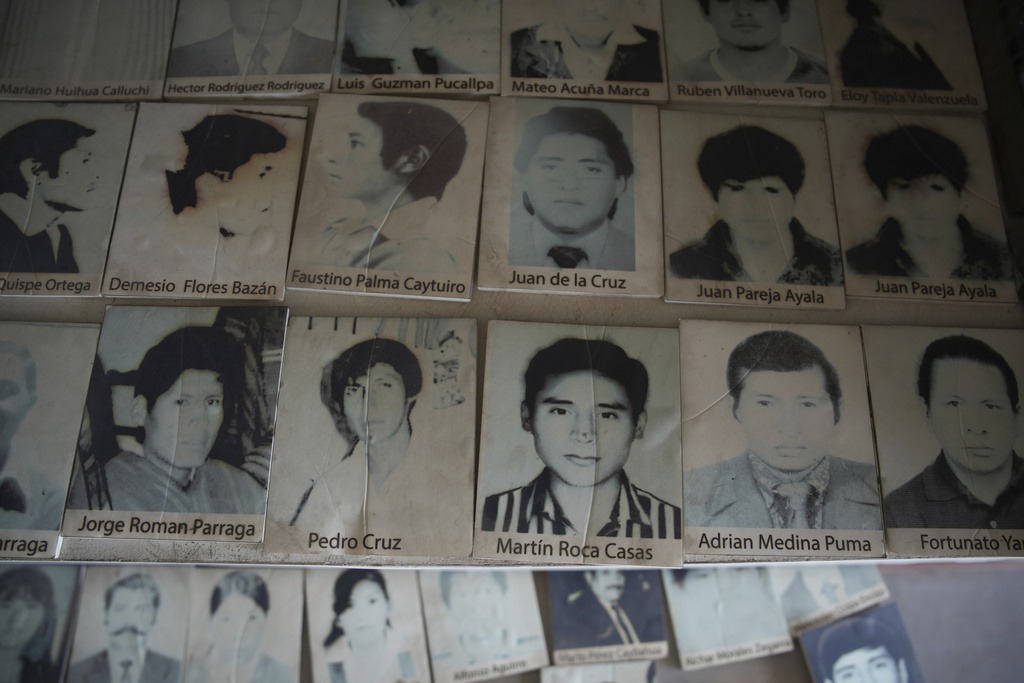
Photos of people who disappeared during Peru’s internal armed conflict (1980-2000) lie on display at the House of Memory museum in Lima, Peru, Sunday, Oct. 20, 2024. (AP Photo/Guadalupe Pardo)
Thousands of people have disappeared in Latin America during decadeslong conflicts. Many have never been found, presumed to be the victims of dictatorships, insurgencies or organized crime.
The most well-known of these mass disappearances occurred in Argentina and Chile during their military dictatorships. There are similarly wrenching but less well-known traumas elsewhere in the region.
In Peru, Colombia and Paraguay, for example, many people are still searching for answers. Loved ones have found comfort in their faith but have faced years of uncertainty and a lack of official justice.
In Peru, out of 20,000 disappeared people, only 3,200 remains have been found. In Colombia, five decades of war left a staggering death toll and more than 124,000 people missing. Paraguay’s dictatorship left a smaller number of disappeared (500 people), but only 15 bodies have been recovered.
Some key aspects of AP’s reporting from these three countries:A divisive peace in Colombia
Fighting among leftist guerrillas, right-wing paramilitaries, drug lords and government forces left more than 450,000 people killed and 124,000 disappeared. These figures are on par with other conflicts in Latin America, where thousands have vanished under similar circumstances.
In Colombia, though, a peculiar thing happened. Aiming to heal long-time wounds and build new paths toward reconciliation, dozens of former rebels, officials, forensic anthropologists and religious leaders now work side-by-side in finding their country’s disappeared.
A 2016 peace pact with the main rebel group — the Revolutionary Armed Forces of Colombia (FARC) — earned then-President Juan Manuel Santos a Nobel Peace Prize. But neither he nor his successors have fully addressed endemic violence, displacement and inequality — issues that helped spark Colombia’s conflict in the 1960s.
In 2022, Gustavo Petro, a former rebel, was sworn in as the country’s first leftist leader. His goal is to demobilize all rebels and drug trafficking gangs, but even as a ceasefire was carried out, negotiations with Colombia’s remaining guerrilla group, the National Liberation Army (ELN), failed and violence reemerged. Simultaneously, FARC hold-out groups and trafficking mafias continue to affect the country.
The peace pact established three crucial institutions for searching efforts: the Truth Commission; the Special Jurisdiction for Peace, which encourages offenders to confess their crimes and make restitution actions in exchange for not serving any jail time; and the Search Unit for Disappeared Persons, which traces disappearances, conducts exhumations and returns loved ones’ remains to hurting relatives like Doris Tejada, whose son Óscar Morales disappeared in 2007.
“It’s been 17 years and still hurts,” said Tejada, who found Morales’ remains in 2024. “I asked God for help because it was difficult to see his bones. We still mourn.”
Government forces and illegal groups were as responsible for massacres, forced recruitment and disappearances. According to the Truth Commission, paramilitary groups committed 45% of the homicides, while guerrillas — most of them FARC — carried out 27% and the government forces 12%.In Paraguay, a dictator’s sway is felt long after his ouster
Despite being ousted in 1989 after a 35-year reign of terror, during which 20,000 people were tortured, executed or disappeared, some Paraguayans feel as if Gen. Alfredo Stroessner never truly left.
“This is probably the only country in which the political party that supported a dictator, once he is gone, remains in power,” said Alfredo Boccia, an expert on Paraguay’s history. “That’s why scrutiny took so long, most disappeared were never found and there were barely trials.”
Stroessner served as Paraguay’s president, leader of the conservative Colorado Party, commander of the armed forces and chief of police. He was not overthrown by enemies, but by his in-law, and the military members involved were affiliated with his party, which has ruled almost uninterrupted since.
The Colorado Party’s dominance makes accountability elusive. Few of those responsible for crimes have faced trial, and public schools avoid mentioning the dictatorship during history lessons.
“Paraguayans now vote for the party freely,” Boccia said. “For those of us who fight for memory, that battle was lost.”
Rogelio Goiburu, who has searched for his father for 47 years, was named director of historic memory at the Ministry of Justice, but has no budget. By his own means or raising funds, he has filled in the blanks about the fate of his father and other disappeared people, earning the trust of retired police and military officers who confessed to him how bodies were disposed.
Only one major excavation has been done in Paraguay seeking to solve disappearances. It was led by Goiburu between 2009 and 2013. Of the 15 bodies found, only four were identified.
While 30,000 Argentinians disappeared in a less than a decadelong dictatorship, around 500 people vanished in Paraguay amid the 35-year regime. Regardless, relatives argue that searches must continue.
“Every disappearance attacks the right to mourn,” said Carlos Portillo, who interviewed thousands of victims for the Truth Commission. “There’s no culture which doesn’t have a ritual for mourning. A disappearance is the denying of this ritual, and that’s why it’s impossible to let go.”Grim legacy of Peru’s 20-year insurgency
In Peru, an estimated 20,000 people disappeared between 1980 and 2000 during a brutal conflict between the government and the Sendero Luminoso (or Shining Path), a Communist organization that claimed to seek social transformation through an armed revolution.
Founded in the 1970s by Abimael Guzman, the group turned violent a decade later. Older Peruvians still tell tales about donkeys strapped with explosives detonating in crowds, bombs that blew up streetlamps to plunge cities into darkness, and massacres that wiped out entire families.
The terror, though, was not merely unleashed by the insurgents. The armed forces were equally responsible for deaths and human rights violations.
Hundreds of men — many of them innocent — were captured by the military, often to face torture and execution. Others were slain and buried in mass graves by insurgents seeking to control communities by spreading fear.
Although hundreds of people have disappeared for other motives since then, the Truth Commission said this was the most violent period in Peru’s history. More than 69,000 people are counted as “fatal victims” — about 20,000 classified as “disappeared” and the rest killed by insurgents or the military.
“In many ways, Peru is still dealing with the repercussions of the political violence from the late 20th century,” said Miguel La Serna, a history professor at the University of North Carolina.
“Whole generations of adult men disappeared and that impacted the demographics in these communities. People moved out to escape the violence and some never returned,” he added. “And that’s to say nothing of the social, collective trauma that people experienced.”
Despite the work of forensic doctors, prosecutors and organizations like the International Committee of the Red Cross, only about 3,200 remains have been found. Some now fear that President Dina Boluarte might cut the government’s support to keep searching.
___
Associated Press religion coverage receives support through the AP’s collaboration with The Conversation US, with funding from Lilly Endowment Inc. The AP is solely responsible for this content.
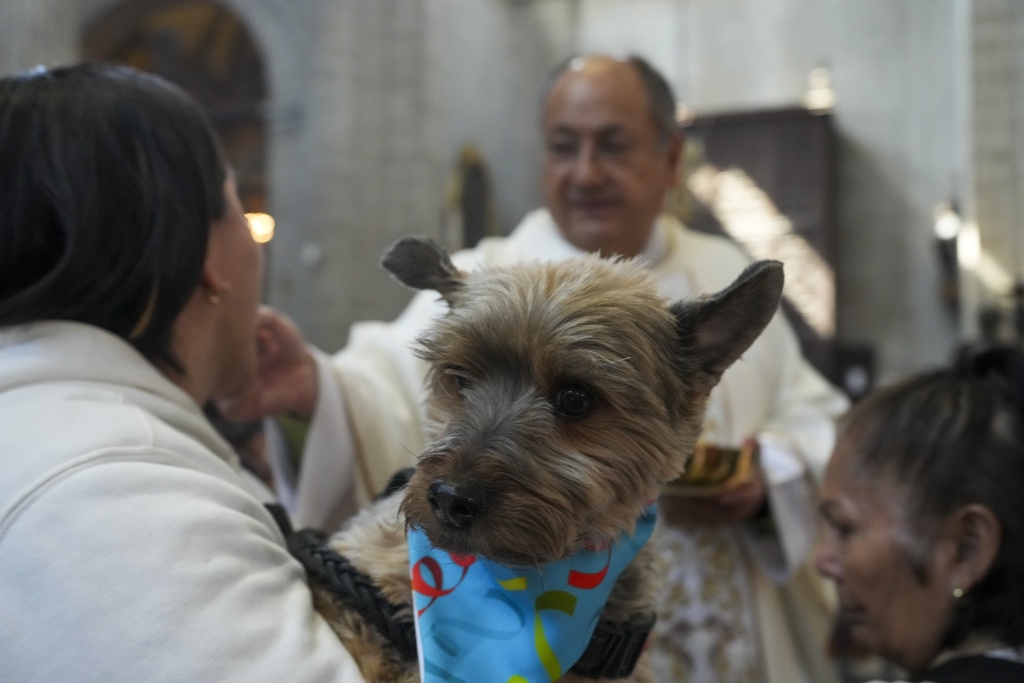
Gabriela Viquez holds onto her black and tan Yorkie Jerome, as she receives communion during the annual blessing of the animals Mass in Mexico City’s Metropolitan Cathedral, Friday, Jan. 17, 2025. (AP Photo/Marco Ugarte)
MEXICO CITY – Behaving at their best, a dozen dogs attended Mass at Mexico City’s cathedral Friday, waiting for their turn to be doused with holy water.
The blessing of the animals is a long-time Catholic tradition celebrated on January 17. On this day, Mexican Catholic congregations and priests welcome pups, cats and the occasional parrot on the feast day of St. Anthony the Abbot, considered the patron saint of animals.
A few parishioners dress up their beloved pets with sweaters or scarves. But all pray to God and their four-legged friends’ patron to keep them healthy and safe.
Karla Flores feels as if Lana, her 11-year-old dog, was a true blessing. Someone abandoned her as a newborn outside her home on Dec. 12, when millions of Mexican Catholics celebrate Our Lady of Guadalupe.
“We found her next to her mom and little brothers inside a box,” Flores said. “We rescued them and gave up most of them for adoption, but we kept her and her mom.»
Recently, Lana has been depressed and sick, Flores said, so a blessing felt in order.
Rocky, a black, poodle-looking dog, came with owner Naydelin Aguilar. He was a gift from her mother during the pandemic, she said, and will forever feel grateful for the joy he’s brought into her life.
“We have faced tough situations,” Aguilar said. “But he’s been like a light for us during the storms we have endured, and this will be his fifth year as part of our family.”
The Rev. José Antonio Carballo, rector of the cathedral, addressed the pets waiting attentively and calmly in their owners’ arms during his service.
“We ask the Lord to bless them, so he can preserve them and care for them, since they bring company and encouragement to their caretakers,” Carballo said.
As soon as he finished noon Mass, pet owners headed to the cathedral’s entrance, where Carballo sprinkled holy water on both humans and pets.
There was Jerome, a black and tan colored yorkie, held by loving owner Gabriela Viquez.
She adopted him four years ago as a pup and immediately fell head over heels for him. Since then, on the anniversary of the day he arrived home, she gets a cake and hosts a party to celebrate Jerome.
“I once spoke to a person who can talk to animals and she told me that he once was a gift for someone, but was later abandoned and beaten, so he carried a lot of trauma,” Viquez said.
“We are now very happy together and it was a fortune to have found each other.”
____
Associated Press religion coverage receives support through the AP’s collaboration with The Conversation US, with funding from Lilly Endowment Inc. The AP is solely responsible for this content.
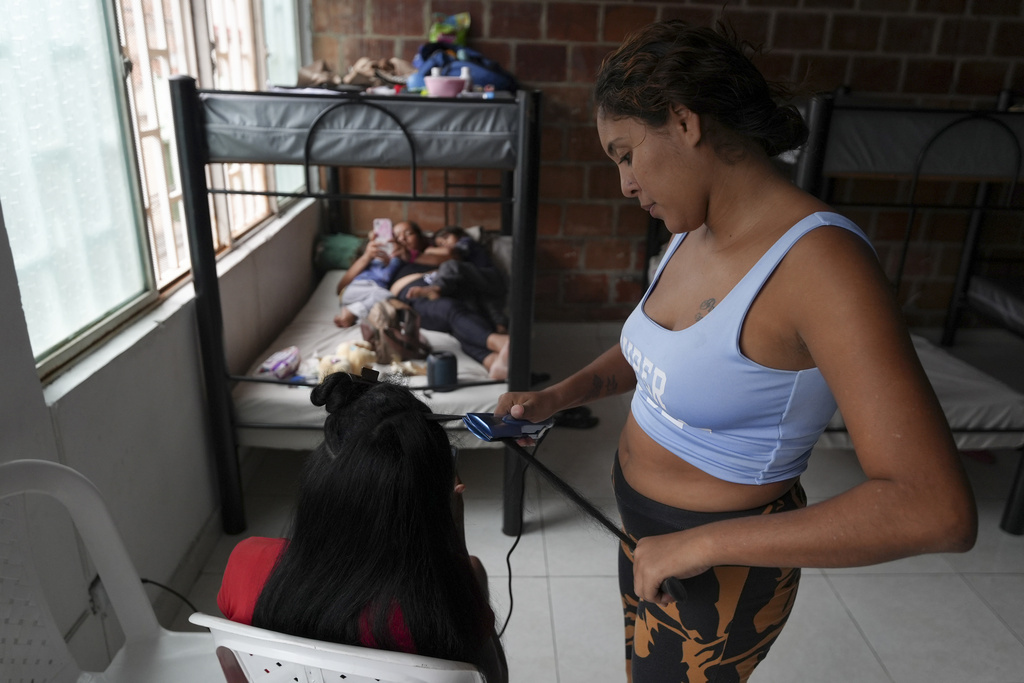
Mariana Ariza, of Venezuela, straightens a compatriot’s hair at the Pope Francis Migrant Shelter in Palmira, Colombia, Friday, Nov. 1, 2024. (AP Photo/Juan Diaz)
PALMIRA, Colombia (AP) – It’s been three years since Douarleyka Velásquez abandoned her career in human resources. Her new job is not what she had planned for, but still feels rewarding. As a cleaning supervisor at a migrant shelter in Colombia, she gets to comfort Venezuelans who, just like herself, fled their homes hoping for a better life.
“I feel that in here I can help my brothers, my countrymen who come and go,” said Velásquez, 47, from Pope Francis Migrant Shelter in Palmira, a city in southwestern Colombia.
The U.N. refugee agency, UNHCR, estimates that more than 7.7 million Venezuelans have left their homeland since 2014, the largest exodus in Latin America’s recent history, with most settling in the Americas, from neighboring Colombia and Brazil to more distant Argentina and Canada.
According to the International Organization for Migration, Colombia hosts the highest population of migrants from Venezuela. Colombian records show that as of mid-2024, more than 2.8 million Venezuelans were in the country.
Pope Francis Migrant Shelter was founded in 2020 to address this phenomena, said the Rev. Arturo Arrieta, who oversees human rights initiatives in the Catholic Diocese of Palmira.
The city is mostly a transit point, Arrieta said. Migrants pass through on their way to the Darien Gap, a treacherous route to reach North America. A few others, who found it impossible to keep migrating or yearned for their past life, make a stop before heading back home.
“It’s one of the few shelters en route,” Arrieta said. “The international community has stopped financing places like this, thinking that it would discourage immigration, but that will never happen. On the contrary, this leaves migrants unprotected.”
People reaching the shelter can stay up to five days, though exceptions can be made. Velásquez was welcomed to the team when she settled in Palmira, which was also the case of Karla Méndez, who works in the kitchen and said that cooking traditional Venezuelan meals for her compatriots brings her joy.
According to Arrieta, the shelter is mostly sought out by families, women traveling alone and the LGBTQ+ population. Food, clothing and spiritual counsel are provided to those in need; facilities include showers, a playground for children, and cages for pets.
Aside from this, the team provides information on human trafficking and support to women who have been abused and to children who travel unaccompanied.
“We have also encountered Venezuelan mothers who are looking for their relatives and are coming from or towards the Darien Gap in a never-ending search,” Arrieta said. “Families are searching for loved ones who disappeared while migrating.”
While no official records track the number of migrants who have vanished – in part because some of them traveled illegally – their disappearances have been acknowledged by human rights organizations and Colombian institutions.
“In recent years, we have found unidentified bodies whose clothing or belongings indicate that they are migrants,” said Marcela Rodriguez, who works at a local missing-persons search unit.
Arrieta knows he can’t protect every migrant from stepping into territories controlled by illegal armed groups. But he does his best to comfort migrants at the shelter.
“Our motto is that we are a caress from God,” he said. “We want them to find an oasis here.”
Velásquez, whose husband, two children and a grandson left Venezuela with her, said that leaving everything behind was tough, but her family now feels at home.
“I feel very proud of what I do,” she said. “I always try to provide encouragement and tell people that all will work out wherever they go.”
One floor up, 20-year-old Mariana Ariza faces a dilemma that many migrants share: Where to go next?
After leaving Venezuela in 2020, she arrived in Bogotá with her 2-year-old and became a sex worker to support her child.
“It’s really hard to migrate and not being able to get a job,” said Ariza, now a mother of two. “I would do anything for my children. I would never let them starve.”
She’s undecided about going back to Venezuela to reunite with her family or heading to Ecuador, to look for better opportunities.
“Some people tell me, ‘You have that job because you don’t know how to do anything,’ but that’s not true,” Ariza said. “I learned a lot of things, but I haven’t had the money or the opportunity to move ahead.”
In Bogotá, where she initially arrived, the Rev. René Rey has spent decades supporting Colombian sex workers and LGBTQ+ people with HIV. In recent years his work has broadened to aid Venezuelan migrants.
He noticed an increased influx starting in 2017, when protests flared in Venezuela in reaction to an attempt by the government to strip the National Assembly of its powers.
“It was a strong wave,” Rey said. “Many of them, who were sexually abused or were victims of human and labor trafficking, got here.”
According to Rey, about half of the sex workers in Santa Fe – the neighborhood where he works in Colombia’s capital – are Venezuelan, most of them between 21 and 24 years old.
The building where he teams up with a Catholic organization called Eudes Foundation to provide information on HIV and cook lunches for homeless people is known as “The Refuge.” It’s also a place of prayer, where locals and migrants converge and a few transgender Venezuelan sex workers have found a safe space to practice their faith.
“We just tell them: ‘God is around here, how are you? We would like to be friends’,” Rey said. “I think these honest encounters provoke something new, where the Holy Spirit really is.”
Out of the three prayer groups that he oversees at The Refuge, one is led by Lía Roa, a Colombian transgender woman who became a seminarian before her transition and later struggled for acceptance within the Catholic Church.
Rey initially invited her to participate in activities inclusive of transgender people during Holy Week but later thought: What if she could have a bigger role in our community? So he took his proposal to the cardinal, and he enthusiastically supported it.
The group of half a dozen transgender sex workers – most of them from Venezuela – meet at The Refuge most Saturdays. First, they share a meal. Afterwards, they pray, meditate and talk.
“It’s been a challenge because Santa Fe is like Mecca for trans women,” Roa said. “They carry a rough past that has made them become invisible to the point that they lose their dignity as humans and daughters of God.”
Members of her prayer group often recount that they migrated because they could not find safes spaces for them as trans women in Venezuela. And even if many of them are just passing through Bogotá before heading back home or toward the Darien Gap, Roa feels that their meetings at The Refuge are meaningful and build loving, truthful friendships.
“In their own words, this process becomes spiritual nourishment for their way forward,” Roa said.
“They leave with a new vision, because once you’ve been told that God hates you because you are trans, hearing a priest and another trans telling you that God loves you just the way you are definitely makes a difference.”
____
Associated Press religion coverage receives support through the AP’s collaboration with The Conversation US, with funding from Lilly Endowment Inc. The AP is solely responsible for this content.
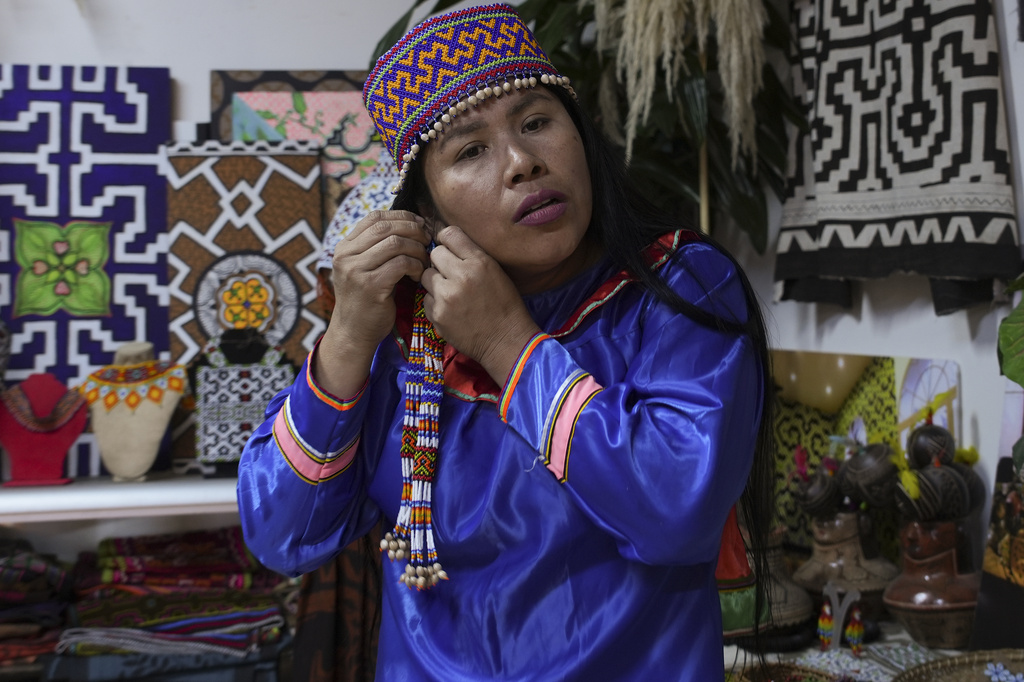
Sadith Silvano, de los Paoyhan, una comunidad indígena Shipibo-Konibo en la Amazonía, se pone aretes en su vivienda y taller de arte en Lima, Perú, el 19 de octubre del 2024. (Foto AP/Guadalupe Pardo)
LIMA (AP) – Sadith Silvano’s crafts are born from ancient songs. Brush in hand, eyes on the cloth, the Peruvian woman paints as she sings. And through her voice, her ancestors speak.
“When we paint, we listen to the inspiration that comes from the music and connect to nature, to our elders,” said Silvano, 36, from her home and workshop in Lima, Peru, where she moved two decades ago from Paoyhan, a Shipibo-Konibo Indigenous community nestled in the Amazon.
“These pieces are sacred,” she added. “We bless our work with the energy of our songs.”
According to official figures, close to 33,000 Shipibo-Konibo people inhabit Peru.
Settled in the surroundings of the Uyacali river, many relocated to urban areas like Cantagallo, the Lima neighborhood where Silvano lives.
Handpainted textiles like the ones she crafts have slowly gained recognition. Known as “kené,” they were declared part of the “Cultural Heritage of the Nation” by the Peruvian government in 2008.
Each kené is unique, Shipibo craftswomen say. Every pattern speaks of a woman’s community, her worldview and beliefs.
“Every design tells a story,” said Silvano, dressed in traditional clothing, her head crowned by a beaded garment. “It is a way in which a Shipibo woman distinguishes herself.”
Her craft is transmitted from one generation to another. As wisdom is rooted in nature, the knowledge bequeathed by the elders connects younger generations to their land.
Paoyhan, where Silvano was born, is a flight and a 12-hour boat trip away from Lima.
In her hometown, locals rarely speak languages other than Shipibo. Doors and windows have no locks and people eat from Mother Nature.
Adela Sampayo, a 48-year-old healer who was born in Masisea, not too far from Paoyhan, moved to Cantagallo in the year 2000, but says that all her skills come from the Amazon.
“Since I was a little girl, my mom treated me with traditional medicine,” said Sampayo, seated in the lotus position inside the home where she provides ayahuasca and other remedies for those ailing with a wounded body or soul.
“She gave me plants to become stronger, to avoid getting sick, to be courageous,” said Sampayo. “That’s how the energy of the plants started growing inside me.”
She, too, conveys her worldview through her textiles. Though she does not paint, she embroiders, and each thread tells a tale from home.
“Each plant has a spirit,” said the healer, pointing to the leaves embroidered in the cloth. “And medicinal plants come from God.”
The plants painted by Silvano also bear meaning. One of them represents pure love. Another symbolizes a wise man. One more, a serpent.
“The anaconda is special for us,” Silvano said. “It’s our protector, like a god that cares for us and provides food and water.”
In ancient times, she said, her people believed that the sun was their father and the anacondas were their guardians. Colonization brought a new religion — Catholicism — and their Indigenous worldview was diluted.
“Nowadays we have different religions,” Silvano said. “Catholic, evangelical, but we respect our other beliefs too.”
For many years, after her father took her to Lima hoping for a better future, she yearned for her mountains, her clear sky and her time alone in the jungle. Life in Paoyhan was not precisely easy, but from a young age she learned how to stay strong.
Back in the 1990s, Amazonian communities were affected by violence from the Shining Path insurgency and illegal logging. Poverty and sexism were also common, which is why many Shibipo women taught themselves how to navigate their anguish through the heartfelt music they sing.
“When we encounter difficult times, we overcome them with our therapy: designing, painting, singing,” Silvano said. “We have a song that is melodic and heals our soul, and another one that is inspiring and brings us joy.”
Few Shipibo girls are encouraged to study or make a living of their own, Silvano said. Instead, they are taught to wait for a husband. And once married, to endure any abuse, cheating or discomfort they may encounter.
“Even though we suffer, people tell us: Take it, he’s the father of your children. Take it, he is your husband,” Silvano said. “But deep inside, we are wounded. So what do we do? We sing.”
The lesson is taught from mothers to daughters: If you hurt at home, grab your cloth, your brush and leave. Go far away, alone, and sit. Connect with your kené and paint. And while you paint, sing.
“That’s our healing,” Silvano said. “Through our songs, our kenés, we are free.”
In the workshop where she now works and raises her two children on her own, Delia Pizarro crafts jewelry. She, too, sings as she creates birds out of colorful beads.
“I didn’t use to sing,” Pizarro said. “I was very submissive and I didn’t like to speak, but Olin, Sadith’s sister, told me, ‘You can do this.’ So now I’m a single mother, but I can go wherever I want. I know how to defend myself and fight. I feel valued.”
The figures in the products they craft for sale are varied. Aside from anacondas, they like to depict jaguars, which represent women, and herons, which were treasured by the elders.
A Shipibo textile can take up to a month and a half to be completed. Materials required to craft it — the cloth, the natural pigments — are brought from the Amazon.
The black color used by Silvano is extracted from a bark tree that grows in Paoyhan. The cloth is made of local cotton. The mud used to set the colors comes from the Uyacali river.
“I like it when a foreigner comes and leaves with something from my community,” said Silvano, touching one of her freshly painted textiles to bless it for a quick sale.
She said that her people’s crafts were barely known when she and her father first arrived in Lima 20 years ago. But in her view, things have now changed.
In Cantagallo, where around 500 Shipibo families have settled, many make a living selling their crafts.
“My art has empowered me and is my loyal companion,” Silvano said. “Thanks to my mother, my grandmother and my sisters, I have a knowledge that has allowed me to open doors.”
“Here’s the energy of our children, our ancestral world and our community,” she added, her textiles still between her hands. “Here’s the inspiration from our songs.”
____
Associated Press religion coverage receives support through the AP’s collaboration with The Conversation US, with funding from Lilly Endowment Inc. The AP is solely responsible for this content.
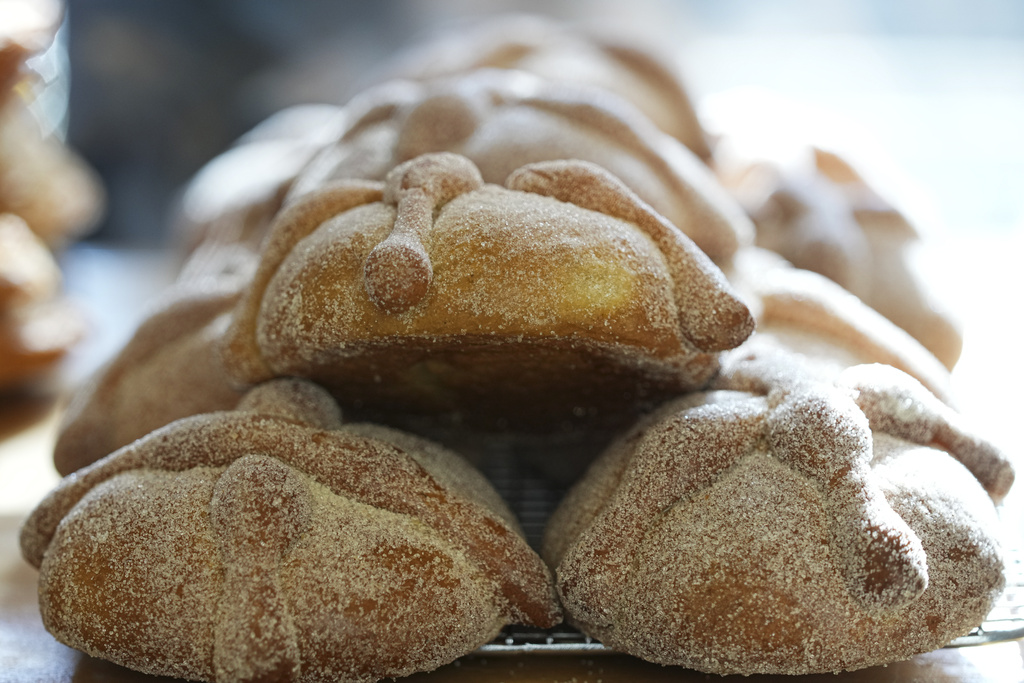
Pan de muerto, or «bread of the dead,» traditional for Mexico’s Day of the Dead, sits for sale at a bakery in the San Rafael neighborhood of Mexico City, Thursday, Oct. 17, 2024. (AP Photo/Fernando Llano)
Its date of origin can’t be specified, but pan de muerto can be thought of as a fusion of Mesoamerican and Spanish traditions, said Andrés Medina, a researcher at the Anthropological Research Institute of the National Autonomous University of Mexico.Mexicans have remembered the dead with festivities and food for centuries
Since pre-Hispanic times, festivities for the dead have existed and skull-shaped products have been made. But in the 1500s, when the Spaniards arrived, new elements such as sugar and bread were incorporated into Indigenous offerings.
Those early celebrations, Medina said, coincided with the crop season, which provides pan de muerto a spiritual, symbolic meaning. If its decorations resemble bones, it’s because Mesoamerican worldviews regarded them as the origin of life.
According to an ancient myth, Quetzalcóatl created humankind out of bones. Details vary from one source to another, but soon after the god apparently stole them from the underworld, he fell. And from his blood, the seed of life was born.
“Under this worldview, the human body’s bones, just like the fruit’s insides, are seeds,” Medina said. “So, in a way, altars are offerings to fertility. And Day of the Dead is a celebration of the life contained in each seed.”
Pan de muerto’s shape, ingredients and preparations differ from one Mexican state to another, but is enjoyed all over the country.100 and counting: One man’s quest to try every variation of “pan de muerto”
In Mexico City, hundreds of bakeries make their own version. Rodrigo Delgado has spent years trying to taste them all.
For fun, he challenges himself to try as many as possible and review them on his Instagram account. On his first quest, a decade ago, he tried 15. In 2023, he had a bite of 100. This year, he expects to taste at least 110.
“I like pan de muerto because of what it means during Day of the Dead season,” said Delgado, who also reviews local restaurants on his blog, Godínez Gourmet. “The mix of flavors of the bread, as much as its texture, are very comforting.”
He can’t remember the first time he tried pan de muerto, but he treasures the memories of his mother baking it at home. He and his brother used to knead the dough, he said, and shape the bone-like decorations of its top.
Baking pan de muerto is not an easy task. At Panadería Dos Veinte, in Mexico City’s San Rafael neighborhood, owner Manu Tovar said that having these sweet buns ready for sale takes three days of work: one to extract the infusions that will provide the bread with its flavor, another to incorporate them into the dough and one more day to knead and shape the buns.
There’s no secret in his recipe, Tovar said. The ingredients — although seasonal — are simple: orange blossom, tangerine zest, anise and butter.
His special touch, what makes his bread unique, is the sourdough. “It’s an ancestral process,” Tovar said. “A millenary way to make bread.”
The sourdough that he and four assistants use is 20 years old. He incorporates water and flour daily, to keep it alive, and mixes part of it with new dough. This gives the bread a better taste, he said, and makes it easier to digest.Pan de muertos’ seasonal flavors help make it special
For years, said Tovar, he resisted the temptation of baking pan de muerto in early October. The quality of the ingredients improves as November gets closer, but customers kept asking when the buns would be ready, so he caved.
This season, aside from baking 90 pan de muertos per day, he came up with two new creations: a croissant roll filled with marigold cream and a bun — locally known as “concha” — shaped like a marigold flower and prepared with tangerine instead of vanilla or chocolate.
“If you bake it in a traditional way, you can only have pan de muerto now, because that’s when the fruit is available,» Tovar said. «That’s what I think makes it so special.”
The ambience of the Day of the Dead season, he added, also plays a role. Nightfall comes earlier during this time of year and there’s certain mysticism, a particular feeling in the air.
“It probably has to do with the melancholy of what this festivity means,” he said. “For one day a year, you can feel closer to those who are no longer with you.”
____
Associated Press religion coverage receives support through the AP’s collaboration with The Conversation US, with funding from Lilly Endowment Inc. The AP is solely responsible for this content.
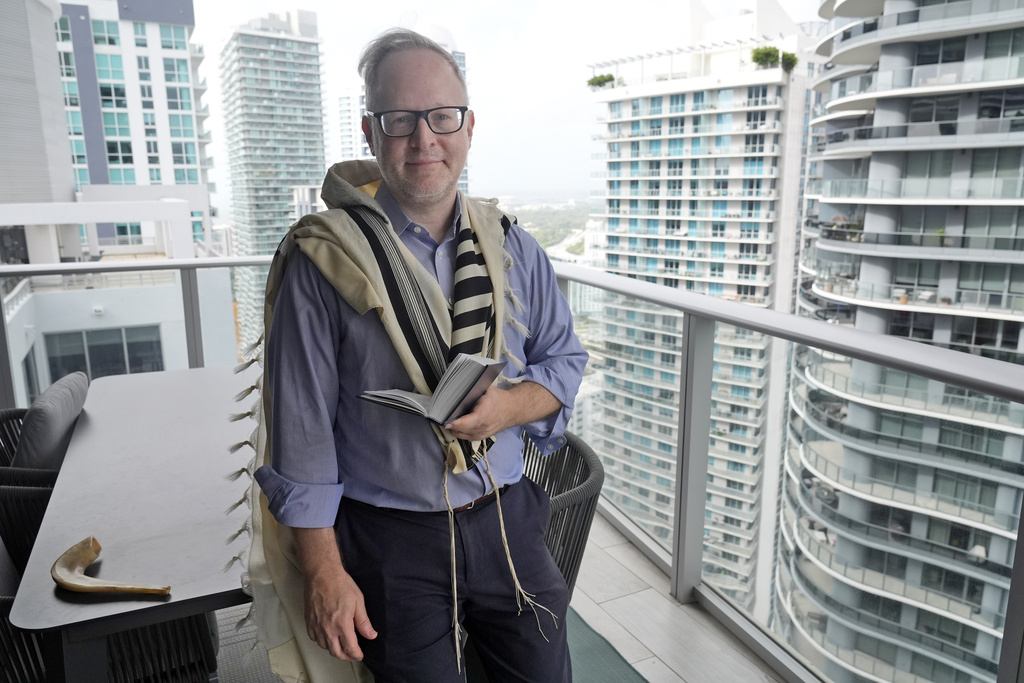
Daniel Gammerman poses for a photo on his balcony where he sometimes prays as he prepares to worship at home for the Jewish High Holy Days, Thursday, Sept. 26, 2024, in Miami. (AP Photo/Wilfredo Lee)
It was a heart-wrenching choice. But when Daniel Gammerman decided to never set foot back in an Orthodox synagogue, he thought of it as an act of love. Not toward the Jewish community he was born into, but to himself.
“A synagogue is a spiritual place, but it’s also a community place,” said Gammerman, 47, from his home in Miami. “If I have to basically check at the door half of my identity in order to come in, I don’t feel that’s welcoming enough for me.”
Dozens of LGBTQ+ Jews like him have struggled to find support and acceptance within their Orthodox communities. Most were raised with little knowledge of what being gay or queer meant. They just felt different, but found it hard to ask their rabbis: “This is who I am, is there still room for me here?”
“The way it mostly works is invisibility,” Gammerman said. “There’s no addressing the existence of LGBT people among us. And, whenever you hear something about it, of course it’s negative.”
He can’t put his finger on a specific date in which he realized he was gay. But he remembers clearly what happened to him when the news got out.
“I used to get enormous texts from different people trying to explain to me how this was wrong,” Gammerman said. “It was a bombardment of people trying to fix me.”
Grandson to Eastern European Jews who fled during World War II, Gammerman was born in Brazil. He moved to the U.S. after finishing high school in the 1990s and continued his studies at a Jewish Orthodox university. At age 21, he got married. He and his wife — who he still thinks of as a friend — raised four children together.
“We built a perfect family,” he said. “I checked all the boxes of what a nice Jewish Orthodox family is supposed to be.”
Afraid to destroy his future and his children’s lives, he shut down his feelings for years, until he could do it no more.
He initially traveled to Brazil and met with a therapist who counseled gay men in heterosexual marriages. That helped, Gammerman said, but something was missing. What about his life within an Orthodox religious community that didn’t even acknowledge that LGBTQ+ people exist?
Embracing his true identity felt easier after meeting Steven Greenberg, an openly gay rabbi who founded Eshel, a U.S.-based organization focused on connecting LGBTQ+ Orthodox Jewish communities.
According to Miryam Kabakov, Eshel’s co-founder and executive director, most of the people who reach out share similar concerns: I’m coming out and I’ve been part of this community my whole life. Can I still belong? What will happen to me now? Can you find a rabbi who can help me?
“We guide them toward religious leaders who will tell them that there’s still a place for them,” Kabakov said. “That they still have the religious obligations and expectations that they’ve always had and that they should stay true to their heart and their tradition if that’s what they want.”
Ely Winkler, a 37-year-old LGBTQ+ Orthodox Jew from Brooklyn, will soon be back at an Orthodox synagogue after years of distancing himself from his community.
“After the war broke out between Israel and Gaza, I felt a deeper calling,” he said. “I didn’t feel strong enough to stand up for myself, for my beliefs, and I knew that I needed to strengthen my Judaism, to remember who I was.”
Abrielle Fuerst, 32, moved from Texas to Philadelphia six years ago. Eshel helped her to connect with a local rabbi and an inclusive synagogue.
“Here it’s not: ‘Oh, come because you are Jewish and gay, we’ll accept you.’ It’s just: ‘Hello, you’re Jewish, thanks for being in this space and it’s nice to meet you.’”
One of Eshel’s projects, named the «Welcoming Shuls,” enlists more than 200 rabbis who work across North America to make their synagogues hospitable for LGBTQ+ people. Many of them consent to being publicly identified; others ask to keep a low profile, foreseeing hostile reactions within their Orthodox communities.
“A lot of rabbis are very afraid to be public because they’ll get ostracized,” Kabakov said. “But we know they’re there.”
The group also counsels Orthodox LGBTQ+ Jews who wish to keep a distance from their religion.
“People who don’t want to be religious anymore are torn up about it,” Kabakov said. “But we try to help them through the struggle and let them know that they can be gay and be religious. It might be hard to find a place, but we’re working on that.”
Gammerman has tried to go back to Orthodox synagogues since he came out. Until now, none in Miami have made him feel truly accepted.
“I’ve tried many times, but it’s like wearing a costume,” he said. “At some point I was able to live with that. But the more you accept yourself, the more you love yourself, you just cannot do it.”
His Orthodox community did not prevent him from attending religious services after he came out, but rejection was still there. People stopped greeting him, and he was no longer allowed to officiate services at his synagogue. Once, during a speech, the rabbi looked at him and said: “Homosexuality is destroying humanity and if this continues like this, there’ll be no more children in the world.”
“I lost friendships, relationships, participation and community,” Gammerman said. “It was all gone really, really fast.”
Meeting Greenberg, who is married to another man and has a child, helped him realize he could still live a happy, fulfilling life. After their encounter, Gammerman decided to talk to his wife. The couple separated and found a way to break the news to their children.
“Since then, I have rebuilt my life,” he said. “I remarried. I have a husband. My children are part of my life and they understand.”
In time, he realized that not only his family, but his approach toward his religion would also need to change. At first he tried to attend liberal Reform synagogues, some of which fully embrace LGBTQ+ worshippers, but having been raised an Orthodox Jew, he still felt out of place.
“Being LGBT is a whole identity,” Gammerman said. “And I want to be embraced in a place where there are no buts or ifs.”
He’d rather not label his current religious observance, but Rosh Hashana and Yom Kippur still bear huge significance for him. So, every year, during the High Holy Days, he wakes up early, dresses nicely and opens his prayer book.
“I say the prayers from beginning to end,” Gammerman said. “I call to all the praises as if I was in a synagogue, but I do it by myself in my house.”
He was once taught that Jewish prayer required at least 10 men to be conducted, but he has learned a few things since.
“If I was given a switch that I could press to change who I am, I would not do it,” he said. “God made me like this, so it’s not up for me to switch. I have to love myself for who I am.”
_____
Associated Press religion coverage receives support through the AP’s collaboration with The Conversation US, with funding from Lilly Endowment Inc. The AP is solely responsible for this content.
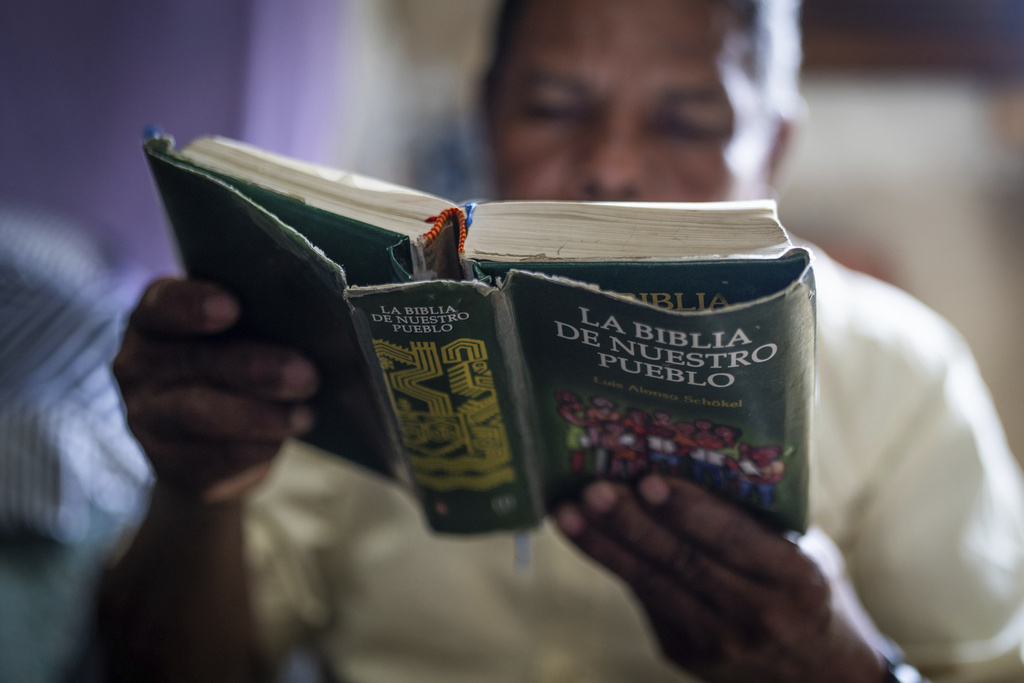
Nicaraguan exile Francisco Alvicio, a deacon of Nicaragua’s Moravian Church, reads a Bible in his rented room in San Jose, Costa Rica, Sunday, Sept. 22, 2024. (AP Photo/Carlos Herrera)
When their church no longer felt safe, deacon Francisco Alvicio and his congregation made a plan. Cautiously, discreetly, they took their worship to their homes.
“If I’m pursued at the church, I still have my Bible,” the 63-year-old Nicaraguan said.
Praying in hiding became his last resort before fleeing his country in 2023.
“Arriving with a weapon is not kind-hearted,” Alvicio said from Costa Rica, where he currently lives. “If someone goes into a church wearing a uniform, speaking loudly, it’s to intimidate.”
The relationship between Nicaraguan religious communities and the government has been strained since President Daniel Ortega’s crackdown on massive street protests in 2018.
Among evangelicals, relatively few pastors have openly supported the president. Most congregations have refrained from any political participation, though this has not prevented leaders from being imprisoned and hundreds of organizations from being closed.
In northern Nicaragua, where Alvicio was born, most of the Indigenous Miskito people are evangelicals. The Moravian Church — to which the deacon belonged — was established in Nicaragua in 1894. Until its closure alongside more than 1,600 nongovernmental organizations last August, it had about 350,000 members in the country.
For decades, Alvicio said, the Miskitos could profess their faith freely. Services took place every Wednesday, Friday and Sunday. Elders and children alike gathered at the church, where clergy read the Bible and ceremonies ended by singing a Miskito hymn.
Things started shifting when the government imposed new rules on the congregation. First came a tax that its members had never paid. Then, an order to replace their logo.
“We did not accept,” Alvicio said. “We can’t change something just because the government wants to. The only path we follow is the one of God.”
Before long, black-clad strangers started showing up at his church.
Those too afraid to attend a public service decided to pray at home. Some read their Bibles in solitude. Others with spare chairs turned their tiny houses into makeshift churches, calling in a few neighbors and leaders like Alvicio.
By changing venues every day, lowering their voices and gathering as early as 4 a.m. to avoid detection, they kept worshipping. How evangelicals have been affected by Ortega’s government
According to CSW, a British-based organization that advocates for religious freedom, violations against the faith practice of Nicaraguan Protestants have been less visible than those against the Catholic Church.
Anna Lee Stangl, CSW’s head of advocacy, noted in a recent publication that the Catholic Church is a single religious organization whose structure spreads geographically and has a clear, public hierarchy.
“The Protestant Church is made up of many different denominations and independent churches, some of which may be dominant in one part of the country and absent in another, and which do not necessarily work together or even communicate,” she said.
In both Catholic and Protestant communities, violations reported by organizations and faith leaders are similar: restrictions on the length, location and frequency of services; prohibition of processions; invasion of masked men into churches; theft or destruction of religious objects and infiltration of informants.
“The situation has seriously worsened,” said Martha Patricia Molina, a Nicaraguan lawyer who keeps a record of religious freedom violations.
According to her latest report, 870 violations were committed against the Catholic Church between 2018 and 2024, and 100 against Protestants in the same period.
Additionally, said human rights organization Nicaragua Nunca Más, more than 256 evangelical churches have been closed by the government in the past four years, while 43 Catholic groups have been targeted since 2022.
At least 200 religious leaders have fled Nicaragua, the organization said. More than 20 were stripped from their citizenship and 65 have been indicted for conspiracy and other charges.
The Nicaraguan government did not immediately respond to a request for comment.
An American pastor’s tale
Pastor Jon Britton Hancock didn’t see it coming.
How could he suspect that 11 pastors from his evangelical church could be arrested if Ortega’s government had greenlighted their operations for years?
He and his wife, both Americans and founders of Mountain Gateway, started working in Nicaragua in 2013. Two years later, they sent their first missionaries and began collaborating with local pastors.
For the next decade, they developed fair-trade coffee practices, offered disaster relief to families affected by hurricanes and organized mass evangelism campaigns.
But then, it all suddenly changed.
In December 2023, 11 of his church’s pastors and two lawyers were arrested; their families didn’t hear from them for months. It wasn’t until Sept. 5 that they were released on humanitarian grounds.
Hancock wondered why this happened. Though he never engaged in political discourse, he had preached in Congress and to the national police. He had met with officials. Ortega and his wife, Vice President Rosario Murillo, had sent notes congratulating him on his church’s work.
“I think the real reason is the Gospel is a threat to totalitarian ideas,” Hancock said. “Our perspective is about personal relationship with God and it’s based on love. And love doesn’t thrive if there’s control or coercion.”
With Ortega’s measures against faith communities, he said, not only freedom is lost.
Confiscations by the government have been a blow to church investments. And, in many cases, pastors imprisoned or forced into exile are the providers for their homes.
Mountain Gateways’ local leader, Walder Blandon, was arrested with his wife, so they were both separated from their 2-month-old baby. He and his brother, who is two years older, had to be taken in by their grandmother, who had health issues, until their parents were released in September.
“So, whether or not the Nicaraguan government intends for people to be fearful, I can promise you that there is much fear and people are responding,” Hancock said.
He, too, has heard of multiple people holding house meetings to pray. Parishioners’ modest sound systems are no longer an option, he said, because a guitar or a piano could attract police asking for a registration, so congregations have gone underground.
“It’s not very known what’s happening with evangelicals in Nicaragua,” he said. “Evangelical pastors don’t take their stands in the same way that Catholic priests do, so it’s kind of gone under the radar, but it’s certainly there.”There’s nothing left but leaving
One pastor had already gotten used to police watching his sermons and strangers listening to his conversations, but when someone told him “they’re after your head,” he decided he should flee.
“The government wants to control everything,” said the evangelical leader, who agreed to an interview on the condition his name and new home base be withheld for safety reasons. “They fear that if one speaks against the government, the people will rise.”
In his hometown, he said, he was targeted by informants who would seek to make his acquaintance, then surreptitiously use their phones to record sounds or video that the government might find of interest.
Now, with him gone, his family no longer goes to church. They worship at home and he joins them from a distance, praying for his people and the government, for justice and peace.
Alvicio, too, has kept his faith strong.
His church might be gone and he yearns to return to his country, but through his prayers, he remains tied to his land.
“We, the Moravians, believe that wherever we are, we can pray to God,” he said. “So I can walk and speak and think bearing that power, knowing that, even if I’m alone, he’ll be with me.”
____
Associated Press religion coverage receives support through the AP’s collaboration with The Conversation US, with funding from Lilly Endowment Inc. The AP is solely responsible for this content.

 mthernandezr.com