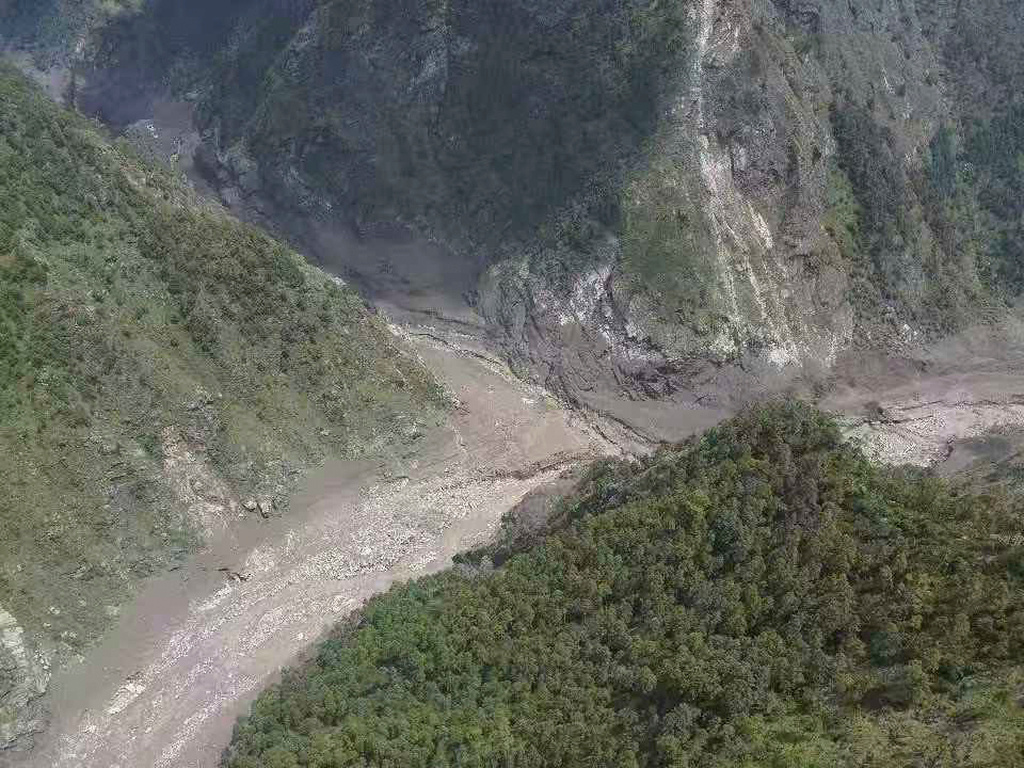
This photo released by Xinhua News Agency, shows a mudslide-hit area near Gyirong Port in southwestern China’s Tibetan Autonomous Region on Wednesday, Aug. 26, 2026. (Xinhua via AP)
BEIJING (AP) – Devotees on a pilgrimage to Mount Kailash — a sacred site in the Himalayas — were among the many people missing after the massive floods along the border between Nepal and China.
Here’s what to know about the mountain and its centuries-old role as a pilgrimage site.
Mount Kailash is sacred for several religious traditions
Mount Kailash is a Himalayan peak in southwestern Tibet, near China’s borders with Nepal and India. It rises more than 6,400 meters (21,000 feet) above sea level and lies close to Lake Manasarovar. Both have long been part of Sanskrit religious and literary traditions.
Mount Kailash holds sacred significance for Hinduism, Buddhism, Jainism and the Tibetan Bon tradition. Each associates the mountain with different beliefs and sacred histories.
According to the International Centre for Integrated Mountain Development, the mountain is considered the home of Shiva, the Hindu god of destruction, and Parvati, a Hindu goddess associated with marriage, fertility and motherhood.
Followers of the Tibetan Bon tradition regard it as a seat of spiritual power and associate the region with Tonpa Shenrab, the tradition’s founder.
Geographer Emily Yeh, a professor at the University of Colorado Boulder, who has conducted research in Tibet, wrote in 2017 that Kailash is associated with the mythical Mount Meru, considered the center of the world in Hindu and Buddhist cosmology.
The surrounding landscape also figures in local legends and Himalayan traditions. “Shared Sacred Landscapes,” a book published by ICIMOD in 2017, gathers some of them.
One story tells of Guru Nanak, the founder of Sikhism, who visits villagers longing to make the pilgrimage to Mount Kailash. Nanak teaches them that the true pilgrimage is a spiritual journey within themselves.
Pilgrims travel to the mountain for purification
India’s government operates an official Kailash Manasarovar pilgrimage from June through August or September each year, with routes through the states of Uttarakhand and Sikkim. Private operators also organize pilgrimages through Nepal.
Pilgrims traditionally walk around Mount Kailash rather than climb it, completing a roughly 33-mile (53-kilometer) circuit around the mountain.
The journey around the peak is believed to cleanse pilgrims of their sins and can take about three days to complete. Hindus and Buddhists traditionally circle the mountain clockwise, while followers of Bon travel counterclockwise.
At nearby Lake Manasarovar, some Hindu pilgrims bathe in its waters as a ritual of spiritual purification.
Yeh wrote that Tibetan pilgrims stop at monasteries and other sacred sites along the route, touching prayer beads or their foreheads to features believed to bear sacred imprints. Other rituals are meant to test a pilgrim’s merit, sin or fortune.
Pilgrims are among the missing after floods
The death toll for the disaster continues to grow, and hundreds more are missing in Nepal and China.
The missing include at least 178 people from India, most of whom were believed to be on the pilgrimage. The missing also includes people from U.S., Australia, Britain and Canada.
Indian spiritual guru Jaggi Vasudev, also known as Sadhguru, said in a post on X that 77 people returning from the mountain with groups organized by his Isha Foundation were at an immigration center in Gyirong, Tibet, when the floods struck.
—
Associated Press religion coverage receives support through the AP’s collaboration with The Conversation US, with funding from Lilly Endowment Inc. The AP is solely responsible for this content.
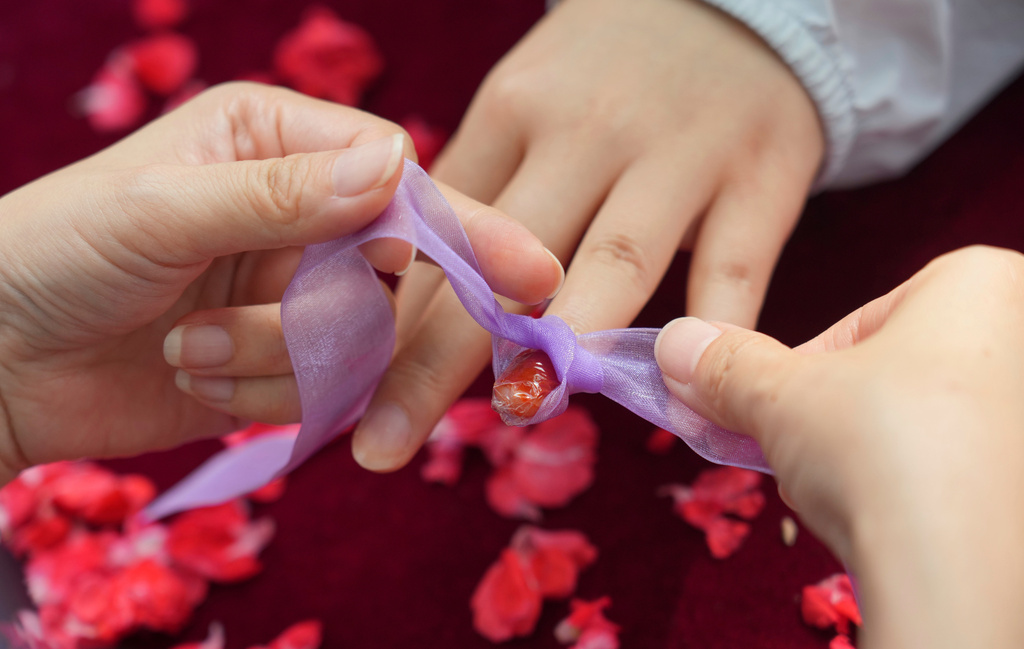
A woman gets her nail dyed with garden balsam, a natural pigment traditionally associated with beauty and blessings, during a festival to celebrate Qixi at the Beijing Folk Custom Museum in Beijing, Wednesday, Aug. 19, 2026. (AP Photo/Achmad Ibrahim)
BEIJING (AP) – Chinese Valentine’s Day is not all about flowers and chocolates. Beyond the romance embraced by some contemporary couples, Qixi is an ancient tradition rooted in legend, prayer and cultural activities that survive to this day.
The festival is observed on the seventh day of the seventh month of the Chinese calendar, which fell on Aug. 19 in 2026. Celebrations are also held in Singapore, Vietnam and other Asian countries.
Beijing’s Folk Custom Museum hosted activities on Wednesday under a program called “Asking for Skills,” reflecting a tradition at the heart of Qixi in which women historically prayed for skillfulness and displayed their abilities through crafts.
“We especially hope that young audiences can understand the meaning of our traditional festivals through interactive and engaging experiences,” said Jia Juan, who works in the museum’s Public Education Department.
The museum, housed in Beijing’s Dongyue Taoist Temple, has been hosting Qixi-related activities for the last 14 years, drawing about 500 people each time.
Old practices become hands-on
Wednesday’s program began with a performance of Chinese classical music, followed by hands-on activities for families inspired by traditional Qixi customs.
One involved dyeing fingernails with garden balsam, a natural pigment traditionally associated with beauty and blessings. Another featured Song brocade bead painting, combining a precious Chinese silk fabric with pearls that symbolize completeness and good fortune.
Participants were encouraged to create their own sachet-shaped Song brocade pearl painting. Their work was meant to embody “qiqiao,” a concept centered on the pursuit of skill and dexterity.
Wang Xuejie attended with her 7-year-old daughter and they created “qiaoguo,” a pastry made by pressing dough into decorative molds.
“We were able to get a general understanding of how, during the Qixi Festival in ancient times, girls and women expressed their aspirations and hopes for their own growth,” Wang said.
A love story in the stars
Jia said that Chinese girls started practicing qiqiao during the Tang and Song dynasties, which spanned the seventh through the 13th centuries.
“The history of the Qixi Festival can be traced back to ancient people’s worship and study of the stars,” she added.
Qixi has historically centered on two main elements. One is related to a legend — its romantic component — and the other to qiqiao.
In Chinese mythology, Zhinü, a weaver girl represented by the Vega star, falls in love with Niulang, a cowherd embodied by the Altair star. Their forbidden love leads the Jade Emperor to decree their separation on opposite sides of the Milky Way. They reunite once a year — on the seventh day of the seventh lunar month — on a bridge formed by magpies.
Jia said records of the Cowherd and Weaver Girl date back to the pre-Qin period, before 221 B.C. Then, during the Han Dynasty, customs related to qiqiao began to develop.
Women carried Qixi abroad
Researcher Lynn Wong is eager to revive the festival in Singapore through an initiative called Qixi Fest, a multiday event launched in 2023. This year’s edition will run through Aug. 23.
“We’re trying to create the childhood memories of this new generation of Singaporeans so that they grow up with the stories that our forefathers grew up with,” Wong said.
She recalls that one day, while talking to a friend about Chinese festivals, she realized she had never heard of Qixi. She then started interviewing elders who shared their memories of the festival. That research is documented in a book.
Qixi came to Singapore around the 1930s with Chinese women migrants. Large numbers of men had previously settled there in search of work, but migration patterns shifted. With the women — particularly those from China’s Guangdong region — came customs and beliefs, some of which faded over time.
“I feel that in my generation, we lost quite a lot of our roots,” Wong said. “I grew up with things like the Tooth Fairy, ‘Hansel and Gretel’ and ‘Three Little Pigs,’ but what about the stories that our foremothers grew up listening to?”
For one family, Qixi endures
Hor Xin Hao, of Cantonese descent, is among a handful of people who preserve a traditional observance of Qixi in Singapore.
Late at night on the sixth day of the seventh lunar month, his family sets up a prayer table facing the night sky in front of his house. They pray past midnight and make offerings to the Seven Maidens, celestial sisters including the Weaver Girl.
Ritual gifts include incense, flowers, perfume, cosmetics and soap, which Hor said are believed to bring beauty and charm after being blessed by the cowherd and seven maidens.
“I personally feel that the idea of a Valentine’s Day actually reduces the original idea behind the festival into something narrower,” said Hor, who sees Qixi as a celebration of traditional values and ancestral legacy.
“It contains the way we look at life from the interaction between us and the universe,” he said.
___
Associated Press video producer Olivia Zhang contributed.
___
Associated Press religion coverage receives support through the AP’s collaboration with The Conversation US, with funding from Lilly Endowment Inc. The AP is solely responsible for this content.
BEIJING (AP) – It is said that Empress Dowager Cixi once dreamed of a pastry during the final decades of imperial China.
The same treat was served to her at breakfast the following morning. Delighted, she summoned her chef and rewarded him with a silver ingot.
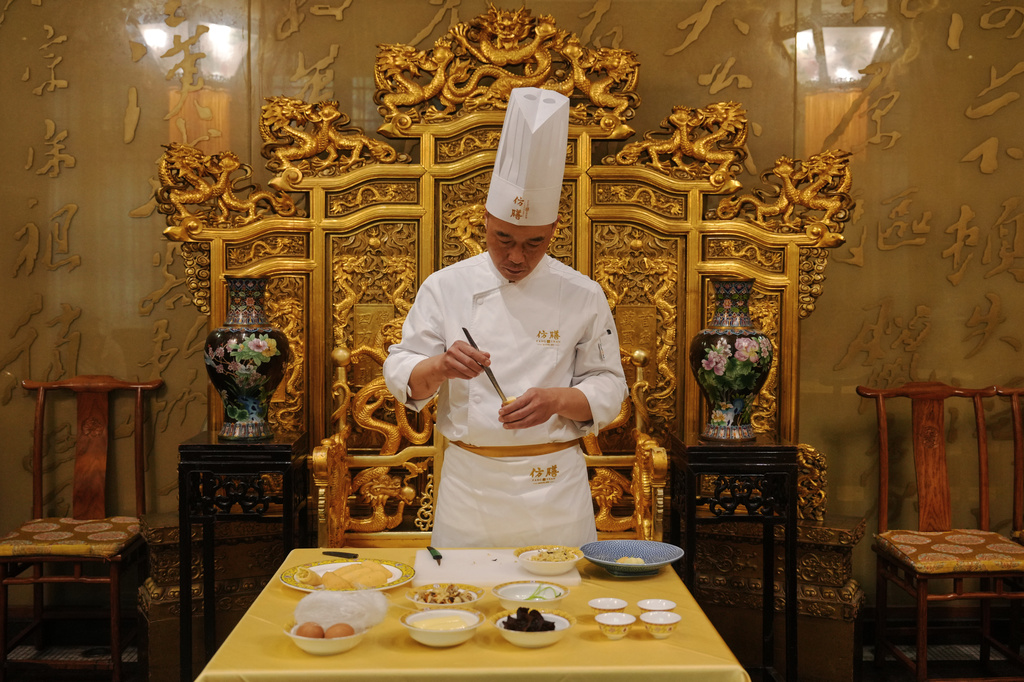
“It was originally called ‘minced pork pancake,’ but because it had fulfilled her dream, it later became known as ‘dream pastry,’” said Zhou Tong, a chef at Fangshan Restaurant in Beijing.
Fangshan specializes in imperial cuisine, preserving dishes like the one associated with Cixi and other culinary traditions from China’s imperial court. The restaurant was founded in 1925 by former chefs from the Qing Dynasty at Beihai Park, a garden where royals from several dynasties rested, handled government affairs and performed ritual sacrifices.
“The name Fangshan literally means ‘imitating the imperial cuisine,’” said assistant general manager Di Xin.
A handful of other Beijing restaurants also serve versions of imperial cuisine, while the Palace Museum preserves Qing-dynasty objects tied to court dining, including pastry molds.
Every meal comes with its own rules
Imperial cuisine encompasses the meals emperors ate daily and the feasts their courts held throughout the year.
Each had its own rituals. Drinking milk tea, for instance, was an important first step at Qing-dynasty banquets, said Teng Deyong, a researcher at China’s Palace Museum.
During the banquet, the emperor bestowed wine or food on princes and officials. Recipients performed rites and paid their respects to him before they ate or drank.
Aside from banquets, sacrificial rituals were held. They followed a separate system and could involve meat offerings.
“At the Palace of Earthly Tranquillity, there was the eating of sacrificial pork, which we know was one of the most important rituals of the Qing imperial court,” Teng said.
In that ritual, fatty pork was boiled without salt. After the ceremony, it was distributed among guests, and receiving the sacrificial meat was considered a great honor.
Unseasoned food also appears in earlier Chinese ritual traditions. Wandi Wang, a professor of Chinese at Lehigh University in Pennsylvania, said the “Book of Rites,” a classical work on rites and ceremonies, describes a meat broth known as “grand stew” that was served without seasoning during sacrificial ceremonies.
“The absence of added flavoring was itself meaningful: the unseasoned dish evoked an earlier and simpler way of cooking and thus expressed a ritual ideal of honoring antiquity and remembering cultural origins,” Wang said.
Traditional techniques keep imperial pastry-making alive
Pastries were key to imperial cuisine, and the court had an institution specialized in making them.
Sweets made at Fangshan by Zhou include Cixi’s dream pastry and a small steamed corn bun. Their recipes are rooted in the imperial court.
“When customers visit, our servers often tell them the stories behind these dishes,” Zhou said. “People enjoy them even more because they carry such meaningful history.”
He learned his pastry-making technique from a master who had also learned from a mentor. It’s a craft that has been passed from one generation to the next.
Traditional imperial methods mean cooking must be done by hand — no blenders or food processors are allowed. Ingredients like beans are pulverized using sieves and certain flours are handled in custom-made copper pots.
“A machine may be more convenient, but the texture is completely different,” Zhou said. “You lose the delicate graininess and sandy mouthfeel that handcrafted pastries are supposed to have.”
Among Fangshan’s bestselling delicacies are the pea flour cake and the red bean roll. During the busy season, customers order more than 200 of the cakes per day.
Balancing ancient cooking methods with a changing world
When he joined Fangshan as a kitchen apprentice, now-executive chef Fan Liangliang had to relearn everything he was taught at culinary school. Rather than employing techniques that allowed him to work quickly, he embraced slower processes he had never heard of.
One of them is “Nizihuo,” which Fan said involves mincing ingredients such as fish, shrimp or chicken into a smooth paste. It is then reshaped into decorative forms such as frogs, birds and flowers.
“This is one of the hallmarks of imperial cuisine,” Fan said. “Every dish had to be innovative, visually beautiful, nutritious and worthy of presentation on the imperial dining table.”
Rare ingredients such as bear paws are no longer served. Fan said adaptations are made to retain the spirit of each dish.
Chinese cuisine has long reflected cultural values, politics and ideals
A celebrated Chinese poet once wrote about cold noodles made with pagoda-tree leaves.
“The poem is not simply a description of a dish,” Wang said. “Du Fu turns the verdant, fresh, yet modest dish into an expression of his political loyalty and thwarted ambition to serve the emperor.”
She added that Chinese cuisine has historically carried meaning beyond food, reflecting broader ideas about politics, culture and aesthetics that have evolved as circumstances changed.
“Preserving a culinary tradition begins with taking its history seriously,” Wang said. “Culinary heritage tells us not only how people ate in the past, but also how people in the present choose to remember and give meaning to that past.”
Chef Fan said that at the heart of Fangshan’s imperial cuisine is a fusion of Manchu and Han culinary traditions, bringing together the culture of the Qing rulers and that of China’s majority population.
“It’s not simply a collection of dishes from the two cultures,” he said. “It represents the blending of their different approaches to food into a unified cuisine.”
Some inherited techniques such as stir-frying, braising and stewing have survived. And while some ingredients have been substituted both for availability reasons and to suit modern tastes, Fan said his team’s commitment to Chinese heritage remains strong.
“When people dine at Fangshan Restaurant, I hope they experience more than just a meal,” Fan said. “They experience the weight of history.”
AP video journalist Wu Jia contributed to this report.
Associated Press religion coverage receives support through the AP’s collaboration with The Conversation US, with funding from Lilly Endowment Inc. The AP is solely responsible for this content.
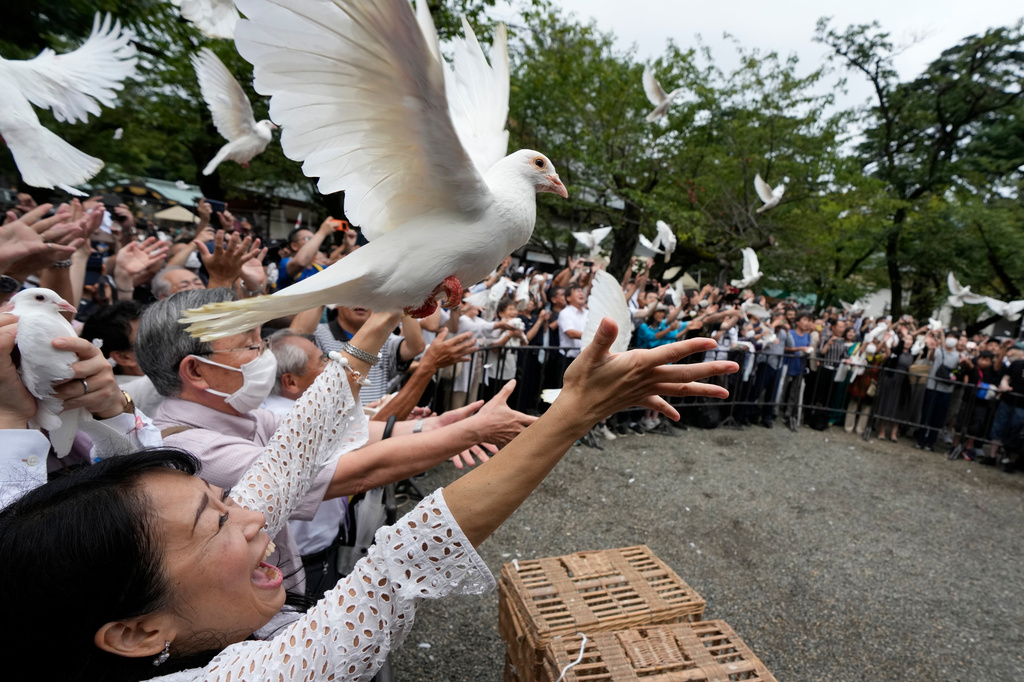
FILE – Doves are released in prayer of peace by worshippers at the Yasukuni Shrine in Tokyo, Japan, Tuesday, Aug. 15, 2023. (AP Photo/Eugene Hoshiko, File)
Emperor Meiji first visited the site that would become one of Japa’s most controversial shrines in 1874. He vowed that the names of those who died for their country would live there forever.
More than 2.4 million people are now honored at Yasukuni, a memorial and Shinto shrine in central Tokyo. Among them are 14 war criminals who are also commemorated each Aug. 15, when Japan’s surrender ended World War II.
The shrine provides spiritual comfort for some who mourn relatives and others who visit to express gratitude. Yet for Asian countries that endured Japanese imperial rule and expansion, Yasukuni remains a symbol of Japan’s militarism.
Visits by Japanese leaders frequently draw criticism from China and South Korea, which see them as a sign of insufficient remorse for Japan’s wartime aggression.
Here’s a look at the history and religious background of a shrine that is both a sacred place of remembrance and a source of controversy.
Yasukuni’s foundation followed a historic transformation
Imperial rule was restored in Japan in the 19th century after the fall of a military government that ruled for more than 250 years. A year into the new imperial era, in 1869, Emperor Meiji ordered the construction of the shrine that would later be renamed Yasukuni.
The name derives from two Japanese characters that can be translated as “peaceful country,” and its purpose was to honor those who fell defending the imperial cause.
“Yasukuni Shrine was initially conceived as a way to send a message to the Japanese people,” said Akiko Takenaka, a professor of history at the University of Kentucky. “The message was about the emperor; the message was about a new Japan.”
In that Japan, Takenaka added, Meiji became the one who could bestow the highest honor on those who died fighting for the empire and men were expected to consider it an honor to sacrifice their lives for him.
Religion and government became intertwined
Japan’s emperors have long been regarded as descendants of the sun goddess Amaterasu under Shinto beliefs. However, the notion of the emperor’s divine origins strengthened during the Meiji era, when the concept of State Shinto arose.
On one hand, that meant the government exercised control over the shrine’s practices and finances. Beyond that, the line between patriotism and religion blurred.
“The Meiji reformers believed that they were establishing an ideal nation in which the people and the sacred emperor maintained a spiritual union,” wrote Susumu Shimazono, a scholar specializing in religion and modern Japan, in the Japanese Journal of Religious Studies.
The separation of religion and state came after Japan’s surrender in WWII. |
In December 1945, U.S. Gen. Douglas MacArthur issued an order that abolished State Shinto. The measure effectively cut off government funding for shrines and removed Shinto practices and teachings from public institutions.
Yasukuni subsequently became a private religious corporation. Official visits have raised questions about the constitutional separation of religion and government.
Enshrinement at Yasukuni has long stirred controversy
Yasukuni is not a cemetery. Rather than bodies or graves, those remembered there are enshrined as “kami” — divinities or sacred spirits in the Shinto tradition.
They include soldiers, women who provided battlefield relief, students mobilized to support wartime production, and foreign nationals who died while serving Japan.
Yasukuni’s most controversial kami are 14 Class-A war criminals, a designation applied to Japanese leaders accused of “crimes against peace” by planning and waging the war. Among them is wartime Prime Minister Hideki Tojo, one of the masterminds behind the attack on Pearl Harbor.
Their enshrinement was carried out in secret by Yasukuni’s head priest in 1978, three years after Hirohito last prayed at the shrine.
“Emperor Hirohito did not go again after he found out,” said Mark R. Mullins, professor of Japanese and religious studies at the University of Auckland. “He didn’t want to get caught up in criticism surrounding that.”
Hirohito’s successors have sent emissaries to Yasukuni for its key annual rites, but neither has visited the shrine in person as emperor.
Other controversial enshrinements include Buddhists, Christians, Koreans and Taiwanese whose families say they were included without their consent, Mullins said.
Some have taken legal action, but Japanese courts have rejected efforts to have relatives removed from the shrine.
Yasukuni means different things to different people
“For some of those in the bereaved families’ association, the focus may be on the personal grief,” Mullins said. “But for those who are keen to restore what they feel was lost by the loss of the war and the foreign occupation, it means something more.”
Adjacent to the shrine is the Yushukan Museum, which displays wartime artifacts. Scholars have underscored how its account of Japan’s military history leaves out the experiences of China and Korea under Japanese imperialism.
“By eliminating the enemy, the Yushukan remembers a war that was only ever glorious,” wrote John Breen, a professor at the International Research Center for Japanese Studies, in a paper called “Yasukuni Shrine: Ritual and Memory.”
Some visitors say paying respects at Yasukuni carries a spiritual meaning that should not be equated with endorsing war.
Kana Shindo, a member of Tokyo’s Minato City Assembly, said she regards the shrine as a place where she purifies her mind, gives thanks to the kami and reflects on herself.
“I have absolutely no intention of glorifying war,” said Shindo, who added that politicians also have freedom of religion and conscience. “I visit because I believe that the peaceful Japan in which we live today exists upon the lives and accumulated history of the people who lived before us.”
Bereaved families maintain ties to Yasukuni
Before leaving for war, Japanese soldiers were told that if they died, they would be enshrined at Yasukuni.
“They told their families: ‘I want you to come see me at Yasukuni Shrine,’” said Toshiei Mizuochi, president of the Japan War-Bereaved Families Association.
His father, who served in the Japanese navy, was killed in a bombing six days before the end of the war, on Aug. 9, 1945.
More than 2.4 million Japanese soldiers died overseas during WWII. The remains of approximately 1 million have yet to be recovered.
“For that reason, the vast majority of bereaved families who received neither remains nor personal belongings believe that the spirits of the war dead are at Yasukuni Shrine,” Mizuochi said.
Relatives like him visit Yasukuni beyond Aug. 15. They attend major ceremonies, commemorate death anniversaries and report family milestones — entering school, starting a job, getting married or having a child.
“I visit Yasukuni Shrine more times than I can count in a year,” Mizuochi said. “Every time I put my hands together in prayer, the face of my father in his portrait naturally comes to mind.”
___
Associated Press religion coverage receives support through the AP’s collaboration with The Conversation US, with funding from Lilly Endowment Inc. The AP is solely responsible for this content.
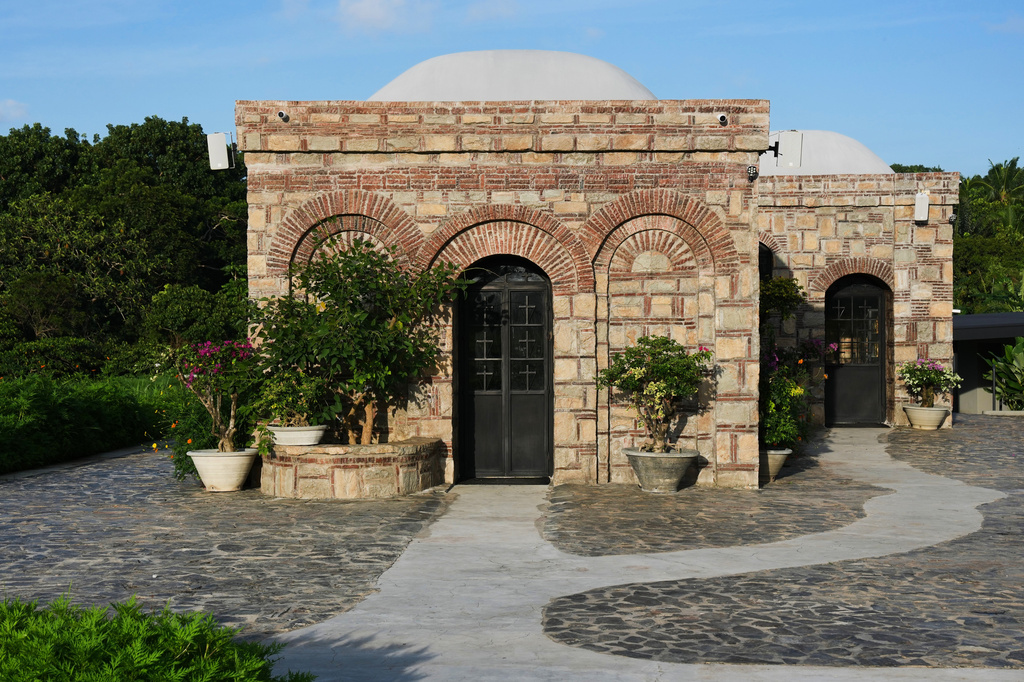
The Ephesus House, a replica of the House of the Virgin Mary in Ephesus, Turkey, now stands at Alfonso town, Cavite province, Philippines on July 16, 2026. (AP Photo/Aaron Favila)
ALFONSO, PHILIPPINES (AP) – The House of the Virgin Mary is a shrine located in Ephesus, Turkey, where the mother of Jesus is believed to have spent her final years. Thousands of miles away, nestled in a field outside Manila, a replica in the Philippines welcomes devotees in Asia’s biggest Catholic nation.
“The idea began as a place of refuge,” said Dennis Paez, the priest who led the project. “This is a place where no questions (are) asked.”
The replica was inaugurated in 2024 in Alfonso, a town in Cavite province about 70 kilometers (45 miles) south of the capital. Since opening, it has hosted Catholic pilgrimages, including celebrations for the Feast of Our Lady of Mount Carmel in mid-July. The 67-square-meter (720-square-foot) structure mirrors the exact dimensions, shape and look of every stone at the original site.
According to Catholic tradition, the house in Ephesus is where Mary spent much of her life after Jesus’ crucifixion and before her assumption into heaven. The apostle John is said to have brought her to the region to escape persecution in Jerusalem.
Paez said the replica took about 10 months to complete. Workers of different faiths took part in the construction, something Paez viewed as the Virgin Mary bringing all of her children together.
“The apostolate of this place is to accept people with unconditional positive regard,” added Paez, who is also a psychologist specializing in supporting youth. “There is no therapy here. The therapist is our Mother.”
Marian devotion shapes Filipino faith
In the country of about 113 million people, nearly 80% identify as Catholic.
Philippine faithful often refer to the Virgin Mary as the Blessed Mother. Processions honoring her are held regularly throughout the country.
“We are a long-suffering people,” Paez said. “Our wealth is really our faith and our faith is such like that because of the Blessed Mother.”
Religious historian Michael Delos Reyes said that Filipino devotion to the Virgin Mary dates back to the time Spanish colonizers introduced Christianity in the 16th century. However, that devotion has also found expression in more recent moments of the country’s history.
Delos Reyes said that some attributed the 1986 People Power Revolution that led to the ouster of then-President Ferdinand Marcos to the Virgin’s intercession. And in 2013, when the Typhoon Haiyan ravaged Tacloban, devotees looked to the Blessed Mother for hope.Filipinos turn to Mary for comfort
“To Jesus through Mary” is a phrase that reflects the central place Mary holds in Filipino Catholic life.
“Her maternal dimension is what Filipinos find meaningful, as well as her power to intercede on believers’ behalf,” said Deirdre de la Cruz, a professor of history and Southeast Asian studies at the University of Michigan.
Marian iconography and rosaries frequently adorn Filipino cars, public transportation, individual altars and shrines both in urban and rural landscapes, De la Cruz added.
“As someone who is known to provide comfort, Mary is a very familiar figure and someone to whom one can appeal in difficult times,” she said.
Daphne Oseña Paez, who recently visited the replica, said that despite being raised Catholic her devotion was not as strong as it became in adulthood. It began with a trip to Mexico, where she saw the image of Our Lady of Guadalupe, and it deepened years later after enduring a difficult pregnancy that made her seek refuge in her faith.
“We don’t pray to Mary herself, but Mary intercedes for us,” Oseña Paez said. “In my times of trouble, and I’ve had a lot, I really clung on to the love and comfort of her as a mother.”
A pilgrimage closer to home
Donated Marian icons line the walls inside the replica. At the center stands a statue of Mary modeled after the one in Turkey, alongside a relic said to be from her veil.
Most of the displayed images were donated by art collector and Philippine culture advocate Maritess Pineda. She said her devotion to Mary led her to start a collection that has finally found a home.
Other Filipinos felt drawn to contribute in their own way. Rupert Suarez and his wife had visited the House of the Virgin Mary in Ephesus years earlier. When he learned about plans to build a replica in the Philippines, he joined the the project.
“I usually pray to the Mother,” Suarez said. “It’s so very blessed that we already have this replica built.”
The site has received little public promotion since its inauguration. Yet Father Paez said pilgrims have visited.
“I don’t at all think that it is me bringing them,” Paez said. “It’s The Blessed Mother asking them, inviting them to come.” ___
Hernández reported from Beijing.
___
Associated Press religion coverage receives support through the AP’s collaboration with The Conversation US, with funding from Lilly Endowment Inc. The AP is solely responsible for this content.
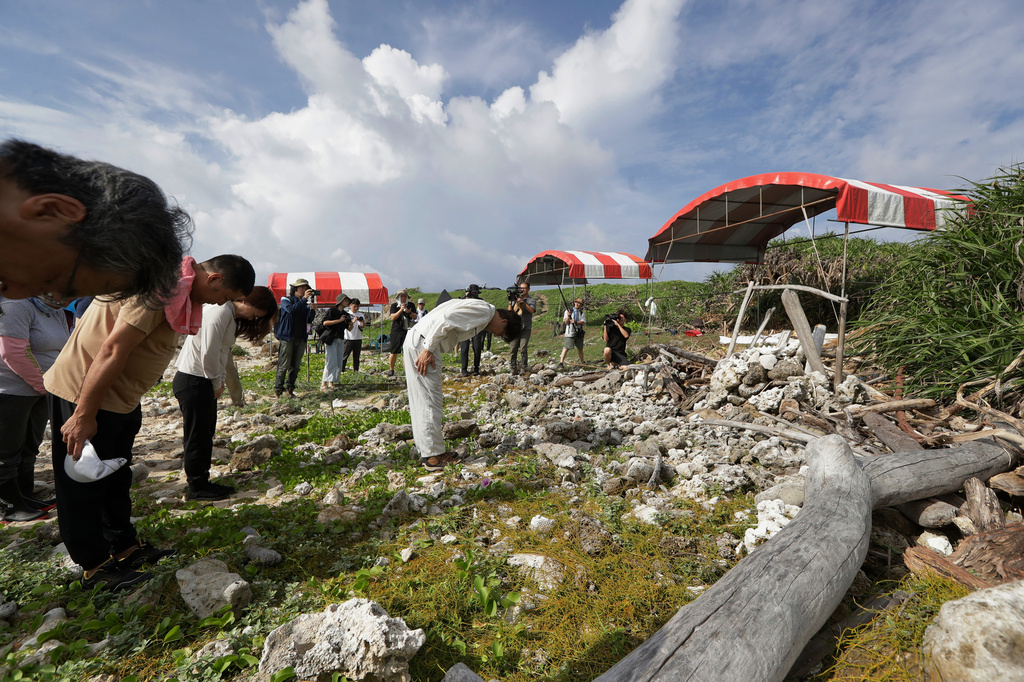
Tatsuaki Inoue, a member of the Japan Association for Recovery and Repatriation of War Casualties, leads volunteers to pay respects ahead of their excavation work to find remains of Japanese soldiers who died during WWII and washed ashore on the coastline of Hengchun township, Pingtung county, southern Taiwan, Monday, July 20, 2026. (AP Photo/Chiang Ying-ying)
PINGTUNG, Taiwan (AP) – Heads bowed, experts offered their respects on Monday ahead of an excavation aimed at recovering the remains of Japanese soldiers from World War II in southern Taiwan.
The site is linked to the sinking of a military transport vessel and other ships in the Bashi Channel after they were attacked by U.S. forces in 1944. According to historian Kazuko Tachi, who is also an activist involved in the recovery efforts, more than 4,700 soldiers and crew members died while 65 survived.
Taiwan, a self-governing island claimed by China as its territory, was a Japanese colony from 1895 until the end of the war.
“It is believed that many bodies from the sunken vessel reached this shore,” said Tatsuaki Inoue, representing the Japan Association for the Recovery and Repatriation of War Casualties.
The excavation in Hengchun Township is expected to continue for a week. If any remains believed to be Japanese are found and DNA samples can be extracted, they will be sent to Japan during a future mission.
Japan enacted a law in 2016 to accelerate the recovery of war remains, an effort that has been extended through 2030 and includes expanded DNA testing.
Thousands remain missing after WWII
Official Japanese records say about 41,900 soldiers who fought for Japan during WWII died in Taiwan. Around 26,300 bodies have been recovered and 15,600 remain missing.
The last excavation in Taiwan took place in 1975, when 242 bodies were found.
“We feel very sorry that we kept them waiting for such a long time,” Inoue said. “But on the other hand, we are very happy that we came to be able to excavate in search of their remains.”
Historians, residents and Japanese volunteers living in Taiwan spent years conducting interviews and collecting historical records to establish what might have happened to those washed ashore.
They believe the bodies may have been gathered by residents and placed together in a rocky coastal area near the discharge outlet of Taiwan’s Third Nuclear Power Plant, where they may still lie.
Religious groups have played a key role
More than 2.4 million Japanese soldiers died overseas during WWII. The remains of approximately 1 million have yet to be recovered.
In response to public demand, the Japanese government implemented three plans to recover remains between the 1950s and the 1970s, said Akira Nishimura, professor of religious studies at the University of Tokyo.
“For bereaved families who have not received the remains of their loved ones, the lack of certainty regarding where and how their relatives met their end — and the feeling that they were unable to give them a proper sendoff — is likely one of the main reasons why the recovery of remains continues even 80 years later,” Nishimura said.
He added that religious organizations and volunteers have played a key role in recovering remains and holding memorial services, offering comfort to bereaved families while helping preserve the memory of those who never returned.
In Pingtung, where Monday’s excavation began, two sites honor Japan’s war dead.
A monument dedicated to the spirits of Japanese service members who perished stands beside Chaoyin Temple, where an inscription reads: “We pray for the peace of all humanity in the world.”
The temple is dedicated to those who died in the Bashi Channel during the war. Inside stands a Japanese flag beside a statue of the Buddhist Bodhisattva Ksitigarbha, who is believed to guide and protect the souls of the departed.
Many Japanese died at sea
Japan’s wartime losses were unusual in that many soldiers and sailors died at sea, leaving their remains unrecovered, said Beatrice Trefalt, associate professor of Japanese studies at Monash University in Australia.
“Because of the enormous amount of uncertainty about who died or not, or how, the search for remains has been a constant in postwar Japanese history,” Trefalt said.
She added that many families believe the government has a responsibility to acknowledge those who were conscripted and died during the conflict.
Tachi learned about the fate of the Japanese soldiers who died in the Bashi Channel only after moving to Taiwan. After locals recounted that history, she decided to get involved in recovering their remains.
“Those Taiwanese uncles taught me the importance of holding a memorial service for the war dead,” Tachi said. “It’s been more than 80 years since the war ended but I believe it is important to pray for the war dead, which I will keep on doing.”
Hernández reported from Beijing. AP journalists Mayuko Ono and Mari Yamaguchi in Tokyo contributed.
Associated Press religion coverage receives support through the AP’s collaboration with The Conversation US, with funding from Lilly Endowment Inc. The AP is solely responsible for this content.
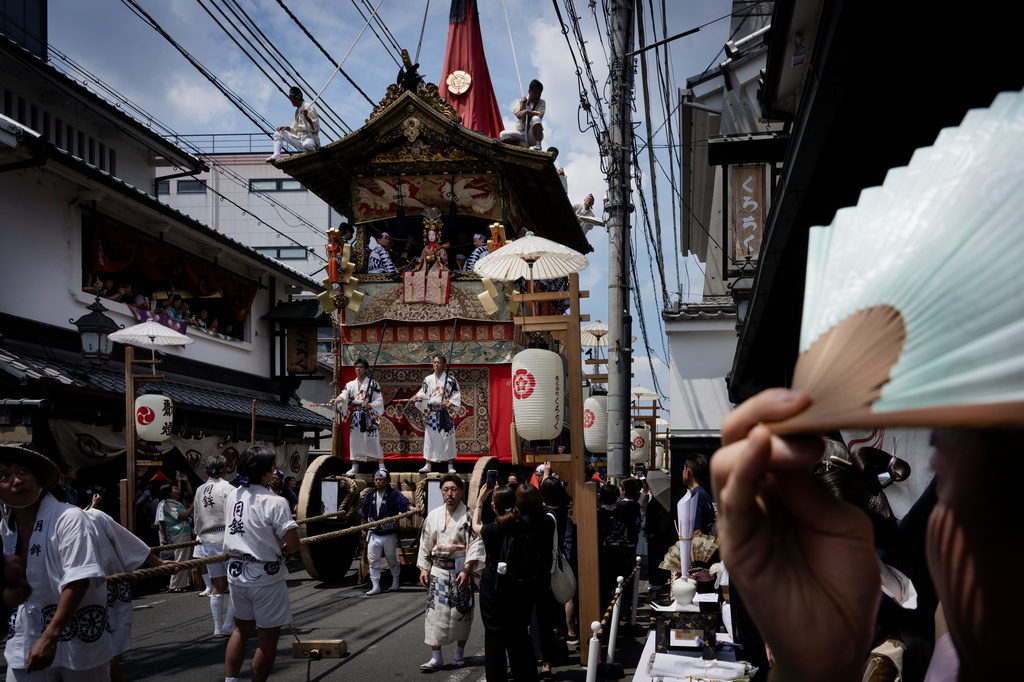
A festival float passes through a narrow street during one of the main parades of Shinto’s Gion Matsuri festival in Kyoto, western Japan, Friday, July 17, 2026. (AP Photo/Fred Mery)
KYOTO, Japan (AP) – There’s a special moment when Katsushi Horikawa feels closer to the gods. It comes as he rides atop one of the towering floats pulled through the streets in a centuries-old procession in Japan.
This is the Gion Matsuri festival, born more than 1,000 years ago as a ritual to ward off epidemics and celebrated in the former imperial city of Kyoto throughout July.
“I am conscious of them when I’m riding on top,” Horikawa said. “When we’re assembling it as well, but I think the main time is when I’m riding on it.”
The parades — accompanied by dances, music and song — draw large crowds and tourists every year. The biggest floats can weigh up to 12 tons. Yet behind the festive atmosphere lies a tradition rooted in the worship of deities and rituals of protection.
“Those performances are not meant primarily for the entertainment of people,” said Fabio Rambelli, a religious studies professor at the University of California, Santa Barbara. “They are offerings to the gods.”
A festival that has layers of religious history
The Gion Matsuri originated in the late 9th century as a ritual to appease spirits believed to cause epidemics and to pray for protection from disease. It takes its name from Kyoto’s Gion District and “matsuri,” the Japanese word for festival.
At the heart of the celebration is Kyoto’s Yasaka Shrine, a Shinto site whose principal deity has long been revered as a protector against calamities. But the shrine’s history also reflects centuries of interaction between Shinto and Buddhism in Japan.
“Until about 150 years ago it was a Buddhist temple,” Rambelli said. “That’s part of the religious changes that have taken place in Japan.”
Back then, the sanctuary’s main deity was Gozu Tennō, an ox-headed figure believed to have the power either to spread epidemics or to avert them.
“It was a kind of syncretic deity — probably of Indian origin — with connections to Korea and local folklore,” Rambelli said. “A lot of gods in Japan are a mixture of different traditions.”
Early versions of the Gion Matsuri involved that deity, Rambelli said.
To show evil forces and spirits that their god would confront them, devotees carried him around the city in processions that resembled those seen throughout Kyoto today.
A shrine’s turn from Buddhism helps shape today’s Shinto practices
Japan’s government separated the two traditions of Shinto and Buddhism in 1868 during the Meiji era, effectively bringing Shinto shrines under state control and placing the emperor at the center of the new order.
“Because the emperor was the direct descendant of the goddess of the sun, they purified the whole system creating what now we see as Shinto,” said Andrea De Antoni, professor of anthropology and religious studies at the University of Kyoto.
De Antoni said a strong anti-Buddhist movement followed. Temples, mandalas and statues were burned and destroyed.
Shinto was formally separated from the state after World War II, but its traditions still reflect a broader history of religious and cultural influences.
“It is an institutionalized religion that revolves around ideas of deities called kami and different spirits,” De Antoni said.
“Kami shares its rules with general ideas of animism that can be found throughout the world, but there are a lot of similarities with certain parts of Southeast Asia and with the Pacific,” he added.
Ancient traditions bring communities together
Japanese festivals often serve as ways for deities to be brought into the streets for sacred or ritual purposes while also bringing communities together in celebration.
“This is the festival of all the people in the neighborhood,” said Jacques Garrigues, a Frenchman who has lived in Kyoto for three decades and who attended the Gion Matsuri procession with his son on Friday.
“We also come together through a certain sense of religion, although the religious significance is not the same as in France,” he added.
Among the traditions preserved by the Gion Matsuri is the choosing of a boy as a sacred messenger to the gods. During the parade, the selected boy is seen sitting on one of the floats, his feet never touching the ground.
Some key participants spend months getting ready for the celebrations. Different neighborhoods prepare their floats with great care and dedication, with many people trusting the floats will drive away evil spirits.
Atsushi Matono is responsible for erecting the shingi, a sacred tree placed at the top of one of the floats —the holiest part of the structure, to which a deity is believed to descend.
Like Horikawa, he describes feeling a sacred presence.
“I always carry out my work with great care and respect,” Matono said. “Feeling the presence of the gods.”
___
Associated Press religion coverage receives support through the AP’s collaboration with The Conversation US, with funding from Lilly Endowment Inc. The AP is solely responsible for this content.
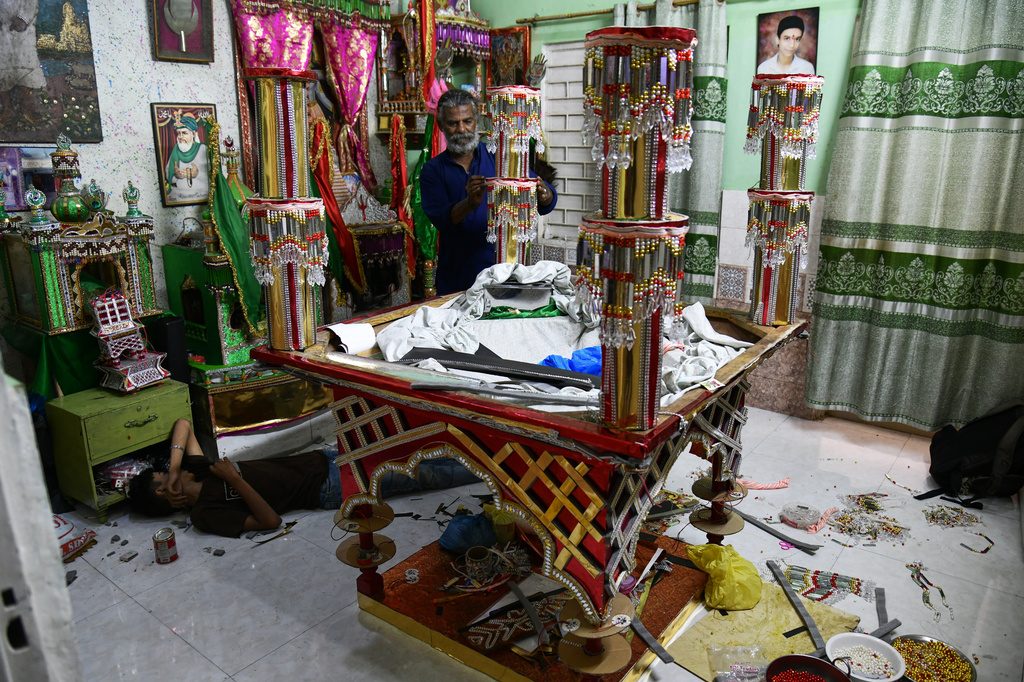
Raju Rathore, an artisan from Pakistani Hindu community, makes a replica of the mausoleum of Imam Hussain locally called ‘Tazia’, in preparation for the upcoming Ashoura, when Shiites Muslims mark the death of Hussein, at his home in Karachi, Pakistan, Tuesday, June 23, 2026. (AP Photo/Ali Raza)
KARACHI, Pakistan (AP) – Raju Rathore’s Hindu faith and devotion to Imam Hussein converge in Pakistan’s port city of Karachi during Muharram, one of Islam’s sacred months
Religious observances during this period are primarily associated with Shiite Muslims. But in Rathore’s hometown some members of the Hindu community also commemorate the martyrdom of the Prophet Muhammad’s grandson, Imam Hussein
“Muharram is very important to me and I want to keep participating in it for as long as I live,” said Rathore, whose parents migrated from India’s Gujarat state after the Partition of India in 1947. “I go there in devotion to Imam Hussein.”
Hussein was killed alongside family members during the Battle of Karbala in present-day Iraq in the seventh century. The episode became a defining moment in the split between Sunni and Shiite Islam.
The mourning over the deaths of Hussein and his companions reaches its peak on Ashoura, the 10th day of Muharram, which millions observe worldwide.
Rathore’s devotion to Hussein came from his parents. He said they were unable to have children until his mother made a personal vow at the shrine of Masoom Shah Bukhari. She promised that, if she got pregnant, her child would honor Hussein’s martyrdom by making tazias — temporary replicas of his mausoleum carried during Muharram processions.
“This is our passion,” said Rathore, who has crafted these pieces for decades in fulfillment of his mother’s vow. “Our devotion to Imam Hussein is such that even giving our lives would feel insufficient.”
Historical ties draw Hindus into Muharram observances
The involvement of non-Shiite communities in Muharram rituals has long been documented across South Asia, including among groups known as Hussaini Brahmins, whose traditions have incorporated elements associated with both Hinduism and Shiite Islam.
“There are many reasons for this, but one is that, historically, many ruling dynasties in South Asia were Shi’a,” said Justin Jones, a professor of religious studies at the University of Oxford.
Jones said Shiite rulers in several South Asian kingdoms sponsored processions and other commemorations of Hussein’s martyrdom, helping turn them into public events that drew wider audiences.
Over time, Muharram observances became woven into civic and cultural life across parts of the region, where some Hindus participated as musicians in processions and others crafted tazias.
Such traditions persist across the region, Jones said. However, they have become less common over the past century as religious communities increasingly observe Muharram separately.
How Hindus in Karachi keep Muharram traditions alive
According to Pakistan’s 2023 census, Hindus number nearly 3.9 million people, making them the country’s largest religious minority.
Organizations such as Minority Rights Group point out that some Pakistani Hindus have faced violations of their religious freedom. Yet Rathore said he has been able to practice his faith freely.
“Yes, I am Hindu, but this is not about religion,” Rathore said. “Many of my fellow Hindus also hold Imam Hussein in great respect.”
Rathore said he attends Shiite congregation halls during Muharram with other members of Karachi’s Hindu community. There they offer prayers and take part in rituals associated with the holy month — including chest beating — before joining processions.
“Our religion has never taught us that because we are Hindus we should not participate in or respect others’ traditions,” said Bharat Kumar, another Pakistani Hindu who dearly respects Imam Hussein. “We celebrate our own festivals with great enthusiasm and grandeur and we approach this in the same way.”
Both Kumar and Rathore craft tazias ahead of Ashoura. The latter’s are made from paper, glass, cardboard and other materials at his own expense. He said family members gather materials over time for use in the structures ahead of Ashoura.
The tradition will now pass to his own son, who now also takes part in commemorating the martyrdom of Hussein through the mausoleum replicas.
“I have been doing this not just for a few years but for about 45,” Rathore said. “I am now 52 years old, and as long as I have the strength to continue, I will keep making them.”
___
Hernández reported from Beijing.
___
Associated Press religion coverage receives support through the AP’s collaboration with The Conversation US, with funding from Lilly Endowment Inc. The AP is solely responsible for this content.
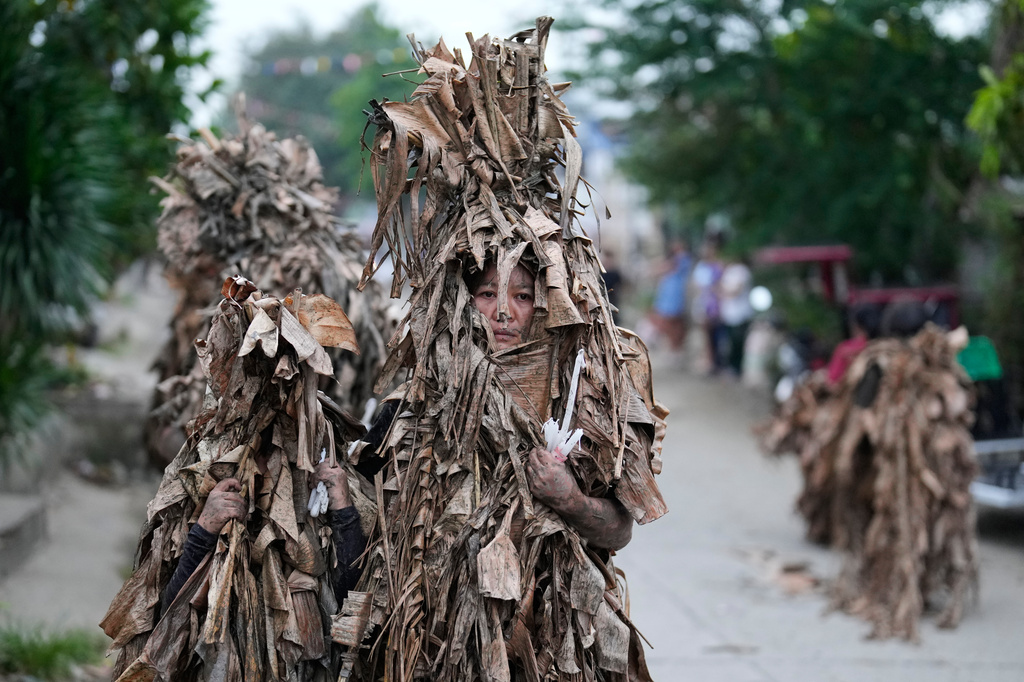
Catholic devotees covered in mud and dried banana leaves join the mud people festival on the feast day of Saint John the Baptist at Bibiclat, Nueva Ecija province, northern Philippines on Wednesday, June 24, 2026. (AP Photo/Aaron Favila)
BIBICLAT, Philippines (AP) – Hundreds of Catholic devotees wrapped themselves in dried banana leaves and covered their bodies with mud on Wednesday in the Philippine village of Bibiclat, taking part in a display of faith honoring St. John the Baptist.
The Taong Putik, or Mud People, festival is held annually in this village in Asia’s largest Catholic nation as devotees thank the local patron saint for miracles and fulfill vows made in prayer.
Melencio Nenuda, a 39-year-old construction worker, said the mud-covered parishioners frightened him as a child and he used to hide when they passed by. But that changed when when he fell seriously ill in the sixth grade and his mother prayed to St. John the Baptist, vowing that he would join the tradition if he recovered.
“I will continue to go back to this tradition because it gives me a good future,” said Nenuda, adding that his wife and son also participate.Village residents link the festival to faith and survival
Devotees prepare for the observance before dawn
Heading into nearby fields around 4 a.m., they search for soft mud and smear it over their bodies before wrapping themselves in dried banana leaves.
Once ready, they walk barefoot to St. John the Baptist Church carrying only cellphones and lighted candles. As they wait for Mass to begin, hymns are sung near a small fire formed by the candle offerings.
Local church leaders say the practice began in the 1800s, when farmers smeared themselves with mud as an expression of humility, and covered themselves with the leaves to conceal their identities due to discrimination against the poor during that time.
According to the Rev. Elmer Villamayor, who led the parish between 2014 and 2021, devotion to St. John the Baptist grew after a group of local men escaped execution during the Japanese occupation in World War II.
Villamayor said residents say the men were spared after a sudden rainstorm interrupted the proceedings, an event many interpreted as divine intervention.
Participants trace their devotion to personal blessings
While no official attendance records are kept, Villamayor estimates that up to 3,000 people take part in the festival.
Rickmar Castilio, 43, has participated for the last two decades. This year, his 11-year-old son Nathan joined him for the first time.
“There are a lot more devotees now,” Castilio said. “Maybe they have experienced miracles or they have seen good things and that is why there is an increasing number of people who believe in St. John.”
His family has its own blessing to be thankful for, Castilio said. After his first child died, he vowed to continue honoring St. John the Baptist through the annual ritual if a future child survived. He has returned every year since his prayers were answered.
“(I bring my child so) that he will get closer to St. John,” Castilio said. “The youth now are starting that path.”
___
Hernández reported from Beijing.
Associated Press religion coverage receives support through the AP’s collaboration with The Conversation US, with funding from Lilly Endowment Inc. The AP is solely responsible for this content.
Fans wait for the start of a friendly soccer match between Argentina and Zambia next to a banner of Argentine soccer legend Diego Maradona in Buenos Aires, Argentina, Tuesday, March 31, 2026. (AP Photo/Rodrigo Abd)
MEXICO CITY (AP) – The chain that hung from Santiago García’s neck carried no crosses or saint medals, yet it felt sacred nonetheless.
When García’s grandmother fell sick years ago and he visited her in intensive care, the Argentine soccer fan took off his beloved Boca Juniors necklace and placed it around her neck.
“Boca will save you,” García murmured to his grandmother. “And it did. So now it’s hers.”
García’s faith in his club mirrors that of millions across Latin America as the region prepares for the 2026 World Cup. From Argentina to Mexico, devotion to the game often spills into everyday life, inspiring rituals and beliefs tied to the sport.
“There has been an emotional connection between the public and their soccer teams for a long time,” said Mexican analyst Erick Fernández. “It fosters identity and bonds that make us feel part of a sporting process that represents us.”
In Argentina, the home country of Lionel Messi, sports passion is often inherited within families and loyalty to clubs strengthens over time. Pope Francis himself — born in Argentina and lifelong supporter of club San Lorenzo — said he agreed with those describing soccer as the world’s most beautiful game.
García’s love for Boca Juniors came from his father. He said his mother used to support another team, but after the couple met, she became a Boca fan too.
“You usually support your mother’s or father’s club,” García said. “Soccer is the backbone of it all, but you develop a sense of belonging to a team and carry it with you everywhere.”
He may have let go of his Boca necklace and the energy he believed it carried, but the club’s imprint was already etched into his skin.
At age 17, García tattooed a phrase from the club’s anthem on his torso. Fourteen years later, those words remain as meaningful as they were when the ink was fresh.
“It belongs to a song that is like a chant of war for us,” he said. “It’s like saying: ‘No matter the storm, no matter what happens, we will always be there for you.’”
The power of belonging
Pope Francis once told a crowd that soccer is a team sport whose beauty comes from its collective spirit.
Among fans, too, passion is nurtured through a sense of community. The singing of anthems, tears shed after victories or defeats, and the embrace of strangers inside a stadium are experiences that can mirror forms of collective devotion.
“Each person can support a team, but the sense of togetherness that generates ‘communitas’ — a word associated with religion — is only possible when people gather,” said Argentine anthropologist Eloísa Martín.
Both negative and positive reactions can emerge from that sense of collective identity. A fan who feels a member of his sporting community has been attacked by a rival may react violently in ways he otherwise never would. But the same dynamic can strengthen solidarity, leading fans to help strangers because they support the same club.
“Soccer creates a community even for those who lack one,” Martín said.
On a recent night, among a sea of fans heading towards Maracanã stadium in Rio de Janeiro was Adilvania Santos. Dressed in the maroon and green colors of Fluminense, the 27-year-old said that supporting the club had helped her through a difficult time in her life.
“I get emotional talking about Fluminense,” said Santos, who described the passion for her club as the most important aspect of her life, apart from her family. “Some people come together to go to church. For us, accompanying Fluminense is also sacred.”
Santos tries to attend every game despite living nearly 100 kilometers (about 60 miles) from Rio. When she follows matches from home, she stays alone in her bedroom to avoid interruptions from family members who may not support her team.
“Soccer deeply moves Brazilians because it creates a sense of belonging, identity and hope,” said Jeferson Mengali, a Catholic priest in the Bragança Paulista diocese and a lifelong fan of Corinthians. “People suffer, work hard and face difficulties, and soccer becomes a space for collective joy.”
Rituals for victory
Mengali supported Corinthians as a chaplain for years. He celebrated Masses with the team and was present during training sessions and matches.
“I have always liked praying before important games,” he said. “Asking more for serenity than victory.”
While not all soccer fans pray, many cling to rituals they believe can influence the outcome of a game. In Argentina these practices are known as “cábalas.” According to Martín, they became widespread during the 1990s.
Cábalas vary widely. Fans may drink from the same cup, sit in the exact same spot or wear the same underwear during every match. Others insist on watching games with certain people, while some avoid watching altogether after concluding they bring bad luck to their team.
Rituals are repeated if the team wins and abandoned if it loses. For some supporters, avoiding a match can even feel like a sacrifice made in hopes of securing victory.
At García’s home, his father sits in a specific chair whenever Boca is playing well. If the rival team scores, he changes seats. His mother cleans the house instead of watching the game, stopping every so often to ask about the score.
García’s current cábala includes wearing the same jersey throughout the season and carrying a small image of Diego Maradona everywhere he goes.
“After he died, he was rapidly sanctified by the people,” García said. “He became a figure bigger than sports.”
Saints of the stadium
Argentines rarely call him Maradona. He’s simply “El Diego,” as one would refer to a family member or an old friend from the neighborhood.
“Maradona is the player, while ‘El Diego’ is the one people turn to like a family member when they need help,” Martín said. “Sacredness only works when there’s a community behind it.”
Legends like “El Diego” or Brazil’s “The King” Pelé are recognized across the world. But other soccer fans in Latin America revere personal idols of their own.
In Chile, Héctor Hermosilla keeps a black-and-white portrait of Colo Colo club founder David Arellano at his home.
“He founded Colo Colo in 1925 and before every match I always say goodbye to him and ask him to watch over us,” Hermosilla said.
He still remembers attending his first match in 1986 and falling under the spell of the atmosphere inside the arena. From then on, he faithfully began to follow his team, traveling from Chile’s far north to Puerto Montt, considered the gateway to Patagonia.
To finance his trips, he and his wife typed out the iconic anthems of Colo Colo and sold photocopies to fans, earning him the nickname “Nano Fotocopia.”
“There were around 20 songs and I would make photocopies and sell them for 100 pesos,” he said.
Typewriters and photocopies became obsolete over time. Hermosilla now sells necklaces, bracelets and other accessories to finance the trips he now does with his wife and teenage son.
When in Chile, Hermosilla still attends matches every Sunday and performs a ritual he has followed since the 1980s. Beneath Arellano’s portrait, he asks for the club founder’s blessing, packs his products for sale and heads to a roast chicken restaurant where fans gather.
“He is like our God,” Hermosilla said. “He is the one who guides us.”
___
Batschke reported from Santiago, Chile, and Hughes from Rio de Janeiro.
___
Associated Press religion coverage receives support through the AP’s collaboration with The Conversation US, with funding from Lilly Endowment Inc. The AP is solely responsible for this content.