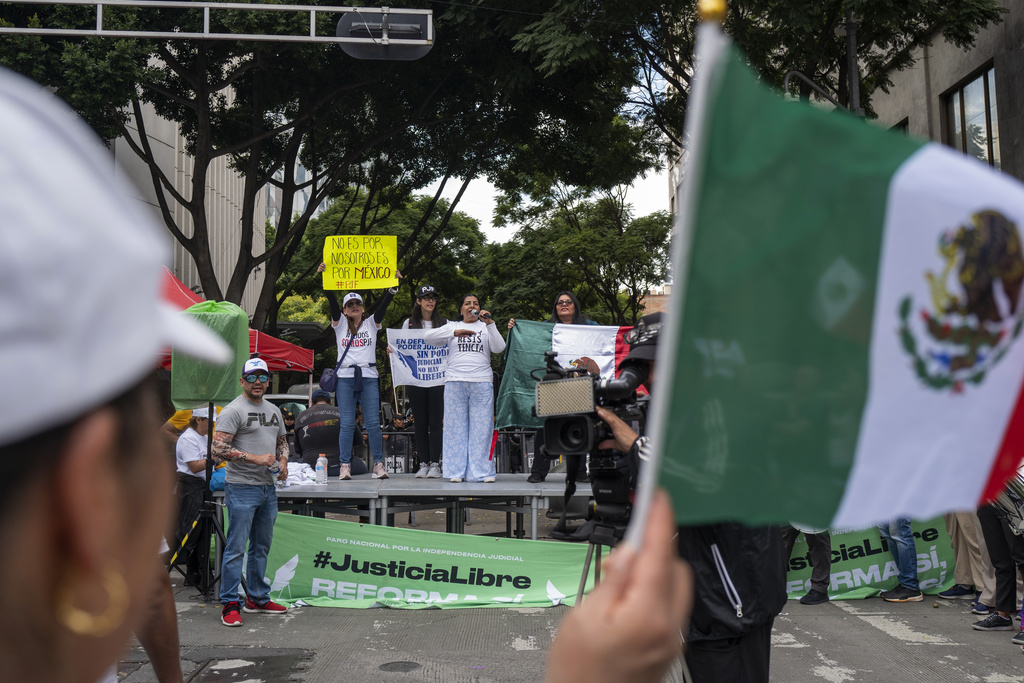
Judicial workers lead a strike to protest the government’s proposed judicial reform, which would make judges stand for election, outside the Senate in Mexico City, Friday, Sept. 6, 2024. (AP Photo/Jon Orbach)
MEXICO CITY – (AP) Mexico’s Catholic leaders said Monday that the judicial reform pushed by President Andrés Manuel López Obrador might not necessarily bring justice for victims of the crime wave that is rampant across the country.
“The proposal promoted by the Executive does not respond to a comprehensive review of the judicial system nor does it guarantee a better and more qualified administration of justice,” said Archbishop Gustavo Rodríguez in a video released by the Catholic bishops conference of Mexico.
López Obrador, who has clashed repeatedly with judges throughout his six-year term, has claimed that the judges in the current court system are corrupt. The governing party’s proposal would make the country’s entire judicial branch — around 7,000 judges — stand for election.
The proposal has fueled a wave of protests and drawn extensive criticism from analysts, judges and international observers. Some of the critics contend that it would compromise the independence of the judiciary and the system of checks and balances.
U.S. Ambassador Ken Salazar warned on Aug. 22 that electing judges is a “risk” for Mexico’s democracy and “threatens the historic commercial relationship” between the two countries. The proposal has also sparked nervousness among investors, while the Mexican peso has plunged.
The lower house of Mexico’s Congress passed the legislation on Sept. 4. It then moved to the Senate, where it is expected to pass by a razor-thin margin.
Bishop Ramón Castro, secretary of the bishops conference, said Monday that Catholic faith leaders are praying for the senators to reflect on the responsibility that’s been laid on them.
“May they contemplate the benefit of the nation beyond unnecessary partisanship, so we can move towards a comprehensive reform that includes prosecutors’ offices, local courts and respect for the judicial career,” Castro said.
This is not the first time that Catholic leaders have voiced their concerns over Lopez Obrador’s decisions and policies.
The church spoke out in 2022, when the murder of two Jesuits priests shook the public opinion and the Catholic hierarchy. Calls for peace have been followed by nationwide meetings to search for solutions to achieve justice and security.
“The national agenda for peace, presented to those seeking the presidency in the last electoral process, expresses the need of a comprehensive reconstruction of justice at all levels,” Castro said. “It’s a request from Mexico’s society, especially from victims of widespread criminal violence throughout the country.”
Various faith leaders have supported violence victims — both Mexican citizens and migrants — in recent years.
While bishops of Guerrero, one of the most violent states in Mexico, negotiated with criminal groups in an attempt to stop the wave of violence that afflicts its population, several priests have supported relatives of disappeared people.
On Aug. 30, after nationwide protests demanded justice and the safe return of 150,000 people who vanished under unclear circumstances, Catholic Bishop Javier Acero joined a group of mothers searching for their disappeared children during a news conference at Our Lady of Guadalupe’s Basilica in Mexico City.
Many of these mothers, he said, have tried to approach government officials, but the doors have remained closed for them. Now, with Sheinbaum soon to be in power, he hoped for a change and sent a message to her: “I ask this on their behalf: As a mother, listen to these moms.”
____
Associated Press religion coverage receives support through the AP’s collaboration with The Conversation US, with funding from Lilly Endowment Inc. The AP is solely responsible for this content.
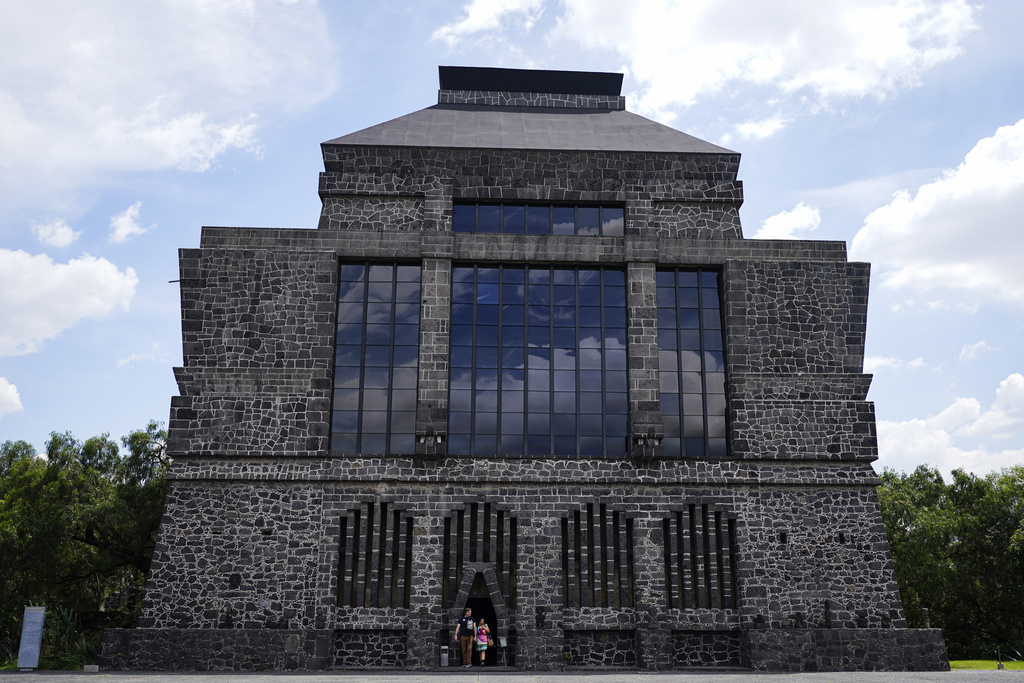
Visitors exit the Anahuacalli Museum in Mexico City, Tuesday, Aug. 20, 2024. Built by Mexican artist Diego Rivera, its name, Anahuacalli, translates from the Nahuatl language as «house surrounded by water.» (AP Photo/Eduardo Verdugo)
MEXICO CITY (AP) – In the 1940s, Mexican artist Diego Rivera had a dream: to build a sacred place to preserve and display his lifelong collection of pre-Hispanic art.
The Anahuacalli Museum in Mexico City, which celebrates its 60th anniversary this month, is everything he hoped for.
Inch by inch, its pyramid structure honors the Mexica worldview. Among its 60,000 archeological pieces, dozens represent ancient deities. And though foreigners visit on a regular basis, its workshops and year-round activities aim to connect the local communities to their historic roots.
“This is Diego Rivera’s dream come true: a space in which art, nature and the public coexist,” said María Teresa Moya, director of the Anahuacalli.
The Mexican muralist was aligned with a Communist ideology. He and his wife — renowned artist Frida Kahlo — openly criticized the Catholic Church. But their fascination with Mexico’s pre-Hispanic spirituality is palpable through their work.
In Rivera’s case, he bought and collected archeological pieces, depicted them on his murals and designed the Anahuacalli for their exhibition.
“Diego had a great respect, affection and admiration for our ancestors,” Moya said. “Everything he designed or created was inspired by our origins.”
Mexico’s pre-Hispanic worldview was so important to him that it even influenced the Anahuacalli’s architecture. While its main floor represents the underworld — and feels dimly lit and cold — the second and third levels were inspired by the earthly and celestial worlds, which makes them seem warmer and flooded by light.
Though Mexica heritage is dominant in the museum’s design, visitors can also appreciate other Mesoamerican influences, said Aldo Lugo, a researcher who points out the Mayan, Toltec and Teotihuacan elements through guided tours of the museum.
The three-story pyramid was inaugurated in September 1964, seven years after Rivera died. Its name, Anahuacalli, translates from the Nahuatl language as “house surrounded by water.”
According to a recent government publication, the Anahuacalli is distinctive among Mexican museums in being situated in an ecological reserve of about six acres (2.6 hectares) protecting nearby flora and fauna. The museum itself was built with volcanic rock to fuse with its natural surroundings.
Rivera and Kahlo first thought of the place as an oasis where they could move away from the buzz of the city. Later, even as their plans changed and Rivera decided to build the museum, the couple desired to be buried in the Anahuacalli’s underworld.
The adjoining niches of the main floor are currently empty. Kahlo’s remains are located in her “Blue House” and Rivera was buried in the Rotunda of Illustrious Persons, a national cemetery site that honors those who made major contributions to Mexico’s history and culture. “But we keep the niches, just in case they end up here,” Lugo said.
During a one-hour visit through the Anahuacalli, its various rooms and cabinets can be read as a book.
From the start, Coatlicue, mother of the gods, greets all visitors from the ceiling. Her myth was special for the pre-Hispanic understanding of the world: a battle between her son and daughter — the sun and the moon — explained the origins of day and night.
The Anahuacalli’s main floor is focused on rituals and burials. The first level displays archeological pieces depicting everyday life, while the second level — representing the celestial world — is devoted to the gods.
The museum’s walls and stairs bear meanings too. Each of the Anahuacalli’s four corners depict a natural element — earth, wind, water and fire — and their respective pre-Hispanic deities. The stairs represent the transition between the stages of one’s existence.
“The Anahuacalli is a temple,” Moya said. “And one of a kind.”
To celebrate its 60th anniversary, the museum planned various activities reflecting on Mexico’s artistic and cultural landscape.
Aside from a gastronomic festival in June and monthly lectures on Rivera’s legacy — which the public can attend through December — neighbors who knew the artist are working on a video to preserve the oral collective memory of the museum and the neighborhood where it’s located.
“We want the community to keep feeling that this space belongs to them,” Moya said.
Contemporary artists are often invited to host exhibitions at Anahuacalli. “Atomic amnesia,” by Mexican sculptor Pedro Reyes, will be on exhibit from Sept. 13 through January 2025.
His 20 works on display, a press release said, were inspired by one of Rivera’s murals, which was highly controversial and mysteriously disappeared, though its sketch is preserved: “The Nightmare of War, The Dream of Peace. A Realist Fantasy (1952).”
Like Rivera, Reyes’ art reflects society. His works are meant to express the current political landscape and, following in Rivera’s footsteps, he regards his art as a platform to protest and raise awareness.
“Diego was quite controversial,” Moya said. “On the one hand, he had a huge interest in rescuing our pre-Hispanic heritage, but he also adhered to socialism in an unwavering way.”
“He wanted us to look at our past to understand our present and plant something for the future.”
____
Associated Press religion coverage receives support through the AP’s collaboration with The Conversation US, with funding from Lilly Endowment Inc. The AP is solely responsible for this content.
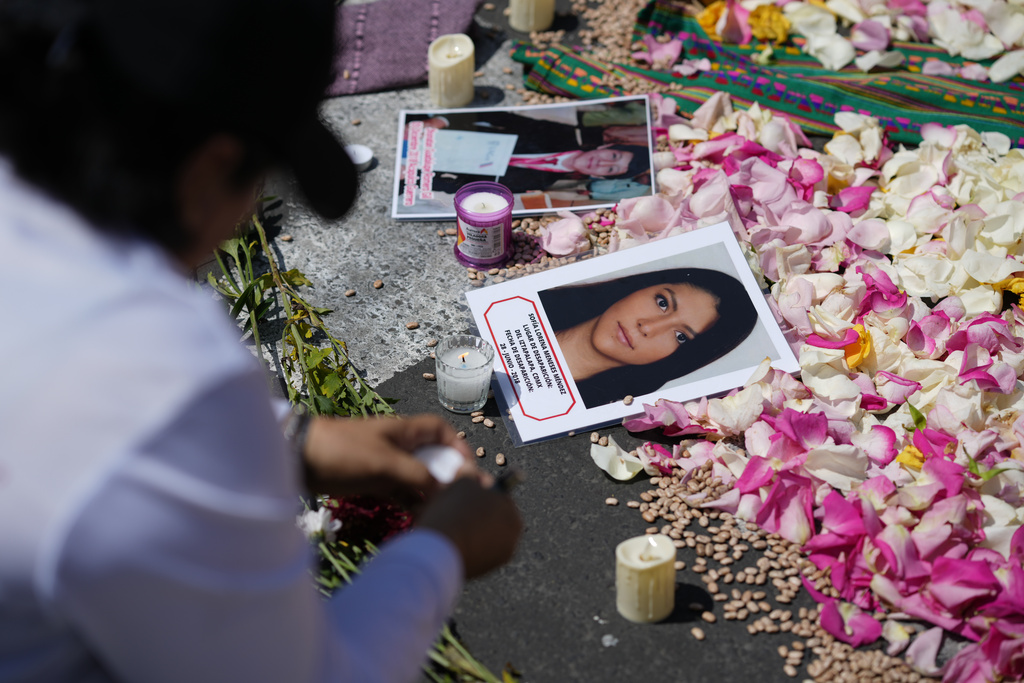
La foto de una persona desaparecida yace en un mandala creado por familias que protestan para que el gobierno ayude a localizar a sus familiares desaparecidos en el Día Internacional de los Desaparecidos en la Ciudad de México, el viernes 30 de agosto de 2024. (AP Foto/Eduardo Verdugo)
CIUDAD DE MÉXICO (AP) – “Estamos en una reunión que no debería de existir”, dijo el viernes por la mañana el sacerdote anglicano Arturo Carrasco durante una misa ecuménica celebrada en Ciudad de México en el marco del Día Internacional de las Víctimas de Desapariciones Forzadas.
A su alrededor, decenas de familiares portaban mantas y camisetas con las fotos, nombres y fechas de desaparición de sus seres queridos.
Al menos 115.000 personas han sido víctimas de este flagelo en el país desde 1952, reportan cifras oficiales, aunque diversas organizaciones estiman que la cantidad podría ser mayor. Trata de personas, secuestros, represalias y reclutamiento forzado a manos del crimen organizado están entre las motivaciones detrás de las desapariciones.
Marcela González, de 58 años, viajó desde Jalisco para exigir respuestas sobre el paradero de su hijo, Alan, que tenía 33 años cuando salió a trabajar y no volvió a casa en 2017. Junto a otras 30 familias, la madre integra la organización “Por Amor a Ellxs” en un estado que registra más de 15.000 desapariciones.
«Venimos a ver si así nos hacen caso, porque la empatía no existe en el gobierno», dijo la mujer. “Merecemos que el gobierno voltee y se haga presente, nada más en señal de solidaridad».
Angelina Banda, de 65, se movilizó desde Estado de México, vecino a la capital, para manifestarse por la desaparición de su hijo Roberto, a quien vio por última vez en 2021.
“Las madres buscadoras andamos en campo pegando volantes, buscando en situación de calle, SEMEFOS (servicios médicos forenses), psiquiatrías, hospitales, vamos a donde uno pueda y le digan”, explicó la madre buscadora que forma parte del colectivo “Uniendo Esperanzas”.
Amnistía Internacional señaló el día anterior, durante la presentación de un informe que enlista estándares para proteger a las madres buscadoras en todo el continente, que los Estados son los que deberían encabezar las búsquedas con debida diligencia y aplicando enfoques diferenciales y de género acordes a casa caso, así como garantizar que los familiares puedan participar en condiciones adecuadas sin que se les discrimine o peligren sus derechos humanos.
Según la organización, ésta es la región más peligrosa para la defensa de los derechos humanos en el mundo y las madres buscadoras reciben amenazas de violencia física que en ocasiones interrumpen sus labores búsqueda. También hay varias que han sido asesinadas o desaparecidas.
El Comité Internacional de la Cruz Roja (CICR) se sumó a la exigencia de responsabilizar al Estado de las búsquedas y agregó en un comunicado que los gobiernos deben coordinarse para mitigar las consecuencias de la violencia armada, la migración y el desplazamiento en la región, pues también suelen impactar las desapariciones.
“Establecer políticas de Estado coordinadas y sostenibles que aborden las causas profundas de las desapariciones para prevenirlas y erradicarlas debe ser un compromiso político a largo plazo, sostenido a pesar de cambios de gobierno o instituciones”, dijo Marianne Pecassou, asesora regional de protección del CICR.
Las actividades del viernes arrancaron en México con la pegada de boletines a manos de familiares que recorrieron diversos puntos del país. A lo largo del día se sumarían protestas, conferencias, presentaciones de libros y celebraciones religiosas de distintas confesiones.
En la Glorieta de los Desaparecidos, antes de la misa celebrada por miembros del “Eje de Iglesias” —organización que agrupa a religiosos anglicanos, metodistas, evangélicos y católicos—, familiares y líderes de fe crearon un mandala, representación espiritual que proviene del budismo e hinduismo.
Sobre el suelo colocaron velas, fotos de sus familiares y flores. Cada pétalo, dijo la religiosa católica Paola Clerico, representa a uno de los 116.000 desparecidos en el país.
____
La cobertura de noticias religiosas de The Associated Press recibe apoyo a través de una colaboración con The Conversation US, con fondos del Lilly Endowment Inc. La AP es la única responsable de todo el contenido.
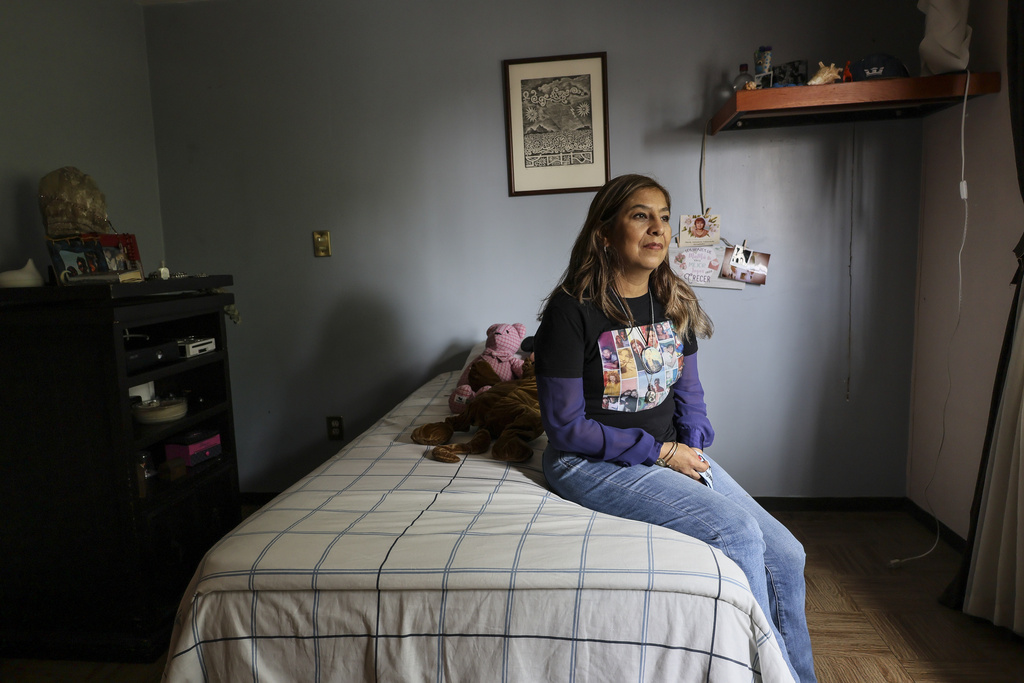
Veronica Rosas poses for a portrait in the bedroom of her missing son Diego Maximiliano in Ecatepec, Mexico, Friday, Aug. 2, 2024. Rosas’ son went missing when he was 16 years old on Sept. 4, 2015. (AP Photo/Ginnette Riquelme)
MEXICO CITY (AP) – Each time the kidnapper hung up the phone, Veronica Rosas and her relatives did the only thing they could think of: kneel, grab each other’s hands and pray.
“I told God: Please help me,” said Rosas, who has spent the past nine years searching for her son, Diego Maximiliano.
The 16-year-old vanished in 2015 after leaving home to meet with friends. They lived in Ecatepec, a Mexico City suburb where robbery, femicide and other violent crimes have afflicted its inhabitants for decades.
“Many joined us in prayer,” said Rosas, who 10 days after the kidnapping received one of her son’s fingers as proof of life. “Christians, Catholics, Jehovah Witnesses. I opened my door to everyone and — maybe — that’s why I didn’t die.”
For weeks, she could barely eat or sleep. How could she, if Diego might be famished, exhausted or wounded?
In spite of her efforts, Rosas was unable to gather the amount of money requested by the kidnappers. And though they agreed to a lower sum, Diego was never released.
According to official figures, at least 115,000 people have disappeared in Mexico since 1952, though the real number is believed to be higher.
During the country’s “dirty war,” a conflict that lasted throughout the 1970s, disappearances were attributed to government repression, similar to the dictatorships in Chile and Argentina.
In the past two decades, as officials have fought drug cartels and organized crime has tightened its grip in several states, it’s been more difficult to trace the perpetrators and causes of disappearances.
Human trafficking, kidnapping, acts of retaliation and forced recruitment by cartel members are among the reasons listed by human rights organizations. Disappearances impact local communities as well as migrants who travel through Mexico hoping to reach the U.S.
For thousands of relatives like Rosas, the disappearance of their children is life-altering.
“A disappearance puts a family’s life on pause,” said the Rev. Arturo Carrasco, an Anglican priest who offers spiritual guidance to families with missing members.
“While searching for them, they neglect their jobs. They lose their sense of security and many suffer from mental health problems,” he added. “In many cases, families fall apart.”
Relatives initially trust the authorities, but as time passes and no answers or justice comes, they take the search into their own hands.
To do that, they distribute bulletins with photos of the missing person. They visit morgues, prisons and psychiatric institutions. They walk through neighborhoods where homeless people spend the day, wondering if their sons or daughters might be close, affected by drug abuse or mental health problems.
“Ninety percent of the people who search are women,” said Carrasco. “And from that percentage, most of them are housewives who suddenly had to face a crime.”
“They lack legal and anthropological tools to do that,” he added. “But they have something that the rest of the population does not: the driving force of love for their children.”A mother’s search
When Rosas was pregnant with Diego, she made a decision: “This will be my one and only son.”
She raised him on her own, juggling several jobs and finding the time to check his homework every night. They lived a simple, joyful life.
Diego practiced karate and soccer. At his birthday parties, he loved to wear costumes. Their shared hobby was going to the movies. Their favorite films? “Transformers” and “Spider-Man.”
Now, with him gone, Rosas has been to the movies only once. She agreed because a friend she made after Diego’s disappearance — a Catholic nun named Paola Clericó, who comforts relatives with missing children — was there, holding her hand.
It doesn’t feel right for her to have fun, to take a break. But if she does not take care of herself, who will find out what happened to her son?
Three months after Diego’s disappearance, she got tired of waiting to hear from the police. She opened a Facebook page called “Help me find Diego” and, though she was frightened of stepping out of her home, she started looking for him, dead or alive.
For three years, her search was lonely. Relatives, co-workers and friends commonly distance themselves from people with missing family members, claiming that “they only talk about their search” or “listening to them is too sad.”
It wasn’t until 2018 that Rosas met Ana Enamorado, a Honduran woman who moved to Mexico to search for her son after he migrated and disappeared. They got acquainted and Enamorado invited Rosas to an annual protest in which thousands of mothers demand answers and justice.
The resentment and disappointment from Mexicans affected by nationwide violence has increased recently. President Andrés Manuel López Obrador and Claudia Sheinbaum, who will succeed him on October 1, constantly minimize the relatives’ recriminations, claiming that homicide rates decreased during the current administration.
But it’s not just violence that victims resent. On a recent evening, in the state of Zacatecas, a mother like Rosas stormed into a session of Congress. Drenched in tears, she screamed that she found her son — with a gunshot to the head — at the morgue. He had been there since November 2023, she said, but the authorities failed to notify her in spite of her tireless efforts to get information about what happened to him.
This is the reality that Rosas became aware of at the 2018 protest.
“When I got there, I saw a mother, and then another and another,” she said. “’Who are you looking for?’ we asked each other. It was an awakening. It was horrible.”
After meeting other women like her, she wondered: What if we use our collective force in our favor?
And so, as other mothers have done in Mexican states like Sonora and Jalisco, Rosas created an organization to provide mutual support for their searches. She called it “Uniendo Esperanzas,” or Uniting Hope, and it currently supports 22 families, mostly from the state of Mexico, where Diego disappeared.
All members learn legal procedures together. They put pressure on judicial authorities who are not always willing to do their jobs. They dress up in boots, sun hats and gloves to explore remote terrain where they have found human remains.
From time to time, they find missing family members. Sometimes alive. Others, regrettably, dead. Whatever the result, as any family would do, they hug and pray and cry.
Sometimes it’s hard, Rosas said. Or ambiguous. “When we find other people, I feel a lot of joy and I thank God, but at the same time, I ask him: Why don’t you give me Diego back?”Together, we search, we pray
On a recent Sunday, Benita Ornelas was mostly serene. But when Carrasco named her son, Fernando, during a Mass to honor him on the fifth anniversary of his disappearance, tears began flowing down her cheeks.
Not many faith leaders — regardless of their religious affiliation — are willing to address the disappearances in Mexico. Or to console hurting mothers in need of spiritual comfort.
“Not everyone has the sensitivity to endure such pain,” said Catholic Bishop Javier Acero, who meets with mothers like Rosas and Ornelas on a regular basis. He pushed for celebrating Mass in Our Lady of Guadalupe’s basilica to remember their disappeared children for the first time in 2023.
“But the numbers of disappearances keep rising and the government doesn’t do anything about it, so, where the state is absent, the church offers guidance,” Acero said.
Some mothers regard him as an ally and leaders from the Catholic church have raised their concerns against Lopez Obrador’s security policy since two Jesuit priests were murdered in 2022. But, in parallel, relatives of missing people claim that many Catholic priests, nuns and parishioners have shown little empathy for their pain.
Soon after their children disappeared, Ornelas and Rosas rushed to nearby parishes. “Please, father, celebrate Mass so we can pray for our sons,” both requested. But the priests refused.
“I cried and cried,” Rosas said. “But he responded: ‘I can’t say that people are being kidnapped, madam. I encourage you to pray for your son’s eternal rest.’”
On another occasion, Rosas recalled, she approached a group of elders praying the rosary, and asked them to pray for her son. “Why don’t you accept it? Hand him to God,” one replied.
In contrast, rain or shine, faith leaders like Carrasco and Clericó are always there for the mothers. They have walked with them through muddy terrain where excavations have been done. They have celebrated Mass in the middle of busy streets and next to canal drainages. They have joined them in visiting prisons and morgues, comforting them no matter what sorrow may come.
“We have the legitimate hope of finding our treasures alive,” Carrasco said. “We are no fools and we understand that there’s a risk they might be dead. But as long as we have no evidence of that, we will keep searching.”
Faith leaders like Carrasco and Clericó are part of an ecumenical group called “The Axis of Churches.” Methodists, Evangelicals, spiritual leaders from Indigenous communities, theologians and feminists are among its members. Sometimes they pray, but on other occasions they share a meal, draw mandalas or simply listen to the mothers.
“When I have a problem and I don’t know what to do, I go to them,” Rosas said. “They always share examples of God’s life, which allows me to flow with love and peace.”
They alone, Rosas said, can understand what she’s been through.
“When a friend tells me that I only speak of my searches or my organization, I answer: ’You wake up every morning to cook breakfast for your child and take him to school, but I wake up trying to find where mine is,’” Rosas said.
“I’m still a mother. My maternity did not disappear, though it now feels sad and unfair.”
Among the mothers of her organization, their missing sons and daughters are always present.
For the gathering to remember Fernando, Ornelas cooked tacos, a Mexican dish her son loved. “They are his favorites,” his mother said.
That Sunday evening, under the rain, Sister Clericó, Rosas, and the rest of the group shared the tacos with homeless people around a Catholic church in Mexico City. The food ran out in an hour, after which Carrasco celebrated Mass and the group hugged Ornelas.
“We live with a such a profound pain that only God can help us endure it,” Rosas said. “If it wasn’t for that light, for that relief, I don’t think we would be able to still stand.”
___
Associated Press religion coverage receives support through the AP’s collaboration with The Conversation US, with funding from Lilly Endowment Inc. The AP is solely responsible for this content.
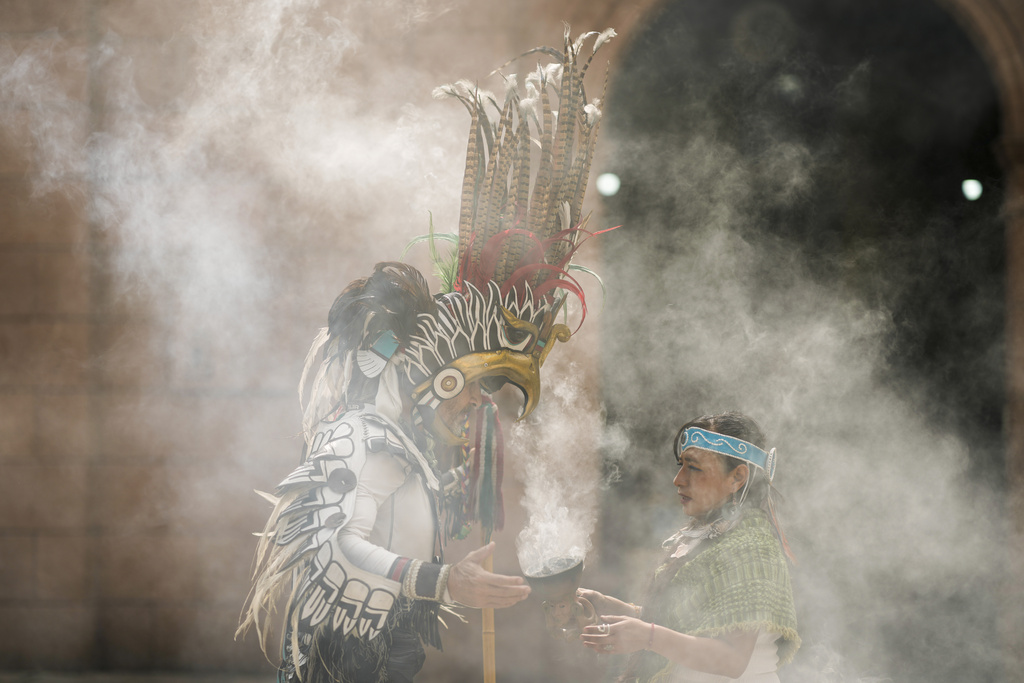
Mexica dancers burn incense during a ceremony commemorating the 503rd anniversary of the fall of the Aztec empire’s capital, Tenochtitlan, in Mexico City, Tuesday, Aug. 13, 2024. (AP Photo/Eduardo Verdugo)
MEXICO CITY (AP ) – Claudia Santos’ spiritual journey has left a mark on her skin.
Soon after the 50-year-old embraced her pre-Hispanic heritage and pledged to speak for her ancestors’ worldview in Mexico City, she tattooed the symbol “Ollin” — which translates from the Nahuatl language as “movement” — on her wrist.
“It’s an imprint from my Nahuatl name,” said Santos, wearing white with feathers hanging from her neck. She was dressed to perform an ancestral Mexica ceremony on Tuesday in the neighborhood of Tepito.
“It’s an insignia that represents me, my identity.”
Since 2021, when she co-founded an organization that raises awareness of her community’s Mexica heritage, Santos and members of close Indigenous communities gather by mid-August to honor Cuauhtémoc, who was the last emperor or “tlatoani” of Mexico-Tenochtitlan, as the capital was known before it fell to the Spaniards in 1521.
“It’s important to be here, 503 years after what happened, not only to dignify Tepito as an Indigenous neighborhood where there has been resistance, strength and perseverance,” Santos said. “But also because this is an energetic portal, a sacred ‘teocalli’ (‘God’s house’, in Nahuatl).”
The site that she chose for performing the ceremony has a profound sacred meaning in Mexico’s history. Though it’s currently a Catholic church, it’s also the site where Cuauhtémoc — a political and spiritual leader — initiated the final defense of the territory that was lost to the European conquerors.
“Our grandfather, Cuauhtémoc, is still among us,” said Santos, who explained that the site where the church now stands is aligned with the sun. “The cosmic memories of our ancestors are joining us today.”
Though he was not present during the pre-Hispanic rituals, the priest in charge of the Tepito church allowed Santos and fellow Indigenous leaders to move freely through the esplanade of the temple. Their preparations started early each morning, carefully placing roses, fruit, seeds and sculptures of pre-Hispanic figures among other elements.
“I’m very thankful to be given the chance of occupying our sacred compounds once again,” Santos said. “Making this connection between a religious and a spiritual belief is a joy.”
Before Tuesday’s ceremony, as this year’s activities began August 9, a Mayan spiritual guide was also invited to perform a ritual at the church’s main entrance.
“This is an act of kneeling with humbleness, not in humiliation, to make an offering to our Creator,” said Gerardo Luna, the Mayan leader who offered honey, incense, sugar, liquor and other elements as a nourishment for the fire.
“The fire is the element that links us to the spirit of the Creator, who permeates everything that exists,” said Luna, also praising the opportunity to practice his beliefs in a Catholic space.
“There are different ways of understanding spirituality, but there is only one language, the one of the heart,” Luna said. “Our Catholic brothers breathe the same air as us. We all have red blood in our veins, and your bones and mine are the same.”
Some locals approached the church and joined both Mayan and Mexica ceremonies. They were drawn in by the sound of a conch shell that was blown to announce the rituals and the smoke released by the lighting of a resin known as “copal.”
Lucía Moreno, 75, said that participating made her feel at peace. Tomás García, 42, added that he is Catholic, but these ceremonies “purify” him and allow him to let go of any wrongdoing.
Others, like Cleotilde Rodríguez, call upon the ancestors — and God — with a deeper need of comfort.
After Tuesday’s Mexica ritual, the 78-year-old said that she prayed for her health and well-being. No doctor or medicine has cured her aching knees, and none of her 10 children visit her or call to ask how she is. Another son of hers, she said, died by suicide some years ago, and she has not felt at ease since.
“This is what has happened to me, so I hope that God allows me to keep working, that my path is not shortened,” Rodríguez said. “Otherwise, what is going to become of me?”
The “tlalmanalli,” as the Mexica ceremony is known, is as an offering to Mother Earth. All members of the community are encouraged to participate and benefit from its spiritual force.
“What people take with them is medicinal,” Santos said. “It is all blessed, so people leave with medicine for life, which they can use in moments of sadness.”
She was not always aware of the depth of the Mexica and other pre-Hispanic worldviews, but a couple of decades ago, feeling that Catholicism no longer fulfilled her spiritually, she started looking for more.
She researched Buddhism and Hinduism. She practiced yoga and studied the awakening of the mind. But still, she wondered: “What’s in my country? Why, if other nations have gurus, aren’t there any widely known spiritual references in Mexico?”
And then she found them. The Mexica provided her with answers. They were wise, spiritual people, who resisted what others brought upon them, always connected to their ancestors and the profoundness of their land.
As part of her transformation, she received a new name, this time in Nahuatl and tied to the pre-Hispanic calendar. And so, just as her parents baptized her in the very same Tepito church where she now performs Mexica rituals, she embraced her current spirituality in a “sowing” ceremony, where she became “Ollin Chalchiuhtlicue,” which means “precious movement of the water.”
The name, she said, also comes with a purpose. As directed, she defined her life mission after the ceremony. Santos chose to comply with Cuauhtémoc’s final wishes for his people: Maybe the sun has gone down upon us, but it will come out again. In the meantime, we must tell our children — and their children’s children — how big our Motherland’s glory is.
“Through the spirituality of our Mexica tradition we are taking back our dignity and the essence of our Indigenous community,” Santos said. “Being here today is a joy, but also a work of resistance.”
“Tepito exists because it has resisted, and we will continue resisting.”
____
Associated Press religion coverage receives support through the AP’s collaboration with The Conversation US, with funding from Lilly Endowment Inc. The AP is solely responsible for this content.
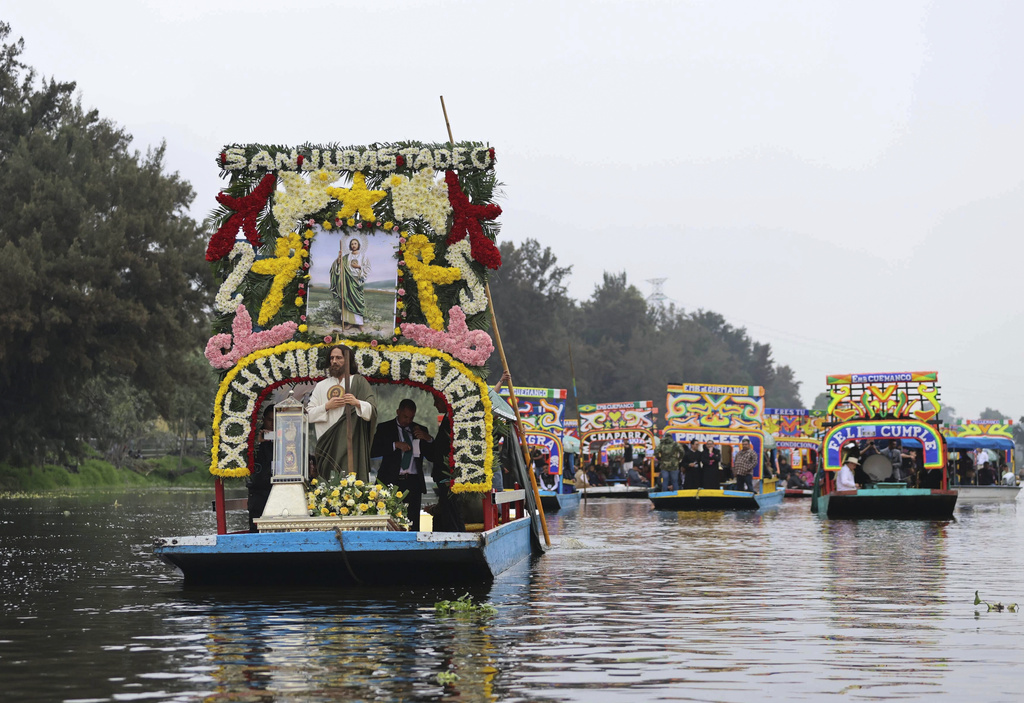
A relic of St. Jude Thaddeus is transported in a glass urn on a trajinera through the canals of Xochimilco, Mexico City, Sunday, Aug. 11, 2024. (AP Photo/Ginnette Riquelme)
MEXICO CITY (AP) – It was no ordinary Sunday on Mexico City’s famed Xochimilco canals.
Instead of tourists and locals hanging out with friends, the brightly painted boats known as “trajineras” were filled with Catholics honoring a relic of St. Jude Thaddeus, one of Jesus’ 12 apostles and patron saint of impossible causes.
A wooden figure holding a bone fragment of St. Jude’s arm was kept in a glass case while it glided through the calm waters as part of a month-long visit to Mexico, a country that is home to nearly 100 million Catholics.
The relic arrived in Mexico in late July after touring the United States in its first-ever trip out of Rome. Devotees will be able to pay respects in a dozen Mexican parishes through Aug. 28.
“Our faith for St. Jude Thaddeus is a family tradition,” Iris Guadalupe Hernández, 36, said while waiting in line to board one of the trajineras escorting the relic early Sunday.
Her mother’s devotion for the saint began four decades ago, when St. Jude granted her what she wished for the most: a family.
“My mother was unable to have babies,” Hernández said. “She had three miscarriages before asking St. Jude for a miracle, so after she got pregnant with my brothers and me, she promised that she would spread the word and our family has honored him since then.”
Like Hernández, thousands of Mexicans gather to celebrate St. Jude every Oct. 28 — his official feast day — at San Hipólito church in Mexico City. The saint is one of the most revered figures in Mexico after Our Lady of Guadalupe, one of several apparitions of the Virgin Mary.
“He is one of the most significant expressions of popular piety among the humblest,” said the Rev. Jesús Alejandro Contreras, a priest in the Xochimilco’s diocese. “In our neighborhoods, where there are mainly merchants, devotion toward this apostle is seen as an intercession for difficult causes.”
Contreras, who was among those who traveled through Xochimilco’s canals in the one-hour trajinera procession, said that being close to the relic is a way to “come into contact with the Lord.”
Parishioners were already waiting in nearby boats when the relic left the dock at 8 a.m. Once the procession began, devotees clapped in rhythm with the Mexican traditional songs performed by a local band.
Hundreds more awaited for the relic’s arrival at the end of the canal, where a procession on foot made its way to Xochimilco’s cathedral.
In the Mexico City neighborhood, locals are also devoted to the “Niñopa,” a life-size wooden figure of a baby that is believed to be about 450 years old. Its origins are unknown but it was found after the Spanish conquest, and Catholic families in Xochimilco typically keep images of him in their homes.
“Our faith here is divided,” said Arturo Espinosa, 52, standing close to a makeshift altar carrying a figure of St. Jude. “There’s a lot of faith here in Xochimilco and the Niñopa is our main representative, but we also have other emblems and participate in these celebrations.”
The festive spirit of the procession was led by “comparsas,” groups of local dancers who are devoted to a specific image of the infant Jesus. Each member wears a long velvet robe, a big drum-like hat and a mask depicting an old man,. The costume is meant to mock the Spanish conquerors.
Francisco García, 33, jumped steadily in his brown velvet robe while he and fellow comparsa dancers waited to make their way to the cathedral, where the archbishop welcomed the relic and celebrated Mass in its honor.
“My mom is sick, so I came to ask St. Jude for her surgery to go well,” said García, who had already seen the relic on July 28, right after it arrived in the capital and was taken to the Zocalo, Mexico City’s main square.
“I was so moved I started crying,” García said. “I told him (St. Jude): ‘You called for me, so here I am.’”
The relic was to be on display in an oratory next to Xochimilco’s cathedral until nightfall, and its trip through central Mexico’s churches resumes Monday. It is scheduled to leave the country in late August.
___
Associated Press religion coverage receives support through the AP’s collaboration with The Conversation US, with funding from Lilly Endowment Inc. The AP is solely responsible for this content.
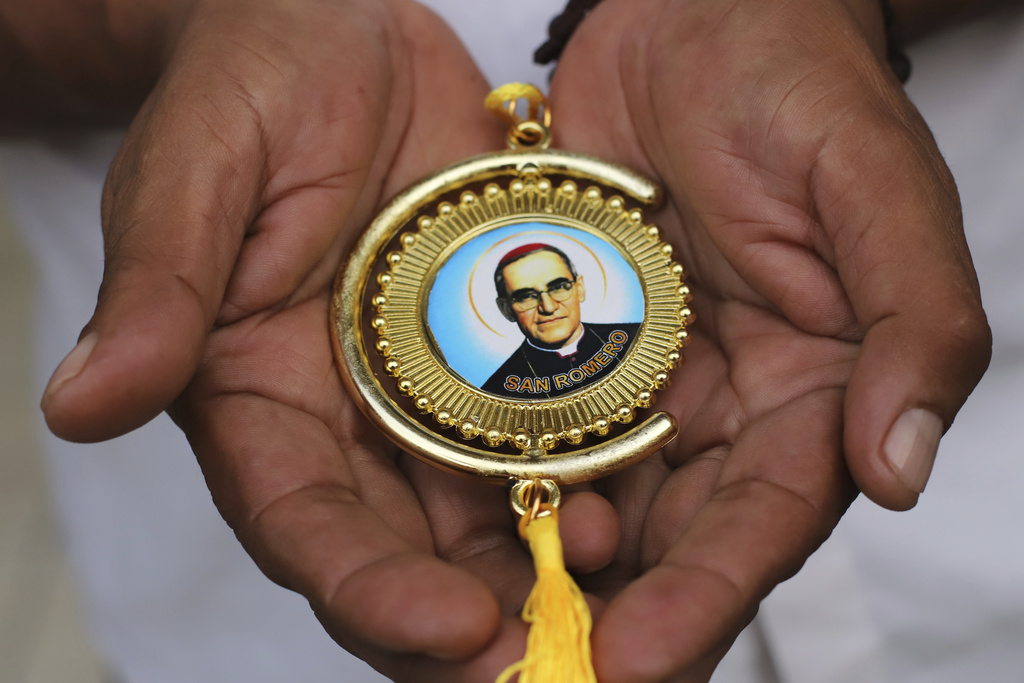
An ornament features Saint Oscar Arnulfo Romero during a religious procession honoring him in San Salvador, El Salvador, Thursday, Aug. 1, 2024. Romero was assassinated on March 24, 1980, while celebrating Mass. (AP Photo/Salvador Melendez)
SAN SALVADOR (AP) – It’s as if Joyce Valencia could still hear Saint Oscar Romero’s voice.
“I met him when I was a little girl,” the 61-year-old Salvadoran said. “We used to gather around our radio with our grandma to listen to him. And, even now, listening to him encourages us to move forward.”
For a few years now, Valencia has joined the yearly pilgrimage that kicks off in El Salvador each Aug. 1 to honor Romero, who was named a saint by Pope Francis in 2018.
According to the committee that organizes the event, up to 3,000 pilgrims will cover 160 kilometers (100 miles) in three days, traveling from San Salvador, the capital, to Ciudad Barrios, where Romero was born in 1917.
Already known to many as “Saint Romero of the Americas,” San Salvador’s archbishop was beloved among the working class and poor for defending them against repression by the army. But he was loathed by conservative sectors who saw him as aligned with leftist causes as the country descended into a 1980-1992 civil war.
Romero was murdered as he celebrated Mass on March 24, 1980, in a hospital chapel. The day before his assassination, he sent a blunt message to the country’s military in his Sunday homily: “In the name of God and this suffering people, I implore you, I order you, in the name of God, to cease the repression.”
Romero’s influence continues to resonate in this Central American country where thousands of lives have been destroyed through decades of extortion and murder committed by the gangs.
“Monsignor Romero is of great importance during these times, under the regime, as many human rights are being violated and very few institutions advocate for them,” said Wilbert Sánchez, 21, a university student whose aunt was detained during Bukele’s crackdown and freed after one year, due to lack of evidence against her.
“I think if he (Romero) were here, things would be different,” Sánchez said. “He would make a change, as he did in the past, when he tried to intercede for the peasants and others affected by the government.”
Soon after a 5 a.m. Mass, Sánchez joined dozens in the pilgrimage, his third since friends invited him to tag along in 2022.
“You can feel a very special connection during the journey,” Sánchez said. “What encourages me the most is faith. And learning more about our country’s only saint.”
Romero’s pilgrimage was first organized by Catholic leaders in 2017, when the archbishop would have turned 100.
The route, said Cardinal Gregorio Rosa Chávez, who was Romero’s disciple and friend, is meant to unite the Saint’s “tomb”, San Salvador, with his “crib”, Ciudad Barrios.
“He was the most beloved and hated man of his time,” Rosa Chávez said. “It was exceptional to watch him in his struggles, his anguish, his doubts and his tribulations until he gave his life on the altar.”
According to the cardinal, Salvadorans participate in the pilgrimage for three main reasons: being at peace with Romero after discovering that government criticisms of him back in the 1980s were “slanders”, to thank him for miracles or favors, and to simply enjoy the spiritual experience of the journey.
Each pilgrimage has a theme.
“This year’s mark the 500th anniversary of our encounter with Christ,” said the Rev. Santos Belisario during a recent news conference. “The first Mass that took place in El Salvador calls us to remember the first priests and bishops who arrived in Salvadoran territory, many of whom valiantly fight for the dignity and rights of the Indigenous people.”
During the journey to Ciudad Barrios, pilgrims not only pray, but also participate in dances and cultural activities in the towns where locals offer shelter and food. Religious leaders from across the country join the celebrations as well.
Abraham Hernández, 87, has completed the procession times. “I hope that my age and body won’t fail me this time,” he said.
The Salvadoran man never met Romero personally but is grateful for his political stances. “He even gave his life for us, so that we would have a better government,” Hernández said.
Joyce Valencia, too, feels nothing but gratitude. “I thank God for our saint,” she said. “He is our pastor and friend”.
She has asked many favors of Romero and he has granted them all, including a return to good health for a girl who had seemed destined for heart surgery.
“It’s a joy to attend this pilgrimage. To pray for our country,” Valencia said. “During these difficult times, he is like a ray of hope.”
____
Associated Press religion coverage receives support through the AP’s collaboration with The Conversation US, with funding from Lilly Endowment Inc. The AP is solely responsible for this content.
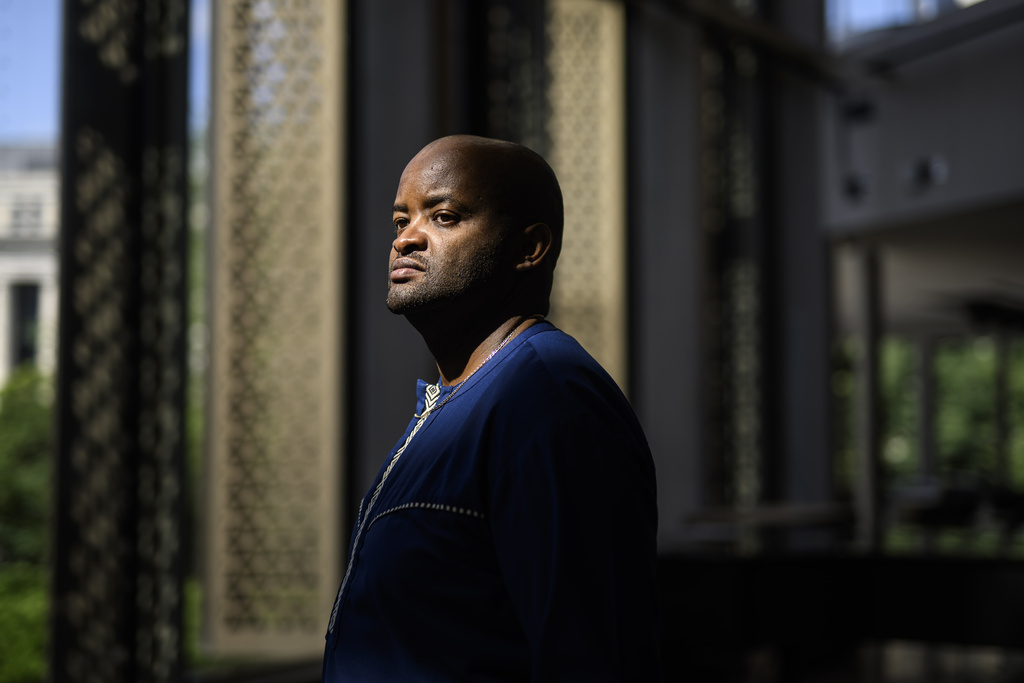
Pascal Kanyemera is shown at the National Arts Centre in Ottawa, Ontario, Canada, on Wednesday, July 17, 2024. Kanyemera has no doubts: Back in 1994, when he survived the genocide against the Tutsi in Rwanda, God had his back. (AP Photo/Justin Tang)
(AP) – Thirty years ago, while he was hiding from the machetes that killed his father, two of his brothers and an estimated 800,000 other people during the genocide against Rwanda’s Tutsi minority, Pascal Kanyemera made a deal with God.
“Please, if I survive one more week, I will give you 100 Rwandan francs.”
God listened, so the 15-year-old prayed again. Then again. And again, until the killings stopped in July 1994.
“By the end of the genocide, I owed God 400 Rwandan francs,” said Kanyemera, now 45, from his home in Ottawa, the capital of Canada. “That shows you how I always put my life and my survival in his hands.”
His grandmother, uncles and cousins were also among the thousands of Tutsi killed by extremist Hutus in massacres that lasted over 100 days.
The genocide was ignited on April 6, 1994, when a plane carrying President Juvénal Habyarimana, a member of the Hutu majority, was shot down as it prepared to land in Rwanda’s capital, Kigali. The Tutsi were blamed for downing the plane and killing the president. Enraged, gangs of Hutu extremists began killing Tutsi, backed by the army and police.
Kanyemera was hiding at a local school when his family was slaughtered on April 9. He learned about their deaths by late May, when he reunited with his mother and sisters at a refugee camp that was controlled by the French.
Other Tutsi witnessed the killings firsthand and barely survived to tell the tale.
In her book “Chosen to Die: Destined to Live,” Frida Umuhoza recounts how her mother was beheaded before her eyes. She gazed at her grandfather begging his assassins — Bible in hand — to let her family pray together one last time. She shuddered when the Hutu extremists coaxed her into choosing the weapon she would be killed with.
“Please, don’t kill me with anything else,” said Umuhoza, who was terrified of machetes and opted for a club.
Soon after, the 14-year-old felt a smack in the back of her head and all went dark. When she woke up, her heels were sliced open and her body covered in dirt inside the ditch where her relatives lay dead. She remained numb for hours, until one of her Hutu neighbors took pity on her and dug her out to a life of sorrow, orphanhood and anger.
“Sometimes, when people hear about what happened to us, they don’t believe it,” Kanyemera said. “Some men killed their kids, their own kids. Out of hate.”
Healing, he said, is a long process. But many survivors hold on to faith to bring back peace into their lives.
Umuhoza details in her book how becoming a Christian allowed her to forgive. Another survivor, Immaculée Ilibagiza, has written about hiding for 91 days in the tiny bathroom of a pastor’s house. Now a U.S.-based author, motivational speaker and devout Catholic, Ilibagiza often recounts how reciting the rosary drew out the pain and rage inside her.
Kanyemera — the current president of the Humura Association, which supports genocide survivors — has always attributed his survival to God.
Hutu militias patrolled the school where he was hiding, looking for the Tutsi who lived in the surrounding area, but he was never caught. And though the Hutu planned to kill the surviving Tutsi in the refugee camp where he was, French troops took over, so he survived.
As painful as it is, many survivors remain committed to remembrance. They visit schools to share their stories with younger generations. They write books. They speak to journalists, willing to reopen their wounds year after year, hoping that no genocide is ever committed again.
“Someone said that whoever forgets the past is condemned to relive it,” said Tarcisse Ruhamyandekwe, who lost a brother, uncles and aunts in 1994. “Our people, our families, were killed in unusual circumstances, so it is a way of giving them back the dignity they did not have.”
During the genocide, Hutu extremists engaged in extreme brutality. Killings were often preceded by beatings, torture and mutilation. Militias sang “Kill them all!” before reaching the homes of the families they would exterminate. An estimated 100,000 to 250,000 women were brutally raped, many of whom later needed reconstructive surgery or HIV/AIDS treatment.
“Rwanda was full of bodies,” said Ruhamyandekwe, who also lives in Ottawa. “Imagine you go back as a survivor and in your house you only find the bodies of your brothers and sisters.”
He, like Kanyemera, moved far from Rwanda to be safe. His first stop was Congo, where his parents sent him in 1985, fearing that the violence against Tutsi would escalate.
Survivors like them have emphasized that the genocide arose from longstanding Hutu-Tutsi animosity.
“I remember that, when I was 7 or 8, I used to see my dad taken by the military to jail,” Ruhamyandekwe said. “I remember thinking he was lucky because he came back. Other people did not; they were killed in jail.”
Discrimination, he said, was inflicted on the Tutsi from a very young age. Schools required teachers to keep a detailed registration of students. It was common for them to enter the classrooms and say: “All the Tutsi, stand up.”
“We carried our IDs to show our race and we could not escape,” Ruhamyandekwe said. “That’s why during the genocide it was very simple to ask: ‘Where is your ID?’ And get the Tutsi killed.”
His father was not a victim of the Hutu, but when he died later in the 1990s — probably of a heart attack — Ruhamyandekwe was unable to bury him. “Taking that risk, going back to Rwanda, was probably going to get me killed,» he said.
He has no pictures or material possessions from his life in Rwanda, but his memories of the country of a thousand hills remain intact.
A few years ago, he took his children there.
Nothing is left of the house where his parents — both teachers — raised him comfortably and lovingly, except for marks in the ground. And there, with his hands moving through the air, he “drew” his childhood home for his kids.
“I showed them where my room was. My brother’s, my sister’s,” Ruhamyandekwe said. “I told them: ’That’s the house where I grew up, but everything was destroyed.’”
Sharing his feelings has not been easy. Rwandans, he said, are not open with emotion, even within their own families. Crying or confiding in someone is discouraged from an early age. For him, though, writing has been like therapy. And there has been his faith.
“In my book I write about what I call ‘God’s invisible hand,’” Ruhamyandekwe said. “Some people say it’s luck, but I say it was God guiding me through all the stuff I went through.”
By writing, he has not only expressed himself, but tried to spread awareness about his people’s history.
“We cannot forget our loved ones,” Ruhamyandekwe said. “If reconciliation has to happen, as it is happening, we have to remember that and teach what happened to the next generation.”
“Someone said that there’s something stronger than death: It’s the presence of the dead in the memory of the living.”
___
Associated Press religion coverage receives support through the AP’s collaboration with The Conversation US, with funding from Lilly Endowment Inc. The AP is solely responsible for this content.
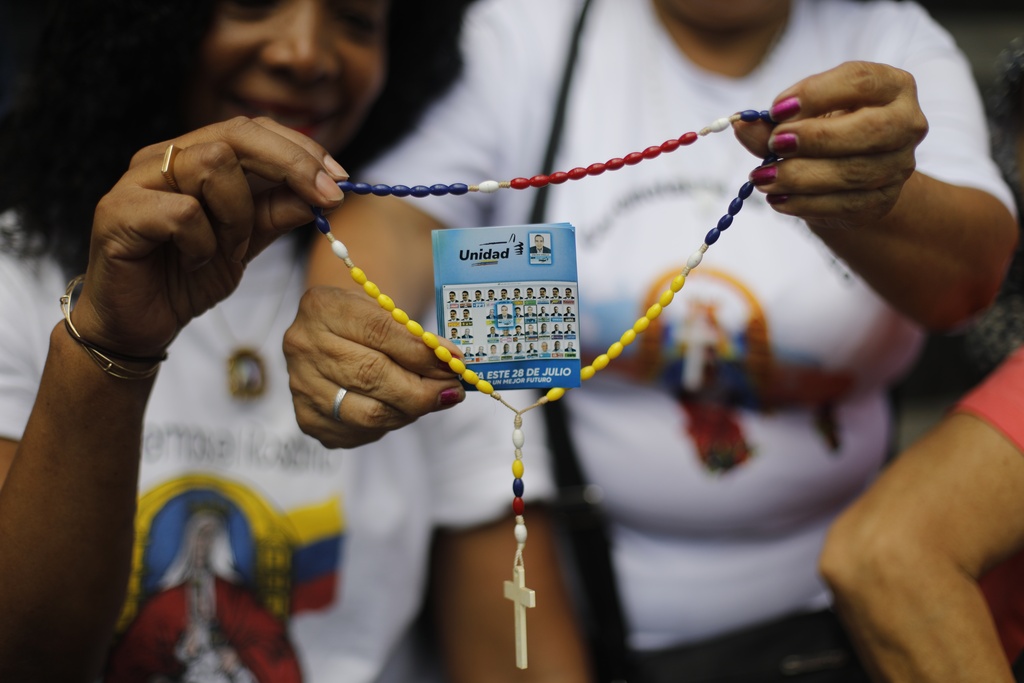
(AP) – Venezuela es un país mayoritariamente católico, pero el número exacto devotos es difícil de determinar. Dado que el gobierno no ha publicado cifras oficiales en más de una década, el panorama religioso actual sólo puede dimensionarse mediante proyecciones y trabajo de campo independiente.
La religión no ha jugado un papel clave en esta carrera electoral. Sin embargo, sí se ha entrelazado con la política, en especial durante el mandato del fallecido expresidente Hugo Chávez, quien llegó a convertirse en una figura de culto para decenas de venezolanos y se distanció de la Iglesia católica abrazando la religiosidad popular.
Aquí una mirada al contexto religioso de Venezuela.
¿Qué dice la ley?
La Constitución garantiza la libertad de religión y culto. También dicta que toda persona tiene derecho a profesar su fe y manifestar sus creencias siempre que no se oponga a la moral, las buenas costumbres y el orden público. Además, establece la independencia de las iglesias y cada familia es libre de elegir si sus hijos reciben educación religiosa o no.
De acuerdo con un reporte que el gobierno estadounidense publicó en 2023 sobre libertad religiosa en Venezuela, las comunidades de fe profesan sus creencias libremente siempre que se abstengan de criticar al gobierno. Representantes católicos y evangélicos han dicho que partidarios de Maduro acosan verbalmente a miembros de sus instituciones si llaman la atención sobre la crisis humanitaria del país.
¿Con qué religión se identifican los venezolanos?
Sin números oficiales a mano, todas las estimaciones coinciden en que la población es mayoritariamente católica.
Según el reporte del gobierno estadounidense de 2023, el 96% de la población sería católica y el resto englobaría otras confesiones.
Desde Venezuela, una de las investigaciones más recientes fue encabezada por la Universidad Católica Andrés Bello y data de 2016.
Enrique Alí González, sociólogo que comparó las cifras con su experiencia en campo, estima que el paisaje religioso actual podría ser el siguiente: católicos 82%-84%, evangélicos (sin distinguir denominación) 10%-12%, adeptos de la santería 1,5%-2% y ateos 1%. Los testigos de Jehová, musulmanes, Baha’i y otras minorías integrarían el porcentaje restante.
Según el experto, la mayor concentración de evangélicos está en el estado de Apure —fronterizo con Colombia—, mientras que la santería está más presente en Caracas. Además, algunos venezolanos participan de dos religiones: muchos devotos del espiritismo —cuya máxima representante es María Lionza, deidad femenina que se venera en la Montaña del Sorte— también son católicos.
Según el sociólogo Hugo Pérez Hernáiz, más allá de que el pastor evangélico Bertucci aparezca en una boleta, la adscripción religiosa difícilmente determinará lo que arrojen las urnas. “Una persona no te dirá que su creencia en Dios es la que la está llevando a votar”.
La manera en la que sí influye, explica Alí González, es en el acompañamiento social y espiritual.
En un país en el que la pobreza alcanza a más del 90% de la población, la organización religiosa Cáritas ofrece ollas comunes y suplementos alimenticios para niños y niñas.
“Y, por supuesto, también está el acompañamiento pastoral”, agrega. “Porque, ¿qué te queda cuando vives una situación tan miserable?”.
“La fe, y cuando la fe es sólida, se transforma en esperanza”.
¿Cómo ha sido la relación entre el gobierno y las iglesias?
Allá por 2013, cuando apenas buscaba el poder, Nicolás Maduro dijo que, mientras oraba en una capilla, el fallecido Hugo Chávez se le apareció en forma de pajarito y lo bendijo.
El video produjo todo tipo de reacciones pero no fue sorpresivo. Afirmando que los obispos eran “demonios” y favoreciendo el culto a María Lionza, era usual que el mismo Chávez se mostrara más cercano al espiritismo que a la Iglesia católica.
Según Alí González, en la historia venezolana se han dado varios roces entre gobernantes y líderes católicos.
El primero ocurrió en el S.XIX, cuando el presidente Antonio Guzmán (1870-1887) trató de suplantar a la Iglesia con una visión que incorporara la masonería y el protestantismo. Tras su muerte, el anticatolicismo declinó, las congregaciones europeas volvieron a Venezuela y varios gobiernos subsecuentes se mantuvieron al margen siempre que la Iglesia no interviniera en política.
A mediados de los años 40, hubo una segunda ruptura cuando un sector político apegado al socialismo emprendió nuevas acciones anticlericales. Los ánimos se enfriaron con el retorno a la democracia en los años 50 y no fue sino hasta la llegada de Chávez al poder, a finales de los 90, que la grieta se reabrió.
Según Alí González, Chávez fomentó una suerte de divinización o “culto humano” que algunos expertos llaman “religión atea” en consonancia con el “guevarismo” o “fidelismo”, derivados del fervor que aún despiertan líderes como Ernesto “Che” Guevara y Fidel Castro.
En paralelo, Chávez se propuso reducir el culto a la Iglesia católica aliándose con sectores evangélicos. Por ejemplo, sacó a las capellanías de las cárceles y cedió ese terreno a los evangélicos.
¿Qué ha sido de la religión en el chavismo?
Algunos sacerdotes apoyaron a Chávez y a Maduro. Otros los enfrentaron. Y, en uno de los puntos más álgidos de las protestas que estallaron en 2017, el papa Francisco llamó al diálogo y la paz.
Religiosamente hablando, Maduro se dice un hombre espiritual que públicamente ha hecho guiños a prácticas tanto católicas como evangélicas. Y como presidente, en su relación con la Iglesia, suele seguir los pasos de su antecesor. Aunque ha viajado al Vaticano para encontrarse con el papa y celebra al beato venezolano José Gregorio Hernández, también ha criticado a líderes católicos y estos a él.
Más recientemente, su acercamiento con las iglesias evangélicas aumentó. En 2023, lanzó el programa “Mi iglesia bien equipada” para mejorar y restaurar templos cristianos y su hijo preside una oficina estatal de Asuntos Religiosos para “fortalecer el acompañamiento a los sectores cristianos”.
¿La religiosidad ha cambiado por la crisis?
Aunque algunos reportes señalan que la espiritualidad de los venezolanos ha ganado fuerza debido a la crisis económica y política, Pérez Hernáiz explica que esa afirmación no cuenta con datos que la respalden.
“Siempre ha habido un sustrato de religiosidad popular muy fuerte en Venezuela”, dice. “Y lo que comúnmente se llama ‘santería’ es un abanico de espiritualidades populares que se mezclan con expresiones religiosas más formales, como el catolicismo”.
Según añade, tras revisar las cifras de afiliaciones de diversas comunidades religiosas, los académicos coinciden en que ha incrementado el número de pentecostales, pero sin datos oficiales es imposible precisar cuánto. Este incremento es consistente con el que expertos de la región y Estados Unidos han reportado en América Latina en los últimos cinco años.
____
AP Foto: Cristian Hernandez
La cobertura de noticias religiosas de The Associated Press recibe apoyo a través de una colaboración con The Conversation US, con fondos del Lilly Endowment Inc. La AP es la única responsable de todo el contenido.
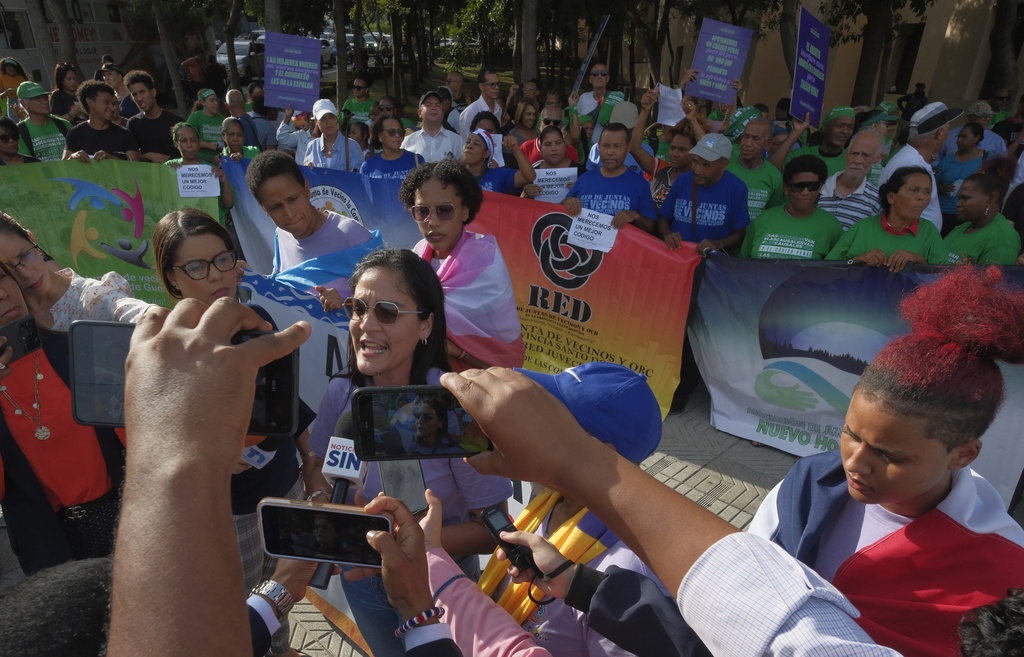
Luego de que el Senado diera una primera aprobación a un proyecto de Código Penal que mantiene la prohibición total a la interrupción del embarazo a finales de junio, decenas de personas se lanzaron a las calles el miércoles para exigir que se garanticen los derechos de las mujeres, de la niñez y de la comunidad LGBTQ, que —según diversas organizaciones de derechos humanos— se vulnerarían con los posibles cambios al documento.
“Nosotras seguimos en pie de lucha», dijo antes de la protesta la reconocida activista dominicana Sergia Galván.
Galván y otras feministas llevan décadas exigiendo que el aborto se despenalice bajo tres causales: cuando esté en riesgo la vida de la mujer, cuando el embarazo sea producto de violación o incesto y cuando existan malformaciones fetales incompatibles con la vida.
República Dominicana es uno de los cuatro países latinoamericanos que criminalizan el aborto sin excepción. El Código Penal actual establece que cualquier persona que aborte enfrenta hasta dos años de cárcel. Para médicos, parteras o enfermeras, la pena va de cinco a 20 años de prisión.
El presidente dominicano, Luis Abinader, quien se reeligió en mayo pasado, se dijo dispuesto a respaldar la despenalización en sus dos campañas presidenciales, pero tras ganar ambas elecciones no volvió a mostrar su apoyo.
“Las organizaciones de mujeres estuvimos en reunión con él y dijo estar de acuerdo con las tres causales y que iba a trabajar para que en su partido hubiera una postura a favor», dijo Galván. “Realmente fue un engaño a la ciudadanía, a las mujeres y al pueblo”.
Tanto Galván como miembros de otros organismos locales e internacionales han denunciado que la prohibición absoluta del aborto tiene diversas ramificaciones. Alrededor de un 30% de las adolescentes carece de acceso a métodos anticonceptivos, no existe la educación sexual integral laica, siete de cada 10 mujeres sufre violencia de género —como incesto, matrimonio infantil y explotación sexual— y los niveles de pobreza incrementan los riesgos de enfrentar un embarazo no deseado.
“Queremos un Código que respete a las mujeres y a las niñas, que les permita decidir, que respete el oficio y el criterio de los médicos para decidir en caso de hacer un aborto, pero también queremos un Código que sancione la impunidad, esa corrupción burda que nos ha robado el futuro a muchos jóvenes”, dijo desde la protesta Nicole Pichardo, dirigente de un partido político minoritario.
Más allá de la despenalización, organismos como Human Rights Watch alertaron que el proyecto de Código Penal reduce las penas por violencia sexual dentro del matrimonio y excluye la orientación sexual de la lista de características protegidas contra la discriminación, lo que traería más vulneración a la comunidad LGBTQ.
“Estamos aquí, frente a la Presidencia de la República Dominicana, porque el Código Penal que aprobaron los senadores y está próximo a aprobarse por los diputados, no nos representa”, añadió desde la manifestación del miércoles Rosalba Díaz, miembro de la Comunidad de Lesbianas Inclusivas Dominicanas (Colesdom). “¿Qué significa eso? Que ahora las personas que vivimos con diferentes orientaciones sexuales, identidades de género, vamos a estar en riesgo de que constantemente nos discriminen”.
A la lista de preocupaciones de ciudadanos y activistas se suman otras cuestiones. El artículo 14, por ejemplo, exime de responsabilidad penal a las iglesias, lo que según activistas como Galván dejaría impunes crímenes de pedofilia, lavado de activos o encubrimiento entre los líderes de fe.
En la isla caribeña, la religión es fundamental. Es el único país del mundo con una Biblia en su bandera y el lema del Estado es “Dios, Patria y Libertad”.
Según activistas del sector conservador y que se oponen a la despenalización, su relación con algunos legisladores es cercana y miembros de organizaciones como 40 Días por la Vida dicen orar para que los congresistas mantengan los candados que impiden abortar o brindar educación sexual integral.
____
AP Foto: Ricardo Hernandez
La cobertura de noticias religiosas de The Associated Press recibe apoyo a través de una colaboración con The Conversation US, con fondos del Lilly Endowment Inc. La AP es la única responsable de todo el contenido.

 mthernandezr.com