Giant Baby Jesus statue visits Mexico City’s Tepito neighborhood with message of peace

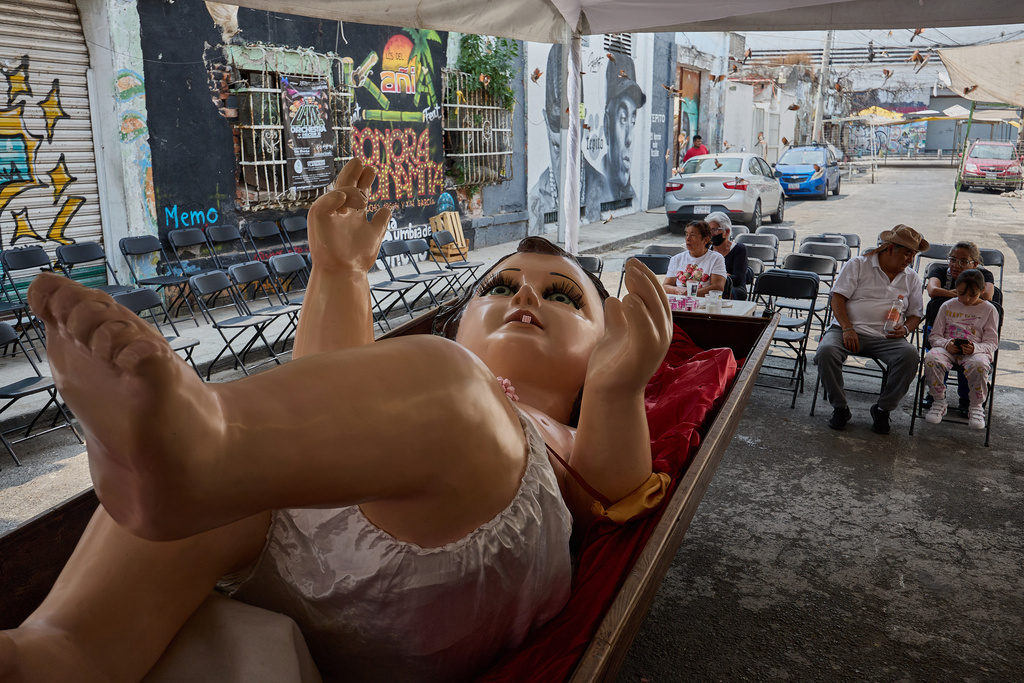
Parishioners take part in an offering to a giant Baby Jesus in Mexico City, Tuesday, March 10, 2026. (AP Photo/Ginnette Riquelme)

Published by The Associated Press, March 2026

MEXICO CITY (AP) – His face and body resemble those of a newborn. Yet the Baby Jesus statue towers 16 feet (5 meters) tall and travels across central Mexico spreading a message of peace.

The giant figure arrived this week in Mexico City’s Tepito neighborhood, known for its bustling street markets and strong local identity, but also for longstanding crime problems. Prayers, offerings and a Mass followed.

“The Baby Jesus means everything to me and my family because we are very Catholic,” said Guillermo Ramírez, a local resident who coordinated logistics for the statue’s visit. “By bringing it here, I want to show that there are good people in Tepito.”

The 49-year-old musician first saw the giant Baby Jesus in 2024 in a nearby neighborhood. Seeing the devotion it drew from worshippers, he thought his own community could benefit too. So he reached out to the family who owns the statue, which made its first visit to Tepito later that year.

“Since it represents peace, we hope for peace in our neighborhood, in our family,” said Ramírez’s wife, Alma Cravioto. 

A statue on a mission

Mexican artist Abraham Gómez created the Baby Jesus figure with his brother in 2013. 

“This began as a project called ‘Walk for Peace and Good,’ intended to promote and spread values in families, towns and neighborhoods through sacred art,” Gómez said.

The statue has traveled to communities in the Mexican states of Puebla, Tlaxcala and Jalisco, including places where violence stemming from drug trafficking affects local communities.

“Insecurity has complicated our visits lately,” Gómez said. “But that’s why we think these activities are more necessary than ever.”

Made with a steel frame and layers of polyurethane foam and resin reinforced with fiberglass, the statue weighs about half a ton. Gómez said he found inspiration in the smaller Baby Jesus figures cherished among Mexican Catholics, who traditionally dress them ahead of Candlemas on Feb. 2.

He and his brother transport the image in a massive basket placed on top of a flatbed truck. For each of the Baby Jesus’ journeys, they lead a procession that heads to a local church or meeting point, where devotees can make offerings and a priest celebrates Mass.

After its arrival in Tepito on Monday night, dozens of residents gathered around the towering statue as music and prayers filled the street. Neighbors also shared “atole,” a traditional warm corn drink.

“For us, the important thing is not just bringing the statue so visitors can take photos,” Gómez said. “It’s that they leave with a message that stays in their hearts.”

Faith in the neighborhood 

The giant Baby Jesus left his sleeping position on Tuesday and was seated upright. Following the Mexican custom of dressing him up, locals clothed the statue with traditional textiles inspired by Huichol art, a colorful Indigenous tradition from western Mexico.

“We want to reclaim the traditions of our ancestral communities,” Gómez said. “To show that Mexico is a blend of cultures, shaped by both Spanish heritage and Indigenous roots.”

María Concepción Franco, who lives in Tepito, said she had previously seen the figure and was excited about having him visit her neighborhood.

“This is a blessing for me,” she said. “He has granted me miracles and I have asked much of him.”

Friends and loved ones have given her images of the Baby Jesus throughout the years. She keeps some at home and carries one in her purse.

“He helps me stay strong despite all difficulties,” Franco said. “I don’t have any children, but I am really devoted to him.”

___

Associated Press religion coverage receives support through the AP’s collaboration with The Conversation US, with funding from Lilly Endowment Inc. The AP is solely responsible for this content.
An offering, a fire, a prayer. How a Mexico City community celebrates its pre-Hispanic origins

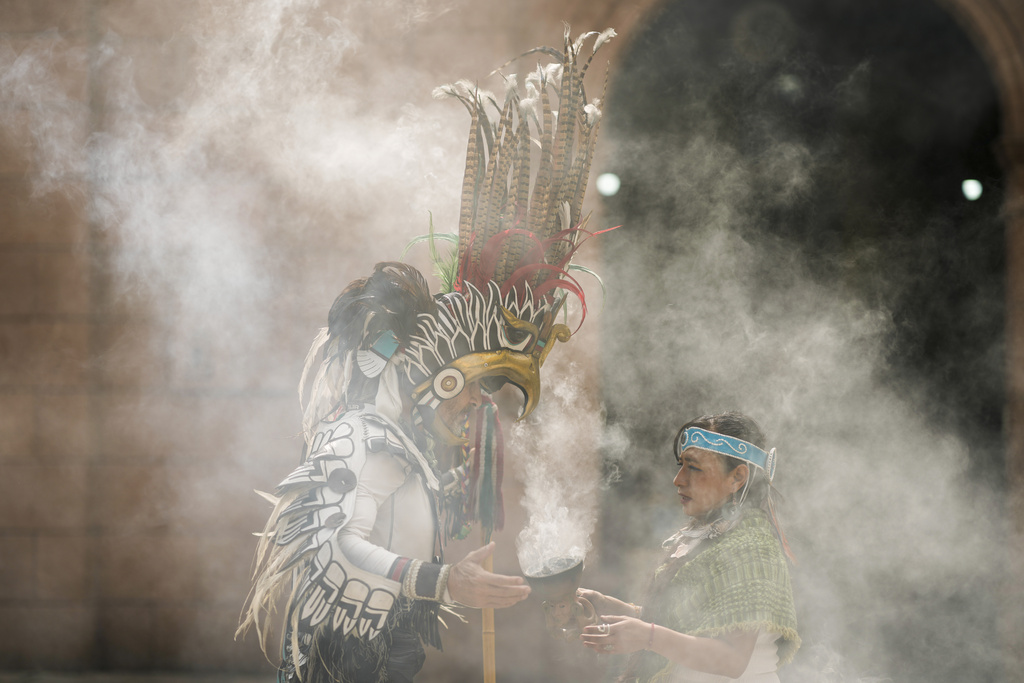
Mexica dancers burn incense during a ceremony commemorating the 503rd anniversary of the fall of the Aztec empire’s capital, Tenochtitlan, in Mexico City, Tuesday, Aug. 13, 2024. (AP Photo/Eduardo Verdugo)

Published by The Associated Press, August 2024 (link aquí)

Spanish language story here

MEXICO CITY (AP ) – Claudia Santos’ spiritual journey has left a mark on her skin.

Soon after the 50-year-old embraced her pre-Hispanic heritage and pledged to speak for her ancestors’ worldview in Mexico City, she tattooed the symbol “Ollin” — which translates from the Nahuatl language as “movement” — on her wrist.

“It’s an imprint from my Nahuatl name,” said Santos, wearing white with feathers hanging from her neck. She was dressed to perform an ancestral Mexica ceremony on Tuesday in the neighborhood of Tepito. 

“It’s an insignia that represents me, my identity.”

Since 2021, when she co-founded an organization that raises awareness of her community’s Mexica heritage, Santos and members of close Indigenous communities gather by mid-August to honor Cuauhtémoc, who was the last emperor or “tlatoani” of Mexico-Tenochtitlan, as the capital was known before it fell to the Spaniards in 1521.

“It’s important to be here, 503 years after what happened, not only to dignify Tepito as an Indigenous neighborhood where there has been resistance, strength and perseverance,” Santos said. “But also because this is an energetic portal, a sacred ‘teocalli’ (‘God’s house’, in Nahuatl).”

The site that she chose for performing the ceremony has a profound sacred meaning in Mexico’s history. Though it’s currently a Catholic church, it’s also the site where Cuauhtémoc — a political and spiritual leader — initiated the final defense of the territory that was lost to the European conquerors.

“Our grandfather, Cuauhtémoc, is still among us,” said Santos, who explained that the site where the church now stands is aligned with the sun. “The cosmic memories of our ancestors are joining us today.”

Though he was not present during the pre-Hispanic rituals, the priest in charge of the Tepito church allowed Santos and fellow Indigenous leaders to move freely through the esplanade of the temple. Their preparations started early each morning, carefully placing roses, fruit, seeds and sculptures of pre-Hispanic figures among other elements.

“I’m very thankful to be given the chance of occupying our sacred compounds once again,” Santos said. “Making this connection between a religious and a spiritual belief is a joy.”

Before Tuesday’s ceremony, as this year’s activities began August 9, a Mayan spiritual guide was also invited to perform a ritual at the church’s main entrance.

“This is an act of kneeling with humbleness, not in humiliation, to make an offering to our Creator,” said Gerardo Luna, the Mayan leader who offered honey, incense, sugar, liquor and other elements as a nourishment for the fire. 

“The fire is the element that links us to the spirit of the Creator, who permeates everything that exists,” said Luna, also praising the opportunity to practice his beliefs in a Catholic space. 

“There are different ways of understanding spirituality, but there is only one language, the one of the heart,” Luna said. “Our Catholic brothers breathe the same air as us. We all have red blood in our veins, and your bones and mine are the same.”

Some locals approached the church and joined both Mayan and Mexica ceremonies. They were drawn in by the sound of a conch shell that was blown to announce the rituals and the smoke released by the lighting of a resin known as “copal.”

Lucía Moreno, 75, said that participating made her feel at peace. Tomás García, 42, added that he is Catholic, but these ceremonies “purify” him and allow him to let go of any wrongdoing.

Others, like Cleotilde Rodríguez, call upon the ancestors — and God — with a deeper need of comfort.

After Tuesday’s Mexica ritual, the 78-year-old said that she prayed for her health and well-being. No doctor or medicine has cured her aching knees, and none of her 10 children visit her or call to ask how she is. Another son of hers, she said, died by suicide some years ago, and she has not felt at ease since.

“This is what has happened to me, so I hope that God allows me to keep working, that my path is not shortened,” Rodríguez said. “Otherwise, what is going to become of me?”

The “tlalmanalli,” as the Mexica ceremony is known, is as an offering to Mother Earth. All members of the community are encouraged to participate and benefit from its spiritual force.

“What people take with them is medicinal,” Santos said. “It is all blessed, so people leave with medicine for life, which they can use in moments of sadness.”

She was not always aware of the depth of the Mexica and other pre-Hispanic worldviews, but a couple of decades ago, feeling that Catholicism no longer fulfilled her spiritually, she started looking for more.

She researched Buddhism and Hinduism. She practiced yoga and studied the awakening of the mind. But still, she wondered: “What’s in my country? Why, if other nations have gurus, aren’t there any widely known spiritual references in Mexico?”

And then she found them. The Mexica provided her with answers. They were wise, spiritual people, who resisted what others brought upon them, always connected to their ancestors and the profoundness of their land.

As part of her transformation, she received a new name, this time in Nahuatl and tied to the pre-Hispanic calendar. And so, just as her parents baptized her in the very same Tepito church where she now performs Mexica rituals, she embraced her current spirituality in a “sowing” ceremony, where she became “Ollin Chalchiuhtlicue,” which means “precious movement of the water.”

The name, she said, also comes with a purpose. As directed, she defined her life mission after the ceremony. Santos chose to comply with Cuauhtémoc’s final wishes for his people: Maybe the sun has gone down upon us, but it will come out again. In the meantime, we must tell our children — and their children’s children — how big our Motherland’s glory is.

“Through the spirituality of our Mexica tradition we are taking back our dignity and the essence of our Indigenous community,” Santos said. “Being here today is a joy, but also a work of resistance.”

“Tepito exists because it has resisted, and we will continue resisting.”

____

Associated Press religion coverage receives support through the AP’s collaboration with The Conversation US, with funding from Lilly Endowment Inc. The AP is solely responsible for this content.