An excavation in Taiwan searches for remains of Japanese soldiers lost in WWII ship sinking

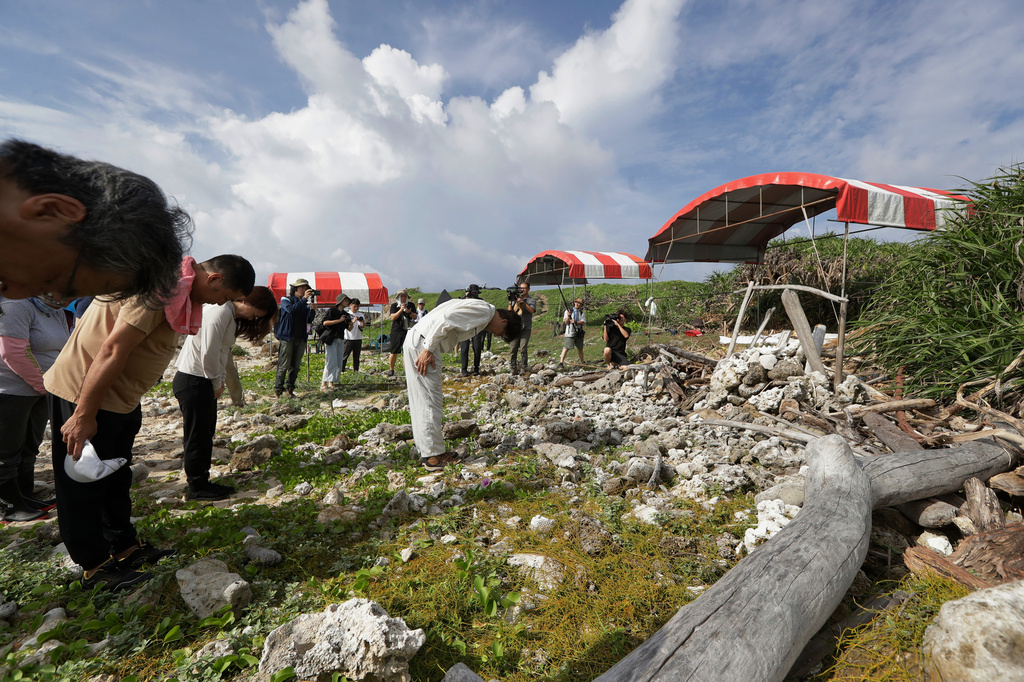
Tatsuaki Inoue, a member of the Japan Association for Recovery and Repatriation of War Casualties, leads volunteers to pay respects ahead of their excavation work to find remains of Japanese soldiers who died during WWII and washed ashore on the coastline of Hengchun township, Pingtung county, southern Taiwan, Monday, July 20, 2026. (AP Photo/Chiang Ying-ying)

Published by The Associated Press, July 2026

PINGTUNG, Taiwan (AP) – Heads bowed, experts offered their respects on Monday ahead of an excavation aimed at recovering the remains of Japanese soldiers from World War II in southern Taiwan.

The site is linked to the sinking of a military transport vessel and other ships in the Bashi Channel after they were attacked by U.S. forces in 1944. According to historian Kazuko Tachi, who is also an activist involved in the recovery efforts, more than 4,700 soldiers and crew members died while 65 survived.

Taiwan, a self-governing island claimed by China as its territory, was a Japanese colony from 1895 until the end of the war.

“It is believed that many bodies from the sunken vessel reached this shore,” said Tatsuaki Inoue, representing the Japan Association for the Recovery and Repatriation of War Casualties.

The excavation in Hengchun Township is expected to continue for a week. If any remains believed to be Japanese are found and DNA samples can be extracted, they will be sent to Japan during a future mission.

Japan enacted a law in 2016 to accelerate the recovery of war remains, an effort that has been extended through 2030 and includes expanded DNA testing.

Thousands remain missing after WWII

Official Japanese records say about 41,900 soldiers who fought for Japan during WWII died in Taiwan. Around 26,300 bodies have been recovered and 15,600 remain missing.

The last excavation in Taiwan took place in 1975, when 242 bodies were found.

“We feel very sorry that we kept them waiting for such a long time,” Inoue said. “But on the other hand, we are very happy that we came to be able to excavate in search of their remains.”

Historians, residents and Japanese volunteers living in Taiwan spent years conducting interviews and collecting historical records to establish what might have happened to those washed ashore.

They believe the bodies may have been gathered by residents and placed together in a rocky coastal area near the discharge outlet of Taiwan’s Third Nuclear Power Plant, where they may still lie.

Religious groups have played a key role

More than 2.4 million Japanese soldiers died overseas during WWII. The remains of approximately 1 million have yet to be recovered.

In response to public demand, the Japanese government implemented three plans to recover remains between the 1950s and the 1970s, said Akira Nishimura, professor of religious studies at the University of Tokyo.

“For bereaved families who have not received the remains of their loved ones, the lack of certainty regarding where and how their relatives met their end — and the feeling that they were unable to give them a proper sendoff — is likely one of the main reasons why the recovery of remains continues even 80 years later,” Nishimura said.

He added that religious organizations and volunteers have played a key role in recovering remains and holding memorial services, offering comfort to bereaved families while helping preserve the memory of those who never returned.

In Pingtung, where Monday’s excavation began, two sites honor Japan’s war dead.

A monument dedicated to the spirits of Japanese service members who perished stands beside Chaoyin Temple, where an inscription reads: “We pray for the peace of all humanity in the world.”

The temple is dedicated to those who died in the Bashi Channel during the war. Inside stands a Japanese flag beside a statue of the Buddhist Bodhisattva Ksitigarbha, who is believed to guide and protect the souls of the departed.

Many Japanese died at sea

Japan’s wartime losses were unusual in that many soldiers and sailors died at sea, leaving their remains unrecovered, said Beatrice Trefalt, associate professor of Japanese studies at Monash University in Australia.

“Because of the enormous amount of uncertainty about who died or not, or how, the search for remains has been a constant in postwar Japanese history,” Trefalt said.

She added that many families believe the government has a responsibility to acknowledge those who were conscripted and died during the conflict.

Tachi learned about the fate of the Japanese soldiers who died in the Bashi Channel only after moving to Taiwan. After locals recounted that history, she decided to get involved in recovering their remains.

“Those Taiwanese uncles taught me the importance of holding a memorial service for the war dead,” Tachi said. “It’s been more than 80 years since the war ended but I believe it is important to pray for the war dead, which I will keep on doing.”


Hernández reported from Beijing. AP journalists Mayuko Ono and Mari Yamaguchi in Tokyo contributed.


Associated Press religion coverage receives support through the AP’s collaboration with The Conversation US, with funding from Lilly Endowment Inc. The AP is solely responsible for this content.

Este Soy Yo: Luc Besson

luc_besson1

Originalmente publicado en Esquire no. 71 (PDF aquí)

DIRECTOR, GUIONISTA Y PRODUCTOR DE CINE, 55 AÑOS, PARÍS, FRANCIA

> Cuando era más joven viví en Grecia y Yugoslavia. No tenía radio, tele, cine ni nada, así que sólo me quedaba la imaginación. Jugaba con piedras, pedazos de madera y cajas viejas. No tenía juguetes. No había ninguna tienda cerca de mi casa; la más cercana estaba, quizás, a unos 500 kilómetros. Así que aprendí a usar la imaginación, y de eso se trata la ciencia ficción, pues nadie conoce el futuro.

> Desde hace algunos años, gracias al desarrollo de la tecnología, el límite de la ciencia ficción es tu imaginación. Puedes crear todo lo que quieras. Para mí ha sido una bendición.

> Mis películas se quedan conmigo cuando acabo de filmarlas, en mi cabeza no terminan. Se mantienen frescas. Es como cuando tienes un hijo de 18 años que ya se fue de tu casa, pero como padre te niegas a aceptarlo.

> Terminar una película me deja exhausto. Para volver a tener energía intento irme tan lejos como puedo y apartarme de los humanos durante un rato. Veo a mis amigos, los delfines, y pasó una buena temporada con ellos, que siempre me enseñan lo que realmente importa en la vida [ríe].

> Me encanta escribir. Así ha sido desde que tenía 16 años. Escribir es mi gimnasio. Me levanto todas las mañanas y escribo sin importar lo que suceda. Me gusta porque me hace sentir pleno. Es como liberarme. Prefiero escribir que dirigir, pero cuando me emociono con un guión entonces soy muy feliz de salir a trabajar todos los días.

> Me gusta cuando la gente empieza a hablar de alguna de mis películas pero se olvida de que yo la hice. Por ejemplo, una vez alguien me dijo: “Tienes que ver esta película porque tal tipo hace tal cosa”, y esa persona se olvidó de que estaba hablando con quien la hizo [ríe]. Fue muy gracioso. Me ha pasado dos veces y ha sido mi cumplido favorito.

> La mayor parte del tiempo me desprendo de mis películas, permito que le pertenezcan al público y las veo después de un par de años. Por ejemplo, ahora creo que ya soy mayor de edad y ya puedo ver The Professional [película con Jean Reno y Natalie Portman que escribió y dirigió en 1994].

> Lucy fue una película muy difícil. Parecía un rompecabezas y es la primera vez que veo a mi equipo tan perdido. Me veían como si estuviera loco, me decían: “Ok, como tú digas”. Fue como una gran partida de ajedrez. Me arriesgué mucho y confié en la gente que me ayudó con los efectos especiales porque con estos nunca se sabe si el resultado será lo que tienes en mente, y no puedes ver nada sino hasta nueve meses después. Al final, disfruté mucho hablar de inteligencia, de capacidad cerebral, de lo que se oculta detrás del universo. Fue fascinante.

> Los personajes femeninos no me interesan más que los
masculinos.
Hombres y mujeres me importan igual, pero lo que me atrajo mucho de Lucy —quizá por primera vez en mi carrera— es que era una mujer normal que no sabía qué hacer con su vida, que se iba demasiado de fiesta y tenía un novio. Así que es una chica promedio, no hay nada particular en ella.

> Con Lucy me distancié de lo que suelo hacer porque obviamente Juana de Arco [The Messenger: The Story of Joan of Arc, 1999] fue muy diferente, así como Nikita [La Femme Nikita, 1991] y Aung San Suu Kyi [The Lady, 2011], que son personajes muy fuertes. Lucy [Scarlett Johansson en la película homónima] no pudo haber sido hombre. Quise que fuera mujer porque así su situación sería peor, estaría en desventaja incluso física. Quería que fuera normal al inicio de la historia.

> El proyecto comenzó cuando conocí a una profesora que realizaba estudios sobre células y cáncer. Tuvimos una conversación fascinante durante un par de horas y empecé a sentirme atraído por la inteligencia y el cerebro. Luego descubrí que el cerebro de la verdadera Lucy —el ancestro histórico que vemos al principio de la película— pesaba 400 gramos y que el que tienen los humanos de nuestros días pesa un kilo más. Eso quiere decir que aumentó un kilo en tres millones de años, ¡no es nada! Y sólo usamos el 10 por ciento de nuestra capacidad cerebral, pero es impresionante lo que hemos logrado con ello.

> No suelo arrepentirme de nada. Hoy puedo afirmar que filmas las películas de tus tiempos. Es decir, cuando tienes 25 años —hice Subway en 1985— es imposible desear hacer la película que haría un hombre de 40. Lo que uno sabe de la vida a esa edad tiene que ver quizá con una o dos aventuras sexuales, nada de hijos, y ves la vida de cierta manera, así que creas películas de acuerdo a ello. Creo que es bueno que a los 20 filmes algo según tu edad y que cuando cumples 50 —como es mi caso— te dediques a hacer películas en las que hables de filosofía y menosprecio.

> Nunca he hablado de retirarme. Alguna vez dije que quería dejar de dirigir en cierta etapa de mi vida, porque dirigir es exhaustivo. Cuando era joven y tenía 16 o 17 años, conocí a un tipo que me dijo algo muy sabio: “Si no tienes nada que decir, mejor cállate”. Así que si no tengo nada que decir, si no tengo una película que en verdad me haga pensar “quiero hacerla y vivir con ella”, entonces no la filmaré.

Foto: theplace2.ru

Nota: Lucy, de Luc Besson, se estrena el 28 de agosto. Narra la historia de una mujer (Scarlett Johansson) que vive en Taiwan y es secuestrada para transportar una bolsa de droga que le introducen en el intestino. Tras una golpiza, el polvo se derrama y su inteligencia se potencializa.