How Orthodox Jewish families are finding ways to support their trans children

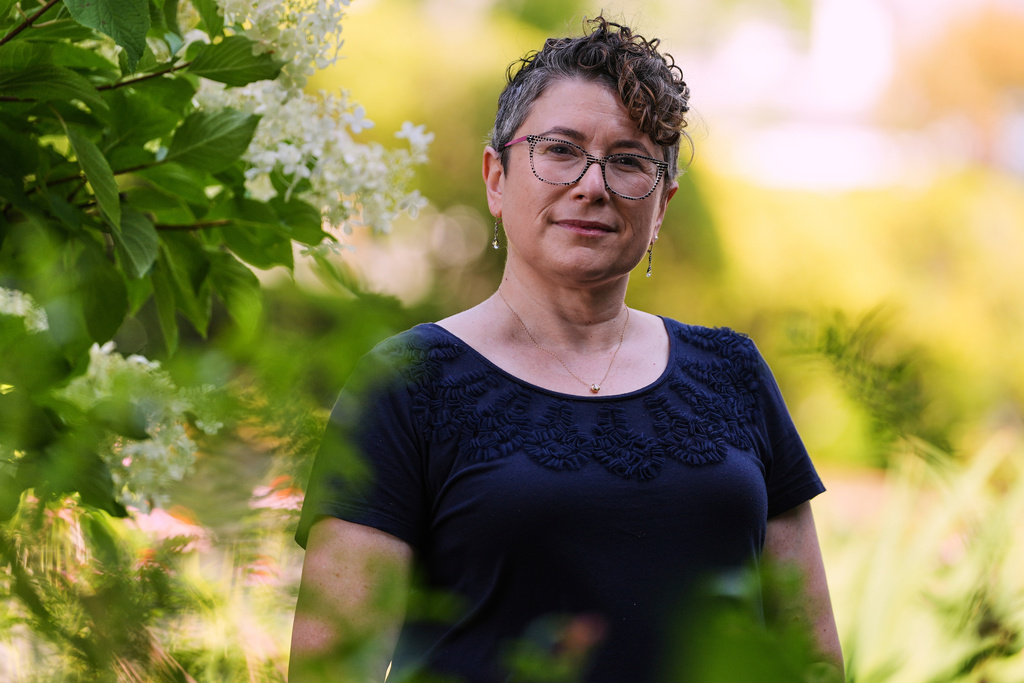
Ziva Mann, mother of a transgender child and member of a welcoming synagogue, poses in her garden, Wednesday, Aug. 13, 2025, in Newton, Mass. (AP Photo/Charles Krupa)

Published by The Associated Press, August 2025

Spanish story language here

Ziva Mann remembers how joyful and smiley her daughter was as a child — the family even gave her the nickname “Giggles.”

“She was just sunshine,” Mann said. That changed around second grade, when her joy began to fade. “She got sadder and sadder,” Mann recalled. “It was like watching someone disappear.”

Mann later realized that her child’s growing sadness was connected to a struggle to reckon with her gender identity

Her daughter came out as transgender at home in Massachusetts four years ago. “Mom, I’m a girl,” Mann remembers hearing her say. Though she was surprised by the news, she quickly came to admire her daughter’s bravery.

Since then, the family has striven to find the best ways to support Ellie within their modern Orthodox community, where tradition and strict gender roles shape daily life. They’ve managed to find emotional and spiritual resources close to home at a time when transgender rights are under attack nationwide.

Raising a trans child in Orthodox Jewish communities

Two of the three biggest branches of Judaism in the U.S. — Reform and Conservative — support the rights of transgender people, but it can still be challenging for trans youth to find an inclusive congregation. 

Schools in Orthodox Jewish communities are typically divided by gender, and most synagogues have separate seating sections for men and women — sometimes on different floors.

“Orthodoxy today is just binary,” said Myriam Kabakov, co-founder and executive director of Eshel, an organization supporting LGBTQ+ people in Orthodox environments. “You’re either male or you’re female. So if a trans person is in between transitioning, very often they will be asked not to come to synagogue.”

She said even after someone has fully transitioned, rabbis should allow them to sit where they feel comfortable. But that acceptance is not guaranteed.

To connect parents and trans children with inclusive synagogues, Eshel developed a program called “Welcoming Shuls,” where people can confide in spiritual leaders who will treat them with respect. 

According to Kabakov, about 300 rabbis and 160 families with trans members have joined their listings. Deslie Paneth is among them. She lives on Long Island and has traveled far to find support for Ollie, her transgender son. 

“One night, I said to my husband ‘I need help, I don’t know how to navigate this,’” Paneth said. “Without Eshel, I don’t know how this would have turned out for any of us.”

Balancing tradition and change

Mann defines herself as modern Orthodox, meaning she strives to uphold Judaic law while embracing the values within her family.

“The only time we break the rules is to save someone’s life,” she said. “Because a life is more important than all of the rules.”

Respecting her daughter’s identity felt akin to saving her life, so Mann didn’t feel the need to talk to God about it. She said who her daughter is as a person mattered more than the gender she thought she had.

Mann has heard of families with trans children who were asked to leave their synagogue, but this didn’t happened to her. Before discussing Ellie’s identity with other relatives, Mann reached out to her rabbi. He assured her that her daughter would be treated with dignity and respect.

“He offered us a blessing,” Mann said. “The strength, the love and the grace to parent a child who’s walking a difficult path.”

Finding a place to belong

Mann feels lucky to have found support, both in religious spaces and among family members, which has helped Ellie be her joyful self again. Some Orthodox families have faced a tougher process.

Paneth recalled her son, before starting his transition around 2017, was deeply religious and they enjoyed sitting together at synagogue. 

“He tells me still today that, especially around the holiday times, it hurts him that he can’t sit next to me in temple,” Paneth said. “He’s probably my child that has the strongest commitment to Judaism from an emotional connection.»

A rabbi told Paneth that Ollie is welcome to come to services, but he would now be expected to sit among the men. This is part of the reason why Ollie has not returned to synagogue since his transition.

Faith and identity at a crossroads

Ollie believes that his relationship with religion splintered as a student in an all-girls Orthodox Jewish high school. As he started raising questions about gender equality, none of the answers sufficed.

“I’m still convinced that if I wasn’t trans, I would still be a religious Jew,” the 27-year-old said.

He initially told his parents he was a lesbian. But since attending a secular college, making LGBTQ+ friends and feeling trapped during the pandemic, he decided to speak with them again. “If I was going to survive this, I had to come out with my parents as trans and start medically transitioning.” 

He had top surgery in 2022 and soon after met his girlfriend at JQY, a program for Jewish LGBTQ+ teens. The couple now lives together in New York.

Ollie doesn’t think of himself as Orthodox, and says he would like to find a new path toward God. Paneth understands and still includes him in the Jewish holidays. Ollie appreciates it.

Because he first connected to God as a girl, it doesn’t feel natural to him to embrace traditions that are typical for Jewish men, like wearing a kippah.

“I don’t do any of the tasks that men do religiously because I’m the same person I always was,” he said. “Even though I look different, my relationship to God didn’t change.”

Making synagogues more inclusive

Kabakov said many LGBTQ+ Jews eventually decide to leave Orthodoxy, but for those who wish to remain, Eshel and some spiritual leaders offer support.

Rabbi Mike Moskowitz, who works at an LGBTQ+ synagogue in New York, thinks of his job as helping people understand how they can be their authentic selves and still feel accepted by their religion. “It’s not that Judaism is the problem,” he said. “Orthodoxy, the people, are the problem.”

The counseling he provides for trans children and their parents is specific to each person, but in general, he offers fresh interpretations of the Hebrew Bible.

“Those who want to be transphobic say the Bible says you can’t wear misgendered clothing,” Moskowitz said. “I think a response is that trans folks are not wearing misgendered clothing. They’re wearing gender-affirming clothing.”

He, like Kabakov, believes there’s a trend in Orthodoxy toward more inclusivity, but there’s more work to do.

“Discrimination is unholy,” he said. “Unity is coping through kindness and being able to replace the weight of oppression with the elevation of love.”

____

Associated Press religion coverage receives support through the AP’s collaboration with The Conversation US, with funding from Lilly Endowment Inc. The AP is solely responsible for this content.

How one man’s dream led to 50,000 pilgrims honoring Our Lady of Copacabana in Bolivia

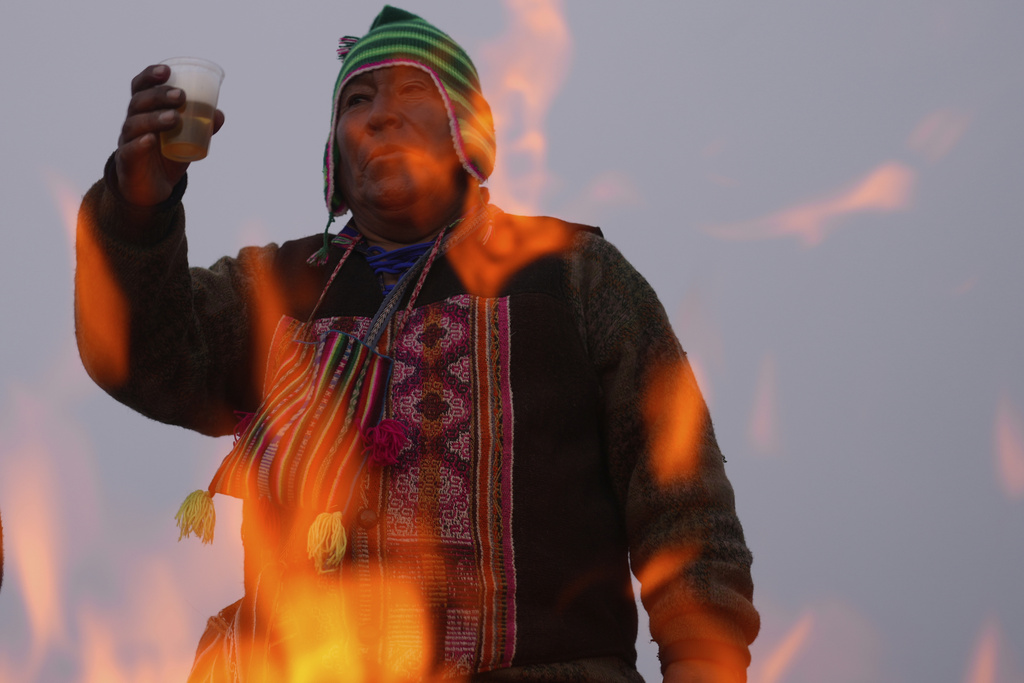
A man is silhouetted against a burst of fireworks during celebrations honoring Bolivia’s patron saint, the Virgin of Copacabana, in Copacabana, Bolivia, Monday, Aug. 4, 2025. (AP Photo/Juan Karita)

Published by The Associated Press, August 2025

Spanish story language here

More than 50,000 people from Bolivia and neighboring Peru make a pilgrimage every August to Copacabana, on the shores of Lake Titicaca, to honor Bolivia’s patron saint, Our Lady of Copacabana. In the main event of the celebration, a replica of the wooden-carved figure of the Virgin Mary leads a procession.

Her official feast is Feb. 2 — coinciding with Candlemas — but Aug. 5 marks the anniversary of her canonical coronation as the patron saint of Bolivia by a papal bull issued by Pius XII in 1925. This year is the 100th anniversary.

“She has granted me various miracles,” said Elizabet Valdivia, who traveled 12 hours by road and boat from the Peruvian city of Arequipa to join the procession. “She gave us our car, the possibility of raising my son, and I always ask her to watch over our jobs.”

The birth of a sacred icon

Our Lady of Copacabana’s basilica has safeguarded this Virgin Mary figure since the late 16th century. Her history dates back to 1583, when Inca descendant Francisco Tito Yupanqui crafted a figure in her honor.

According to Marcela Cruz, a guide at the museum next to the basilica, Yupanqui had a dream about the Virgin and molded a clay figure to depict her. He showed it to the chaplain, but after being rejected and mocked, he went for a walk by the lake.

“There, he encountered the image of the Virgin as an Inca maiden,” Cruz said. “That’s why her image is so simple.”

Inspired by the apparition, Yupanqui set off for the city of Potosí, about 330 miles (530 kilometers) from La Paz, the current capital city. There, he carved the image that is now revered in the basilica from a maguey tree trunk.

When Yupanqui traveled back to Copacabana, the town was under Spanish occupation, and both the Aymara and Quechua Indigenous people — now nationals from Bolivia and Peru — were at the site for evangelization purposes.  

“She arrived at dawn on Feb. 2, and both the Aymara and the Incas bowed down to welcome her,” Cruz said.

A shrine of faith, gratitude and generations of prayer

The museum named after Yupanqui displays hundreds of gifts that devotees have presented over the centuries. These include capes embroidered with gold thread, votive offerings, letters in braille and silver crowns resembling those Simón Bolívar melted down to secure Bolivian independence in 1825.

“Our Lady of Copacabana is the mother who welcomes all of her children regardless of their race or culture,” said Itamar Pesoa, a Franciscan friar residing at the convent adjacent to the basilica. “Within Bolivia, she is the queen.”

According to Pesoa, pilgrims travel from all over South America to present her with offerings. Some women who were unable to have children thank her for enabling them to become mothers. Others praise her for helping them recover from serious illnesses.

Several Masses in her honor are celebrated daily starting Aug. 4.

“This devotion continues to be passed down from generation to generation and inspires many to follow Christ,” Pesoa said.

Yupanqui’s original figure has not left the basilica for a procession since her coronation in 1925, but devotees revere her replicas nonetheless.

In a nearby chapel, parishioners light candles — one per miracle requested — and patiently wait for them to burn out before leaving. 

Sandra Benavides, who traveled from the Peruvian city of Cuzco, lit a candle and prayed for good health. She said some years ago she fell and the accident nearly killed her, but the Virgin interceded.

“Our Lady of Copacabana is miraculous,” Benavides said. “She is as if she were my mother, whom I have never had.”

____

Associated Press religion coverage receives support through the AP’s collaboration with The Conversation US, with funding from Lilly Endowment Inc. The AP is solely responsible for this content.
Burnt offerings, whispering to mountains: Inside Bolivians’ rituals for Mother Earth

Spiritual leader Eusebio Huanca burns offerings observing the month of Pachamama, or Mother Earth, performing an ancient tradition to ask for a good harvest, on La Cumbre, a mountain considered sacred on the outskirts of La Paz, Bolivia, Friday, Aug. 1, 2025. (AP Photo/Juan Karita)

Published by The Associated Press, August 2025

Spanish story language here

Neyza Hurtado was 3 years old when she was struck by lightning. Forty years later, sitting next to a bonfire on a 13,700-foot (4,175-meter) mountain, her scarred forehead makes her proud.

“I am the lightning,” she said. “When it hit me, I became wise and a seer. That’s what we masters are.”

Hundreds of people in Bolivia hire Andean spiritual guides like Hurtado to perform rituals every August, the month of “Pachamama,” or Mother Earth, according to the worldview of the Aymara, an Indigenous people of the region.

Pachamama’s devotees believe that she awakens hungry and thirsty after the dry season. To honor her and express gratitude for her blessings, they make offerings at home, in their crop fields and on the peaks of Bolivian mountains.

“We come here every August to follow in the footsteps of our elders,” said Santos Monasterios, who hired Hurtado for a Pachamama ritual on a site called La Cumbre, about 8 miles (13 kilometers) from the capital city of La Paz. “We ask for good health and work.”

Honoring Mother Earth

Offerings made to Pachamama are known as “mesitas” (or “little tables”). Depending on each family’s wishes, masters like Hurtado prepare one mesita per family or per person.

Mesitas are made of wooden logs. On top of them, each master places sweets, grains, coca leaves and small objects representing wealth, protection and good health. Occasionally, llama or piglet fetuses are also offered.

Once the mesita is ready, the spiritual guide sets it on fire and devotees douse their offerings with wine or beer, to quench Pachamama’s thirst.

“When you make this ritual, you feel relieved,” Monasterios said. “I believe in this, so I will keep sharing a drink with Pachamama.”

It can take up to three hours for a mesita to burn. Once the offerings have turned to ash, the devotees gather and solemnly bury the remains to become one with Mother Earth.

Why Bolivians make offerings to Pachamama

Carla Chumacero, who travelled to La Cumbre last week with her parents and a sister, requested four mesitas from her longtime spiritual guide.

“Mother Earth demands this from us, so we provide,” the 28-year-old said.

According to Chumacero, how they become aware of Pachamama’s needs is hard to explain. “We just know it; it’s a feeling,” she said. “Many people go through a lot — accidents, trouble within families — and that’s when we realize that we need to present her with something, because she has given us so much and she can take it back.”

María Ceballos, 34, did not inherit her devotion from her family, but from co-workers at the gold mine where she earns a living.

“We make offerings because our work is risky,” Ceballos said. “We use heavy machinery and we travel often, so we entrust ourselves to Pachamama.”

A ritual rooted in time and climate

The exact origin of the Pachamama rituals is difficult to determine, but according to Bolivian anthropologist Milton Eyzaguirre, they are an ancestral tradition dating back to 6,000 B.C.

As the first South American settlers came into the region, they faced soil and climate conditions that differed from those in the northernmost parts of the planet, where winter begins in December. In Bolivia, as in other Southern Hemisphere countries, winter runs from June to September.

“Here, the cold weather is rather dry,” Eyzaguirre said. “Based on that, there is a particular behavior in relation to Pachamama.”

Mother Earth is believed to be asleep throughout August. Her devotees wish for her to regain her strength and bolster their sowing, which usually begins in October and November. A few months later, when the crops are harvested in February, further rituals are performed.

“These dates are key because it’s when the relationship between humans and Pachamama is reactivated,” Eyzaguirre said.

“Elsewhere it might be believed that the land is a consumer good,” he added. “But here there’s an equilibrium: You have to treat Pachamama because she will provide for you.”

Bolivians’ connection to their land

August rituals honor not only Pachamama, but also the mountains or “apus,” considered protective spirits for the Aymara and Quechua people.

“Under the Andean perspective, all elements of nature have a soul,” Eyzaguirre said. “We call that ‘Ajayu,’ which means they have a spiritual component.”

For many Bolivians, wind, fire, and water are considered spirits, and the apus are perceived as ancestors. This is why many cemeteries are located in the highlands and why Pachamama rituals are performed at sites like La Cumbre.

“The apus protect us and keep an eye on us,” said Rosendo Choque, who has been a spiritual guide or “yatiri” for 40 years.

He, like Hurtado, said that only a few select people can do they job. Before becoming masters, it is essential that they acquire special skills and ask Pachamama’s permission to perform rituals in her honor.

“I acquired my knowledge little by little,” Choque said. “But I now have the permission to do this job and coca leaves speak to me.”

Hurtado said she mostly inherited her knowledge from her grandmother, who was also a yatiri and witnessed how she survived the lightning strike.

“For me, she is the holiest person, the one who made me what I am,” Hurtado said.

She said she finds comfort in helping her clients secure a good future, but her close relationship with Pachamama brings her the deepest joy.

“We respect her because she is Mother Earth,” Hurtado said. “We live in her.”

____

Associated Press religion coverage receives support through the AP’s collaboration with The Conversation US, with funding from Lilly Endowment Inc. The AP is solely responsible for this content.
Despite rainy weather, Catholics in a Paraguayan town dress as birds to honor their patron saint

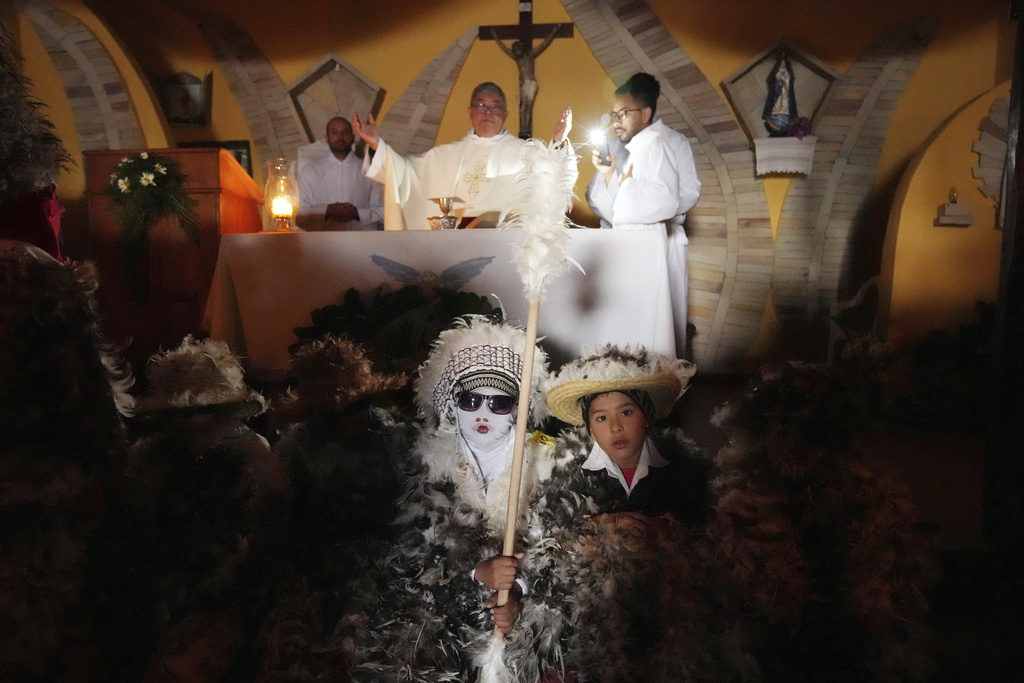
Children dressed in feather costumes attend a Mass celebrating Saint Francisco Solano at his namesake chapel in Emboscada, Paraguay, Thursday, July 24, 2025. Catholic parishioners in Paraguay don bird-like costumes and parade the streets to honor the 16th century saint said to possess miraculous powers. (AP Photo/Jorge Saenz)

Published by The Associated Press, July 2025

Spanish story language here

EMBOSCADA, Paraguay (AP) The rainy weather did not prevent Blanca Servín from dressing her 7-year-old son like a bird. They joined a procession honoring St. Francis Solanus, the patron saint of a town in Paraguay about 20 miles (32 kilometers) from the capital city of Asunción.

Like her child, dozens of Catholics in Emboscada wear elaborate feathered garments each July 24. Dressing up is a ritual aimed at fulfilling promises made to the Spanish friar, who was a missionary in South America during the 16th century and is believed to grant miracles.

“I couldn’t have children,” Servín said. “I underwent several treatments and when I finally got pregnant and my child was born, the doctors said he would barely live for a few days.”

She then prayed to St. Francis Solanus and made a promise many parishioners make: If you do this for me, I will honor you on your feast day for seven years.

“My son is almost 7, and I have kept my promise,” Servín said. “But we will keep coming.”

Dressing in feathers

Participants dressing up in feather garments are known as “promisers.” As part of the rituals, they cover their faces, imitate birds and distort their voices when speaking.

Marcos Villalba said he spent three months crafting his costume. He worked on it every other day and said his father and brothers have also been long-time promisers.

Sulma Villalba — not related to Marcos — devoted six months to the task. Rather than wearing a costume herself, she patiently glued hundreds feathers to her children’s and husband’s clothing. Like Servín, she has already fulfilled the promise she made to St. Francis to protect her family, but she said they still honor him because it has become a tradition they enjoy.

A missionary to Indigenous people

According to Ireneo López, a layperson in charge of recreational activities at the Emboscada parish, St. Francis is remembered as a missionary who evangelized the Indigenous people through music. The first church in his honor was erected in the 1930s. As parishioners increased, a new building was built later.

López said that participants use up to 30 hens, guinea fowls and geese to craft their costumes. 

“These garments represent what people used to wear in ancient times,” he added. “Gala suits were made with what nature provided: birds.”

Jessica López, who attended the festival with her two children and a niece, said she gathered feathers for months. Before crafting the costumes a week ago, her family enjoyed a banquet with a hen they specifically picked for the occasion.

She, too, asked St. Francis for good health, but said parishioners request all sorts of miracles. About 2,500 area residents join the feast every year.

Processions and dances honoring St. Francis start on July 22. The night before the feast day, a local family takes home a wooden figure depicting the friar in order to decorate it for the festivities. 

On July 24, promisers and parishioners attend Mass at the St. Francis chapel, then lead a procession and end up dancing in front of the church.

A tale of land and dispute

According to historian Ana Barreto, the ancient context of the feast is as fascinating as the feast itself. It is celebrated in a territory that was disputed by two Indigenous people — the Guaraní and the Chacoan — before the Spaniards came in the 16th century.

The Europeans eventually subdued the Guaraní, but the Chacoan kept defending the land even after descendants of formerly enslaved people from Africa settled there. 

“The Indigenous people sought to steal young women, take weapons and other valuable objects, and set the ranches on fire,” Barreto said.

Not all current participants in the St. Francis feast are aware of this, but their costumes and celebrations are a remembrance of this historic episode.

According to Barreto, the Guaraní name of the event, “Guaykurú Ñemondé,” translates as “dressing like a barbarian.” Thus Guaraní participants are dressing as their ancestral enemies. 

The reason might be hidden in an ancient Guaraní rite. After battling the Chacoan, the Guaraní people kept their prisoners alive. They provided them with food and energizing drinks, and encouraged them to have sex with their women. Afterwards, they killed the prisoners and cooked them, serving them as a meal at a community banquet.

“In this way, the enemy strengthened the Guaraní,” Barreto said.

____

Associated Press religion coverage receives support through the AP’s collaboration with The Conversation US, with funding from Lilly Endowment Inc. The AP is solely responsible for this content.

Renowned Mexico City restaurant serves traditional street food and nostalgia of the homeland

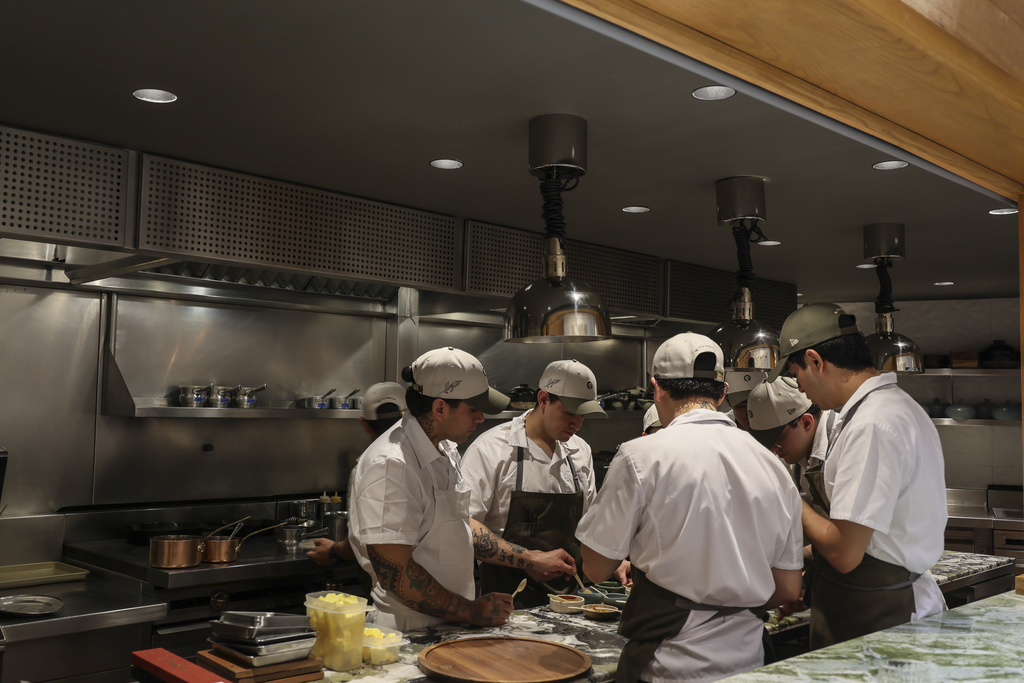
Quintonil’s team of chefs test sauces for the menu at the restaurant in Mexico City, Friday, Feb. 28, 2025. (AP Photo/Ginnette Riquelme)

Published by The Associated Press, March 2025 (link aquí)

Spanish story language here

MEXICO CITY (AP) – Quintonil is not your typical Mexican restaurant.

Clients book tables months in advance to celebrate special occasions. The World’s 50 Best list ranked it as the most acclaimed venue in the country in 2024 — and No. 7 worldwide. But once in a while something unexpected happens: food brings guests to tears.

“We have hosted people who have wept over a tamale,” said chef Jorge Vallejo, who founded Quintonil in Mexico City in March 2012.

He intentionally chose traditional street food for the menu — insects and other pre-Hispanic delicacies included. Priced at 4,950 pesos ($250 US) per person, it evokes the nostalgia of home and the history of the homeland.

The tamale — which translates from the Nahuatl language as “wrapped” — is a Mesoamerican delicacy made of steamed corn dough. It can be filled with savory or sweet ingredients — such as pork meat and pineapple — and topped with sauce.

Official records show that around 500 varieties of tamales can be found in Mexico. And according to a publication of Samuel Villela, ethnologist from the National School of Anthropology and History, Nahua communities used them for ritual purposes.

Most of Vallejo’s clientele are foreigners attracted by the two Michelin stars awarded to Quintonil last year. Others are nationals who spent decades living abroad or Americans of Mexican descent in search of a taste from their ancestry.

“They come to visit their families and feel shaken by the flavors that remind them who they are,” the chef said. “It’s like coming back to their roots.”

Providing that experience is what motivated him to open Quintonil 13 years ago. He first thought of his 11-table restaurant as a “fonda,” as Mexicans call popular food venues offering homemade dishes.

“I didn’t think I would own a restaurant like Quintonil nor did I aspire to that,” Vallejo said. “What I’ve tried to do is to learn from Mexico and show the best of it.” 

He took his first job in a place resembling a fonda, where he and his mom used to have lunch. He then studied culinary arts.

For a while, he worked on a cruise line, peeling crabs and coordinating the logistics to feed thousands of clients. Back in Mexico, he met his wife and business partner at Pujol, run by famed chef Enrique Olvera. They founded Quintonil a few years later and their mission has not changed: We’ll tell our country’s tales through food. 

“We all have a life story,” Vallejo said. “I try to interpret that and transform it into stories we can share at Quintonil.”

Traveling is part of his routine. He meets with colleagues to exchange anecdotes and contacts, but also encounters local farmers and spends time in remote communities to understand how food and tradition intertwine.

“In Mexico, we have ecosystems and ingredients that don’t exist anywhere else,” Vallejo said. “And our recipes, our traditions, are deeply rooted in society.”

His menu at Quintonil often incorporates insects, treasured since pre-Hispanic times.

Ancient documents describe how the Mexica were once established in the Chapultepec Hill. Its name comes from “chapulín,” a type of grasshopper that Mexicans currently enjoy from street vendors or at popular bars known as “cantinas.”

“In Mexico City, we have ‘escamoles’ season,” Vallejo said, referring to an edible larvae the Aztec people ate. “But in Oaxaca, we can find the ‘chicatana’ ants. In Tlaxcala, ‘cocopaches’ (a leaf-footed bug) and in Guerrero, they have insects of their own.” 

Alexandra Bretón, a food enthusiast who has visited Quintonil several times and reviews restaurants in her blog “Chilangas Hambrientas,” feels that Vallejo’s contribution to Mexican gastronomy is invaluable.

“He has elevated Mexican ingredients,” Bretón said. “My memories of Quintonil are of dishes where herbs, insects and vegetables are taken seriously in dishes with great technique.”

During her last visit in February, she tasted a delicious tamale filled with duck. Her second favorite was a taco, which can be found at thousands of food spots, but Vallejo somehow transforms into an experience.

“What we do here are not just beautiful plates,” said Geraldine Rodríguez, Quintonil’s sous chef. “We aim to nourish people, to show what Mexico is.”

There was a time, she said, when fine dining was synonymous of foie gras and lobster. But Quintonil chose another path.

“We have an ancestral cuisine that comes from our grandmothers,” Rodríguez said. “So we respect those recipes and add the chef’s touch.”

The taco experience highlighted by Bretón is among those efforts. Several ingredients — insects, for instance — are offered in plates for clients to wrap in tortillas.

“Through that interaction, that ritual that we Mexicans own, we watch clients wondering if they’re grabbing the taco in a proper way,” Rodríguez said. “But we always tell them we just want them to feel at home.”

Working long shifts and aiming for perfection is not an easy task for the 60 people working at Quintonil.

Rodríguez can spend up to four hours selecting a handful of sprouts to decorate a plate. Other near-invisible, almost ritualistic tasks are performed daily. One of them is brushing the “milpa,” a textile that hangs from the terrace and was named after Mesoamerican fields where crops are grown.

In the end it’s all worth it, Rodríguez said, because Quintonil provides clients with moments that evoke special memories.

She, too, has seen Vallejo’s clients cry over food. One of them was her dad. It was his 50th birthday, she said, and while she was not an employee of Quintonil at the time, Vallejo greeted her warmly.

The menu of the day included “huauzontles,» a green plant commonly cooked as a bun-shaped delicacy dipped in sauce. It also bears history, as Aztec communities ate it and used it to perform religious rites.

Quintonil’s recipe added stir-fry tomato and a local cheese. “When he ate it, he started crying and said they reminded him of my grandma,” Rodríguez said. “I had never seen my dad cry over a plate.”

Vallejo has often expressed joy for the recognition that Quintonil has achieved. But in his view, a chef’s true success is measured by what he make his clients feel.

“Mexican cuisine is a connection to the land, to the ingredients,” he said. “It’s a series of elements that produce not an emotion, but a feeling. And for me, there’s nothing more amazing than provoking that.”

____

Associated Press religion coverage receives support through the AP’s collaboration with The Conversation US, with funding from Lilly Endowment Inc. The AP is solely responsible for this content.
Ancient deity, pet and endangered species. Why is axolotl Mexico’s most beloved amphibian?

An axolotl swims in an aquarium at a museum in Xochimilco Ecological Park in Mexico City, Tuesday, Feb. 11, 2025. (AP Photo/Marco Ugarte)

Published by The Associated Press, February 2025 (link aquí)

Spanish story language here

MEXICO CITY (AP) – Legend has it the axolotl was not always an amphibian. Long before it became Mexico’s most beloved salamander and efforts to prevent its extinction flourished, it was a sneaky god.

“It’s an interesting little animal,” said Yanet Cruz, head of the Chinampaxóchitl Museum in Mexico City.

Its exhibitions focus on axolotl and chinampas, the pre-Hispanic agricultural systems resembling floating gardens that still function in Xochimilco, a neighborhood on Mexico City’s outskirts famed for its canals.

“Despite there being many varieties, the axolotl from the area is a symbol of identity for the native people,” said Cruz, who participated in activities hosted at the museum to celebrate “Axolotl Day” in early February.

While there are no official estimates of the current axolotl population, the species Ambystoma mexicanum — endemic of central Mexico— has been catalogued as “critically endangered” by the IUCN Red List of Threatened Species since 2019. And though biologists, historians and officials have led efforts to save the species and its habitat from extinction, a parallel, unexpected preservation phenomenon has emerged.

Axolotl attracted international attention after Minecraft added them to its game in 2021 and Mexicans went crazy about them that same year, following the Central Bank’s initiative to print it on the 50-peso bill. “That’s when the ‘axolotlmania’ thrived,” Cruz said.

All over Mexico, the peculiar, dragon-like amphibian can be spotted in murals, crafts and socks. Selected bakeries have caused a sensation with its axolotl-like bites. Even a local brewery — “Ajolote” in Spanish — took its name from the salamander to honor Mexican traditions.

Before the Spaniards conquered Mexico-Tenochtitlan in the 16th century, axolotl may not have had archeological representations as did Tláloc — god of rain in the Aztec worldview — or Coyolxauhqui — its lunar goddess — but it did appear in ancient Mesoamerican documents.

In the Nahua myth of the Fifth Sun, pre-Hispanic god Nanahuatzin threw himself into a fire, reemerged as the sun and commanded fellow gods to replicate his sacrifice to bring movement to the world. All complied but Xólotl, a deity associated with the evening star, who fled.

“He was hunted down and killed,” said Arturo Montero, archeologist of the National Commission of Protected Natural Areas. “And from his death came a creature: axolotl.”

According to Montero, the myth implies that, after a god’s passing, its essence gets imprisoned in a mundane creature, subject to the cycles of life and death. Axolotl then carries within itself the Xolotl deity, and when the animal dies and its divine substance transits to the underworld, it later resurfaces to the earth and a new axolotl is born.

“Axolotl is the twin of maize, agave and water,” Montero said.

Current fascination toward axolotl and its rise to sacred status in pre-Hispanic times is hardly a coincidence. It was most likely sparked by its exceptional biological features, Montero said.

Through the glass of a fish tank, where academic institutions preserve them and hatcheries put them up for sale, axolotl are hard to spot. Their skin is usually dark to mimic stones — though an albino, pinkish variety can be bred — and they can stay still for hours, buried in the muddy ground of their natural habitats or barely moving at the bottom of their tanks in captivity.

Aside from their lungs, they breathe through their gills and skin, which allows them to adapt to its aquatic environment. And they can regenerate parts of its heart, spinal cord and brain.

“This species is quite peculiar,” said biologist Arturo Vergara, who supervises axolotl preservation efforts in various institutions and cares after specimens for sale at a hatchery in Mexico City.

Depending on the species, color and size, Axolotl’s prices at Ambystomania — where Vergara works — start at 200 pesos ($10 US). Specimens are available for sale when they reach four inches in length and are easy pets to look after, Vergara said.

“While they regularly have a 15-years life span (in captivity), we’ve had animals that have lived up to 20,” he added. “They are very long-lived, though in their natural habitat they probably wouldn’t last more than three or four years.”

The species on display at the museum — one of 17 known varieties in Mexico — is endemic to lakes and canals that are currently polluted. A healthy population of axolotl would likely struggle to feed or reproduce.

“Just imagine the bottom of a canal in areas like Xochimilco, Tlahuac, Chalco, where there’s an enormous quantity of microbes,” Vergara said.

Under ideal conditions, an axolotl could heal itself from snake or heron biting and survive the dry season buried in the mud. But a proper aquatic environment is needed for that to happen.

“Efforts to preserve axolotl go hand in hand with preserving the chinampas,” Cruz said at the museum, next to a display featuring salamander-shaped dolls. “We work closely with the community to convince them that this is an important space.”

Chinampas are not only where axolotl lay its eggs, but areas where pre-Hispanic communities grew maize, chili, beans and zucchini, and some of Xochimilco’s current population grow vegetables despite environmental threats.

“Many chinampas are dry and don’t produce food anymore,” Cruz said. “And where some chinampas used to be, one can now see soccer camps.”

For her, like for Vergara, preserving axolotl is not an end, but a means for saving the place where the amphibian came to be.

“This great system (chinampas) is all that’s left from the lake city of Mexico-Tenochtitlan, so I always tell our visitors that Xochimilco is a living archeological zone,” Cruz said. “If we, as citizens, don’t take care of what’s ours, it will be lost.”

—-

Associated Press religion coverage receives support through the AP’s collaboration with The Conversation US, with funding from Lilly Endowment Inc. The AP is solely responsible for this content.
Blessings for dogs? Bring them to Mexico City’s cathedral and St. Anthony will do the rest

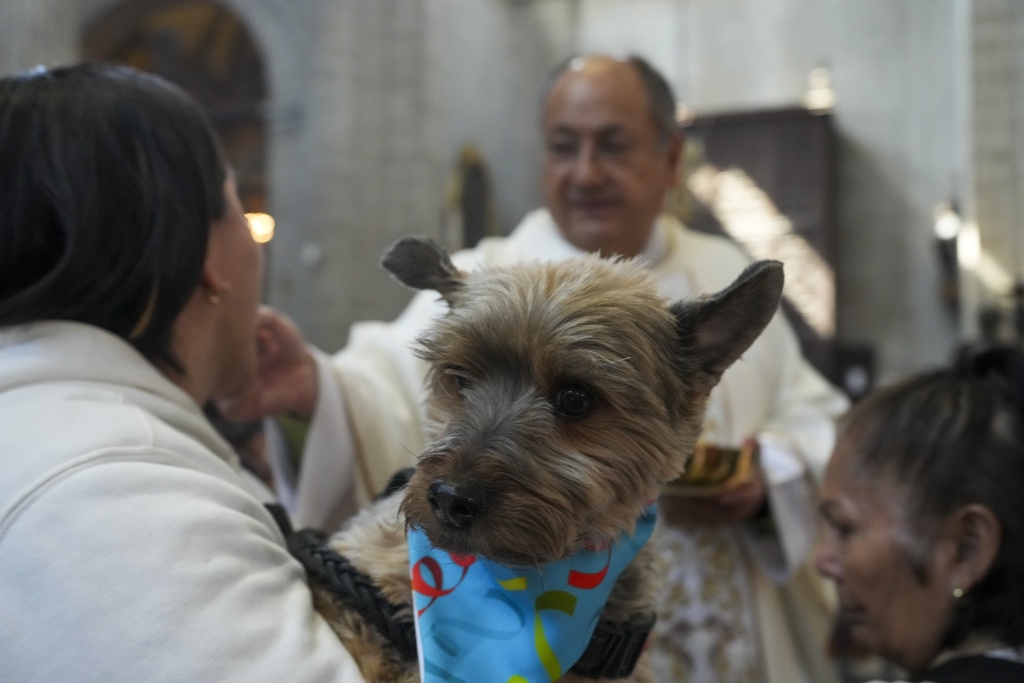
Gabriela Viquez holds onto her black and tan Yorkie Jerome, as she receives communion during the annual blessing of the animals Mass in Mexico City’s Metropolitan Cathedral, Friday, Jan. 17, 2025. (AP Photo/Marco Ugarte)

Published by The Associated Press, January 2025 (link aquí)

Spanish story language here

MEXICO CITY – Behaving at their best, a dozen dogs attended Mass at Mexico City’s cathedral Friday, waiting for their turn to be doused with holy water.

The blessing of the animals is a long-time Catholic tradition celebrated on January 17. On this day, Mexican Catholic congregations and priests welcome pups, cats and the occasional parrot on the feast day of St. Anthony the Abbot, considered the patron saint of animals.  

A few parishioners dress up their beloved pets with sweaters or scarves. But all pray to God and their four-legged friends’ patron to keep them healthy and safe.  

Karla Flores feels as if Lana, her 11-year-old dog, was a true blessing. Someone abandoned her as a newborn outside her home on Dec. 12, when millions of Mexican Catholics celebrate Our Lady of Guadalupe.

“We found her next to her mom and little brothers inside a box,” Flores said. “We rescued them and gave up most of them for adoption, but we kept her and her mom.»

Recently, Lana has been depressed and sick, Flores said, so a blessing felt in order.

Rocky, a black, poodle-looking dog, came with owner Naydelin Aguilar. He was a gift from her mother during the pandemic, she said, and will forever feel grateful for the joy he’s brought into her life.

“We have faced tough situations,” Aguilar said. “But he’s been like a light for us during the storms we have endured, and this will be his fifth year as part of our family.”

The Rev. José Antonio Carballo, rector of the cathedral, addressed the pets waiting attentively and calmly in their owners’ arms during his service.  

“We ask the Lord to bless them, so he can preserve them and care for them, since they bring company and encouragement to their caretakers,” Carballo said.

As soon as he finished noon Mass, pet owners headed to the cathedral’s entrance, where Carballo sprinkled holy water on both humans and pets.

There was Jerome, a black and tan colored yorkie, held by loving owner Gabriela Viquez.

She adopted him four years ago as a pup and immediately fell head over heels for him. Since then, on the anniversary of the day he arrived home, she gets a cake and hosts a party to celebrate Jerome.

“I once spoke to a person who can talk to animals and she told me that he once was a gift for someone, but was later abandoned and beaten, so he carried a lot of trauma,” Viquez said.

“We are now very happy together and it was a fortune to have found each other.”

____

Associated Press religion coverage receives support through the AP’s collaboration with The Conversation US, with funding from Lilly Endowment Inc. The AP is solely responsible for this content.
These Peruvian women left the Amazon, but their homeland still inspires their songs and crafts

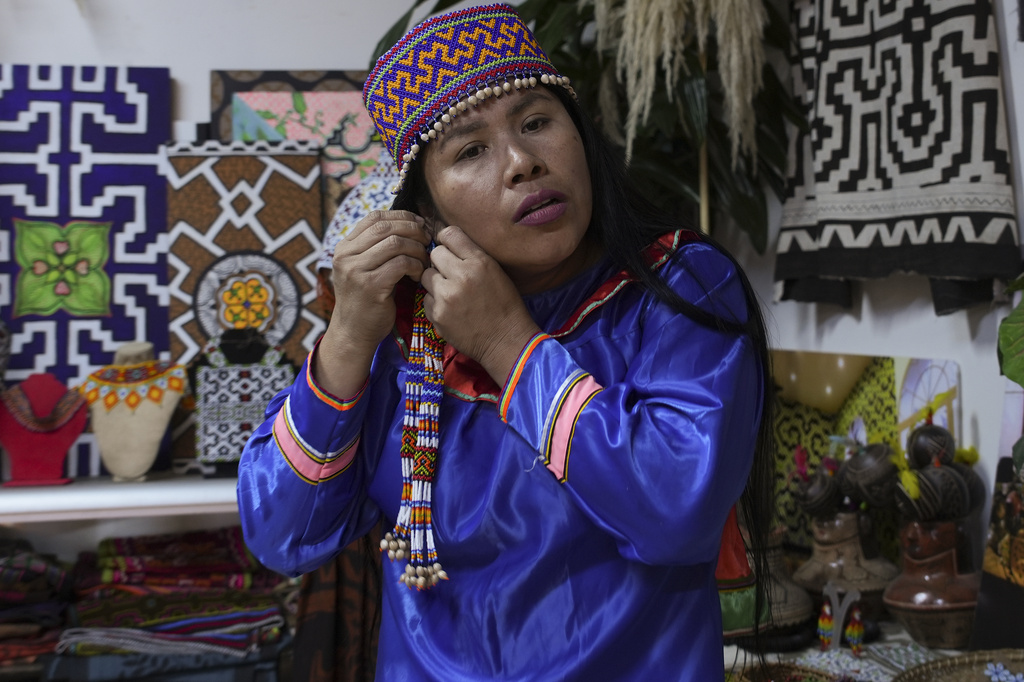
Sadith Silvano, de los Paoyhan, una comunidad indígena Shipibo-Konibo en la Amazonía, se pone aretes en su vivienda y taller de arte en Lima, Perú, el 19 de octubre del 2024. (Foto AP/Guadalupe Pardo)

Published by The Associated Press, November 2024 (link aquí)

Spanish story language here

LIMA (AP) – Sadith Silvano’s crafts are born from ancient songs. Brush in hand, eyes on the cloth, the Peruvian woman paints as she sings. And through her voice, her ancestors speak.

“When we paint, we listen to the inspiration that comes from the music and connect to nature, to our elders,” said Silvano, 36, from her home and workshop in Lima, Peru, where she moved two decades ago from Paoyhan, a Shipibo-Konibo Indigenous community nestled in the Amazon.

“These pieces are sacred,” she added. “We bless our work with the energy of our songs.”

According to official figures, close to 33,000 Shipibo-Konibo people inhabit Peru.

Settled in the surroundings of the Uyacali river, many relocated to urban areas like Cantagallo, the Lima neighborhood where Silvano lives.

Handpainted textiles like the ones she crafts have slowly gained recognition. Known as “kené,” they were declared part of the “Cultural Heritage of the Nation” by the Peruvian government in 2008.

Each kené is unique, Shipibo craftswomen say. Every pattern speaks of a woman’s community, her worldview and beliefs.

“Every design tells a story,” said Silvano, dressed in traditional clothing, her head crowned by a beaded garment. “It is a way in which a Shipibo woman distinguishes herself.”

Her craft is transmitted from one generation to another. As wisdom is rooted in nature, the knowledge bequeathed by the elders connects younger generations to their land. 

Paoyhan, where Silvano was born, is a flight and a 12-hour boat trip away from Lima.

In her hometown, locals rarely speak languages other than Shipibo. Doors and windows have no locks and people eat from Mother Nature.

Adela Sampayo, a 48-year-old healer who was born in Masisea, not too far from Paoyhan, moved to Cantagallo in the year 2000, but says that all her skills come from the Amazon. 

“Since I was a little girl, my mom treated me with traditional medicine,” said Sampayo, seated in the lotus position inside the home where she provides ayahuasca and other remedies for those ailing with a wounded body or soul.

“She gave me plants to become stronger, to avoid getting sick, to be courageous,” said Sampayo. “That’s how the energy of the plants started growing inside me.”

She, too, conveys her worldview through her textiles. Though she does not paint, she embroiders, and each thread tells a tale from home.

“Each plant has a spirit,” said the healer, pointing to the leaves embroidered in the cloth. “And medicinal plants come from God.”

The plants painted by Silvano also bear meaning. One of them represents pure love. Another symbolizes a wise man. One more, a serpent.

“The anaconda is special for us,” Silvano said. “It’s our protector, like a god that cares for us and provides food and water.”

In ancient times, she said, her people believed that the sun was their father and the anacondas were their guardians. Colonization brought a new religion — Catholicism — and their Indigenous worldview was diluted.

“Nowadays we have different religions,” Silvano said. “Catholic, evangelical, but we respect our other beliefs too.”

For many years, after her father took her to Lima hoping for a better future, she yearned for her mountains, her clear sky and her time alone in the jungle. Life in Paoyhan was not precisely easy, but from a young age she learned how to stay strong.

Back in the 1990s, Amazonian communities were affected by violence from the Shining Path insurgency and illegal logging. Poverty and sexism were also common, which is why many Shibipo women taught themselves how to navigate their anguish through the heartfelt music they sing.

“When we encounter difficult times, we overcome them with our therapy: designing, painting, singing,” Silvano said. “We have a song that is melodic and heals our soul, and another one that is inspiring and brings us joy.”

Few Shipibo girls are encouraged to study or make a living of their own, Silvano said. Instead, they are taught to wait for a husband. And once married, to endure any abuse, cheating or discomfort they may encounter.

“Even though we suffer, people tell us: Take it, he’s the father of your children. Take it, he is your husband,” Silvano said. “But deep inside, we are wounded. So what do we do? We sing.” 

The lesson is taught from mothers to daughters: If you hurt at home, grab your cloth, your brush and leave. Go far away, alone, and sit. Connect with your kené and paint. And while you paint, sing.

“That’s our healing,” Silvano said. “Through our songs, our kenés, we are free.”

In the workshop where she now works and raises her two children on her own, Delia Pizarro crafts jewelry. She, too, sings as she creates birds out of colorful beads.

“I didn’t use to sing,” Pizarro said. “I was very submissive and I didn’t like to speak, but Olin, Sadith’s sister, told me, ‘You can do this.’ So now I’m a single mother, but I can go wherever I want. I know how to defend myself and fight. I feel valued.”

The figures in the products they craft for sale are varied. Aside from anacondas, they like to depict jaguars, which represent women, and herons, which were treasured by the elders.

A Shipibo textile can take up to a month and a half to be completed. Materials required to craft it — the cloth, the natural pigments — are brought from the Amazon.

The black color used by Silvano is extracted from a bark tree that grows in Paoyhan. The cloth is made of local cotton. The mud used to set the colors comes from the Uyacali river.

“I like it when a foreigner comes and leaves with something from my community,” said Silvano, touching one of her freshly painted textiles to bless it for a quick sale. 

She said that her people’s crafts were barely known when she and her father first arrived in Lima 20 years ago. But in her view, things have now changed.

In Cantagallo, where around 500 Shipibo families have settled, many make a living selling their crafts.

“My art has empowered me and is my loyal companion,” Silvano said. “Thanks to my mother, my grandmother and my sisters, I have a knowledge that has allowed me to open doors.”

“Here’s the energy of our children, our ancestral world and our community,” she added, her textiles still between her hands. “Here’s the inspiration from our songs.”

____

Associated Press religion coverage receives support through the AP’s collaboration with The Conversation US, with funding from Lilly Endowment Inc. The AP is solely responsible for this content.
Care for a sweet treat during Mexico’s Day of the Dead? Have a bite of ‘pan de muerto’

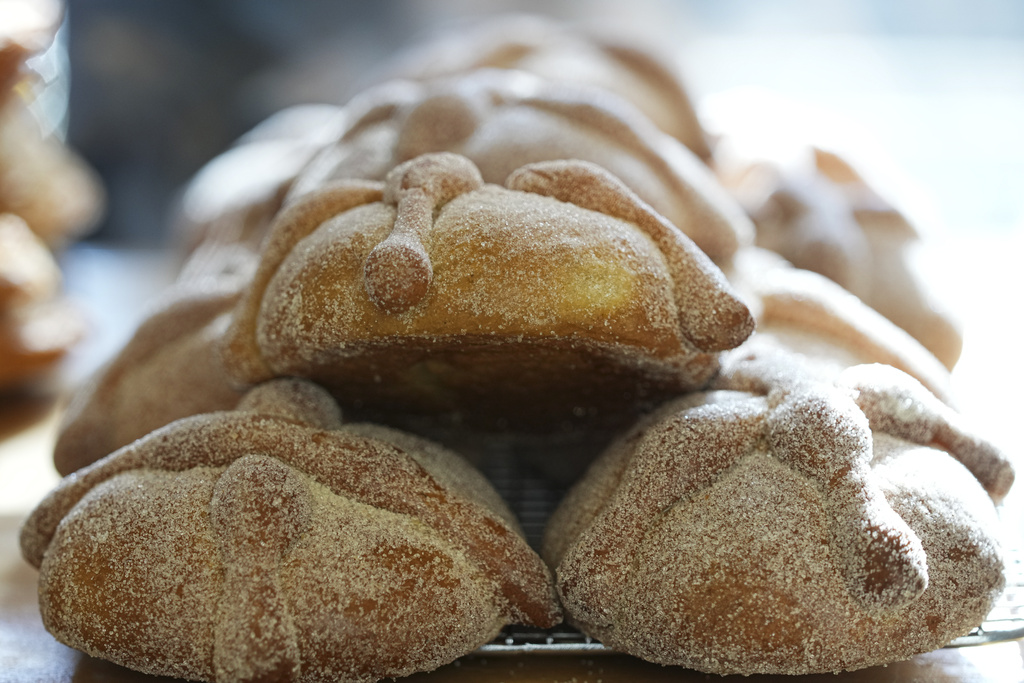
Pan de muerto, or «bread of the dead,» traditional for Mexico’s Day of the Dead, sits for sale at a bakery in the San Rafael neighborhood of Mexico City, Thursday, Oct. 17, 2024. (AP Photo/Fernando Llano)

Published by The Associated Press, October 2024 (link aquí)

Spanish language story here

The first bite is an assault to the senses. A sugary, citric, fluffy delight.

“Pan de muerto” or “bread of the dead” is baked in Mexico every year, from early October to mid-November, amid Day of the Dead celebrations. 

Shaped like a bun, decorated with bone-like bread pieces and sugar on top, pan de muerto can be seen at coffee shops, dinner tables or home-made altars, which Mexicans build to remember their deceased loved ones and welcome them back for a night on Nov. 2.

Its date of origin can’t be specified, but pan de muerto can be thought of as a fusion of Mesoamerican and Spanish traditions, said Andrés Medina, a researcher at the Anthropological Research Institute of the National Autonomous University of Mexico.Mexicans have remembered the dead with festivities and food for centuries

Since pre-Hispanic times, festivities for the dead have existed and skull-shaped products have been made. But in the 1500s, when the Spaniards arrived, new elements such as sugar and bread were incorporated into Indigenous offerings.

Those early celebrations, Medina said, coincided with the crop season, which provides pan de muerto a spiritual, symbolic meaning. If its decorations resemble bones, it’s because Mesoamerican worldviews regarded them as the origin of life.

According to an ancient myth, Quetzalcóatl created humankind out of bones. Details vary from one source to another, but soon after the god apparently stole them from the underworld, he fell. And from his blood, the seed of life was born.

“Under this worldview, the human body’s bones, just like the fruit’s insides, are seeds,” Medina said. “So, in a way, altars are offerings to fertility. And Day of the Dead is a celebration of the life contained in each seed.”

Pan de muerto’s shape, ingredients and preparations differ from one Mexican state to another, but is enjoyed all over the country.100 and counting: One man’s quest to try every variation of “pan de muerto”

In Mexico City, hundreds of bakeries make their own version. Rodrigo Delgado has spent years trying to taste them all.

For fun, he challenges himself to try as many as possible and review them on his Instagram account. On his first quest, a decade ago, he tried 15. In 2023, he had a bite of 100. This year, he expects to taste at least 110.

“I like pan de muerto because of what it means during Day of the Dead season,” said Delgado, who also reviews local restaurants on his blog, Godínez Gourmet. “The mix of flavors of the bread, as much as its texture, are very comforting.”

He can’t remember the first time he tried pan de muerto, but he treasures the memories of his mother baking it at home. He and his brother used to knead the dough, he said, and shape the bone-like decorations of its top.

Baking pan de muerto is not an easy task. At Panadería Dos Veinte, in Mexico City’s San Rafael neighborhood, owner Manu Tovar said that having these sweet buns ready for sale takes three days of work: one to extract the infusions that will provide the bread with its flavor, another to incorporate them into the dough and one more day to knead and shape the buns.

There’s no secret in his recipe, Tovar said. The ingredients — although seasonal — are simple: orange blossom, tangerine zest, anise and butter.

His special touch, what makes his bread unique, is the sourdough. “It’s an ancestral process,” Tovar said. “A millenary way to make bread.”

The sourdough that he and four assistants use is 20 years old. He incorporates water and flour daily, to keep it alive, and mixes part of it with new dough. This gives the bread a better taste, he said, and makes it easier to digest.Pan de muertos’ seasonal flavors help make it special 

For years, said Tovar, he resisted the temptation of baking pan de muerto in early October. The quality of the ingredients improves as November gets closer, but customers kept asking when the buns would be ready, so he caved.

This season, aside from baking 90 pan de muertos per day, he came up with two new creations: a croissant roll filled with marigold cream and a bun — locally known as “concha” — shaped like a marigold flower and prepared with tangerine instead of vanilla or chocolate.

“If you bake it in a traditional way, you can only have pan de muerto now, because that’s when the fruit is available,» Tovar said. «That’s what I think makes it so special.”

The ambience of the Day of the Dead season, he added, also plays a role. Nightfall comes earlier during this time of year and there’s certain mysticism, a particular feeling in the air.

“It probably has to do with the melancholy of what this festivity means,” he said. “For one day a year, you can feel closer to those who are no longer with you.”

____

Associated Press religion coverage receives support through the AP’s collaboration with The Conversation US, with funding from Lilly Endowment Inc. The AP is solely responsible for this content.

Are LGBTQ Jews welcome in Orthodox communities? This is how they are building spaces of their own

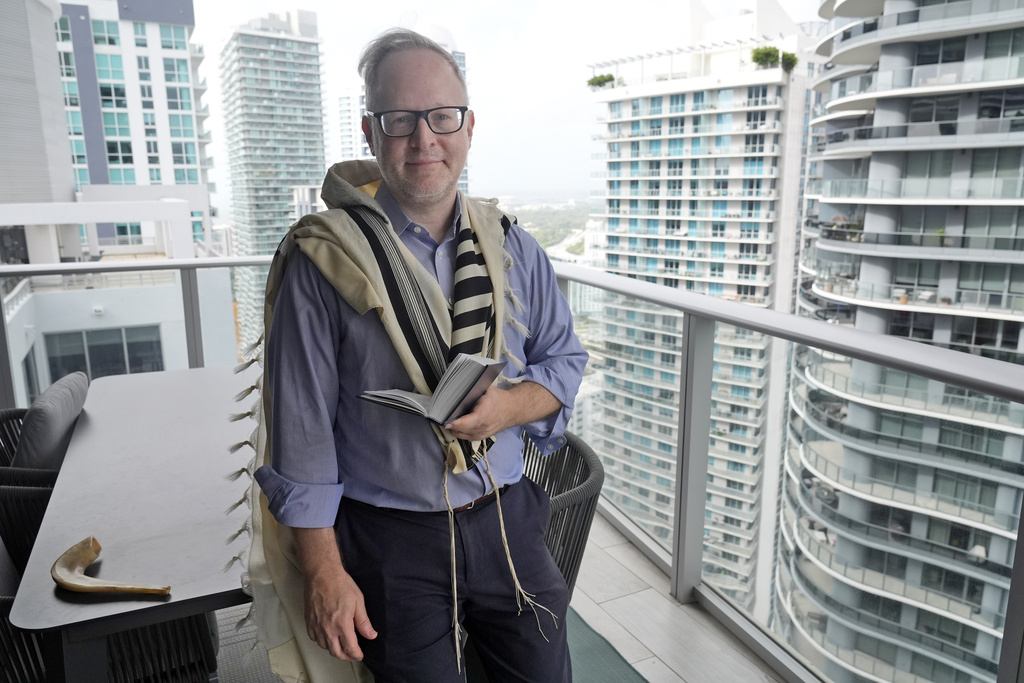
Daniel Gammerman poses for a photo on his balcony where he sometimes prays as he prepares to worship at home for the Jewish High Holy Days, Thursday, Sept. 26, 2024, in Miami. (AP Photo/Wilfredo Lee)

Published by The Associated Press, October 2024 (link aquí)

Spanish language story here

It was a heart-wrenching choice. But when Daniel Gammerman decided to never set foot back in an Orthodox synagogue, he thought of it as an act of love. Not toward the Jewish community he was born into, but to himself.

“A synagogue is a spiritual place, but it’s also a community place,” said Gammerman, 47, from his home in Miami. “If I have to basically check at the door half of my identity in order to come in, I don’t feel that’s welcoming enough for me.”

Dozens of LGBTQ+ Jews like him have struggled to find support and acceptance within their Orthodox communities. Most were raised with little knowledge of what being gay or queer meant. They just felt different, but found it hard to ask their rabbis: “This is who I am, is there still room for me here?”

“The way it mostly works is invisibility,” Gammerman said. “There’s no addressing the existence of LGBT people among us. And, whenever you hear something about it, of course it’s negative.”

He can’t put his finger on a specific date in which he realized he was gay. But he remembers clearly what happened to him when the news got out.

“I used to get enormous texts from different people trying to explain to me how this was wrong,” Gammerman said. “It was a bombardment of people trying to fix me.”

Grandson to Eastern European Jews who fled during World War II, Gammerman was born in Brazil. He moved to the U.S. after finishing high school in the 1990s and continued his studies at a Jewish Orthodox university. At age 21, he got married. He and his wife — who he still thinks of as a friend — raised four children together.

“We built a perfect family,” he said. “I checked all the boxes of what a nice Jewish Orthodox family is supposed to be.”

Afraid to destroy his future and his children’s lives, he shut down his feelings for years, until he could do it no more.

He initially traveled to Brazil and met with a therapist who counseled gay men in heterosexual marriages. That helped, Gammerman said, but something was missing. What about his life within an Orthodox religious community that didn’t even acknowledge that LGBTQ+ people exist?

Embracing his true identity felt easier after meeting Steven Greenberg, an openly gay rabbi who founded Eshel, a U.S.-based organization focused on connecting LGBTQ+ Orthodox Jewish communities.

According to Miryam Kabakov, Eshel’s co-founder and executive director, most of the people who reach out share similar concerns: I’m coming out and I’ve been part of this community my whole life. Can I still belong? What will happen to me now? Can you find a rabbi who can help me?

“We guide them toward religious leaders who will tell them that there’s still a place for them,” Kabakov said. “That they still have the religious obligations and expectations that they’ve always had and that they should stay true to their heart and their tradition if that’s what they want.”

Ely Winkler, a 37-year-old LGBTQ+ Orthodox Jew from Brooklyn, will soon be back at an Orthodox synagogue after years of distancing himself from his community.

“After the war broke out between Israel and Gaza, I felt a deeper calling,” he said. “I didn’t feel strong enough to stand up for myself, for my beliefs, and I knew that I needed to strengthen my Judaism, to remember who I was.”

Abrielle Fuerst, 32, moved from Texas to Philadelphia six years ago. Eshel helped her to connect with a local rabbi and an inclusive synagogue.

“Here it’s not: ‘Oh, come because you are Jewish and gay, we’ll accept you.’ It’s just: ‘Hello, you’re Jewish, thanks for being in this space and it’s nice to meet you.’”

One of Eshel’s projects, named the «Welcoming Shuls,” enlists more than 200 rabbis who work across North America to make their synagogues hospitable for LGBTQ+ people. Many of them consent to being publicly identified; others ask to keep a low profile, foreseeing hostile reactions within their Orthodox communities.

“A lot of rabbis are very afraid to be public because they’ll get ostracized,” Kabakov said. “But we know they’re there.”

The group also counsels Orthodox LGBTQ+ Jews who wish to keep a distance from their religion.

“People who don’t want to be religious anymore are torn up about it,” Kabakov said. “But we try to help them through the struggle and let them know that they can be gay and be religious. It might be hard to find a place, but we’re working on that.”

Gammerman has tried to go back to Orthodox synagogues since he came out. Until now, none in Miami have made him feel truly accepted.

“I’ve tried many times, but it’s like wearing a costume,” he said. “At some point I was able to live with that. But the more you accept yourself, the more you love yourself, you just cannot do it.”

His Orthodox community did not prevent him from attending religious services after he came out, but rejection was still there. People stopped greeting him, and he was no longer allowed to officiate services at his synagogue. Once, during a speech, the rabbi looked at him and said: “Homosexuality is destroying humanity and if this continues like this, there’ll be no more children in the world.”

“I lost friendships, relationships, participation and community,” Gammerman said. “It was all gone really, really fast.”

Meeting Greenberg, who is married to another man and has a child, helped him realize he could still live a happy, fulfilling life. After their encounter, Gammerman decided to talk to his wife. The couple separated and found a way to break the news to their children.

“Since then, I have rebuilt my life,” he said. “I remarried. I have a husband. My children are part of my life and they understand.”

In time, he realized that not only his family, but his approach toward his religion would also need to change. At first he tried to attend liberal Reform synagogues, some of which fully embrace LGBTQ+ worshippers, but having been raised an Orthodox Jew, he still felt out of place.

“Being LGBT is a whole identity,” Gammerman said. “And I want to be embraced in a place where there are no buts or ifs.”

He’d rather not label his current religious observance, but Rosh Hashana and Yom Kippur still bear huge significance for him. So, every year, during the High Holy Days, he wakes up early, dresses nicely and opens his prayer book.

“I say the prayers from beginning to end,” Gammerman said. “I call to all the praises as if I was in a synagogue, but I do it by myself in my house.”

He was once taught that Jewish prayer required at least 10 men to be conducted, but he has learned a few things since.

“If I was given a switch that I could press to change who I am, I would not do it,” he said. “God made me like this, so it’s not up for me to switch. I have to love myself for who I am.”

_____

Associated Press religion coverage receives support through the AP’s collaboration with The Conversation US, with funding from Lilly Endowment Inc. The AP is solely responsible for this content.