Olympics visitors are invited beyond the Duomo to Milan’s other stunning churches

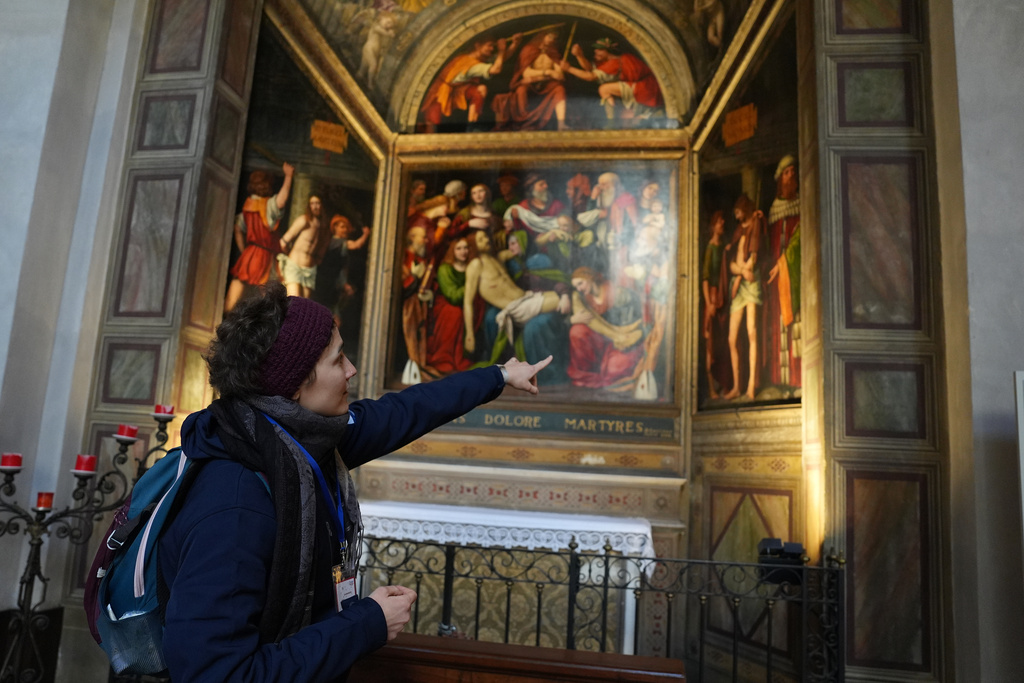
Sara Cainarca, a volunteer with the “La Via della Bellezza,” or “The Path of Beauty,” initiative, gestures toward a fresco in the church of San Giorgio al Palazzo, in Milan, Italy, Wednesday, Feb. 18, 2026. (AP Photo/María Teresa Hernández)

Published by The Associated Press, February 2026

MILAN (AP) – Away from the crowds swarming Milan’s Duomo during the Winter Olympics, young volunteers have been steering visitors toward the city’s lesser-known churches, inviting them to discover their sacred heritage.

Known as “The Path of Beauty” (“La Via della Bellezza” in Italian), the initiative began in 2020 as a project of the archdiocese’s youth ministry office. It typically offers visits on weekends, but the schedule extends to weekdays during the Games and runs through March 15.

“The idea is to welcome visitors inside these churches and invite them to rediscover an artistic beauty that we inherit from the past, but that still speaks today,” Sara Cainarca, who coordinates the team hosting the visits, told The Associated Press on Wednesday.

Faith through art

Between 15 and 20 people are involved in the archdiocese’s project, each specializing in one or two churches in Milan. The short visits are offered to a dozen Catholic sanctuaries across the city.

Volunteers wait for visitors inside their assigned church. Emphasizing they are not certified tour guides, they offer a free introduction to the history and sacred art of each building.

During the Olympic weeks, volunteers say they have welcomed visitors from the United States, France, Germany and Spain, some drawn to the city for the Games and others simply curious to explore beyond its best-known landmarks.

Giovanna Giuditta Mazza is an art history student who joined the initiative two years ago. She offers visits in English, French and Italian and is mostly based in the Basilica of San Lorenzo Maggiore, which dates back to the late 4th and early 5th centuries, making it one of the city’s oldest churches.

“When people enter the church, they often do not know what to expect,” said Mazza, 22. “But when they leave, I see a sparkle in their eyes and that is precious to me.”

For her and other volunteers, these encounters become an opportunity to speak about their faith.

“Beauty is not just about art,” said Víctor Ortíz, a 22-year-old student of cultural heritage. “It is also about the Word of God.”

The church of Santa Maria presso San Satiro is best known for the illusion created by Renaissance architect Donato Bramante, who designed a trompe-l’oeil apse to compensate for limited space. 

Ortiz, who often gives guides there, explains to visitors how the site had also been linked to a 13th-century miracle, in which an image of the Virgin Mary was said to have bled after being stabbed.

“The growing devotion surrounding that event eventually led to the construction of the church in the 16th century,” he said.

Training and tradition

“La Via della Bellezza” began as training sessions in which university students from the Lombardy region explored the relationship between art and spirituality. Volunteers then spread to cities like Brescia or Bergamo, where churches and basilicas are known for their rich Romanesque and Baroque art.

“The idea is to accompany visitors so they move from being tourists to becoming pilgrims who discover a deeper desire within themselves,” said Cainarca, 26.

Volunteers meet at least once a month with experts who provide additional training in art history and other topics. Additionally, the group travels to nearby places to deepen their understanding of both artistic heritage and the spiritual traditions behind it. They will soon head to Ravenna, home to a series of Christian monuments famed for their mosaics that has been recognized as a World Heritage by the U.N. cultural agency UNESCO.

Milan, though, is Cainarca’s favorite city to work in. She says its churches are part of the city’s identity and that its patron, Saint Ambrose, shaped a vision of community and collaboration.

“Today, Milan is known for fashion, shopping, finance and skyscrapers,” she said. “These churches offer a moment of pause, contemplation and discovery.”

___

AP Winter Olympics coverage: https://apnews.com/hub/milan-cortina-2026-winter-olympics

___

Associated Press religion coverage receives support through the AP’s collaboration with The Conversation US, with funding from Lilly Endowment Inc. The AP is solely responsible for this content.
‘Adopt a Statue’ program for Milan’s iconic Duomo restores centuries-old marbles

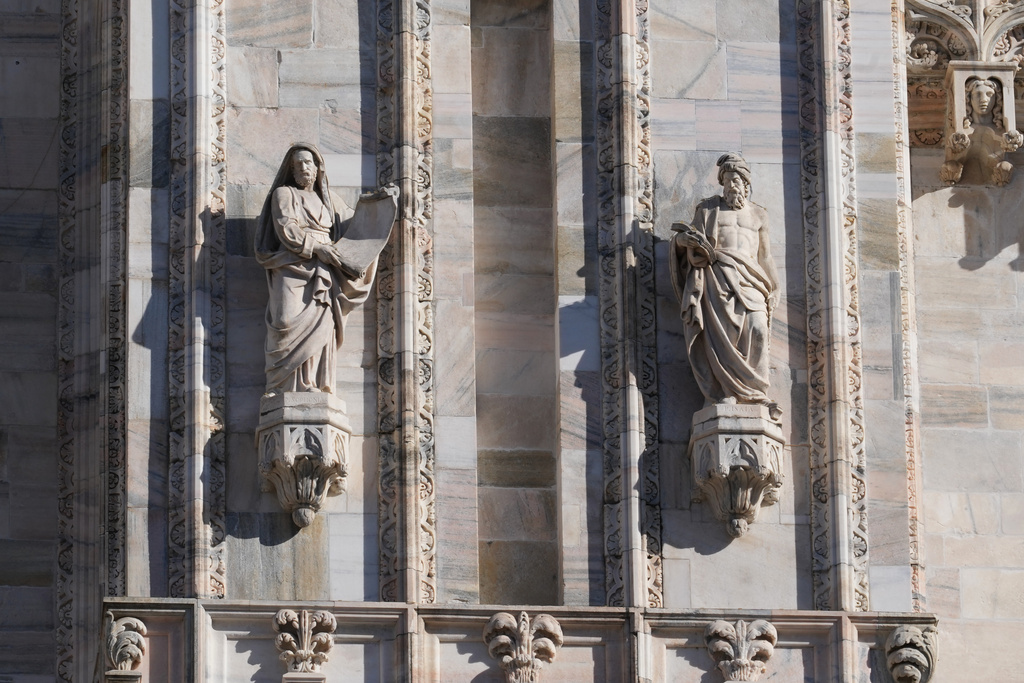
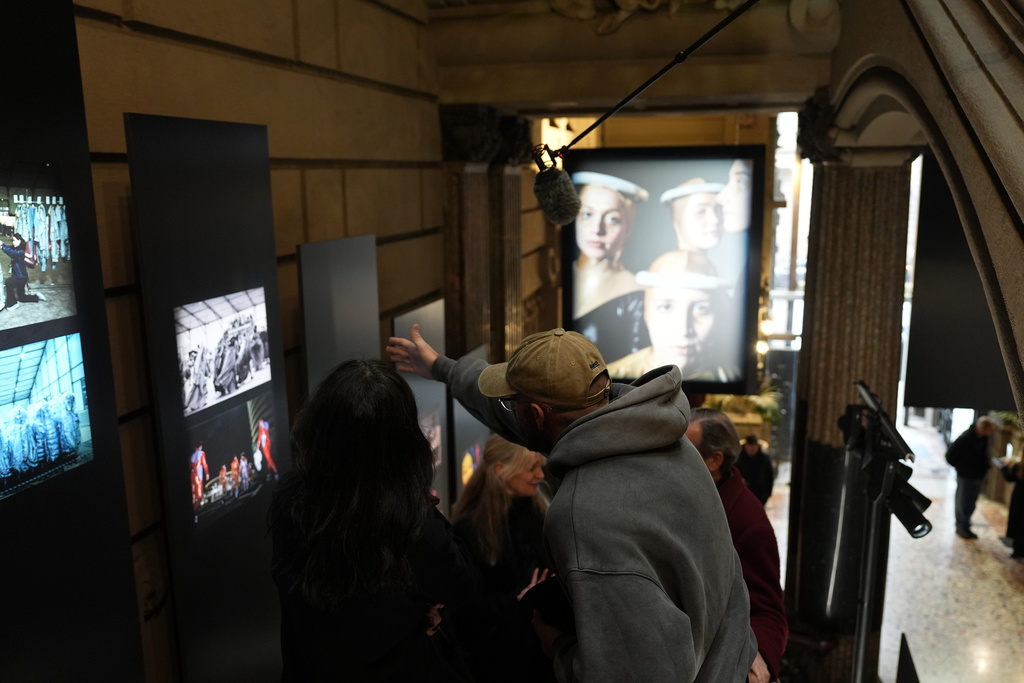
A detail of Milan’s Duomo cathedral is pictured at the 2026 Winter Olympics, in Milan, Italy, Sunday, Feb. 15, 2026. (AP Photo/Antonio Calanni)

Published by The Associated Press, February 2026

MILAN (AP) – A 15th-century statue that once stood outside Milan’s iconic Duomo has found a new home.

The Bearded Saint with Book was recently restored under the “Adopt a Statue” program, launched in 2020 by the centuries-old institution that oversees the cathedral’s conservation. As of Feb. 13, it is on display at Piazzale Cadorna, behind a glass window at the headquarters of FNM, a Lombardy-based transport company.

The program recruits donors — either companies or individuals — to fund restoration of a statue under a loan agreement that allows it to occasionally be displayed outside the Duomo.

“The uniqueness of this project is that statues that would otherwise remain in our deposits are restored and brought back to their original beauty,” the program’s project manager, Elisa Mantia, said in an interview with The Associated Press. “In that way, they can continue to tell the story of the Duomo even in places that are far from the monument.”

These agreements are in some cases granted for an initial one-year term and may be renewed. The initiative follows previous fundraising campaigns in which donors could adopt gargoyles or spires in exchange for inclusion in the Duomo’s donor register, where contributors’ names are recorded as part of the cathedral’s long history of support.

From storage to public display

The construction of the Duomo began in 1386, under the rule of Gian Galeazzo Visconti, then lord of Milan, in collaboration with the city’s archbishop. The cathedral was built on the site of two preexisting basilicas and its completion took more than five centuries. One of its bronze doors was not installed until 1965.

Because construction spanned centuries, the Duomo’s statues were carved by artists from different regions and periods, resulting in a monument that reads as a timeline of evolving artistic styles.

The Veneranda Fabbrica del Duomo, which oversees the cathedral’s conservation, has sought funding to restore statues removed over the centuries for maintenance or safety reasons.

“Culture can save the world,” Andrea Gibelli, president of FNM, said during a press conference on Feb. 13 to mark the unveiling of Bearded Saint with Book. “We want to spread the cultural riches we are fortunate to have, which are often overlooked or not fully appreciated.»

Other sculptures adopted under the program by different sponsors have included a 16th-century David, a depiction of Samson and the Lion, and a statue of Saint Matthew the Apostle.

While the number of adopted statues isn’t disclosed and not all are displayed in public spaces, Mantia said that her institution has preselected around 30 sculptures as eligible for restoration. Each case must be authorized by Italy’s cultural heritage authorities, as the process involves a formal loan agreement subject to conservation, insurance and transport regulations.

“We usually select them because they are very beautiful and not so damaged that they would be unsafe to loan,” Mantia said.

Once a donor reaches out, experts like Mantia accompany them to the Duomo’s storage facilities to choose a sculpture. After it is selected, restoration typically takes between one and three months.

Centuries-old marble

Bearded Saint with a Book was originally displayed outdoors. Aside from a black crust from air pollution on its surface, it had no structural damages preventing its loan.

“This often involves only surface finishing or an intervention with compresses or mechanical cleaning,” Mantia said.

The marble used for both the statues and the Duomo itself comes from the quarries of Candoglia in Italy’s Piedmont region. The same stone has been used since the late 14th century, under the supervision of the Veneranda Fabbrica del Duomo.

“Beyond being the symbol of Milan, the Duomo is also a symbol of its history,” Mantia said. “It is a monument that grew together with the city, that tells within itself, in its statues and in the style with which it is decorated, the entire history of the city.”

___

Associated Press religion coverage receives support through the AP’s collaboration with The Conversation US, with funding from Lilly Endowment Inc. The AP is solely responsible for this content.
Winter Olympics exhibition offers a glimpse behind the opening ceremony in Milan

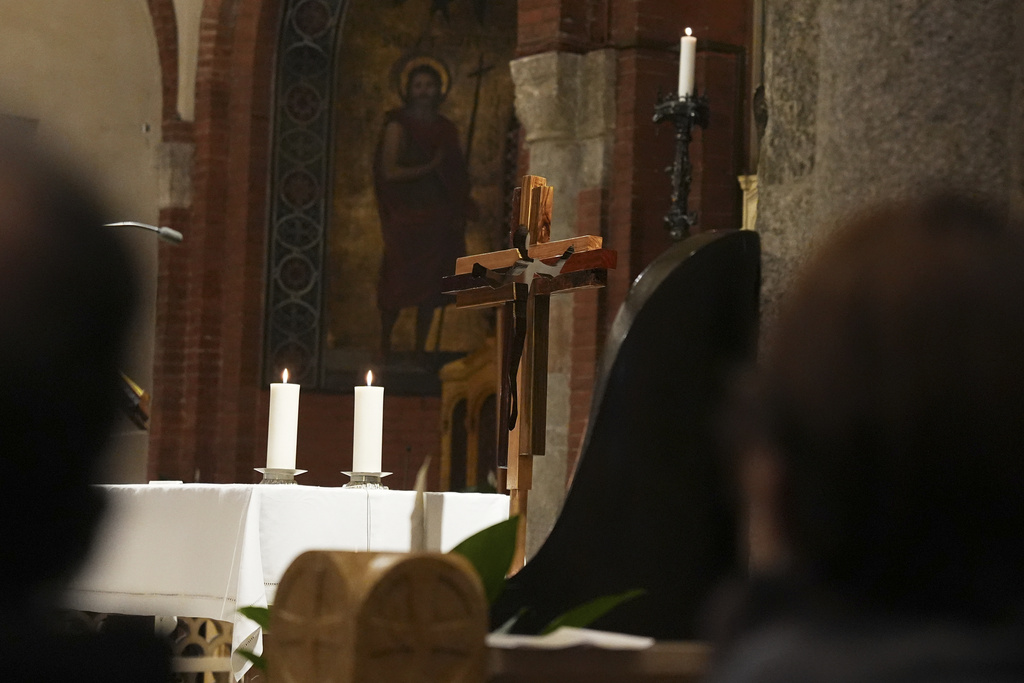
Italian photographer Giampaolo Sgura attends the opening of “REHEARSAL – Before the Applause,” his photographic series documenting rehearsals for the opening ceremony of the 2026 Winter Olympics, in Milan, Italy, Thursday, Feb. 12, 2026. (AP Photo/María Teresa Hernández)

Published by The Associated Press, February 2026

MILAN (AP) – An exhibition that opened Thursday in Milan features a behind-the-scenes look at the moments preceding the Winter Olympics opening ceremony.

“REHEARSAL — Before the Applause,” at Palazzo Castiglioni, features 39 images taken by Italian photographer Giampaolo Sgura, who was granted rare access to intimate moments involving more than 1,200 volunteers during dress rehearsals ahead of the Feb. 6 opening ceremony.

“These volunteers are all together to perform, so I think it is all connected to the spirit of sports and in this case the Olympics,” Sgura told The Associated Press in an interview. “Maybe they don’t have to perform to win, but for the sake of creating something emotionally entertaining and beautiful.”

Sgura, a renowned fashion photographer who has worked for magazines such as Vogue and brands like Dolce&Gabbana, said working with subjects not used to being photographed offered him a different perspective on human nature. 

“The main thing I was photographing was their passion, their professionalism, their desire to be there and communicate a sense of happiness,” he added.

His photographs, displayed on the stairs of the palace located in Milan’s Porta Venezia district, showcase performers in bright, intricately designed costumes, while designers, creative directors, stagehands and craftspeople work to ensure the ceremony unfolds seamlessly. It runs through Feb. 17.

Behind the exhibit is the Olympic Museum in Lausanne, Switzerland. Its director, Angelita Teo, told the AP that Sgura’s photographs are key to conveying how the effort and dedication of hundreds of people make the spectacular event possible.

“We really value volunteers at the Olympic movement and this is a way for us to give back to them,” Teo said. “The Olympic movement is always about more than competition. It is about humanity, about people coming together and making something that will make a difference.”

The show fits into the museum’s ongoing efforts to interpret Olympic values through contemporary art. Once it closes in Milan, on Feb. 17, the photographs will become part of its permanent collection.

___

AP Olympics: https://apnews.com/hub/milan-cortina-2026-winter-olympics

____

Associated Press religion coverage receives support through the AP’s collaboration with The Conversation US, with funding from Lilly Endowment Inc. The AP is solely responsible for this content.
Catholic cross like no other is a beacon of unity in Olympic host city Milan

The “Cross of Athletes” is seen during a Mass at the Basilica of San Babila, known as the Church of Athletes during the 2026 Winter Olympics, in Milan, Italy, Saturday, Feb. 8, 2026. The cross travels to Olympic host cities as a symbol of faith, unity, and the values of sport. (AP Photo/María Teresa Hernandez)

Published by The Associated Press, February 2026

MILAN (AP) – Much like the Olympic flame, there is another symbol of triumph and transcendence — far less known — that graces one host city after another: a one-of-a-kind, wooden cross. 

The Cross of the Athletes has arrived in Milan for the Winter Games and holds pride of place beside the main altar in the Basilica of San Babila. It is one of the city’s oldest churches that — for a few weeks, while the cross is within its walls — holds the title of Church of Athletes. 

The presence of the cross at the Games is a tangible sign of the Catholic Church’s belief that sport is a powerful way to bring people together. And this cross is unique in that it is made from pieces of wood sourced in five continents, an apparent nod to the five Olympic rings that convey the same sentiment. 

“We think of sport not as an instrument that separates, but as one that unites,” said the Rev. Stefano Guidi, who heads the Archdiocese of Milan’s Service for Oratories and Sport. “The cross represents this precisely through the way it was created.”

The making of the cross

English artist Jon Cornwall used 15 pieces of wood from continents around the world to craft the cross, which made its grand debut at the London Olympics in 2012. 

Since then, special ceremonies have marked its arrival to host cities for both the Summer and Winter Games. (The exception was Tokyo, when pandemic travel restrictions were in place.) Last June, it was in the Vatican for the Jubilee of Sport, celebrated with Pope Leo XIV, who has a long-standing personal connection to sport. And the cross is expected to travel to Los Angeles for the 2028 Games.

“The cross — carrying the prayers and hopes of athletes — is a Christian message addressed to the entire world of sport, a sign of hope for humanity, and a proposal of peace among peoples,” according to a document from the Vatican’s culture ministry, which includes a sports department.

Leo said in a message entitled “Life in Abundance” issued on the same day as the Milan Cortina opening ceremony, that sport brings people together and values the journey as well as the end result.

“It teaches us that we can strive for the highest level without denying our own fragility; that we can win without humiliating others; and that we can lose without being defeated as individuals,” he wrote.

On a recent February morning, Giovanna Spotti and her husband attended Mass at San Babila and took a moment to closely admire the cross.

“The Cross of the Athletes moves us a great deal, because it is displayed and venerated here,” said Spotti, who lives nearby. “And San Babila is important because it is a very old church, truly characteristic of Milan.”

A message of unity beyond language

The Romanesque basilica sits in the heart of the city near Piazza San Babila, a major transit and meeting point. Milan’s Catholic archdiocese has designated it the Church of Athletes during the Olympics and Paralympics. 

As part of the church’s activities for this period, it is celebrating some Masses in Italian, English, French and German.

The church was packed during the first Mass on Feb. 8, in Italian. The homily focused on the importance of embracing fraternity over individualism and fostering a spirit of unity beyond divisions.

Later, the Rev. Stefano Chiarolla celebrated a German-language Mass. All attendees were Italian, but Chiarolla said the initiative is important nonetheless.

“Multilingual Masses are a sign of welcome,” said Chiarolla, who asked German speakers to raise their hands at the end of his homily and smiled when merely one Italian man did. “People can always attend Mass in Italian, but the diocese wants to offer a visible sign of hospitality that reflects the international nature of the event.”

Marino Parodi, who raised his hand, said he attended because family issues prevented him from coming to the earlier service.

“I searched on the web and I found this option,” he said. “I was glad to find it.”

Both the display of the cross and the multilingual Masses are part of the Milan archdiocese’s efforts to promote unity during the 2026 Winter Olympics. That broader program includes a youth-focused “Tour of Sports Values,” cultural exhibitions, a theatrical performance, concerts and inclusive sports initiatives, as well as art routes through some of Milan’s historic churches.

___

AP Olympics: https://apnews.com/hub/milan-cortina-2026-winter-olympics

___

Associated Press religion coverage receives support through the AP’s collaboration with The Conversation US, with funding from Lilly Endowment Inc. The AP is solely responsible for this content.

Milan’s Catholic archdiocese brings Olympic values into parish life

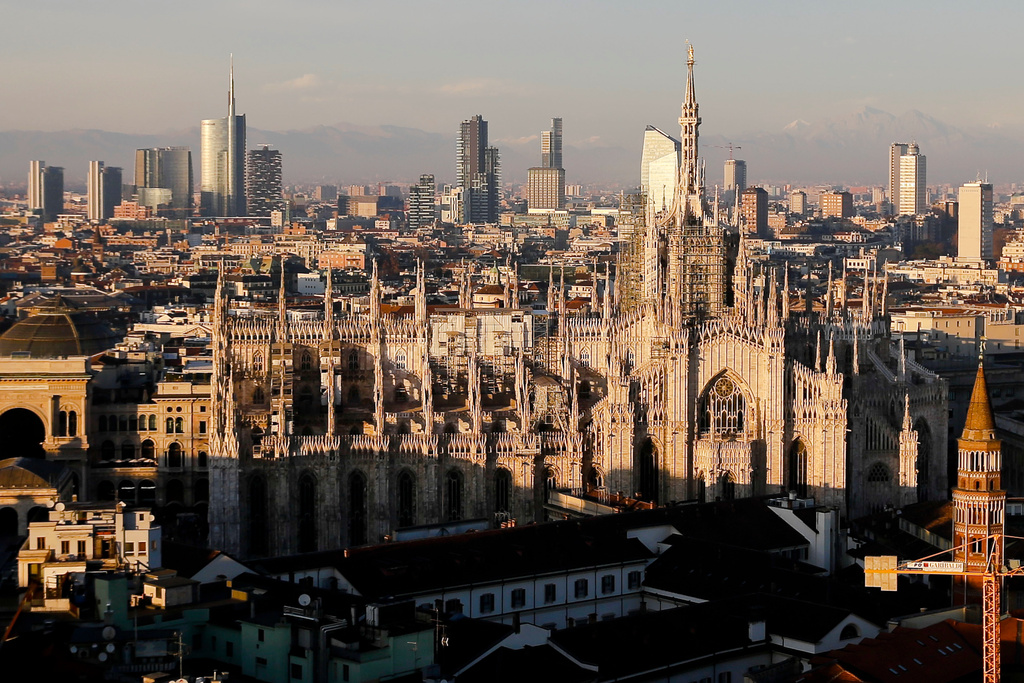
FILE – The pinnacles of the Duomo cathedral are lit by the afternoon declining sun and backdropped by the new Business Center in Milan, northern Italy, Jan. 4, 2017. (AP Photo/Luca Bruno, File)

Published by The Associated Press, January 2026

Milan’s Catholic leaders faced a choice when the city was selected to host the 2026 Winter Olympics.

They could passively wait for the event to unfold or immediately bring the Olympic spirit into their pastoral work. They chose the latter.

“We believe that the Olympics represent a great educational opportunity in the meanings they will carry,” wrote Milan’s Archbishop Mario Delpini in a letter following the launch of a program aimed at promoting Olympic values among young people.

The Ora Sport on Fire Tour has been underway since late 2022, with new activities led by the archdiocese planned during the Games.

“The city as an Olympic village is a metaphor to say that relationships are shaped by competing in mutual esteem,” Delpini added.

In Italy, a country shaped by Catholic tradition, the Ora Sport on Fire Tour operates in parish youth centers and schools. It was developed by the Milan archdiocese’s sports and youth outreach offices, in collaboration with its school pastoral services.

According to the Rev. Stefano Guidi, who heads the archdiocese’s Service for Oratories and Sport, both the program and the activities that will run during the Games aim to make a specific contribution by highlighting the inclusive and social aspects of sport.

“We hope that these values will help young people in our city grow,” he said.

Turning Olympic values into action

The first step in shaping the Ora Sport on Fire Tour was studying the Olympic Charter, the founding document of the Olympic movement.

Faith leaders in Milan then rooted their project in the cultural values of the event. Through sporting events, contests and workshops, themes such as human rights and peace have been promoted.

These are hosted in Christian-inspired schools and oratories, parish spaces that are turned over to afterschool activities for young people, including sports and Catholic catechism classes.

Among its activities ahead of the Winter Olympics, the archdiocese has also hosted encounters between religious leaders, athletes and young people.

During one of the early events tied to the program’s rollout, Paralympic swimmer Arianna Talamona shared how being an athlete is both an honor and a responsibility.

“One thing I often feel like saying when I go into schools and meet students is to be patient and to have very clear ideas about their passions,” said Talamona during the encounter, which was streamed on the archdiocese’s channels. “And if they have dreams and passions, it’s important to cultivate them.”

A traveling torch

The Ora Sport On Fire Tour has its own Olympic torch. It’s a symbolic path to bring the Games’ spirit to participating institutions.

The torch has traveled throughout the territories of the diocese, visiting two pastoral zones per year. As each deanery welcomed it, gatherings, prayer and talks on Olympic values were held.

Oratories in towns such as Tradate, in northern Italy, posted on social media how children and adolescents transported the torch and reflected on its meaning.

In other cities, such as Gallarate, sports activities were focused on inclusion. They taught youths how to recognize and respect differences and diverse abilities.

The approach has been a constant of the program since its beginnings. To mark the launch of the third year of the Ora Sport On Fire Tour, Paralympic swimmer Alberto Amodeo appeared as a guest at a diocesan sports gathering in Abbiategrasso.

He recalled his achievements in both the Tokyo and Paris Paralympics, underlining how the Games bring together athletes of different ethnicities.

“These are beautiful results that will remain forever in my heart,” Amodeo said.

A broader mission

The initiatives implemented during the Ora Sport On Fire Tour changed from one deanery to another. Some hosted sports-themed plays overseen by a professional theater company. Others organized film forums or large-scale sports activities.

All remain tied to the upcoming Olympics. Yet sports have long been key to the archdiocese’s pastoral outreach to youths even before Italy was chosen to host the Winter Games.

According to Guidi, there are about 1,000 oratories in Milan’s diocese. Practically all of them have a sports club that carries out activities. “Some even reach 100 years of history,” he said. “For many kids, adolescents and families, this is their only possibility to practice sports.”

He added that most activities are offered at low cost, mainly thanks to volunteer work.

Throughout the diocese’s sport-related programs, three aspects remain key: conveying how sport helps develop the physical abilities of each person, how it supports socialization and how it develops respect for one’s opponent.

“It therefore proposes a kind of growth that has the meaning of constant training of oneself and of one’s relationships,” Guidi said. “And the possibility of learning from one’s mistakes.”

____

Associated Press religion coverage receives support through the AP’s collaboration with The Conversation US, with funding from Lilly Endowment Inc. The AP is solely responsible for this content.