How Mexico’s Day of the Dead turns skulls into joyful sugar treats

Sugar skulls known as “calaveritas” or little skulls, traditionally added to Day of the Dead altars honoring deceased loved ones, are displayed for sale at the Dulces de Ampudia market in Mexico City, Thursday, Oct. 30, 2025. (AP Photo/Claudia Rosel)

Published by The Associated Press, November 2025

Spanish story language here

MEXICO CITY (AP) – Marigolds? Check. Candles? Check. And of course, sugar skulls — the final touch on altars honoring deceased loved ones during Mexico’s Day of the Dead.

Just like the traditional “pan de muerto,” these colorful treats known as “calaveritas” (or little skulls) capture how Mexicans remember their dearly departed with celebration rather than sorrow each November.

“Very few customers buy them to eat,” said Adrián Chavarría, whose family has crafted and sold calaveritas since the 1940s in a Mexico City market. “Most people get them to decorate their altars.”

Following a tradition rooted in pre-Hispanic beliefs related to agriculture, many think their loved ones return home to spend the night on Nov. 2.

To welcome them, families set up homemade altars. Candles are lit in the hope of illuminating their paths and the departed’s favorite dishes are cooked for the occasion.

“I set out a beer, a Coke, a cigarette — a little of everything just in case,” said Margarita Sánchez, who spent a recent October evening shopping for calaveritas and other items for her altar. “That way, whoever comes can help themselves.”

Her whole family takes part in setting up the offerings, but her daughters lead the way, finding creative ways to surprise their deceased relatives with a fresh display each year.

“This is how we honor our loved ones who left earlier than we would have hoped,” Sánchez said. “We do this to remember them.”

A sweet tradition with ancient roots

Calaveritas are mostly made of sugar, chocolate or amaranth. Nonetheless, each Mexican state has its variations. Ingredients such as almonds, peanuts, pumpkin seeds and honey can be added as well.

According to Mexico’s Agriculture and Rural Development Department, the calaveritas’ origins date back to ancient Mesoamerican traditions.

The Aztecs used to make amaranth figures mixed with honey as offerings to their gods. Sugar was introduced in the 16th century with the arrival of the Spaniards, who brought a new technique to mold figures — a practice that eventually led to the colorful sugar skulls made today.

The pre-Hispanic offerings, however, bear no resemblance to the altars used nowadays during Day of the Dead. 

“Those offerings were not structures set up at home,” said historian Jesús López del Río, who recently led a tour on human sacrifices to deities in Mesoamerica. “They were given to entities beyond the human realm and consisted of food, blood, animals, songs, prayers and other things.”

Calaveritas are family heirlooms

Chavarría sells a wide variety of sweets at his shop, but most come from external providers. His sugar skulls are the only products crafted at home.

“I feel very proud and happy to carry on this legacy,” he said. “When we encounter an altar bearing our calaveritas, it fills us with pride.”

The design of his products was his mother’s. Yet his grandfather launched the business around 1941. “Besides being part of our folklore, calaveritas are artisanal sweets,” he said.

All are made by hand. The process is so meticulous that production starts in April, sales kick off by mid-September and by late October his products are sold out.

He can’t specify how many calaveritas are crafted per year, but his shop offers 12 different sizes and produces around 40 boxes per size. Packages containing the tiniest sugar skulls can accommodate up to 600 pieces, while those holding the largest can store around 300.

Prices are affordable — ranging from 3 to 400 pesos ($0.17 to $20) — but days are required to finish each piece. According to his son Emmanuel, who will inherit the business, the process is equally hard and fascinating.

“When your hands burn from handling the sugar skull molds, you feel so satisfied,” he said. “It’s fulfilling because, besides being your creation, it’s part of your family’s legacy.”

The process begins by adding sugar to hot water and lemon juice is incorporated to prevent the mixture from sticking. Once it boils, the blend is poured into ceramic molds, where it sits for a few minutes before the skulls are removed to cool. Around five days later, each calaverita is painted by hand.

Beyond the Day of the Dead, Emmanuel feels close to his departed relatives every day he crafts calaveritas and puts them up for sale at his family’s shop.

“This is how we remember them,” he said. “In each calaverita, their memory prevails.”

___

Associated Press religion coverage receives support through the AP’s collaboration with The Conversation US, with funding from Lilly Endowment Inc. The AP is solely responsible for this content.
Mexican artisans turn clay into Trees of Life that are celebrated worldwide

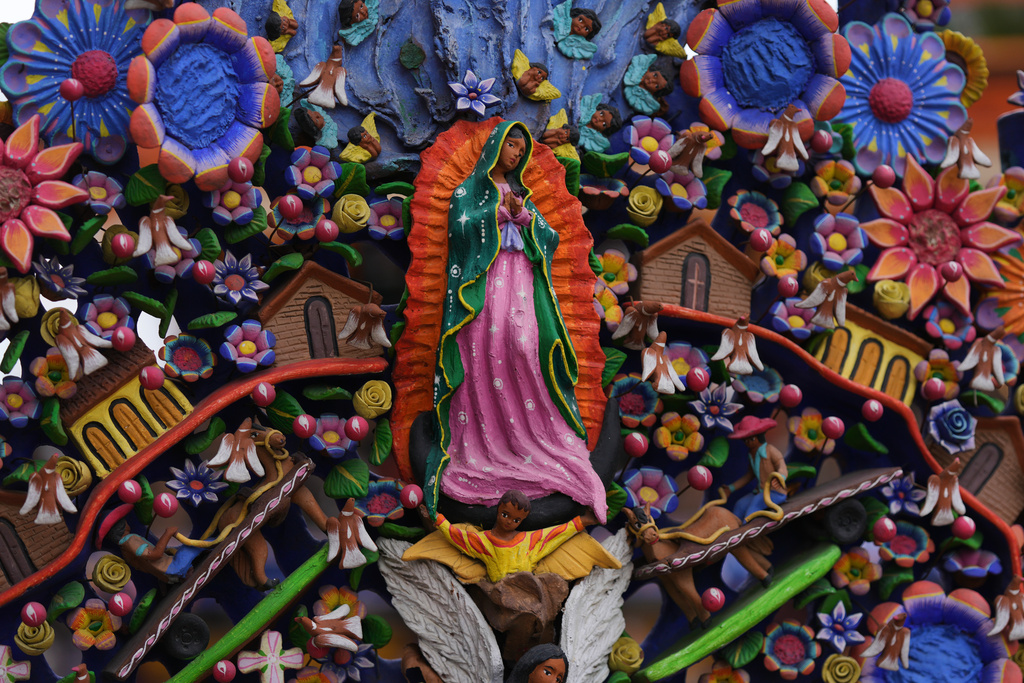
A statue of the Virgin of Guadalupe decorates a tree of life sculpture in the main square of Metepec, Mexico, Thursday, Oct. 9, 2025. (AP Photo/Fernando Llano)

Published by The Associated Press, September 2025

Spanish story language here

The first time he met a pope, Mexican craftsman Hilario Hernández could not believe his luck. He did not travel to the Vatican as a guest, but as the guardian of the fragile ceramic piece he had created as a gift for Benedict XVI.

“No one really planned to take me along,” Hernández said. “But a Tree of Life can easily break, so I got the chance to bring it myself.”

The work he was commissioned to create for the pope in 2008 is a celebrated expression of Mexican craftsmanship

Known as a Tree of Life, it belongs to a tradition that flourished in the hands of artisans in the mid-20th century and is considered a symbol of identity in Hernández’s hometown.

In Metepec, where he lives and runs a family workshop about 40 miles (65 kilometers) southwest of Mexico City, dozens of craftsmen devote themselves to creating Trees of Life. Their designs vary, but most share a common motif: the biblical scene of Genesis, with Adam and Eve at the center, separated by the tree’s trunk and a coiled snake.

“The tree allows you to express whatever you want,” said Carolina Ramírez, a guide at Metepec’s Clay Museum. “It’s a source of pride for us, as it has become part of the town’s identity and charm.”

The museum holds an annual contest that encourages artisans from across Mexico to submit their versions of the tree. It now houses more than 300 pieces and displays a permanent selection of them.

Aside from Adam and Eve, the trees display a variety of figures like Catrinas — skeletal female figures that have become a symbol of Mexico’s Day of the Dead celebrations — and Xoloitzcuintles, hairless dogs sacred to ancient Nahua people.

“A tree’s theme draws from our culture and traditions,” Ramírez said. “And for the people who buy them, they’ve become a source of identity.”

Heritage in clay

Hernández’s ancestors have crafted clay pieces for as long as he can remember. His grandfather, now 103, still creates pots in Metepec.

“We’re the fifth generation of potters and artisans,” said Felipe, one of Hilario’s younger brothers. “Our knowledge is passed down by word-of-mouth.”

All five siblings trained for technical careers. None went on to practice them, choosing to become full-time artisans instead.

Hilario — the eldest — became his brothers’ mentor. Their tasks now rotate among them. While one shapes leaves for the trees, another attaches them or paints. All take pride in their family’s legacy.

Luis, now 34, said he has crafted Trees of Life since age 12. “This workshop was my playground,” he recalled. “What I initially thought of as a game, later became my job.”

Another local artisan, Cecilio Sánchez, also inherited his father’s skills and went on to found his own workshop. Now his wife, two children and other relatives work together to create a tradition of their own.

His technique is known as pigmented clay and consists of mixing clay with oxides. “Some fellow artisans add industrial pigments to their pieces, but our work is about preserving what the earth itself gives us,” he said.

Where tradition meets myth

While making his first tree for a pope, Hilario pushed his own limits as an artisan. 

Drawing on his father’s ancestral wisdom, he fired the 2-meter-tall (6.6-foot-tall) clay piece at just the right temperature. To transport it, he wrapped it like a giant mummy using 200 rolls of toilet paper to cushion and seal every hollow space.

Then there was the design. For six months, he and his family patiently crafted figures on both sides — a challenge rarely faced in the business. One face told the story of Mexico’s most revered saints; the other, the origins of Metepec’s Tree of Life.

The details of that history are unclear. Yet experts agree that such trees might have played a role in evangelization after the Spanish Conquest in the 16th century.

According to Ramírez, the first artisans to reinterpret them in modern times incorporated elements distinctive to Metepec. One of them is known as the Tlanchana, a half-woman, half-serpent figure who, legend has it, once ruled the waters around the town.

“It was thought that her coming out of the water brought abundance,” Ramírez said. “For our ancestors, deities were bound to fire, water and nature.”

The Tlanchana figures in Hernández’s Trees of Life, though, no longer resemble snakes. Given that the reptile is regarded as a representation of evil, temptation and death within the Catholic worldview, its tail was replaced. In her current form as a mermaid, she is perhaps Metepec’s most iconic symbol alongside the Tree of Life.

Faith in his hands

Hilario keeps a special frame on his worktable: a photograph of the day he met a pope for the second time.

On that occasion he didn’t travel to the Vatican. In 2015, a stranger knocked on his door and asked him to create another Tree of Life — this time, for another pope. Francis was soon to visit Mexico and the president wanted the artisan to present him with a masterpiece.

Hilario’s new assignment took three months of hard, family work. Francis’ tree would not be as tall as the one made for Benedict. But the design presented challenges of its own, as it was to portray the pope’s life.

The craftsman visited nearby chapels, spoke to priests and read as much as he could. In February 2016, when he met the pope inside Mexico’s Presidential Palace, he realized he still had much to learn.

“He ended up explaining to me his own tree,” he said. “And he added: ‘I know you didn’t do this on your own, so God bless your family and your hands.’”

The meeting had a life-changing effect on him. It made him reflect on his purpose in life and reaffirmed his calling to his craft.

“Making Trees of Life is a commitment,” he said. “It’s how we make a living, but it’s also how we keep our culture alive.”

____

Associated Press religion coverage receives support through the AP’s collaboration with The Conversation US, with funding from Lilly Endowment Inc. The AP is solely responsible for this content.

For Paraguay’s transgender women, survival often means leaving home

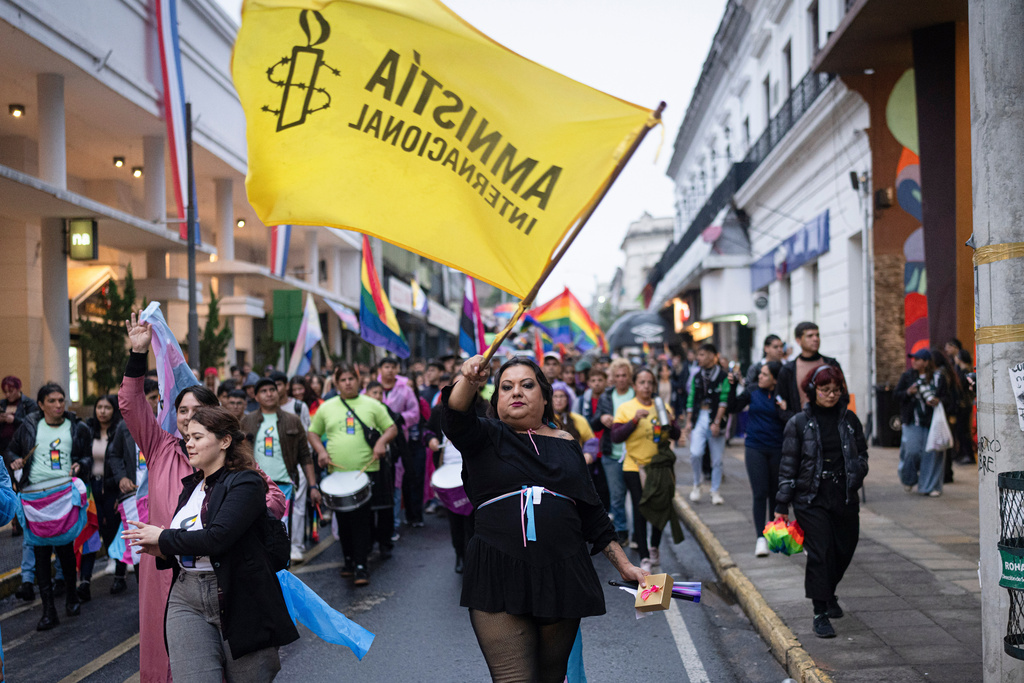
Activist Yren Rotela waves an Amnesty International flag during a Pride March in Asuncion, Paraguay, Saturday, June 28, 2025. (AP Photo/Jorge Saenz)

Published by The Associated Press, September 2025

Spanish story language here

ASUNCIÓN (AP) – In Paraguay, one of the most conservative countries in the Americas, many LGBTQ+ people feel compelled to leave their hometowns due to discrimination, harassment and gender-based violence. 

Social rejection and the absence of legal protections take a particular toll on transgender women like Alejandra Mongelós, who first fled her home in 2013 when she was 8 and already identifying as trans. The search for a safe place where she could be herself became an ongoing struggle.

Her life took a turn after a relative molested her. The situation sparked a family quarrel that ended with her mother in prison. Mongelós was then placed in the first of several foster homes where rejection became the norm.

“In one of them, there was this guy who talked to me about God,” said Mongelós, now 20. “He told me: ‘God created you a man, so you have to be a man.’”

Before meeting another trans woman who would take her under her wing at age 13, she says she cycled through nearly 30 foster homes. She would sometimes stay for a month. Other times, not even for a week.

“I kept running away,” she said. “My own caretakers mistreated me.”

Faith and politics uphold exclusion

Macho attitudes have long fueled discrimination against LGBTQ+ Paraguayans.

Close to 90% of the population is Catholic. And while a repressive dictatorship ended in 1989, the conservative Colorado Party has ruled almost uninterrupted since 1947.

Months before he was elected in 2013, former President Horacio Cartes compared gay people to monkeys and said he would rather shoot himself before his son married a man.

The current president, Santiago Peña, said prior to his election in 2023 that he rejects abortion and Paraguay would defend marriage as the union between a man and a woman.

“As an election cycle begins, the ruling party launches a battle against what it calls ‘gender ideology,’” said attorney Michi Moragas, who specializes in cases involving women’s rights and LGBTQ+ causes. “It’s a way of turning gender issues into an internal enemy.”

That campaign extends to classrooms and encompasses reproductive rights. Comprehensive sex education programs are banned in schools. Curricula overseen by the Catholic Church promote abstinence as the ideal. And the power of the Colorado Party in Congress has prevented discussion on abortion or same-sex marriage, both of which remain forbidden.

“We have a sexist culture where men are men, women are women and nothing else is accepted,” said Yrén Rotela, a trans activist who became a mentor to Mongelós. “That’s why this prejudice endures.”

Shelters offer safety as violence goes unrecorded

Mongelós now lives in Casa Diversa, a shelter founded by Rotela in 2018 to protect LGBTQ+ people.

Most beneficiaries migrated within Paraguay in need of safety, work and companionship. Rotela provides them with clothing, meals, training to work as hairdressers and support to overcome addictions.

“I migrated too and was a victim of human trafficking,” said Rotela, who transitioned at age 13 and turned to sex work to sustain herself. “All my scars are the result of the violence I experienced on the streets.”

Activists like her contend that some Paraguayans who spot trans women walking down the street throw glass, liquids and stones at them. Others chase them with machetes or shoot at them.

These attacks generally go unrecorded by the authorities. Most cases are documented only by LGBTQ+ organizations. According to Moragas, trans women feel discouraged to file a police report after being attacked, believing officers won’t take them seriously.

“In theory, the police are supposed to pass on the reports to the prosecutor’s office,” she said. “In practice, they often don’t — or they mistreat the women, mock them, and as a result many decide not to file a complaint.”

Isabel Gamarra, director of another LGBTQ+ organization called Escalando, said she started migrating after her family forced her out when she transitioned at 15.

She became a sex worker for about 10 years. The violence became unbearable and she fled to Argentina, where she lived for three years before returning to Paraguay.

“The killings of trans people were horrific,” she said.

A fight for dignity beyond legal texts

Paraguayan law does not recognize transgender identity or hate crimes. The Constitution forbids discrimination, but what that means in practice — and the legal steps victims should take — remains unclear. Given the legal loophole, a bill is pending in Paraguay’s Congress to establish mechanisms to address cases of discrimination.

To push for its approval and to demand a gender identity law, human rights defenders and members of the community protest each Sept. 30.

The date commemorates the publication of an anonymous letter regarded as a symbolic act of resistance against Gen. Alfredo Stroessner’s regime in 1959.

Days prior to the letter’s publication, radio host Bernardo Aranda was found dead in his home and Stroessner used the case as an excuse to prosecute 108 men identified as homosexual as suspects of the crime.

Nelson Viveros joins the protests each year. In Asunción, where he settled after years of leaving his hometown, he joins the march as his drag persona, Dislexia.

“Nowadays I’m doing fine, but I have to endure constant remarks,” said Viveros, who identifies as a gay man. “Everything I represent is despised and marginalized. People want us to hide.”

His relationship with his family was never as fractured as those of the trans women at Casa Diversa. But it took a while for his parents to fully embrace his identity and relocating became essential for him to feel comfortable.

“I don’t know if I want to wait for things to improve in Paraguay,” said Viveros, who had plans to migrate to the United States but gave up that dream when Donald Trump won the presidency.

“I want to have a better life and feel safe,” he added. “If something ever happens to me, I want to be able to denounce it.”

He, like Rotela and other activists, thinks that Paraguayan trans women face tougher challenges than gay men or lesbians, given that their physical appearance can make them targets for violence.

“I dress like this (in masculine garments) because I take the bus and walk,” he said. “But one shouldn’t alter one’s personality in order to survive.”

Rotela, too, joins the September protest every year and says she won’t stop fighting to secure LGBTQ+ rights.

“We need to start breaking down discrimination, stigma and prejudice,” she said. “Because what’s the point of a law if society won’t respect you?”

“What good is changing our names if we’re still being killed?”

____

Associated Press religion coverage receives support through the AP’s collaboration with The Conversation US, with funding from Lilly Endowment Inc. The AP is solely responsible for this content.
Afro-descendants in Bolivia fight invisibility with dance and memory

A young member of the Afro-Bolivian community dances the “saya,” a traditional dance performed with drums and chants, as part of the celebrations to mark the upcoming National Day of Afro-Bolivian people, in La Paz, Bolivia, Friday, Sept. 19, 2025. (AP Photo/Juan Karita)

Published by The Associated Press, September 2025

Spanish story language here

YUNGAS, Bolivia (AP) – Cielo Torres had always lived in Bolivia. Yet before moving at age 17 to the remote town of Tocaña — where much of the country’s Afro-descendant community lives — she had rarely encountered people who looked like her.

“Back in Santa Cruz, we were the only Afro,” said Torres, now 25. “But when I saw others like me, I told myself: This is where I want to be. Here I feel comfortable and understood.”

Her sense of belonging echoes the experience of many Afro-Bolivians. Although officially recognized in the constitution since 2009, they remain one of Bolivia’s least visible groups, struggling to feel at home in their own land.

“Many think that we are foreigners and we don’t have any rights,” said Carmen Angola, executive director of the Afro-Bolivian National Council (CONAFRO). “But we were born here.”

More than 11.3 million people live in Bolivia. Around 23,000 identified as Afro in a 2012 census, the first and only time they appeared as a distinct category. Most live in Yungas, a region where roads and communications are scarce but coca leaf plantations abound.

“Our Afro communities depend on coca harvesting or honey production,” said Torres, who runs a beekeeping business with her husband.

“We are people used to walking trails instead of paved roads,” she added. “People who learn from the land.”

Symbolic gestures, scarce change

Official information on the community’s history is hard to come by. “We have been made invisible by the state,” said activist Mónica Rey. “There weren’t any written registers reflecting our reality. We wrote that history down ourselves.”

She said some progress was made in 2007, a year after Evo Morales became Bolivia’s first Indigenous president. “By 2009 we were included in the constitution,” she added. “But we have demanded our inclusion and rights to all the past governments.”

Morales supported CONAFRO’s founding in 2011. That same year, Sept. 23 was established as the National Day of the Afro-Bolivian People and Culture. Still, according to Rey, symbolic recognition is not enough to achieve structural change.

“The idea was that this day would serve to reaffirm our identity and that the state would create public policies for the Afro people,” Rey said. “But it turns out we celebrate among ourselves and the government doesn’t do anything.”

She and Carmen Angola contend that promoting their people’s legacy has proven difficult. Angola has tried to convince local authorities to allow a group of Afro-Bolivians to visit schools and share insights of their community. None have agreed so far.

“They just say they’re going to address discrimination, history and racism,” Angola said. “But the people who created the curricula aren’t Black. Their history is not ours.”

From the mines to the ‘haciendas’

CONAFRO joined efforts with another organization to gather testimonies documenting the Afro-Bolivian community’s long-lost past. A comprehensive document was released in 2013.

“We got our history back,” Rey said. “Our experiences, our elders’ tales, our culture, have been retrieved and documented.”

The Afro-Bolivian people descend from the Africans enslaved in the Americas during the European conquest between the 16th and 17th centuries. 

Mostly born in Congo and Angola, they were initially taken to Potosí, a colonial mining city located about 340 miles (550 kilometers) southeast of La Paz.

The high altitude — 13,700 feet (4,175 meters) above sea level — and the extreme weather quickly took a toll. Later on, exposure to mercury and other substances in mining led to severe illnesses — from tooth loss, respiratory disease and death.

Two centuries later, the ancestors of the current Afro-Bolivian population were forcibly relocated to Yungas. There they settled and started working in large estates known as ‘haciendas,’ where coca leaf, coffee and sugar cane were grown.

“The Afro people were dying and that was inconvenient because they were considered investments,” said sociologist Óscar Mattaz. “So people started buying them and taking them away.”

Now Tocaña and neighboring towns are considered the cultural heart of Afro-Bolivians.

A king with no crown

In Mururata lives Julio Pinedo, a symbolic leader regarded as the king of the Afro-Bolivians.

Bolivia’s Black community has recognized kings for centuries. Pinedo’s role carries no political weight within the government, but he is considered a guardian of his people’s rights. Local authorities acknowledge his title and even attended his coronation in 1992.

“The king was a symbolic means to show there’s royalty in the community,” Mattaz said. “He was very influential, worked hard and was respected.”

His position hardly made a difference in his lifestyle. Pinedo, now 83, resides in the same humble home he has always lived. He now relies on his son’s coca harvest for income.

Pinedo welcomes visitors. But engaging in conversation is hard due to his age. According to his wife, Angélica Larrea, his royal ancestry dates back 500 years. 

“I remember his coronation,” she said. “People came from other communities. They danced and there was a procession. A priest came and we celebrated Mass.”

A handful of Afro-Bolivians have tried to decipher what their ancestors’ spirituality was. Yet the community remains overwhelmingly Catholic.

Close to Pinedo’s home, the sole parish of Mururata has no resident priest. Nonetheless, a group of devoted women are welcomed to read the Bible each Sunday. 

Isabel Rey — a distant relative of Mónica — said her ancestors were Catholics. And even without a priest to rely on, the catechist in charge of the church has kept the community’s faith strong.

“She will soon celebrate 40 years sharing the Lord’s word,” Rey said. “I help her, because she can’t keep up the work alone.”

A dance of struggle and love

There might not be an Afro-Bolivian spirituality, but the community’s soul remains bonded through the “saya,” a traditional dance performed with drums and chants.

“Our demands were born through this music,” Rey said. “The saya has become our instrument to gain visibility. We protest with drums and songs.”

Torres recalled dancing saya before moving to Tocaña. Yet her feelings while performing it changed.

“Here it’s danced from the heart,” she said. “I learned how to sing and listen. It’s no ordinary music because we tell our history through it.”

She said each detail in their garments bears meaning. The white symbolizes peace and the red honors the blood shed by their ancestors. Men wear black hats to remember how their predecessors worked endlessly under the sun. And the women’s braids depict the roads they dreamed of to escape.

“It may seem like fashion, but it’s not,” Torres said. “It’s our culture.”

For more than a decade now, she has learned new moves and saya songs. She became fluent in her community’s language — a variation of Spanish that is not officially recognized — and is proud of her identity.

“I used to feel embarrassed for dancing saya,” Torres said. “But when I saw people dancing here, I told myself: ‘This is what I am. I am Black.’”

Committed to raising her daughter to also be proud of her ancestry, she constantly praises her skin color, hair and moves.

“She already dances saya,” Torres said. “I tell her: ‘You are Black. My Black little girl.’”

____

Associated Press religion coverage receives support through the AP’s collaboration with The Conversation US, with funding from Lilly Endowment Inc. The AP is solely responsible for this content.
Mexican churches mark the anniversary of deadly quakes with remembrance and lessons for the future

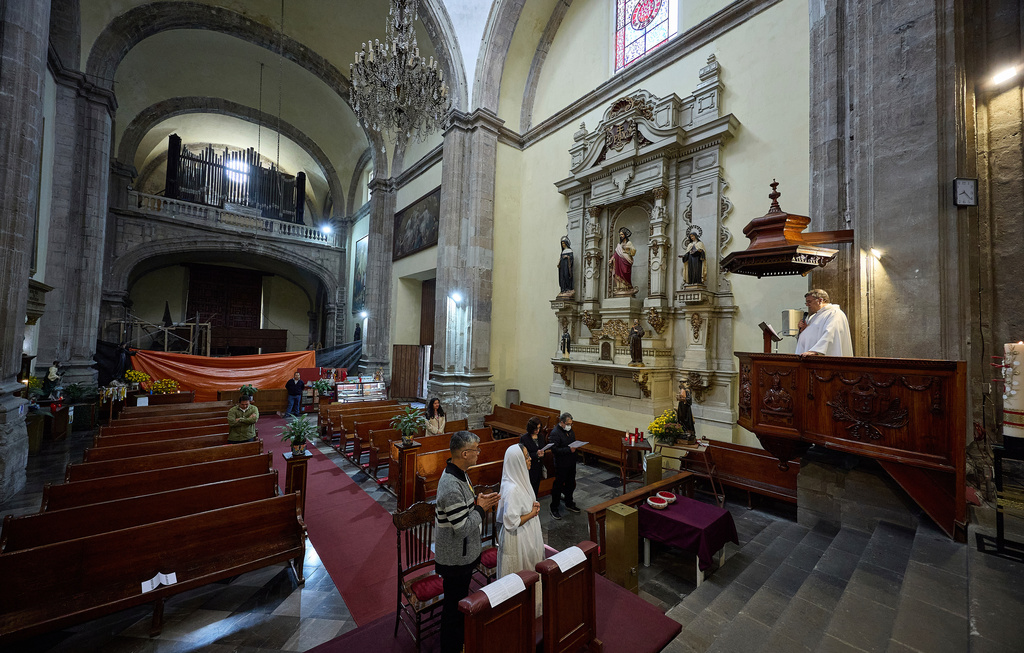
Vinicio Cruz and Carmen Chavez get married during a ceremony by Father Juan Carlos Guerrero inside San Juan de Dios church in Mexico City, Friday, Sept. 19, 2025. The church withstood the 8.0 earthquake of 1985, however, its structure was severely damaged in 2017 and it was forced to shut down and reopened in late 2024 after most of its restoration was completed. (AP Photo/Ginnette Riquelme)

Published by The Associated Press, September 2025

Spanish story language here

MEXICO CITY (AP) – Carmen Chávez has a clear answer for those wondering why she and her partner chose to get married on Sept. 19 — the anniversary of two deadly earthquakes that struck Mexico 32 years apart.

“This was a tragic date for me,” said Chávez, who remembers how buildings collapsed in downtown Mexico City 40 years ago. “So I want to give this day a new meaning. From now on, it will mark the beginning of our life together.”

There is no official consensus on the overall death toll from the 1985 and 2017 earthquakes. Some estimates put the total figure at more than 12,000, but the real number remains unknown.

The coinciding dates fuel anxiety for many, especially after a third, less damaging quake hit the country on Sept. 19, 2022. But seismologists and researchers say there is no physical reason for the concurrence of major earthquakes on a specific date.

As Chávez’s wedding ceremony ended Friday morning, police closed off nearby streets to traffic for an earthquake drill. Meanwhile, exhibits, lectures and Masses took place all over the city to remember the quakes’ victims.

Mexico’s flag was flown at half staff outside Mexico City’s cathedral. A message was posted on its social media channels: “Those days left us wounded, but they also taught us that solidarity is greater than fear.”

Churches still bear scars from quakes

The Catholic venue that Chávez and her partner chose for their wedding carries a deep significance on this particular date.

The San Juan de Dios church withstood the 8.1 magnitude earthquake of 1985. However, its structure was severely damaged in 2017, forcing it to shut down. It reopened in late 2024, after most of its restoration was completed, though some interior work is still pending.

Across the plaza, another sanctuary, Santa Vera Cruz, remains closed to the public. No reopening date has been announced, but Monsignor Juan Carlos Guerrero, in charge of both parishes, hopes it can welcome visitors again by the end of this year.

“We need to keep up the restoration of our buildings,” Guerrero said. “The life of these monuments is closely linked to the people’s identity.”

Chávez said she and her partner chose San Juan de Dios as a wedding venue because her late grandmother used to attend frequently.

“It’s a parish full of history and it’s so beautiful,” she said. “Its paintings, its architecture, I love being here.”

Learning from tragedy

The Rev. Salvador Barba, who became an intermediary between the Catholic church and officials in charge of restoring federal buildings after 2017, said more than 150 churches were damaged by that earthquake in Mexico City alone. Forty were forced to shut down due to structural damage.

Nationwide, more than 3,000 churches were affected. By late 2024, nearly 90% had been restored, along with 4,000 pieces of sacred art, a government press release said.

Barba suggested that the 2017 earthquake was groundbreaking for the Catholic Church. “We raised awareness among priests that we need to take care of our churches,” he said. “An expression that we now frequently use is ’preventive maintenance’.”

That means priests nationwide can reach out to him to report cracks or any details that call for professional attention. Barba then forwards the report to the experts at the federal government and the buildings are inspected.

“We must not wait until it becomes worse,” he said. “That is what caused so much harm.”
____

Associated Press religion coverage receives support through the AP’s collaboration with The Conversation US, with funding from Lilly Endowment Inc. The AP is solely responsible for this content.
Coca leaves remain a source of work, faith and identity in Bolivia

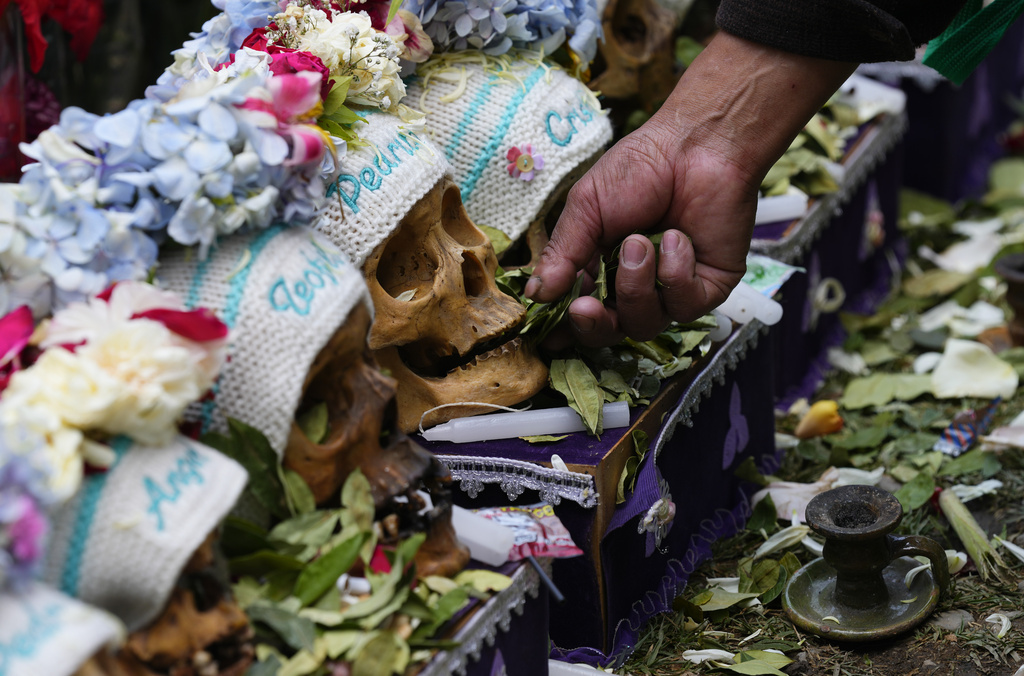
A person puts coca leaves into the mouth of a decorated, human skull on display at the General Cemetery, as an offering during the annual «Natitas» festival, a tradition marking the end of the Catholic holiday of All Saints in La Paz, Bolivia, Nov. 8, 2023. (AP Photo/Juan Karita)

Published by The Associated Press, September 2025

Spanish story language here

LOS YUNGAS, Bolivia (AP) – Tomas Zavala performs a ritual ahead of each workday in his coca field.

Deep in the lush green mountains of Bolivia’s Yungas region, the 69-year-old farmer closes his eyes, faces the soil, and asks Mother Earth for permission to harvest coca leaves.

“The coca leaf is the core of our survival,” Zavala said. “If we work the land without permission, it gets ruined.”

Outside Bolivia, the green leaf is best known as the main ingredient in cocaine. But within the South American country it is widely considered sacred, present in both rituals and everyday life.

“The coca leaf allows us to send our children to school and put food on the table,” said Zavala, who relies on harvesting coca leaves for income. “It’s useful for everything.”

The practice that fuels Bolivia’s workforce

Bolivia recognizes the coca leaf as part of its cultural heritage, allowing cultivation within designated areas. According to the country’s Coca Producers Association, its production employs more than 45,000 people nationwide.

Most Bolivians use coca leaves for “boleo,” a practice recognized as an intangible cultural heritage since 2016. The word has no English translation. It means placing a compact wad of leaves inside the cheek.

Many refer to it as chewing, but the leaves are rarely treated like gum. Instead, people let them slowly release their active compounds. The alkaloids act as stimulants, though producers and government officials insist their effects remain mild — far from those of processed cocaine.

“It slows down our fatigue and takes away our hunger,” said Rudi Paxi, secretary of the producers association. “You’ll always watch the people from Yungas doing boleo as they head to work.”

Neri Argane, 60, works at a coca plantation in Yungas for 11 hours a day, six days per week. “We do this no matter the sun, the rain or the cold,” Argane said.

She eats bananas, rice and corn tortillas to keep up her strength. But only boleo enables her to endure long hours crouching in the fields, she says.

Families pass down coca fields like heirlooms

Bolivia’s government has made several attempts to highlight how the coca leaf is intertwined with its people’s cultural traditions.

Even as coca’s global reputation remains linked to drug trafficking, President Luis Arce sought to highlight its cultural roots. Earlier this year, he performed a public boleo to mark National Coca Chewing Day.

“Our government values the ​​coca because it is a cultural symbol,” he said. “It represents our identity and sovereignty. It has medicinal and ritual values, and is a source of social cohesion.”

In the Yungas region, where Zavala lives about 60 miles (100 kilometers) from the capital city of La Paz, the heritage of dozens of families is tied to these hardy leaves.

“I watched my parents working the land since I was 8,” he said. “Luckily, they entrusted it to me. So I could survive.”

Mónica López also inherited her parents’ coca fields in a neighboring town. “I have been a farmer for as long as I can remember,” she said.

Raising healthy coca leaves is demanding. All work is done by hand, without machinery or animals to help. Farmers prepare the soil by October, sow the land by December and harvest the crops around February.

Most fields are handled by family members. On any given day in Yungas, it’s common to spot children next to their mothers and grandparents while they clean the leaves.

“I’ve been in the coca fields since I was 2 and I can tell you this work is hard,” said 22-year-old Alejandra Escobar. “But the coca leaf brings us plenty of benefits. When we have no money, it’s what we consume.”

Bolivians from rural areas regularly drink coca leaf tea to heal headaches and stomach inflammation. Elsewhere in the country, people use it for pancakes, ice cream and beer.

“The coca is everywhere,” Paxi said. “It unites us as families. It’s our company.”

Coca leaf nourishes both body and spirit

The coca leaf also plays a key role in Bolivians’ spirituality. “It’s used to start most of our rituals,” said anthropologist Milton Eyzaguirre. “Before you start a new job, for example, you set up a ‘mesa’ (or table) and coca leaves around.”

In the worldview of the Aymara, the region’s Indigenous people, ‘mesas’ are offerings for Pachamama (Mother Earth). Built from wooden logs, they are arranged by spiritual leaders who pray for wealth, protection and good health.

“The coca leaf helps us see,” said Neyza Hurtado, who was hired by a family to perform a ritual ahead of the recent Pachamama month. “By deciphering a coca leaf, you can know how a person is.” 

Personal rituals with coca leaves are common. According to Eyzaguirre, bricklayers regularly make a boleo before each workday. And like Zavala, they ask for Mother Earth’s permission to kick off the day.

“People even use it to travel,” Eyzaguirre said. “When you go somewhere by foot, you make coca offerings and consume it, to gather strength.”

Rituals for Pachamama live on in the Yungas

López’s coca leaf rituals start on the first minute of Aug. 1. “We thank Mother Earth, because if she gets tired, nothing sprouts,” she said.

At the mesa inside her home, her spiritual leader places sweets, rice and cinnamon. Before lighting it on fire to complete the offering, López adds 12 coca leaves. “We ask for wishes with the coca,” she said. “We ask for good luck for 12 months, from August to August.”

Just like the Yungas field, her faith in Pachamama was inherited from her parents. Now she performs her rituals alongside her five children, hoping they will keep the tradition alive. 

Zavala’s rituals occur both inside his house and in his field. He, too, encourages his grandchildren to participate. “We need Pachamama in the terrain, to have a good production,” he said.

Aside from asking Mother Earth’s permission to work, Zavala performs an Andean tradition known as “chaya.” The word refers to the custom of spraying alcohol onto the ground as an offering, either for requests or as an act of gratitude that symbolizes giving back to Pachamama.

“It’s what our elders passed down to us», he said. «So we must preserve it.” 

___

Associated Press religion coverage receives support through the AP’s collaboration with The Conversation US, with funding from Lilly Endowment Inc. The AP is solely responsible for this content.
Paraguay is fighting to preserve Guaraní, a language of roots and soul

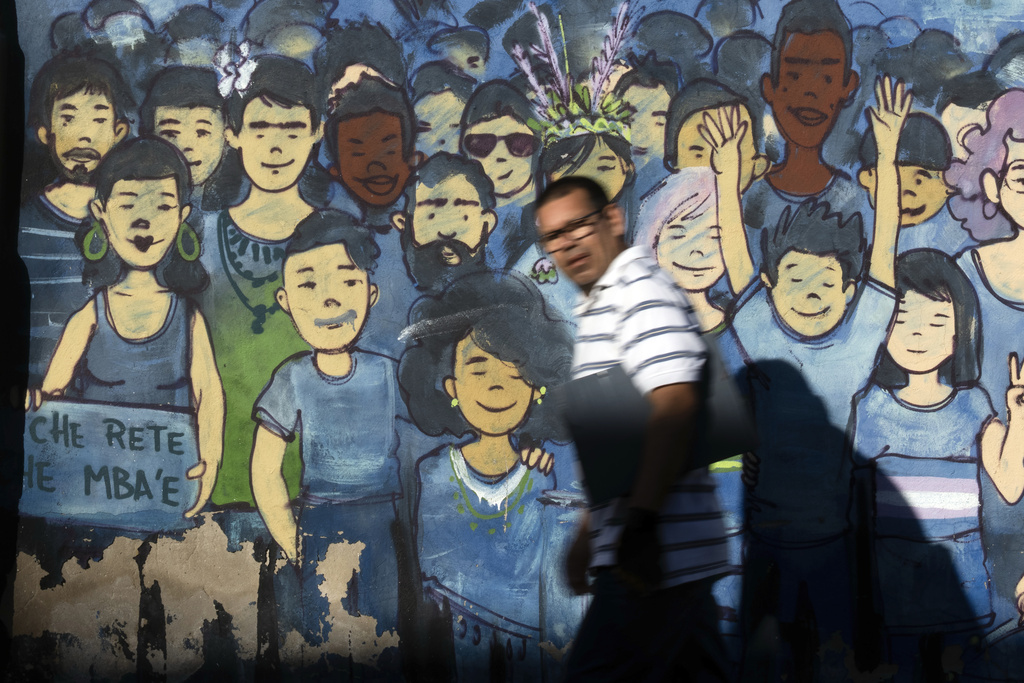
A pedestrian passes a mural that rads in the Indigenous Guarani language «Che rete, che mba’e» which means «My body is mine» in Asuncion, Friday, Aug. 22, 2025. (AP Photo/Jorge Saenz)

Published by The Associated Press, August 2025

Spanish story language here

LOMA GRANDE, PARAGUAY (AP) – When it came time to choose a wedding venue, Margarita Gayoso and her partner Christian Ojeda knew exactly where they wanted to go. 

Despite living in Spain, the couple traveled to their long-missed hometown in Paraguay for a ceremony officiated in their ancestors’ language.

“Everyone was crying because everything feels so profound in Guaraní,” Gayoso said. “It’s as if the pronunciation pours out of your soul.”

Guaraní is one of Paraguay’s two official languages alongside Spanish. But linguists warn that fluency among younger generations is slipping, so nationwide preservation efforts are underway.

Many Paraguayans believe that Guaraní carries a deep emotional significance. Yet because the language’s use remains primarily oral, it rarely appears in official documents, government records and literary works. 

Even finding a Catholic priest who could preside over Gayoso’s wedding ceremony in Guaraní proved difficult. Still, it was worth the extra effort. Some guests told her that it was the first local wedding they had attended that was conducted entirely in their mother tongue.

Why Guaraní remains at the heart of Paraguay

Of the country’s 6.9 million people, about 1.6 million reported Guaraní as their main language, according to Paraguay’s official 2024 data. Whereas, 1.5 million use Spanish, and 2.1 million identify as bilingual. Other Indigenous languages account for the rest. 

The Guaraní spoken today differs from the version that Europeans first encountered during the Latin American conquests in the 1500s. Still, its survival in a region where most countries shifted to Spanish is remarkable. Why has it managed to remain dominant?

“In the Guaraní culture, language is synonymous with soul,” said Arnaldo Casco, a researcher from Paraguay’s Department of Linguistics.

“The word is what the Lord bestowed on men, so we believe that, for the Guaraní people, losing their language was like losing their soul.”

Reflecting this deep connection to their language, the Guaraní people fiercely resisted learning Spanish. That’s why early European missionaries saw no other option but to learn Guaraní for evangelization purposes. 

A language preserved yet punished

Jesuit and Franciscan priests produced Guaraní’s first written records in Paraguay.

The alphabet and dictionary they developed became essential for delivering sermons and helped preserve the language from extinction. Still, those efforts were not enough to shield Guaraní from centuries of marginalization that followed.

Casco said that close to 90% of the population were primarily Guaraní speakers by the early 19th century. But as the country regained its independence from Spain in 1811, efforts to promote its widespread use have been erratic.

While its use was encouraged to promote national unity during wartime in the 1930s, a postwar decree prevented teachers and students from using it in schools. 

“My parents and other parents were tortured for not speaking Spanish,” said Miguel Ángel Verón, a linguistics researcher whose father was beaten in the mouth for communicating in Guaraní. “Why was not speaking Spanish his fault? He and my uncles ended up abandoning school.”

Spanish-Guaraní bilingual education became mandatory in 1992. Both languages are required in classrooms, but the law does not guarantee textbooks in Guaraní or foster widespread awareness of the need to preserve it.

Both Casco and Verón said that dozens of families no longer speak to their children in Guaraní. They fear the use of their mother tongue might hold them back from success, so they encourage them to learn English instead. 

“Paraguay continues to suffer from a deep linguistic wound,” Verón said. “It might be easy to pass a law, but shifting our attitudes requires so much more.”

What language entails

Those working to preserve the language contend there’s more to Guaraní than words.

“The fundamental human values that we Paraguayans hold come from it,” Verón said. “Solidarity, reciprocity and a sacred respect towards nature.”

“Jarýi,” for example, is a Guaraní word that has no Spanish translation. It describes god-like protectors of the land, which according to some people like Verón’s father, needs years of rest in order to regain its wisdom and strength between harvests.

“If you destroy a forest to eat, you won’t be in any trouble. But if you do it just for the sake of it or to earn money, the jarýi will come,” Verón said. 

Casco, too, learned various lessons from a medicine man that cured people in his hometown. “Knowing that prayer can heal is a legacy from the Indigenous people,” he said.

Across Paraguay’s rural areas, hundreds of other testimonies link language with faith. Yet no written records of those beliefs had been produced until now.

To create a register of those collective memories, Casco leads a project to interview Guaraní speakers over 60 years of age. His team has spoken to 72 people so far and the interviews will be published on the Department of Linguistics’ website when the transcripts are done.

“Our goal is to rescue the connection that we have with our roots and history through language,” Casco said.

Rescuing Guaraní

Several interviewees live in Loma Grande, the town where Ojeda and Gayoso wed.

Juana Giménez, 83, possesses a deep understanding of medicinal plants. Desperate parents with crying babies used to take their children to her. And Giménez, with a mix of herbs, smoke and prayer, helped reduce the stomach inflammation that so regularly brought them to tears.

Marta Duarte, 73, learned Spanish and moved to the capital city Asunción to work as a tailor for years. She came back to Loma Grande in her 30s and currently helps at the local church, where attendees read the Bible in Spanish and she discusses the passages in Guaraní.

Carlos Kurt, an 85-year-old descendant of German immigrants, fell in love with Paraguayan ancestral words at a young age. He still laughs as he recalls the day his second-grade teacher sent a note to his German-speaking parents: “Your boy is a good student, but he speaks way too much in Guaraní.”

“I just loved the language,” he said. “I learned it and nothing escaped me. Now my grandson does not speak it. He doesn’t like it.”

Other Paraguayans echoed how their descendants are letting go of the language, but Sofia Rattazzi is an exception. She lives in Asunción with her mother and grandmother, Nancy Vera, to whom she speaks only in Guaraní.

Following Vera’s beliefs in a concept known as “yvyguy» treasure — gold hidden by rich Paraguayans during wartime in the 1800s — the family regularly digs up holes in their backyard.

Vera has always had a particular closeness to the land, Rattazzi said, as it has previously signaled to her where jewelry might be. “She discovered places where the earth and water break and there lay rings and other stuff,” she said. 

Rattazzi said her grandmother doubted participating in the language project, not knowing what good may come from the interviews. But she encouraged her.

“I want her to see how her own history matters,” Rattazzi said. “Now something will be left from her once she is gone.”

___

Associated Press religion coverage receives support through the AP’s collaboration with The Conversation US, with funding from Lilly Endowment Inc. The AP is solely responsible for this content.
How Orthodox Jewish families are finding ways to support their trans children

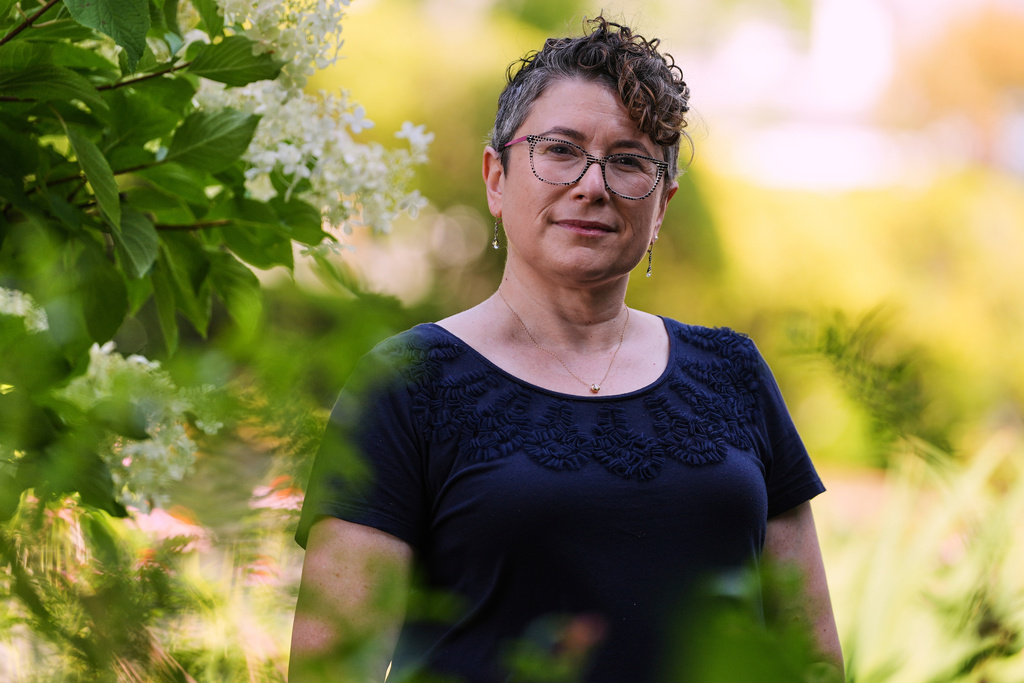
Ziva Mann, mother of a transgender child and member of a welcoming synagogue, poses in her garden, Wednesday, Aug. 13, 2025, in Newton, Mass. (AP Photo/Charles Krupa)

Published by The Associated Press, August 2025

Spanish story language here

Ziva Mann remembers how joyful and smiley her daughter was as a child — the family even gave her the nickname “Giggles.”

“She was just sunshine,” Mann said. That changed around second grade, when her joy began to fade. “She got sadder and sadder,” Mann recalled. “It was like watching someone disappear.”

Mann later realized that her child’s growing sadness was connected to a struggle to reckon with her gender identity

Her daughter came out as transgender at home in Massachusetts four years ago. “Mom, I’m a girl,” Mann remembers hearing her say. Though she was surprised by the news, she quickly came to admire her daughter’s bravery.

Since then, the family has striven to find the best ways to support Ellie within their modern Orthodox community, where tradition and strict gender roles shape daily life. They’ve managed to find emotional and spiritual resources close to home at a time when transgender rights are under attack nationwide.

Raising a trans child in Orthodox Jewish communities

Two of the three biggest branches of Judaism in the U.S. — Reform and Conservative — support the rights of transgender people, but it can still be challenging for trans youth to find an inclusive congregation. 

Schools in Orthodox Jewish communities are typically divided by gender, and most synagogues have separate seating sections for men and women — sometimes on different floors.

“Orthodoxy today is just binary,” said Myriam Kabakov, co-founder and executive director of Eshel, an organization supporting LGBTQ+ people in Orthodox environments. “You’re either male or you’re female. So if a trans person is in between transitioning, very often they will be asked not to come to synagogue.”

She said even after someone has fully transitioned, rabbis should allow them to sit where they feel comfortable. But that acceptance is not guaranteed.

To connect parents and trans children with inclusive synagogues, Eshel developed a program called “Welcoming Shuls,” where people can confide in spiritual leaders who will treat them with respect. 

According to Kabakov, about 300 rabbis and 160 families with trans members have joined their listings. Deslie Paneth is among them. She lives on Long Island and has traveled far to find support for Ollie, her transgender son. 

“One night, I said to my husband ‘I need help, I don’t know how to navigate this,’” Paneth said. “Without Eshel, I don’t know how this would have turned out for any of us.”

Balancing tradition and change

Mann defines herself as modern Orthodox, meaning she strives to uphold Judaic law while embracing the values within her family.

“The only time we break the rules is to save someone’s life,” she said. “Because a life is more important than all of the rules.”

Respecting her daughter’s identity felt akin to saving her life, so Mann didn’t feel the need to talk to God about it. She said who her daughter is as a person mattered more than the gender she thought she had.

Mann has heard of families with trans children who were asked to leave their synagogue, but this didn’t happened to her. Before discussing Ellie’s identity with other relatives, Mann reached out to her rabbi. He assured her that her daughter would be treated with dignity and respect.

“He offered us a blessing,” Mann said. “The strength, the love and the grace to parent a child who’s walking a difficult path.”

Finding a place to belong

Mann feels lucky to have found support, both in religious spaces and among family members, which has helped Ellie be her joyful self again. Some Orthodox families have faced a tougher process.

Paneth recalled her son, before starting his transition around 2017, was deeply religious and they enjoyed sitting together at synagogue. 

“He tells me still today that, especially around the holiday times, it hurts him that he can’t sit next to me in temple,” Paneth said. “He’s probably my child that has the strongest commitment to Judaism from an emotional connection.»

A rabbi told Paneth that Ollie is welcome to come to services, but he would now be expected to sit among the men. This is part of the reason why Ollie has not returned to synagogue since his transition.

Faith and identity at a crossroads

Ollie believes that his relationship with religion splintered as a student in an all-girls Orthodox Jewish high school. As he started raising questions about gender equality, none of the answers sufficed.

“I’m still convinced that if I wasn’t trans, I would still be a religious Jew,” the 27-year-old said.

He initially told his parents he was a lesbian. But since attending a secular college, making LGBTQ+ friends and feeling trapped during the pandemic, he decided to speak with them again. “If I was going to survive this, I had to come out with my parents as trans and start medically transitioning.” 

He had top surgery in 2022 and soon after met his girlfriend at JQY, a program for Jewish LGBTQ+ teens. The couple now lives together in New York.

Ollie doesn’t think of himself as Orthodox, and says he would like to find a new path toward God. Paneth understands and still includes him in the Jewish holidays. Ollie appreciates it.

Because he first connected to God as a girl, it doesn’t feel natural to him to embrace traditions that are typical for Jewish men, like wearing a kippah.

“I don’t do any of the tasks that men do religiously because I’m the same person I always was,” he said. “Even though I look different, my relationship to God didn’t change.”

Making synagogues more inclusive

Kabakov said many LGBTQ+ Jews eventually decide to leave Orthodoxy, but for those who wish to remain, Eshel and some spiritual leaders offer support.

Rabbi Mike Moskowitz, who works at an LGBTQ+ synagogue in New York, thinks of his job as helping people understand how they can be their authentic selves and still feel accepted by their religion. “It’s not that Judaism is the problem,” he said. “Orthodoxy, the people, are the problem.”

The counseling he provides for trans children and their parents is specific to each person, but in general, he offers fresh interpretations of the Hebrew Bible.

“Those who want to be transphobic say the Bible says you can’t wear misgendered clothing,” Moskowitz said. “I think a response is that trans folks are not wearing misgendered clothing. They’re wearing gender-affirming clothing.”

He, like Kabakov, believes there’s a trend in Orthodoxy toward more inclusivity, but there’s more work to do.

“Discrimination is unholy,” he said. “Unity is coping through kindness and being able to replace the weight of oppression with the elevation of love.”

____

Associated Press religion coverage receives support through the AP’s collaboration with The Conversation US, with funding from Lilly Endowment Inc. The AP is solely responsible for this content.
How one man’s dream led to 50,000 pilgrims honoring Our Lady of Copacabana in Bolivia

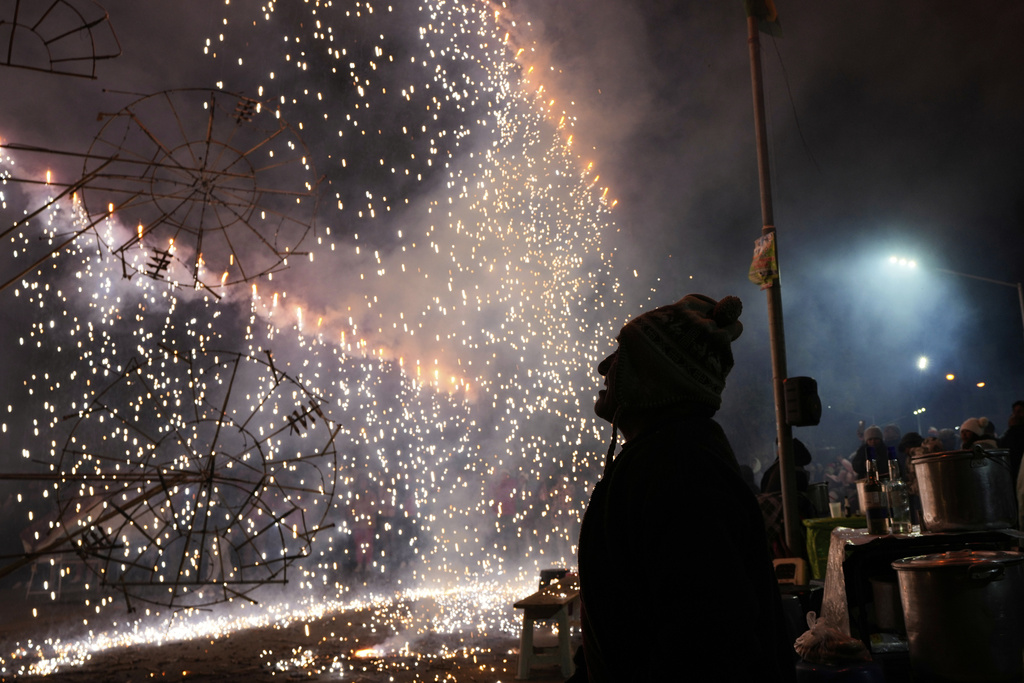
A man is silhouetted against a burst of fireworks during celebrations honoring Bolivia’s patron saint, the Virgin of Copacabana, in Copacabana, Bolivia, Monday, Aug. 4, 2025. (AP Photo/Juan Karita)

Published by The Associated Press, August 2025

Spanish story language here

More than 50,000 people from Bolivia and neighboring Peru make a pilgrimage every August to Copacabana, on the shores of Lake Titicaca, to honor Bolivia’s patron saint, Our Lady of Copacabana. In the main event of the celebration, a replica of the wooden-carved figure of the Virgin Mary leads a procession.

Her official feast is Feb. 2 — coinciding with Candlemas — but Aug. 5 marks the anniversary of her canonical coronation as the patron saint of Bolivia by a papal bull issued by Pius XII in 1925. This year is the 100th anniversary.

“She has granted me various miracles,” said Elizabet Valdivia, who traveled 12 hours by road and boat from the Peruvian city of Arequipa to join the procession. “She gave us our car, the possibility of raising my son, and I always ask her to watch over our jobs.”

The birth of a sacred icon

Our Lady of Copacabana’s basilica has safeguarded this Virgin Mary figure since the late 16th century. Her history dates back to 1583, when Inca descendant Francisco Tito Yupanqui crafted a figure in her honor.

According to Marcela Cruz, a guide at the museum next to the basilica, Yupanqui had a dream about the Virgin and molded a clay figure to depict her. He showed it to the chaplain, but after being rejected and mocked, he went for a walk by the lake.

“There, he encountered the image of the Virgin as an Inca maiden,” Cruz said. “That’s why her image is so simple.”

Inspired by the apparition, Yupanqui set off for the city of Potosí, about 330 miles (530 kilometers) from La Paz, the current capital city. There, he carved the image that is now revered in the basilica from a maguey tree trunk.

When Yupanqui traveled back to Copacabana, the town was under Spanish occupation, and both the Aymara and Quechua Indigenous people — now nationals from Bolivia and Peru — were at the site for evangelization purposes.  

“She arrived at dawn on Feb. 2, and both the Aymara and the Incas bowed down to welcome her,” Cruz said.

A shrine of faith, gratitude and generations of prayer

The museum named after Yupanqui displays hundreds of gifts that devotees have presented over the centuries. These include capes embroidered with gold thread, votive offerings, letters in braille and silver crowns resembling those Simón Bolívar melted down to secure Bolivian independence in 1825.

“Our Lady of Copacabana is the mother who welcomes all of her children regardless of their race or culture,” said Itamar Pesoa, a Franciscan friar residing at the convent adjacent to the basilica. “Within Bolivia, she is the queen.”

According to Pesoa, pilgrims travel from all over South America to present her with offerings. Some women who were unable to have children thank her for enabling them to become mothers. Others praise her for helping them recover from serious illnesses.

Several Masses in her honor are celebrated daily starting Aug. 4.

“This devotion continues to be passed down from generation to generation and inspires many to follow Christ,” Pesoa said.

Yupanqui’s original figure has not left the basilica for a procession since her coronation in 1925, but devotees revere her replicas nonetheless.

In a nearby chapel, parishioners light candles — one per miracle requested — and patiently wait for them to burn out before leaving. 

Sandra Benavides, who traveled from the Peruvian city of Cuzco, lit a candle and prayed for good health. She said some years ago she fell and the accident nearly killed her, but the Virgin interceded.

“Our Lady of Copacabana is miraculous,” Benavides said. “She is as if she were my mother, whom I have never had.”

____

Associated Press religion coverage receives support through the AP’s collaboration with The Conversation US, with funding from Lilly Endowment Inc. The AP is solely responsible for this content.

Burnt offerings, whispering to mountains: Inside Bolivians’ rituals for Mother Earth

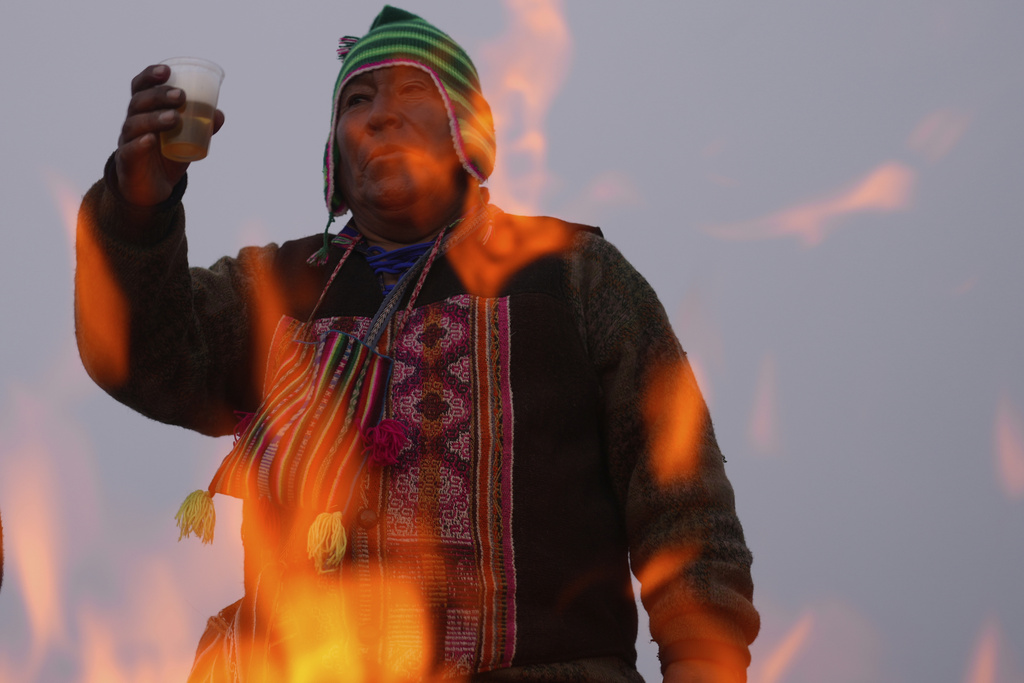
Spiritual leader Eusebio Huanca burns offerings observing the month of Pachamama, or Mother Earth, performing an ancient tradition to ask for a good harvest, on La Cumbre, a mountain considered sacred on the outskirts of La Paz, Bolivia, Friday, Aug. 1, 2025. (AP Photo/Juan Karita)

Published by The Associated Press, August 2025

Spanish story language here

Neyza Hurtado was 3 years old when she was struck by lightning. Forty years later, sitting next to a bonfire on a 13,700-foot (4,175-meter) mountain, her scarred forehead makes her proud.

“I am the lightning,” she said. “When it hit me, I became wise and a seer. That’s what we masters are.”

Hundreds of people in Bolivia hire Andean spiritual guides like Hurtado to perform rituals every August, the month of “Pachamama,” or Mother Earth, according to the worldview of the Aymara, an Indigenous people of the region.

Pachamama’s devotees believe that she awakens hungry and thirsty after the dry season. To honor her and express gratitude for her blessings, they make offerings at home, in their crop fields and on the peaks of Bolivian mountains.

“We come here every August to follow in the footsteps of our elders,” said Santos Monasterios, who hired Hurtado for a Pachamama ritual on a site called La Cumbre, about 8 miles (13 kilometers) from the capital city of La Paz. “We ask for good health and work.”

Honoring Mother Earth

Offerings made to Pachamama are known as “mesitas” (or “little tables”). Depending on each family’s wishes, masters like Hurtado prepare one mesita per family or per person.

Mesitas are made of wooden logs. On top of them, each master places sweets, grains, coca leaves and small objects representing wealth, protection and good health. Occasionally, llama or piglet fetuses are also offered.

Once the mesita is ready, the spiritual guide sets it on fire and devotees douse their offerings with wine or beer, to quench Pachamama’s thirst.

“When you make this ritual, you feel relieved,” Monasterios said. “I believe in this, so I will keep sharing a drink with Pachamama.”

It can take up to three hours for a mesita to burn. Once the offerings have turned to ash, the devotees gather and solemnly bury the remains to become one with Mother Earth.

Why Bolivians make offerings to Pachamama

Carla Chumacero, who travelled to La Cumbre last week with her parents and a sister, requested four mesitas from her longtime spiritual guide.

“Mother Earth demands this from us, so we provide,” the 28-year-old said.

According to Chumacero, how they become aware of Pachamama’s needs is hard to explain. “We just know it; it’s a feeling,” she said. “Many people go through a lot — accidents, trouble within families — and that’s when we realize that we need to present her with something, because she has given us so much and she can take it back.”

María Ceballos, 34, did not inherit her devotion from her family, but from co-workers at the gold mine where she earns a living.

“We make offerings because our work is risky,” Ceballos said. “We use heavy machinery and we travel often, so we entrust ourselves to Pachamama.”

A ritual rooted in time and climate

The exact origin of the Pachamama rituals is difficult to determine, but according to Bolivian anthropologist Milton Eyzaguirre, they are an ancestral tradition dating back to 6,000 B.C.

As the first South American settlers came into the region, they faced soil and climate conditions that differed from those in the northernmost parts of the planet, where winter begins in December. In Bolivia, as in other Southern Hemisphere countries, winter runs from June to September.

“Here, the cold weather is rather dry,” Eyzaguirre said. “Based on that, there is a particular behavior in relation to Pachamama.”

Mother Earth is believed to be asleep throughout August. Her devotees wish for her to regain her strength and bolster their sowing, which usually begins in October and November. A few months later, when the crops are harvested in February, further rituals are performed.

“These dates are key because it’s when the relationship between humans and Pachamama is reactivated,” Eyzaguirre said.

“Elsewhere it might be believed that the land is a consumer good,” he added. “But here there’s an equilibrium: You have to treat Pachamama because she will provide for you.”

Bolivians’ connection to their land

August rituals honor not only Pachamama, but also the mountains or “apus,” considered protective spirits for the Aymara and Quechua people.

“Under the Andean perspective, all elements of nature have a soul,” Eyzaguirre said. “We call that ‘Ajayu,’ which means they have a spiritual component.”

For many Bolivians, wind, fire, and water are considered spirits, and the apus are perceived as ancestors. This is why many cemeteries are located in the highlands and why Pachamama rituals are performed at sites like La Cumbre.

“The apus protect us and keep an eye on us,” said Rosendo Choque, who has been a spiritual guide or “yatiri” for 40 years.

He, like Hurtado, said that only a few select people can do they job. Before becoming masters, it is essential that they acquire special skills and ask Pachamama’s permission to perform rituals in her honor.

“I acquired my knowledge little by little,” Choque said. “But I now have the permission to do this job and coca leaves speak to me.”

Hurtado said she mostly inherited her knowledge from her grandmother, who was also a yatiri and witnessed how she survived the lightning strike.

“For me, she is the holiest person, the one who made me what I am,” Hurtado said.

She said she finds comfort in helping her clients secure a good future, but her close relationship with Pachamama brings her the deepest joy.

“We respect her because she is Mother Earth,” Hurtado said. “We live in her.”

____

Associated Press religion coverage receives support through the AP’s collaboration with The Conversation US, with funding from Lilly Endowment Inc. The AP is solely responsible for this content.