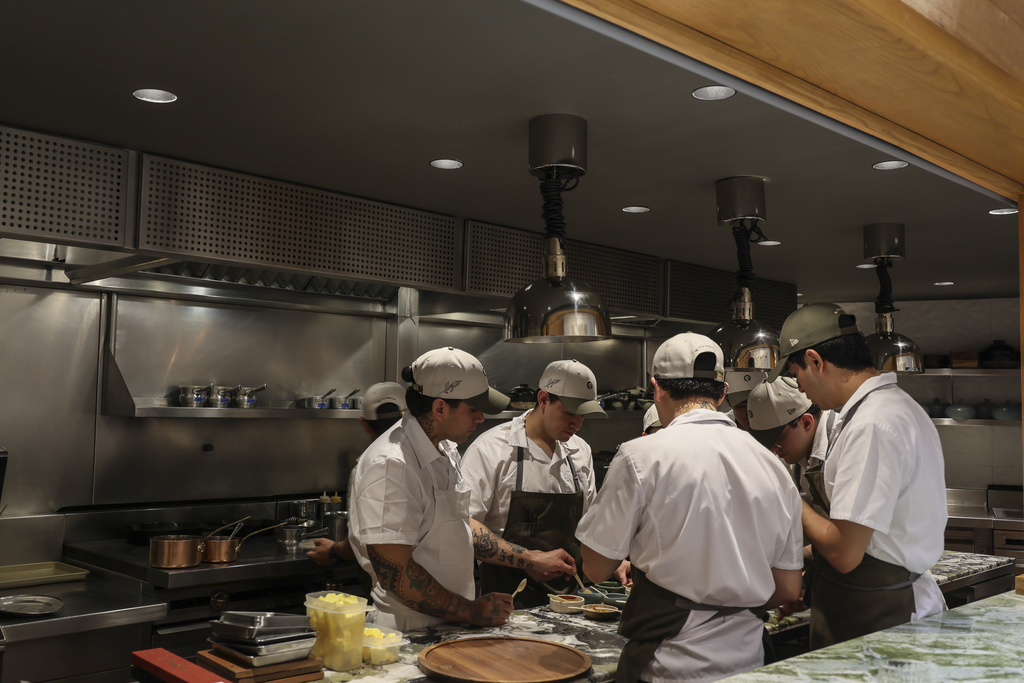
Renowned Mexico City restaurant serves traditional street food and nostalgia of the homeland

Quintonil’s team of chefs test sauces for the menu at the restaurant in Mexico City, Friday, Feb. 28, 2025. (AP Photo/Ginnette Riquelme)

Published by The Associated Press, March 2025 (link aquí)

Spanish story language here

MEXICO CITY (AP) – Quintonil is not your typical Mexican restaurant.

Clients book tables months in advance to celebrate special occasions. The World’s 50 Best list ranked it as the most acclaimed venue in the country in 2024 — and No. 7 worldwide. But once in a while something unexpected happens: food brings guests to tears.

“We have hosted people who have wept over a tamale,” said chef Jorge Vallejo, who founded Quintonil in Mexico City in March 2012.

He intentionally chose traditional street food for the menu — insects and other pre-Hispanic delicacies included. Priced at 4,950 pesos ($250 US) per person, it evokes the nostalgia of home and the history of the homeland.

The tamale — which translates from the Nahuatl language as “wrapped” — is a Mesoamerican delicacy made of steamed corn dough. It can be filled with savory or sweet ingredients — such as pork meat and pineapple — and topped with sauce.

Official records show that around 500 varieties of tamales can be found in Mexico. And according to a publication of Samuel Villela, ethnologist from the National School of Anthropology and History, Nahua communities used them for ritual purposes.

Most of Vallejo’s clientele are foreigners attracted by the two Michelin stars awarded to Quintonil last year. Others are nationals who spent decades living abroad or Americans of Mexican descent in search of a taste from their ancestry.

“They come to visit their families and feel shaken by the flavors that remind them who they are,” the chef said. “It’s like coming back to their roots.”

Providing that experience is what motivated him to open Quintonil 13 years ago. He first thought of his 11-table restaurant as a “fonda,” as Mexicans call popular food venues offering homemade dishes.

“I didn’t think I would own a restaurant like Quintonil nor did I aspire to that,” Vallejo said. “What I’ve tried to do is to learn from Mexico and show the best of it.” 

He took his first job in a place resembling a fonda, where he and his mom used to have lunch. He then studied culinary arts.

For a while, he worked on a cruise line, peeling crabs and coordinating the logistics to feed thousands of clients. Back in Mexico, he met his wife and business partner at Pujol, run by famed chef Enrique Olvera. They founded Quintonil a few years later and their mission has not changed: We’ll tell our country’s tales through food. 

“We all have a life story,” Vallejo said. “I try to interpret that and transform it into stories we can share at Quintonil.”

Traveling is part of his routine. He meets with colleagues to exchange anecdotes and contacts, but also encounters local farmers and spends time in remote communities to understand how food and tradition intertwine.

“In Mexico, we have ecosystems and ingredients that don’t exist anywhere else,” Vallejo said. “And our recipes, our traditions, are deeply rooted in society.”

His menu at Quintonil often incorporates insects, treasured since pre-Hispanic times.

Ancient documents describe how the Mexica were once established in the Chapultepec Hill. Its name comes from “chapulín,” a type of grasshopper that Mexicans currently enjoy from street vendors or at popular bars known as “cantinas.”

“In Mexico City, we have ‘escamoles’ season,” Vallejo said, referring to an edible larvae the Aztec people ate. “But in Oaxaca, we can find the ‘chicatana’ ants. In Tlaxcala, ‘cocopaches’ (a leaf-footed bug) and in Guerrero, they have insects of their own.” 

Alexandra Bretón, a food enthusiast who has visited Quintonil several times and reviews restaurants in her blog “Chilangas Hambrientas,” feels that Vallejo’s contribution to Mexican gastronomy is invaluable.

“He has elevated Mexican ingredients,” Bretón said. “My memories of Quintonil are of dishes where herbs, insects and vegetables are taken seriously in dishes with great technique.”

During her last visit in February, she tasted a delicious tamale filled with duck. Her second favorite was a taco, which can be found at thousands of food spots, but Vallejo somehow transforms into an experience.

“What we do here are not just beautiful plates,” said Geraldine Rodríguez, Quintonil’s sous chef. “We aim to nourish people, to show what Mexico is.”

There was a time, she said, when fine dining was synonymous of foie gras and lobster. But Quintonil chose another path.

“We have an ancestral cuisine that comes from our grandmothers,” Rodríguez said. “So we respect those recipes and add the chef’s touch.”

The taco experience highlighted by Bretón is among those efforts. Several ingredients — insects, for instance — are offered in plates for clients to wrap in tortillas.

“Through that interaction, that ritual that we Mexicans own, we watch clients wondering if they’re grabbing the taco in a proper way,” Rodríguez said. “But we always tell them we just want them to feel at home.”

Working long shifts and aiming for perfection is not an easy task for the 60 people working at Quintonil.

Rodríguez can spend up to four hours selecting a handful of sprouts to decorate a plate. Other near-invisible, almost ritualistic tasks are performed daily. One of them is brushing the “milpa,” a textile that hangs from the terrace and was named after Mesoamerican fields where crops are grown.

In the end it’s all worth it, Rodríguez said, because Quintonil provides clients with moments that evoke special memories.

She, too, has seen Vallejo’s clients cry over food. One of them was her dad. It was his 50th birthday, she said, and while she was not an employee of Quintonil at the time, Vallejo greeted her warmly.

The menu of the day included “huauzontles,» a green plant commonly cooked as a bun-shaped delicacy dipped in sauce. It also bears history, as Aztec communities ate it and used it to perform religious rites.

Quintonil’s recipe added stir-fry tomato and a local cheese. “When he ate it, he started crying and said they reminded him of my grandma,” Rodríguez said. “I had never seen my dad cry over a plate.”

Vallejo has often expressed joy for the recognition that Quintonil has achieved. But in his view, a chef’s true success is measured by what he make his clients feel.

“Mexican cuisine is a connection to the land, to the ingredients,” he said. “It’s a series of elements that produce not an emotion, but a feeling. And for me, there’s nothing more amazing than provoking that.”

____

Associated Press religion coverage receives support through the AP’s collaboration with The Conversation US, with funding from Lilly Endowment Inc. The AP is solely responsible for this content.

La violencia los obligó a migrar; ahora su fe mantiene viva la esperanza de llegar a EEUU

Originalmente publicado en The Associated Press, octubre de 2023 (link aquí)

English story here

TIJUANA, México (AP) – Noche tras noche, hincada frente a su casa en el centro de México, Érika Hernández pasó seis semanas hablando con Dios.

“No permitas que mi hijo se vuelva un criminal”, rezó con las palmas unidas frente al pecho. “No quiero que se convierta en asesino”.

Érika temía que su hijo fuera víctima de reclutamiento forzado. La paciencia de la Familia Michoacana, cártel de las drogas que intentó persuadirlo de participar en uno de sus negocios en el Estado de México, se agotó rápidamente. De ahí el secuestro, la venganza y el terror.

“Le pedía mucho a Dios. Lloraba y me metía en ayuno. Mi fe era muy grande”, recuerda la mexicana de 46 años.

Por fortuna, Dios la escuchó. Su hijo escapó a fines de junio y, para evitar que la ira del narco masacrara a su familia, Érika y diez de sus seres más queridos decidieron migrar.

“Nosotros nunca habíamos pensado irnos a Estados Unidos”, asegura. Su familia tenía una buena vida. Eran dueños de terrenos, huertos de aguacate, vehículos y muchos animales. “Pero siempre le digo a mis hijos: vale más la vida de uno que todos los bienes del mundo”.

En su camino hacia Estados Unidos cruzaron cerros y carreteras. Treparon a buses y taxis. Tres meses después de iniciado el trayecto, a finales de septiembre, tocaron la puerta del albergue Movimiento Juventud en Tijuana, en la frontera mexicana con Estados Unidos, y ahora esperan una oportunidad para hacerse de un hogar seguro.

Érika y su familia se suman a los 10.000 migrantes que diariamente llegan hasta los límites de México y su vecino del norte, dijo hace poco el presidente Andrés Manuel López Obrador. Poco antes, la mayor empresa ferroviaria del país anunció la suspensión de las operaciones de sus trenes debido a que las aglomeraciones de migrantes sobre sus vagones provocaron accidentes.

Las poblaciones de los albergues de las ciudades fronterizas mexicanas suelen estar encabezadas por venezolanos, haitianos y centroamericanos, pero en algunos refugios de Tijuana el flujo de mexicanos ha incrementado. La mayoría, como Érika, migra para escapar de la violencia, la extorsión y las amenazas del narco.

Por eso, para muchos, la fe es vital. No la llevan en rosarios, sino en el pecho. En la oración silenciosa de su propia intimidad. 

José Guadalupe Torres acudió a Dios tan pronto dejó su casa en Guanajuato, otro estado del centro de México. Sus motivos fueron similares a los de Érika: un cártel de las drogas amenazó con destrozar a su familia.

“Unos nos fuimos para un lado y otros para el otro”, cuenta el hombre de 62. “Pero Dios está con todos nosotros en donde sea”. 

Ahora, dice como si intentara que sus palabras no se ahogaran en su tristeza, reza para que el gobierno de Estados Unidos le dé una cita que le permita ingresar de manera legal.

El gobierno de Joe Biden estableció este año que todo migrante que desee entrar a Estados Unidos debe iniciar un trámite a través de una aplicación que le ha dado varios dolores de cabeza a los migrantes y a quienes los asesoran. Por lo mismo, miles se arriesgan a cruzar sin autorización.

“Éste es un tiempo preciso para predicarles la palabra de Dios”, dice el pastor evangélico Albert Rivera, quien ofrece un techo y guía espiritual a los casi 400 migrantes que acoge en Ágape, un refugio cercano.

Muchas personas llegan deprimidas, dice el pastor. Vieron morir a un hijo, sufrieron el secuestro de un familiar o perdieron todo para pagar la cuota que pidió algún criminal de su pueblo.

“Hemos tenido mujeres que sus esposos son sicarios y los enemigos de sus esposos les cayeron a balazos a su casa diciendo que van a matarlas a ellas y a sus hijos”, cuenta el pastor.

Por eso, la fe ha cobijado a varios migrantes refugiados en Ágape. Mariana Flores, quien huyó de Guerrero con su marido y su hijo de 3 años luego de que el crimen organizado secuestrara temporalmente a su pareja, cuenta que ya era creyente pero en Ágape renovó su espiritualidad. 

“De repente estamos tristes y no se siente uno bien, pero cuando hay días de culto se nos olvida un poquito y nos ayuda a seguir echándole ganas”, dice la mexicana de 25 años.

Miguel Rayo, un hombre de 47 que migró desde el mismo estado del centro de México, dice que dejó su casa prácticamente con las manos vacías pero guarda una Biblia digital en su teléfono. “La leo cuando estoy resfriado, cuando lo necesito. Queremos regenerarnos, acercarnos a Dios”.

Ágape recibe a migrantes de cualquier fe o ideología, pero se les invita a los servicios de los miércoles, viernes y domingos. También se ora en los dormitorios varios días por semana y los mismos migrantes se encargan de organizar el rezo.

A pocos kilómetros de ahí, Casa del Migrante también ofrece cobijo espiritual. Fundado por la congregación católica de los misioneros scalabrinianos en 1987, es un albergue que provee un techo temporal, asesoría jurídica y mentoría para que los migrantes consigan trabajo y escuelas para sus hijos.

Cada miércoles, durante la misa semanal que ofrece el padre Pat Murphy, los migrantes pueden participar compartiendo sus vivencias y preocupaciones. “Es una misa muy bonita, un tiempo de compartir”, dice Alma Ramírez, quien llegó como voluntaria hace un año y recientemente se integró como trabajadora de tiempo completo.

El albergue solía recibir únicamente a hombres deportados de Estados Unidos, pero desde que incrementó el flujo migratorio en 2019 empezó a acoger a familias enteras y miembros de la comunidad LGBT.

“Tenemos personas desplazadas internas, mexicanos que tienen que salir de estados del sur y del centro por situaciones de violencia, principalmente del narcotráfico”, agrega la trabajadora.

Para muchos de ellos, la imagen que cuelga de una pared del patio principal brinda esperanza: una representación de la Virgen de Guadalupe.

 “Hay personas que llegan a la puerta y, cuando les decimos que sí pueden ingresar, nos dicen: ’Desde que llegué y vi a la Virgen, supe que todo estaría bien’”, cuenta Alma.

Tanto en Casa del Migrante como Ágape, algunos piden al padre Pat y al pastor Albert que los bautice y muchos más solicitan que acompañen sus rezos. Temen por sus familias, por lo que dejaron atrás y por lo que les espera durante el viaje que esperan continuar rumbo a Estados Unidos.

“Ábreme las puertas, Señor, para que pueda cruzar”, es la oración que les sugiere el pastor.

“Imagina la experiencia de fe”, dice el religioso. “Llegas a un lugar sintiéndote quebrantado, pero entonces ruegas a Dios, llenas tu aplicación, te dan cita y llegas a Estados Unidos”.

“Eso nunca lo van a olvidar”.

——

AP Foto: Karen Castañeda

La cobertura de noticias religiosas de The Associated Press recibe apoyo a través de una colaboración con The Conversation US, con fondos del Lilly Endowment Inc. La AP es la única responsable de todo el contenido.