
A Christmas tree in Mexico carries the faces of loved ones who never came home

A photograph of Argenis Yosimar Pensado Barrera, who disappeared on March 16, 2014 in Xalapa, Veracruz state, covers a Christmas ornament to hang on the Tree of Hope, during an event organized by the diocese of Ecatepec at the Church of the Sacred Heart of San Cristobal in Ecatepec, State of Mexico, Monday, Nov. 17, 2025. (AP Photo/Ginnette Riquelme)

Published by The Associated Press, November 2025

Spanish story language here

MEXICO CITY (AP) – It’s been 10 years since Verónica Rosas set up a Christmas tree. The sorrow brought on by the disappearance of her son in 2015 has been too overwhelming.

Before the 16-year-old vanished in a Mexico City suburb, mother and son yearned for the winter season. They loved buying natural Christmas trees. To brighten them up, they hung Diego’s favorite decorations: figurines of Mickey and Minnie Mouse.

“It’s been too hard and I have not been able to set up a tree,” said Rosas, who recently met with other grieving relatives to make Christmas ornaments in remembrance of missing loved ones.

The gathering was hosted by the Catholic Diocese of Ecatepec, near the capital, where residents endure robbery, femicide and other crimes.

Rosas and a dozen more families showed up carrying pictures of their relatives. For a few hours, they pasted the images onto old CDs and circles of cardboard, and sprinkled them with glitter.

A priest celebrated Mass and blessed their work. Afterward, the ornaments were hung from a “tree of hope” inside the cathedral, where they will remain until Feb. 2.

“We want to draw attention to the crisis that we’re living,” said Rosas, who founded an organization providing support for Mexicans sharing her pain. “It’s a symbolic gesture that keeps what’s happening in plain sight.”

The mark of a disappearance

Official figures indicate that more than 133,000 people have disappeared in Mexico since 1952. Human trafficking, kidnapping, acts of retaliation and forced recruitment by cartel members are among the causes.

The phenomenon has affected Latin America for decades. In each country, many mothers, sons and sisters have made life-altering choices to search for their relatives — often because authorities fail to act or deliver answers.

“This has been a Way of the Cross,” said Marisol Rizo, referencing the biblical account of Jesus carrying the cross before his crucifixion. She has searched for her mother since 2012. “Thirteen years have passed and we can’t make authorities do their jobs.”

She said her children were little when her mother vanished, and juggling motherhood while searching for her took a toll.

“My mom always told me to take care of them,” she said. “But as I searched for her, I forgot about my children.”

Rizo believes her father was responsible for her mother’s disappearance in a country where at least 10 women or girls are killed because of their gender every day. He has denied any involvement.

Like numerous other relatives of the disappeared, Rizo navigates the winter season with sorrow rather than joy. She still remembers how, years ago, she spent days round Christmas posting flyers on the streets.

It’s a common practice among people with disappeared relatives in Mexico. Each poster contains contact information, as well as the photo, name, distinguishing features and the date a person went missing.

“On Dec. 24, I used to cry a lot,” Rizo said. “I could see happy people pouring out of shopping centers while I was posting flyers, dragging my sorrow.”

Rizo’s daughter, now 17, joined her in crafting round ornaments at the Ecatepec cathedral. Yet the memories sparked by seeing photos of her vanished mother felt almost unbearable.

“These spheres represent a deep sadness to me,” Rizo said. “This is not the place where I would have wished to see a picture of my mom.”

A long wait for compassion

In some cases, relatives of the disappeared have been dismayed by lack of support from religious leaders.

Catholic mothers like Rosas, overwhelmed with fear, sought comfort at their local parishes after their children vanished. But long-trusted priests sometimes rebuffed them.

“I remember when I arrived in a church five years ago, requesting a Mass for my daughter, and I was told ‘We don’t celebrate Mass for disappeared people,’” said Jaqueline Palmeros, who recently found her child’s remains in Mexico City.

“But I believe that the Church, which closed its doors to us for a long time, is an alternative path to access truth, justice, memory and repair,” she added.

During a recent encounter with relatives of the disappeared, Bishop Javier Acero asked for forgiveness. Representing Mexico City’s archdiocese, he has publicly supported victims of disappearances and holds a monthly meeting with relatives in need of spiritual support.

“As church leaders, we recognize that at times we have not acted as we should — out of fear or out of not knowing how,” Acero said. “If we failed to receive you with the care you needed, if we did not pray as you asked us to, please forgive us.”A ministry of presence

Rosas attended the meeting alongside members of an ecumenical group that has offered spiritual shelter for years. Known as “the church circle,” it brings together nuns, an Anglican priest and several other pastors from different denominations.

Holding the mothers’ hands, the faith leaders routinely celebrate Mass in public squares ahead of protests demanding answers from the government. They dress up in gloves and rubber boots to dig up pits where human remains may be. All year round, they post flyers of missing sons and daughters throughout Mexico’s streets.

The Rev. Luis Alberto Sánchez is among them. With open arms, he welcomed relatives at the Ecatepec cathedral. There they shared breakfast and he sprayed lacquer on the newly made ornaments.

“We can’t remain silent,” said Sánchez, whose own brother was kidnapped and killed. “The voice of the disappeared, of those who have perished, needs to resound and say ‘no more.’”

Rosas treasures his blessings and regards all members of the church circle as friends. She, too, has spent mournful Christmases searching for Diego, and they have supported her the whole time.

“I wish for people belonging to all faith communities to congregate and replicate our model everywhere,” she said. “In that way, all families could get this constant presence of the church and the hope that we carry within our hearts.”

___

Associated Press religion coverage receives support through the AP’s collaboration with The Conversation US, with funding from Lilly Endowment Inc. The AP is solely responsible for this content.
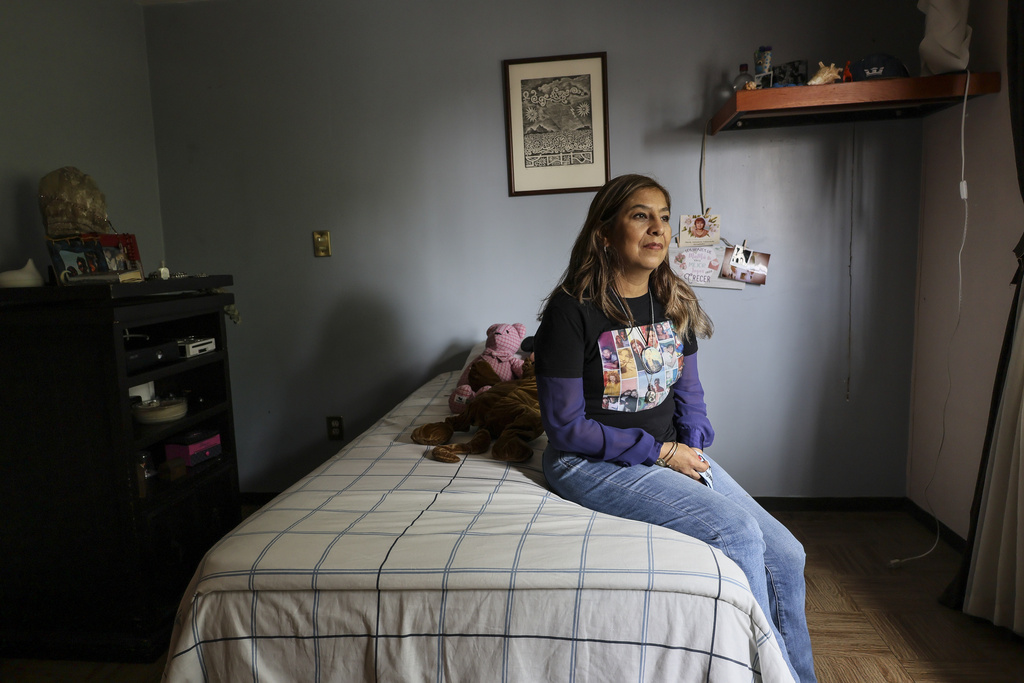
One day, their children didn’t make it back home. Faith helps these Mexican mothers’ search for them

Veronica Rosas poses for a portrait in the bedroom of her missing son Diego Maximiliano in Ecatepec, Mexico, Friday, Aug. 2, 2024. Rosas’ son went missing when he was 16 years old on Sept. 4, 2015. (AP Photo/Ginnette Riquelme)

Published by The Associated Press, August 2024 (link aquí)

Spanish language story here

MEXICO CITY (AP) – Each time the kidnapper hung up the phone, Veronica Rosas and her relatives did the only thing they could think of: kneel, grab each other’s hands and pray.

“I told God: Please help me,” said Rosas, who has spent the past nine years searching for her son, Diego Maximiliano.

The 16-year-old vanished in 2015 after leaving home to meet with friends. They lived in Ecatepec, a Mexico City suburb where robbery, femicide and other violent crimes have afflicted its inhabitants for decades.

“Many joined us in prayer,” said Rosas, who 10 days after the kidnapping received one of her son’s fingers as proof of life. “Christians, Catholics, Jehovah Witnesses. I opened my door to everyone and — maybe — that’s why I didn’t die.”

For weeks, she could barely eat or sleep. How could she, if Diego might be famished, exhausted or wounded?

In spite of her efforts, Rosas was unable to gather the amount of money requested by the kidnappers. And though they agreed to a lower sum, Diego was never released.

According to official figures, at least 115,000 people have disappeared in Mexico since 1952, though the real number is believed to be higher. 

During the country’s “dirty war,” a conflict that lasted throughout the 1970s, disappearances were attributed to government repression, similar to the dictatorships in Chile and Argentina.

In the past two decades, as officials have fought drug cartels and organized crime has tightened its grip in several states, it’s been more difficult to trace the perpetrators and causes of disappearances. 

Human trafficking, kidnapping, acts of retaliation and forced recruitment by cartel members are among the reasons listed by human rights organizations. Disappearances impact local communities as well as migrants who travel through Mexico hoping to reach the U.S.

For thousands of relatives like Rosas, the disappearance of their children is life-altering. 

“A disappearance puts a family’s life on pause,” said the Rev. Arturo Carrasco, an Anglican priest who offers spiritual guidance to families with missing members.

“While searching for them, they neglect their jobs. They lose their sense of security and many suffer from mental health problems,” he added. “In many cases, families fall apart.”

Relatives initially trust the authorities, but as time passes and no answers or justice comes, they take the search into their own hands.

To do that, they distribute bulletins with photos of the missing person. They visit morgues, prisons and psychiatric institutions. They walk through neighborhoods where homeless people spend the day, wondering if their sons or daughters might be close, affected by drug abuse or mental health problems.

“Ninety percent of the people who search are women,” said Carrasco. “And from that percentage, most of them are housewives who suddenly had to face a crime.”

“They lack legal and anthropological tools to do that,” he added. “But they have something that the rest of the population does not: the driving force of love for their children.”A mother’s search 

When Rosas was pregnant with Diego, she made a decision: “This will be my one and only son.”

She raised him on her own, juggling several jobs and finding the time to check his homework every night. They lived a simple, joyful life. 

Diego practiced karate and soccer. At his birthday parties, he loved to wear costumes. Their shared hobby was going to the movies. Their favorite films? “Transformers” and “Spider-Man.”

Now, with him gone, Rosas has been to the movies only once. She agreed because a friend she made after Diego’s disappearance — a Catholic nun named Paola Clericó, who comforts relatives with missing children — was there, holding her hand.

It doesn’t feel right for her to have fun, to take a break. But if she does not take care of herself, who will find out what happened to her son?

Three months after Diego’s disappearance, she got tired of waiting to hear from the police. She opened a Facebook page called “Help me find Diego” and, though she was frightened of stepping out of her home, she started looking for him, dead or alive. 

For three years, her search was lonely. Relatives, co-workers and friends commonly distance themselves from people with missing family members, claiming that “they only talk about their search” or “listening to them is too sad.”

It wasn’t until 2018 that Rosas met Ana Enamorado, a Honduran woman who moved to Mexico to search for her son after he migrated and disappeared. They got acquainted and Enamorado invited Rosas to an annual protest in which thousands of mothers demand answers and justice.

The resentment and disappointment from Mexicans affected by nationwide violence has increased recently. President Andrés Manuel López Obrador and Claudia Sheinbaum, who will succeed him on October 1, constantly minimize the relatives’ recriminations, claiming that homicide rates decreased during the current administration.

But it’s not just violence that victims resent. On a recent evening, in the state of Zacatecas, a mother like Rosas stormed into a session of Congress. Drenched in tears, she screamed that she found her son — with a gunshot to the head — at the morgue. He had been there since November 2023, she said, but the authorities failed to notify her in spite of her tireless efforts to get information about what happened to him. 

This is the reality that Rosas became aware of at the 2018 protest.

“When I got there, I saw a mother, and then another and another,” she said. “’Who are you looking for?’ we asked each other. It was an awakening. It was horrible.”

After meeting other women like her, she wondered: What if we use our collective force in our favor?

And so, as other mothers have done in Mexican states like Sonora and Jalisco, Rosas created an organization to provide mutual support for their searches. She called it “Uniendo Esperanzas,” or Uniting Hope, and it currently supports 22 families, mostly from the state of Mexico, where Diego disappeared.

All members learn legal procedures together. They put pressure on judicial authorities who are not always willing to do their jobs. They dress up in boots, sun hats and gloves to explore remote terrain where they have found human remains.

From time to time, they find missing family members. Sometimes alive. Others, regrettably, dead. Whatever the result, as any family would do, they hug and pray and cry.

Sometimes it’s hard, Rosas said. Or ambiguous. “When we find other people, I feel a lot of joy and I thank God, but at the same time, I ask him: Why don’t you give me Diego back?”Together, we search, we pray

On a recent Sunday, Benita Ornelas was mostly serene. But when Carrasco named her son, Fernando, during a Mass to honor him on the fifth anniversary of his disappearance, tears began flowing down her cheeks.

Not many faith leaders — regardless of their religious affiliation — are willing to address the disappearances in Mexico. Or to console hurting mothers in need of spiritual comfort.

“Not everyone has the sensitivity to endure such pain,” said Catholic Bishop Javier Acero, who meets with mothers like Rosas and Ornelas on a regular basis. He pushed for celebrating Mass in Our Lady of Guadalupe’s basilica to remember their disappeared children for the first time in 2023.

“But the numbers of disappearances keep rising and the government doesn’t do anything about it, so, where the state is absent, the church offers guidance,” Acero said.

Some mothers regard him as an ally and leaders from the Catholic church have raised their concerns against Lopez Obrador’s security policy since two Jesuit priests were murdered in 2022. But, in parallel, relatives of missing people claim that many Catholic priests, nuns and parishioners have shown little empathy for their pain.

Soon after their children disappeared, Ornelas and Rosas rushed to nearby parishes. “Please, father, celebrate Mass so we can pray for our sons,” both requested. But the priests refused.

“I cried and cried,” Rosas said. “But he responded: ‘I can’t say that people are being kidnapped, madam. I encourage you to pray for your son’s eternal rest.’”

On another occasion, Rosas recalled, she approached a group of elders praying the rosary, and asked them to pray for her son. “Why don’t you accept it? Hand him to God,” one replied.

In contrast, rain or shine, faith leaders like Carrasco and Clericó are always there for the mothers. They have walked with them through muddy terrain where excavations have been done. They have celebrated Mass in the middle of busy streets and next to canal drainages. They have joined them in visiting prisons and morgues, comforting them no matter what sorrow may come.

“We have the legitimate hope of finding our treasures alive,” Carrasco said. “We are no fools and we understand that there’s a risk they might be dead. But as long as we have no evidence of that, we will keep searching.”

Faith leaders like Carrasco and Clericó are part of an ecumenical group called “The Axis of Churches.” Methodists, Evangelicals, spiritual leaders from Indigenous communities, theologians and feminists are among its members. Sometimes they pray, but on other occasions they share a meal, draw mandalas or simply listen to the mothers.

“When I have a problem and I don’t know what to do, I go to them,” Rosas said. “They always share examples of God’s life, which allows me to flow with love and peace.”

They alone, Rosas said, can understand what she’s been through.

“When a friend tells me that I only speak of my searches or my organization, I answer: ’You wake up every morning to cook breakfast for your child and take him to school, but I wake up trying to find where mine is,’” Rosas said.

“I’m still a mother. My maternity did not disappear, though it now feels sad and unfair.”

Among the mothers of her organization, their missing sons and daughters are always present.

For the gathering to remember Fernando, Ornelas cooked tacos, a Mexican dish her son loved. “They are his favorites,” his mother said.

That Sunday evening, under the rain, Sister Clericó, Rosas, and the rest of the group shared the tacos with homeless people around a Catholic church in Mexico City. The food ran out in an hour, after which Carrasco celebrated Mass and the group hugged Ornelas.

“We live with a such a profound pain that only God can help us endure it,” Rosas said. “If it wasn’t for that light, for that relief, I don’t think we would be able to still stand.”

___

Associated Press religion coverage receives support through the AP’s collaboration with The Conversation US, with funding from Lilly Endowment Inc. The AP is solely responsible for this content.