
Published by The Associated Press, November 2025
MEXICO CITY (AP) – It’s been 10 years since Verónica Rosas set up a Christmas tree. The sorrow brought on by the disappearance of her son in 2015 has been too overwhelming.
Before the 16-year-old vanished in a Mexico City suburb, mother and son yearned for the winter season. They loved buying natural Christmas trees. To brighten them up, they hung Diego’s favorite decorations: figurines of Mickey and Minnie Mouse.
“It’s been too hard and I have not been able to set up a tree,” said Rosas, who recently met with other grieving relatives to make Christmas ornaments in remembrance of missing loved ones.
The gathering was hosted by the Catholic Diocese of Ecatepec, near the capital, where residents endure robbery, femicide and other crimes.
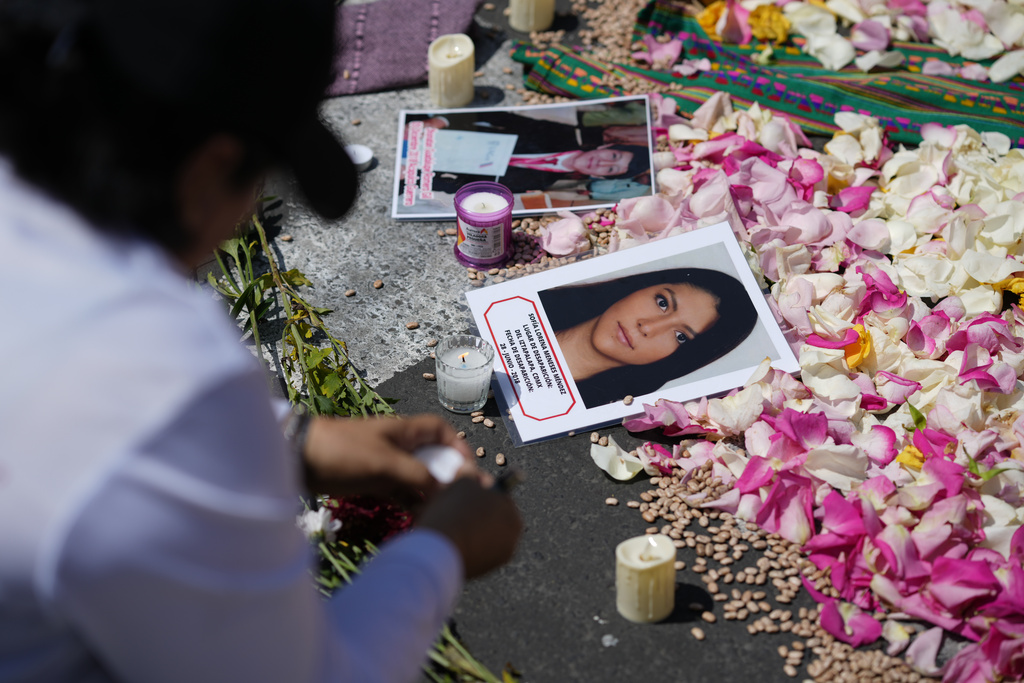
Rosas and a dozen more families showed up carrying pictures of their relatives. For a few hours, they pasted the images onto old CDs and circles of cardboard, and sprinkled them with glitter.
A priest celebrated Mass and blessed their work. Afterward, the ornaments were hung from a “tree of hope” inside the cathedral, where they will remain until Feb. 2.
“We want to draw attention to the crisis that we’re living,” said Rosas, who founded an organization providing support for Mexicans sharing her pain. “It’s a symbolic gesture that keeps what’s happening in plain sight.”
The mark of a disappearance
Official figures indicate that more than 133,000 people have disappeared in Mexico since 1952. Human trafficking, kidnapping, acts of retaliation and forced recruitment by cartel members are among the causes.
The phenomenon has affected Latin America for decades. In each country, many mothers, sons and sisters have made life-altering choices to search for their relatives — often because authorities fail to act or deliver answers.
“This has been a Way of the Cross,” said Marisol Rizo, referencing the biblical account of Jesus carrying the cross before his crucifixion. She has searched for her mother since 2012. “Thirteen years have passed and we can’t make authorities do their jobs.”
She said her children were little when her mother vanished, and juggling motherhood while searching for her took a toll.
“My mom always told me to take care of them,” she said. “But as I searched for her, I forgot about my children.”
Rizo believes her father was responsible for her mother’s disappearance in a country where at least 10 women or girls are killed because of their gender every day. He has denied any involvement.
Like numerous other relatives of the disappeared, Rizo navigates the winter season with sorrow rather than joy. She still remembers how, years ago, she spent days round Christmas posting flyers on the streets.
It’s a common practice among people with disappeared relatives in Mexico. Each poster contains contact information, as well as the photo, name, distinguishing features and the date a person went missing.
“On Dec. 24, I used to cry a lot,” Rizo said. “I could see happy people pouring out of shopping centers while I was posting flyers, dragging my sorrow.”
Rizo’s daughter, now 17, joined her in crafting round ornaments at the Ecatepec cathedral. Yet the memories sparked by seeing photos of her vanished mother felt almost unbearable.
“These spheres represent a deep sadness to me,” Rizo said. “This is not the place where I would have wished to see a picture of my mom.”
A long wait for compassion
In some cases, relatives of the disappeared have been dismayed by lack of support from religious leaders.
Catholic mothers like Rosas, overwhelmed with fear, sought comfort at their local parishes after their children vanished. But long-trusted priests sometimes rebuffed them.
“I remember when I arrived in a church five years ago, requesting a Mass for my daughter, and I was told ‘We don’t celebrate Mass for disappeared people,’” said Jaqueline Palmeros, who recently found her child’s remains in Mexico City.
“But I believe that the Church, which closed its doors to us for a long time, is an alternative path to access truth, justice, memory and repair,” she added.
During a recent encounter with relatives of the disappeared, Bishop Javier Acero asked for forgiveness. Representing Mexico City’s archdiocese, he has publicly supported victims of disappearances and holds a monthly meeting with relatives in need of spiritual support.
“As church leaders, we recognize that at times we have not acted as we should — out of fear or out of not knowing how,” Acero said. “If we failed to receive you with the care you needed, if we did not pray as you asked us to, please forgive us.”A ministry of presence
Rosas attended the meeting alongside members of an ecumenical group that has offered spiritual shelter for years. Known as “the church circle,” it brings together nuns, an Anglican priest and several other pastors from different denominations.
Holding the mothers’ hands, the faith leaders routinely celebrate Mass in public squares ahead of protests demanding answers from the government. They dress up in gloves and rubber boots to dig up pits where human remains may be. All year round, they post flyers of missing sons and daughters throughout Mexico’s streets.
The Rev. Luis Alberto Sánchez is among them. With open arms, he welcomed relatives at the Ecatepec cathedral. There they shared breakfast and he sprayed lacquer on the newly made ornaments.
“We can’t remain silent,” said Sánchez, whose own brother was kidnapped and killed. “The voice of the disappeared, of those who have perished, needs to resound and say ‘no more.’”
Rosas treasures his blessings and regards all members of the church circle as friends. She, too, has spent mournful Christmases searching for Diego, and they have supported her the whole time.
“I wish for people belonging to all faith communities to congregate and replicate our model everywhere,” she said. “In that way, all families could get this constant presence of the church and the hope that we carry within our hearts.”
___
Associated Press religion coverage receives support through the AP’s collaboration with The Conversation US, with funding from Lilly Endowment Inc. The AP is solely responsible for this content.
 mthernandezr.com