Religious leaders released from Nicaraguan prison say their experience only strengthens their faith

José Luis Orozco, a pastor from Nicaragua, ministers to members of the Oasis Church, in Taylor, Texas, on June 15, 2025. (AP Photo/Rodolfo Gonzalez)

Published by The Associated Press, June 2025

Spanish story language here

God’s message didn’t immediately make sense to pastor José Luis Orozco. But when U.S. efforts resulted in his release from a Nicaraguan prison a few months later, everything became clear.

“The Lord had told me: ‘Don’t be afraid, José Luis. A wind will blow from the north, your chains will break and the doors will open,’” the pastor said from his new home in Austin, Texas.

By September 2024, he had spent nine months behind bars. With 12 other Nicaraguan members of the Texas-based evangelical Christian organization Mountain Gateway, he faced charges like money laundering and illicit enrichment. Just like them, other faith leaders had been imprisoned during a crackdown that organizations, such as Human Rights Watch, have said are attacks on religious freedom.

Orozco thought his innocence would eventually surface. So when the U.S. government announced that it had secured his release along with other political prisoners, he wasn’t completely surprised.

“That’s when I understood,” the pastor said. “God was telling me he would act through the United States.”

In the hours following the announcement, 135 Nicaraguans were escorted to Guatemala, where most sought paths to settle in other countries.

Why did Nicaragua imprison religious leaders? 

Tensions between President Daniel Ortega and Nicaraguan faith leaders began in 2018, when a social security reform sparked massive protests that were met with a crackdown. Relations worsened as religious figures rejected political decisions harming Nicaraguans and Ortega moved aggressively to silence his critics.

Members of Catholic and Evangelical churches have denounced surveillance and harassment from the government. Processions aren’t allowed and investigations have been launched into both pastors and priests. CSW, a British-based group that advocates for religious freedom, documented 222 cases affecting Nicaraguans in 2024.

“Religious persecution in Nicaragua is the cruelest Latin America has seen in years,” said Martha Patricia Molina, a Nicaraguan lawyer who keeps a record of religious freedom violations. “But the church has always accomplished its mission of protecting human life.”

Spreading the gospel

Orozco was the first member of his family to become evangelical. He felt called to the ministry at age 13 and convinced relatives to follow in his footsteps. He began preaching in Managua, urging different churches to unite.

His experience became key for Mountain Gateway’s missionary work. Founded by American pastor Jon Britton Hancock, it began operating in Nicaragua in 2013.

CSW had warned that religious leaders defending human rights or speaking critically of the government can face violence and arbitrary detention. But Hancock and Orozco said their church never engaged in political discourse.

While maintaining good relations with officials, Mountain Gateway developed fair-trade coffee practices and offered disaster relief to families affected by hurricanes.

By the time Orozco was arrested, his church had hosted mass evangelism campaigns in eight Nicaraguan cities, including Managua, where 230,000 people gathered with the government’s approval in November 2023.

An unexpected imprisonment

Orozco and 12 other members of Mountain Gateway were arrested the next month.

“They chained us hand and foot as if we were high-risk inmates,” he recalled. “None of us heard from our families for nine months.”

The prison where he was taken hosted around 7,000 inmates, but the cells where the pastors were held were isolated from the others.

The charges they faced weren’t clarified until their trial began three months later. No information was provided to their relatives, who desperately visited police stations and prisons asking about their whereabouts.

“We still had faith this was all a confusion and everything would come to light,” Orozco said.

“But they sentenced us to the maximum penalty of 12 years and were ordered to pay $84 million without a right to appeal.”

Preaching in prison

Fasting and prayer helped him endure prison conditions. Pastors weren’t given drinking water or Bibles, but his faith kept him strong. 

“The greatest war I’ve fought in my Christian life was the mental battle I led in that place,” Orozco recalled.

Guards didn’t prevent pastors from preaching, so they ministered to each other. According to the pastor, they were mocked, but when they were released, a lesson came through.

“That helped them see that God performed miracles,” he said. “We always told them: Someday we’ll leave this place.”

Molina said that several faith leaders who fled Nicaragua have encountered barriers imposed by countries unprepared to address their situation. According to the testimonies she gathered, priests have struggled to relocate and minister, because passports are impossible to obtain, and foreign parishes require documents that they can’t request.

But Orozco fared differently. He shares his testimony during the services he leads in Texas, where he tries to rebuild his life.

“I arrived in the United States just like God told me,” the pastor said. “So I always tell people: ‘If God could perform such a miracle for me, he could do it for you too.’”

Laymen were targets too

Onboard the plane taking Orozco to Guatemala was Francisco Arteaga, a Catholic layman imprisoned in June 2024 for voicing his concerns over Ortega’s restrictions on religious freedom.

“After 2018, when the protests erupted, I started denouncing the abuses occurring at the churches,” Arteaga said. “For example, police sieges on the parks in front of the parishes.”

Initially, he relied on Facebook posts, but later he joined a network of Nicaraguans who documented violations of religious freedom throughout the country.

“We did not limit ourselves to a single religious aspect,” said Arteaga, whose personal devices were hacked and monitored by the government. “We documented the prohibitions imposed on processions, the fees charged at church entrances and restrictions required inside the sanctuaries.”

Arteaga witnessed how police officers detained parishioners praying for causes that were regarded as criticism against Ortega.

According to CSW, the government monitors religious activities, putting pressure on leaders to practice self-censorship.

“Preaching about unity or justice or praying for the general situation in the country can be considered criticism of the government and treated as a crime,” said CSW’s latest report.

Building a new life

Prison guards also denied a Bible to Arteaga, but an inmate lent him his.

It was hard for him to go through the Scripture, given that his glasses were taken away after his arrest, but he managed to read it back-to-back twice. 

“I don’t even know how God granted me the vision to read it,” said Arteaga, who couldn’t access his diabetes medicine during his imprisonment. “That gave me strength.”

He eventually reunited with his wife and children in Guatemala, where he spent months looking for a new home to resettle. He recently arrived in Bilbao, Spain, and though he misses his country, his time in prison shaped his understanding of life.

“I’ve taken on the task, as I promised God in prison, of writing a book about faith,” Arteaga said. “The title will be: ‘Faith is not only believing.’”

____

Associated Press religion coverage receives support through the AP’s collaboration with The Conversation US, with funding from Lilly Endowment Inc. The AP is solely responsible for this content.
How Evangelical pastors provide spiritual comfort in crisis-hit Venezuela

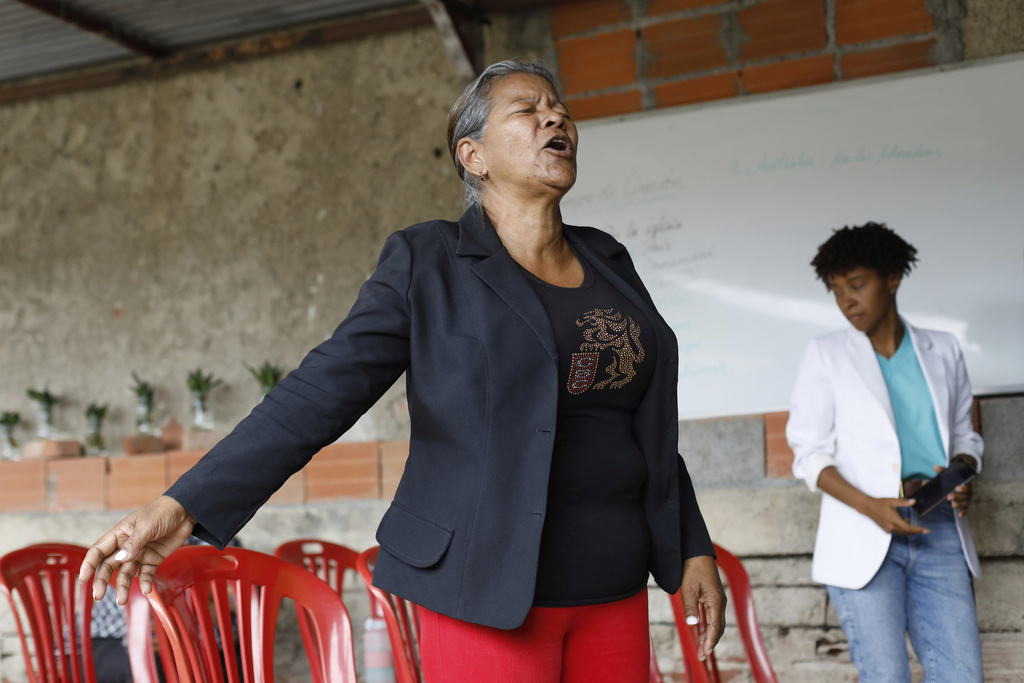
Pastor Fernanda Eglé prays at her Resurrection evangelical church in Caracas, Venezuela, Sunday, May 18, 2025. (AP Photo/Cristian Hernandez)

Published by The Associated Press, May 2025 (link aquí)

Spanish story language here

CARACAS (AP) – “Can I bring my gun into the worship service?”

The question presented Venezuelan pastor Fernanda Eglé with a dilemma. Agreeing might have endangered parishioners at her evangelical church in Caracas. But what if dismissing the gang member pulled him farther from God?

“It was risky, but this was God’s plan,” Eglé said. “He knew these people’s hearts, their need for change. So I created a ‘service for criminals,’ intending they would come.”

Many pastors like Eglé provide spiritual guidance in Venezuelan slums affected by crime, drug addiction and gangs. Their task has proven challenging amid the 12-year crisis that stemmed from a drop in oil prices, corruption and government mismanagement.

The economic collapse has forced millions to emigrate since Nicolás Maduro took power in 2013. And despite official claims of decreasing inflation levels in 2024, he declared an “economic emergency” in April, granting himself powers to implement extraordinary measures.

“Working in these communities has been difficult,” Eglé said. “But we need to keep up our work.”

How big is the evangelical community in Venezuela?

Reliable statistics are hard to come by since official figures have not been issued in more than a decade, but academic experts and community members contend the number of evangelicals in Venezuela has grown in recent decades, just as it has in other Latin American countries. 

The region’s string of social, political and economic crises is a key driver of that growth, said David Smilde, professor of sociology at Tulane University in New Orleans. 

The second issue driving communities to evangelical churches might be the Catholic Church’s priest shortage, which means fewer faith leaders are now serving larger groups of people, said Smilde. With less stringent rules for clergy, evangelical churches can more quickly step into that void.  

As for Venezuelans, many find themselves on the margins of survival. “This is a context in which participation in evangelical churches can provide strength, focus and a social network for mutual support,” Smilde said.

Despite the statistical void, the U.S. State Department’s 2023 report on religious freedom estimated that 96% of the Venezuelan population is Catholic — though that may not reflect the rise in evangelicals.

Sociologist Enrique Alí González estimates that the current religious affiliation would be 82%-84% Catholic and 10%-12% evangelical with other faiths accounting for the rest. He based those numbers on his own field work and data from one of the most recent demographic assessments, which was led by the Andrés Bello Catholic University in Caracas in 2016.

A pastor’s role among the people

Like Eglé, pastor José Luis Villamizar encourages Venezuelans to embrace the Gospel as a path to change course. 

“We have managed to get people who used to be hitmen away from that lifestyle,” Villamizar said.

Also based in Caracas, Villamizar founded his evangelical church at his house during the pandemic. At first he ministered from a window. As lockdown receded, he took his work to the streets.

Both he and Eglé visit elderly people and Venezuelans lacking basic care on a regular basis.

Mostly dependent on donations or their savings, they deliver food, medicines and clothing. Prayers and religious lectures are followed by recreational activities, financial workshops and barbershop days.

“We joke around, we paint the women’s nails, we try everything to make life a little easier,” Eglé said. “To lift some of the burden of loneliness and depression.”

A welcoming church

At Eglé’s sanctuary, gang members eventually agreed to leave their weapons at the entrance. 

“I spoke to many of them and asked: What led you to this life?” Eglé said. “And when they told me their stories, I wept with them.”

Villamizar’s congregation finds temporary homes for those willing to start over and embrace the Gospel. His team monitors their behavior. And like Eglé, he offers support until they find a job and regain self-reliance. 

“If we don’t help them get out of their situation, they’ll end up in the same circumstances,” he said.

Maduro has openly associated with evangelicals

In 2023, the president launched a program called “My well-equipped church” to improve evangelical churches with government funding. Some pastors accept the help. Others prefer to find their own means.

Eglé recalled a contribution that helped her acquire chairs and a house that she later turned into a sanctuary. Villamizar opted to remain fully independent. 

“They have offered us help, but if the church of God gets tangled in politics, one ends up in debt,” he said. “I prefer Him to provide and, to this day, He has fulfilled.”

Maduro’s outreach to evangelical groups has had little effect on gaining the president more supporters, said Smilde. Politicians are mistaken if they think the structure of independent evangelical churches mirror the hierarchical nature of the Catholic Church, he added.

“The possibilities for politically mobilizing evangelicals is widely misunderstood in Venezuela and consistently overestimated,” Smilde said.

“A year ago there was a lot of concern in Venezuela about Maduro’s outreach to evangelicals being a factor in the election, but it was not, despite considerable effort on his part.”

What Venezuelans find in their evangelical church

Israel Guerra was raised Catholic, but a spiritual crisis led him to become evangelical.

“I made the transition because in Catholicism I never felt supported nor that God loved me,” said Guerra, who attends a Caracas megachurch.

He, too, has noticed the expansion of evangelical churches in Venezuela and says people find them approachable.

“More than being places listing rules to enter heaven, they’re a place of refuge,” he said. “They are safe places for the poor and the rich alike, for former gang members and entrepreneurs.” 

Not all congregations are as open or welcoming, said Génesis Díaz, born to evangelical pastors in a church requiring its members to follow strict rules. But their proliferation is nonetheless evident to her.

As a missionary and Christian content creator visiting Caracas congregations on a regular basis, Díaz said she has seen up to 20 evangelical churches in neighborhoods where a single Catholic church stands.

“Venezuela is a Christian, religious country,” she said. “While there are things we have forgotten and bad people are around, there is a very strong awakening towards God.”

____

María Teresa Hernández reported from Mexico City. 

___

Associated Press religion coverage receives support through the AP’s collaboration with The Conversation US, with funding from Lilly Endowment Inc. The AP is solely responsible for this content.
Those devoted to bullfighting in Mexico feel recent bans harm a sacred tradition

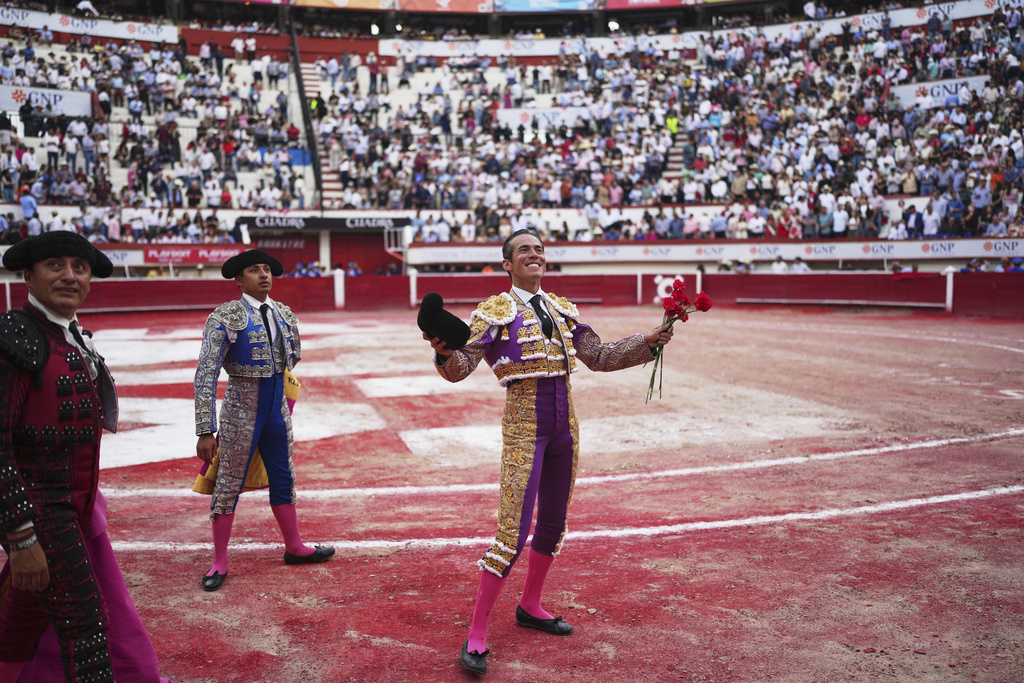
Mexican bullfighter Diego Silveti smiles at fans in the bullring after a bullfight in Aguascalientes, Mexico, Sunday, April 27, 2025. (AP Photo/Eduardo Verdugo)

Published by The Associated Press, May 2025 (link aquí)

Spanish story language here

AGUASCALIENTES, México (AP) – Mexican matador Diego Silveti performs a ritual ahead of each bullfight.

In each hotel room where he dresses in the garment that may bring him glory or death, he sets up an altar where he leaves his wedding band and prays before heading to the arena. 

“By leaving my ring behind, I’m telling God: Here’s everything I am as a father, a husband, a son and a brother,” Silveti said. “I commit to what I was born to be — a bullfighter.”

He last encountered a bull in late April in Aguascalientes, a state in central Mexico where bullfighting is considered a cultural heritage. Weeks before, though, Mexico City lawmakers banned violent bullfighting in the nation’s capital. 

While matadors there are still allowed to fight bulls, piercing their muscles with laces or running a sword through their body is prohibited under that ban.

Animal rights advocates celebrated the ruling and Environment Secretary Julia Álvarez said the lawmakers made history. But matadors like Silveti, as well as fans and cattle breeders, contend this long-time Spanish tradition bears a profound significance that would be undermined if bulls can’t be killed in the arena.

“What they propose goes against the essence and the rituals of bullfighting,” Silveti said. “It’s a veiled prohibition that opposes the ways in which it has been done since its origins.”

Bullfighting in Mexico traces its roots to Spain

The European conquerors of Mesoamerican territories in the 16th century brought along Catholicism and cultural practices that are now intertwined with Indigenous customs.

Researcher and bullfighting fan Antonio Rivera lives in Yucatán, a southeastern state where bullfights reflect ancient Mayan traditions.

“In local celebrations, the roots of bullfighting are sacrificial rites,” Rivera said. “Ancient cultures believed the gods requested sacrifices and blood fertilizes the earth.”

Every year, the Yucatán peninsula celebrates about 2,000 events featuring bulls, he said. 

In 2021, Yucatán’s Congress declared bullfighting part of its cultural heritage. It was a way to keep the ancestral memory alive, the official declaration said, and a way to honor its people’s identity. 

“When I see a bull, I feel an immense devotion,” Rivera said. “It’s a mirror of myself. It’s like looking at a living museum containing all the rituals from our collective memory.”

Like father, like son

Instead of soccer balls, Silveti grew up playing with “muletas” and “capotes” — the brightly colored capes matadors use to channel the bull’s charge.

His father was one of Mexico’s most beloved and renowned bullfighters. Until his death in 2003, fans called him “King David” and many remember him fondly when his son is in the ring.

“No one asked us where we wanted to be born,” Silveti said. “The love towards the bull and the feast of bullfighting has been my life and my ancestors’ life.”

His grandfather and his father before him were also matadors. Silveti emphasizes that his sons — now ages 6 and 2 — will decide their profession, but he would proudly support them if they followed in his footsteps.

Neither the boys nor his wife watch him at the bullring, but Silveti conveys his passion in other ways. His family often visit ranches where bulls are breed. Occasionally, with his sons in his arms, Silveti bullfights baby cows.

“My youngest loves it,” the matador said. “When he watches a bullfight, he plays with a napkin or a cloth and says ‘Olé!’ How is that possible?”

Each bullfight has its rituals

“The King” was no longer alive when Silveti became a professional bullfighter in Spain in 2011, but he senses his father’s presence constantly.

“I feel his spirit in my soul,” Silveti said. “On certain days, when I’m alone and focused, I try to speak to him and follow his example.”

As a child, Silveti never watched his father at the ring. He stayed home with his mother and brothers. With no social media at hand to monitor live updates, they asked God to protect him.

Many matadors, like Silveti, pray ahead of each bullfight. At the Aguascalientes plaza, the Rev. Ricardo Cuéllar blesses them.

“My job is to attend the religious needs of the bullfighting family,” Cuéllar said. “Not only matadors, but also aficionados, those selling food at the arena and the bullfighters’ assistants.”

According to Tauromaquia Mexicana, Mexico’s biggest bullfighting organization, more than 20,000 jobs depend on this tradition.

A take on bulls

One of the organizations opposed to violent bullfighting, Cultura sin Tortura, was pleased by the Mexico City measure and said it would continue its efforts elsewhere. Another half a dozen Mexican states have also imposed bans.

“We will keep advocating for the prohibition, given that no animal must be seen as entertainment,” the group said on social media.

Cattle breeders, meanwhile, say they view bulls not as sources of income but as fascinating creatures they spend years caring for. Manuel Sescosse, who owns a ranch, said that breeding this specific type of bull is as thrilling as bullfighting.

“They must look good at the arena,” Sescosse said. “Offensive but noble. They must charge and simultaneously spark a sensitivity driving the crowds to deep emotion.”

The perfect bull for a fight is 4 or 5 years old and weighs between 900-1,200 pounds.

According to Sescosse, each rainy season a bull is mated with 30 cows and their offspring are carefully monitored. Most receive a name. All are fed exclusively with grass and large areas are secured for them to exercise and grow strong. At the proper age, only a handful will be selected for bullfighting.

“You watch them since they are born and become calves and grow,” Sescosse said. “That affection grows when they turn out good for a bullfight, leave a mark and are revered.”

Long live Centinela

Not everyone attending bullfights is drawn to the sacred aspect, but some do find deeper purpose.

Daniel Salinas says matadors follow strict norms to demonstrate their appreciation toward the bull’s life, even as they end it. “We celebrate death deriving from a rite in which a human being confronts a wild animal,» he said.

At Aguascalientes, when his second bull died, Silveti caressed him and respectfully closed his eyes before stepping out of the arena.

“I’m aware the bull is offering me everything he has and I’m also willing to present him with my life,” Silveti said. “I’ve been gored 13 times and I’ve taken those hits willingly because I do this for a bigger purpose.”

It rarely happens, but when a bull has a unique, artistic connection with its matador, his life is spared. Instead of a sword, he gets a “banderilla” (a dart-like stick). Then he returns to his ranch and breeds a progeny that fans will revere.

Following Silveti’s performance in Aguascalientes, Spanish matador Alejandro Talavante faced one of those bulls.

Centinela — pitch-black hide, four years old, 1,140 pounds — won the fans’ hearts as Talavante’s passes made him spin and dance. The matador aimed to kill more than once, but the crowd pleaded for him not to. And in the end, the judge indulged.

Centinela gave a final, vigorous run and vanished through the tunnel while thousands cheered. It was a day of glory for him as well. 

____

Associated Press religion coverage receives support through the AP’s collaboration with The Conversation US, with funding from Lilly Endowment Inc. The AP is solely responsible for this content.
Thousands flock to central Mexico to celebrate Saint Mark’s Day

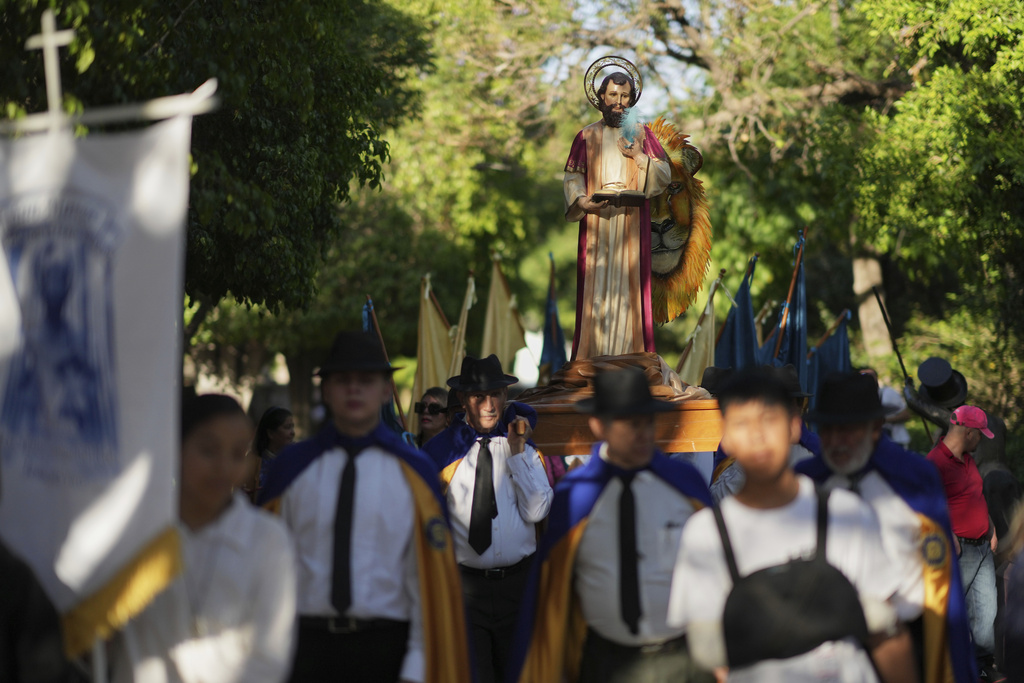
Parishioners carry a religious float with a statue of St. Mark during a month-long event honoring the saint, outside St. Mark’s church in Aguascalientes, Mexico, Friday, April 25, 2025. (AP Photo/Eduardo Verdugo)

Published by The Associated Press, April 2025 (link aquí)

Spanish story language here

AGUASCALIENTES, México (AP) – There’s a corner in central Mexico where much revolves around a revered saint. The neighborhood’s name? Saint Mark’s. The name of the local Catholic church? You guessed it, St. Mark’s. 

It’s no wonder then that the area’s most renowned event is the Fair of Saint Mark — a monthlong celebration that starts every year in mid-April, attracting tourists for its bullfighting and musical events

Last year, 10 million visited the city of Aguascalientes, about 500 kilometers (310 miles) northwest of Mexico City, the country’s capital. But the crowds on Friday were there for something more than just the fair. They came to honor Saint Mark, also known as Mark the Evangelist. 

Rev. Abel Carmona, who leads Masses and processions on April 25, when Catholics observe St. Mark’s Day or the Feast of Saint Mark, says that “even if the fair’s original purpose was commercial and agricultural, a religious sense was later added to it.” 

He says the fair now promotes knowledge about St. Mark, whose relics are kept in Venice, Italy, where the landmark St. Mark’s Basilica is located.

The neighborhood was founded in 1620 as the settlement of “Indios de San Marcos” (St. Mark’s Indians) by Spanish missionaries who built a small church. 

A fair was first held in November 1828 in a nearby village, mainly for farmers to offer their merchandise. But after a beautiful garden was constructed close to St. Mark’s church 20 years later, authorities decided to host the fair in St. Mark’s, ahead of the saint’s feast day.

Jodie Altamira, 35, grew up in the neighborhood and now helps organize processions and a bazar at the church during the fair, which she says it has been part of her identity, both as a resident of Aguascalientes and a Catholic.

Over the years, Carmona and Altamira grew concerned about the fairgoers’ excessive alcohol consumption and now are working to spark a different, healthier ambiance. This year, the neighborhood hosted three lectures about St. Mark’s and the church’s history.  

Carmona said this year was special because the community also marked what is known as “the defense of the temple.”

It commemorates a fraught time in the 1920s, when then-President Plutarco Elías Calles planned to set up a Mexican “schismatic” church, independent from Rome. In February 1925, St. Mark’s church was taken by priests loyal to Calles but the local residents staged a rebellion and eventually got their beloved temple back.

“It was a heroic defense,” Carmona said. “And it was significant because it led to Calles giving up on his idea of founding a Mexican church.”

Carmona celebrated Mass throughout the day on Friday. Afterward, a concert was to follow and a procession before sunset.

“Our procession is a public manifestation to say that ‘Saint Mark’ is not just a pagan fair,” Altamira said. “It’s how we celebrate the saint who brought us to Jesus Christ.”

___

Associated Press religion coverage receives support through the AP’s collaboration with The Conversation US, with funding from Lilly Endowment Inc. The AP is solely responsible for this content.
Renowned Mexico City restaurant serves traditional street food and nostalgia of the homeland

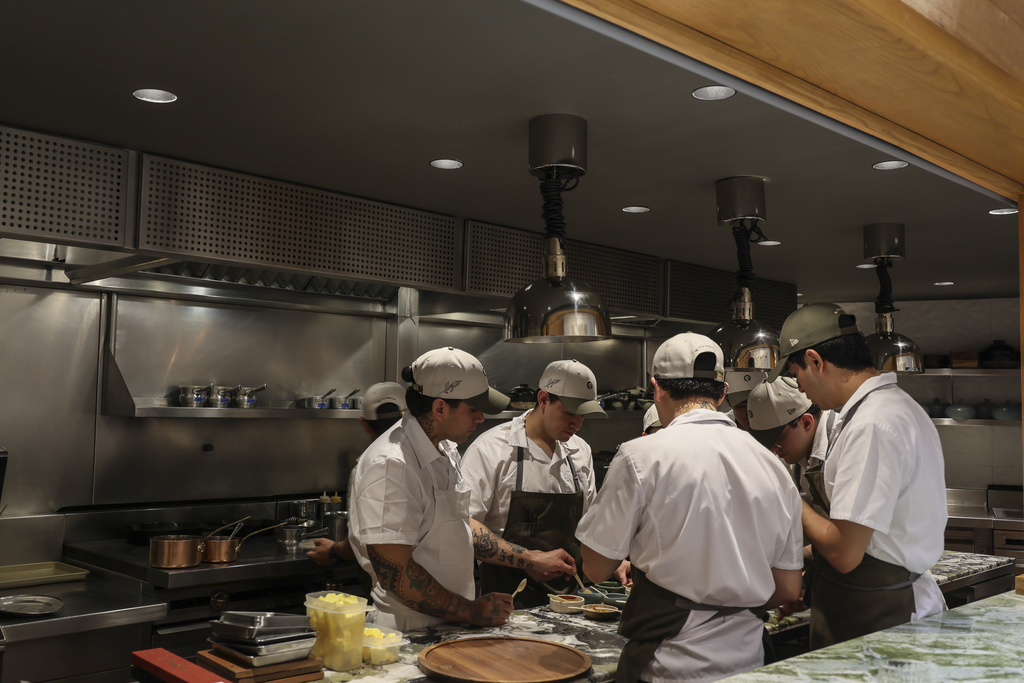
Quintonil’s team of chefs test sauces for the menu at the restaurant in Mexico City, Friday, Feb. 28, 2025. (AP Photo/Ginnette Riquelme)

Published by The Associated Press, March 2025 (link aquí)

Spanish story language here

MEXICO CITY (AP) – Quintonil is not your typical Mexican restaurant.

Clients book tables months in advance to celebrate special occasions. The World’s 50 Best list ranked it as the most acclaimed venue in the country in 2024 — and No. 7 worldwide. But once in a while something unexpected happens: food brings guests to tears.

“We have hosted people who have wept over a tamale,” said chef Jorge Vallejo, who founded Quintonil in Mexico City in March 2012.

He intentionally chose traditional street food for the menu — insects and other pre-Hispanic delicacies included. Priced at 4,950 pesos ($250 US) per person, it evokes the nostalgia of home and the history of the homeland.

The tamale — which translates from the Nahuatl language as “wrapped” — is a Mesoamerican delicacy made of steamed corn dough. It can be filled with savory or sweet ingredients — such as pork meat and pineapple — and topped with sauce.

Official records show that around 500 varieties of tamales can be found in Mexico. And according to a publication of Samuel Villela, ethnologist from the National School of Anthropology and History, Nahua communities used them for ritual purposes.

Most of Vallejo’s clientele are foreigners attracted by the two Michelin stars awarded to Quintonil last year. Others are nationals who spent decades living abroad or Americans of Mexican descent in search of a taste from their ancestry.

“They come to visit their families and feel shaken by the flavors that remind them who they are,” the chef said. “It’s like coming back to their roots.”

Providing that experience is what motivated him to open Quintonil 13 years ago. He first thought of his 11-table restaurant as a “fonda,” as Mexicans call popular food venues offering homemade dishes.

“I didn’t think I would own a restaurant like Quintonil nor did I aspire to that,” Vallejo said. “What I’ve tried to do is to learn from Mexico and show the best of it.” 

He took his first job in a place resembling a fonda, where he and his mom used to have lunch. He then studied culinary arts.

For a while, he worked on a cruise line, peeling crabs and coordinating the logistics to feed thousands of clients. Back in Mexico, he met his wife and business partner at Pujol, run by famed chef Enrique Olvera. They founded Quintonil a few years later and their mission has not changed: We’ll tell our country’s tales through food. 

“We all have a life story,” Vallejo said. “I try to interpret that and transform it into stories we can share at Quintonil.”

Traveling is part of his routine. He meets with colleagues to exchange anecdotes and contacts, but also encounters local farmers and spends time in remote communities to understand how food and tradition intertwine.

“In Mexico, we have ecosystems and ingredients that don’t exist anywhere else,” Vallejo said. “And our recipes, our traditions, are deeply rooted in society.”

His menu at Quintonil often incorporates insects, treasured since pre-Hispanic times.

Ancient documents describe how the Mexica were once established in the Chapultepec Hill. Its name comes from “chapulín,” a type of grasshopper that Mexicans currently enjoy from street vendors or at popular bars known as “cantinas.”

“In Mexico City, we have ‘escamoles’ season,” Vallejo said, referring to an edible larvae the Aztec people ate. “But in Oaxaca, we can find the ‘chicatana’ ants. In Tlaxcala, ‘cocopaches’ (a leaf-footed bug) and in Guerrero, they have insects of their own.” 

Alexandra Bretón, a food enthusiast who has visited Quintonil several times and reviews restaurants in her blog “Chilangas Hambrientas,” feels that Vallejo’s contribution to Mexican gastronomy is invaluable.

“He has elevated Mexican ingredients,” Bretón said. “My memories of Quintonil are of dishes where herbs, insects and vegetables are taken seriously in dishes with great technique.”

During her last visit in February, she tasted a delicious tamale filled with duck. Her second favorite was a taco, which can be found at thousands of food spots, but Vallejo somehow transforms into an experience.

“What we do here are not just beautiful plates,” said Geraldine Rodríguez, Quintonil’s sous chef. “We aim to nourish people, to show what Mexico is.”

There was a time, she said, when fine dining was synonymous of foie gras and lobster. But Quintonil chose another path.

“We have an ancestral cuisine that comes from our grandmothers,” Rodríguez said. “So we respect those recipes and add the chef’s touch.”

The taco experience highlighted by Bretón is among those efforts. Several ingredients — insects, for instance — are offered in plates for clients to wrap in tortillas.

“Through that interaction, that ritual that we Mexicans own, we watch clients wondering if they’re grabbing the taco in a proper way,” Rodríguez said. “But we always tell them we just want them to feel at home.”

Working long shifts and aiming for perfection is not an easy task for the 60 people working at Quintonil.

Rodríguez can spend up to four hours selecting a handful of sprouts to decorate a plate. Other near-invisible, almost ritualistic tasks are performed daily. One of them is brushing the “milpa,” a textile that hangs from the terrace and was named after Mesoamerican fields where crops are grown.

In the end it’s all worth it, Rodríguez said, because Quintonil provides clients with moments that evoke special memories.

She, too, has seen Vallejo’s clients cry over food. One of them was her dad. It was his 50th birthday, she said, and while she was not an employee of Quintonil at the time, Vallejo greeted her warmly.

The menu of the day included “huauzontles,» a green plant commonly cooked as a bun-shaped delicacy dipped in sauce. It also bears history, as Aztec communities ate it and used it to perform religious rites.

Quintonil’s recipe added stir-fry tomato and a local cheese. “When he ate it, he started crying and said they reminded him of my grandma,” Rodríguez said. “I had never seen my dad cry over a plate.”

Vallejo has often expressed joy for the recognition that Quintonil has achieved. But in his view, a chef’s true success is measured by what he make his clients feel.

“Mexican cuisine is a connection to the land, to the ingredients,” he said. “It’s a series of elements that produce not an emotion, but a feeling. And for me, there’s nothing more amazing than provoking that.”

____

Associated Press religion coverage receives support through the AP’s collaboration with The Conversation US, with funding from Lilly Endowment Inc. The AP is solely responsible for this content.
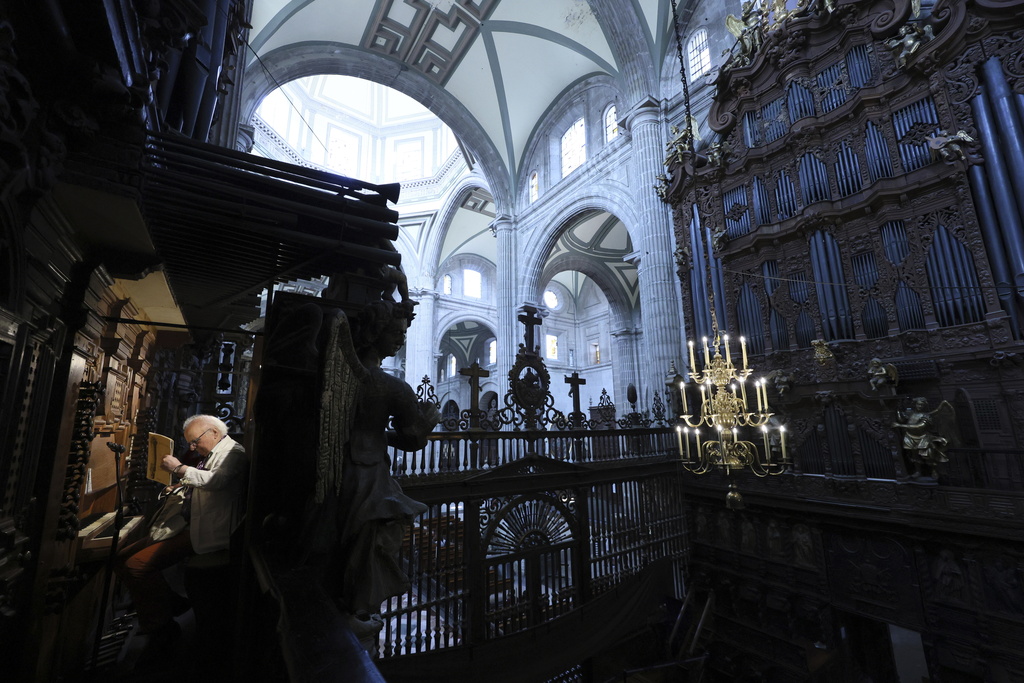
In Mexico City, this German organist says music is a gift from God and the organ’s sound is proof

German director and organist Leo Krämer rehearses for a concert at the Metropolitan Cathedral in Mexico City, Friday, Feb. 28, 2025. (AP Photo/Ginnette Riquelme)

Published by The Associated Press, March 2025 (link aquí)

Spanish story language here

After six decades of devotion to the organ, Maestro Leo Krämer treats the instrument like an extension of himself. He doesn’t even need to lay hands on it to hear in his mind how a song will sound.  

“That’s why it’s called an organ,” Krämer said. “Because it’s alive.”

The 81-year-old German director and organist was the latest guest star of Mexico City’s Catholic cathedral, where he recently inaugurated a season of sacred music concerts.

Subsequent presentations will be announced by the Archdiocese’s social media channels. Throughout 2025, a diverse range of musicians, directors and choirs will play once a month. Krämer is expected to come back for the closing concert in December.

“Our goal is to position the cathedral as a space in which we can praise God and convey the taste for good music,” said Arturo Hernández, from the organizing committee of the music festival, during a recent press conference. “Within these walls, we can find marvelous works of art — paintings, sculptures — but musical expressions can sometimes go unnoticed.”

Not for Krämer, that is. In the 1980s, he performed a concert at the very same Cathedral and was beyond excited to make its two organs roar a second time.

“Each organ represents a nation’s culture,” he said. “It might be a single instrument, but it can be tremendously variable depending on its origin.”

Back home, in Germany, the touchstone moment for organ music came with Johann Sebastian Bach during the Baroque period, he said. And in Mexico, where the Indigenous lands were conquered in 1521, organ music arose from the nation’s Spanish heritage.

“For a European musician like myself, entering a magnificent space as this cathedral, having the opportunity to play and listen to these historical instruments, is just fascinating.”

According to historian Kevin Valdez, the cathedral itself is special because it has two organs — one Mexican, one Spanish — and both survived a fire in 1967.

The wooden titans rest over the choir loft facing each other like 18th century twins. Their dimensions slightly differ with the Spanish one being the tallest, but together have more than 6,000 pipes capable of producing thousands of sound variations.

Since their construction, several composers have specifically written music to be played on the pair. And to this day, cathedral staff take care of its precious musical archive, which musicians worldwide, like Krämer, revere.

Unlike violinists or trumpeters who bring their instruments with them, Krämer encounters new organs as he changes venues.

Days before each concert, he climbs the stairs to the organ’s bench and keyboards, getting to know the instrument by allowing his fingers to dance freely.

“Once I recognize the organ, what I acoustically feel with it, I choose the music I will play,” Krämer said. “It all depends on the acoustic capacities of the instrument and the space.”

His fascination with music came from childhood. In Püttlingen, where he was born, both his parents were amateur singers.

Before he left for school, as his mom prepared his lunch, he listened to her songs. Other days, while his dad took him to church to practice with the choir he was part of, Krämer rejoiced.

“My earliest memories are not from when I learned to read or write,” he said. “My first memories are being in church, listening to music, feeling fascinated by the sound of the organs.”

That was all it took. At age 11, he decided to become a musician and fill holy spaces with an organ’s voice.

It might seem a solitary job. Krämer plays practically isolated, merely aided by two assistants who pull in and out the side knobs that determine the pipes’ sound. But he never feels too far from his listeners.

“I can absolutely feel the contact,” he said. “It’s energy. It’s connection. Music is like a street that you create between yourself and the public. It’s God’s gift for humankind.”

During his latest concert at Mexico’s cathedral, Krämer performed with both organs, pleasing the audience. 

Saira de la Torre, a soprano who happened to be among the audience, said she felt overwhelmed by the opportunity to “watch closely” such an emotive musician and feel an instrument as majestic as the organ. “The most moving moments were those of simplicity,” she said. “This touched my soul.”

Óscar Ramírez, an architect, was impressed by how the organ filled the church. “The sound dissipated through lots of places. You could feel one thing here, another one there,” Ramírez said. “This space alone could make music sound this way.”

Krämer’s repertoire included works by Bach, Italian composer Ignacio de Jerusalem and pieces from the cathedral’s archive, such as “Misa Ferial a 4” by Spanish artist Hernando Franco. Krämer also improvised, sound spilling out of his hands.

Verónica Barrios sat quietly for a few minutes after Krämer faded behind the choir.

“You don’t just come here to pray,” she said. “This is music that brings us closer to God.”

____

Associated Press religion coverage receives support through the AP’s collaboration with The Conversation US, with funding from Lilly Endowment Inc. The AP is solely responsible for this content.

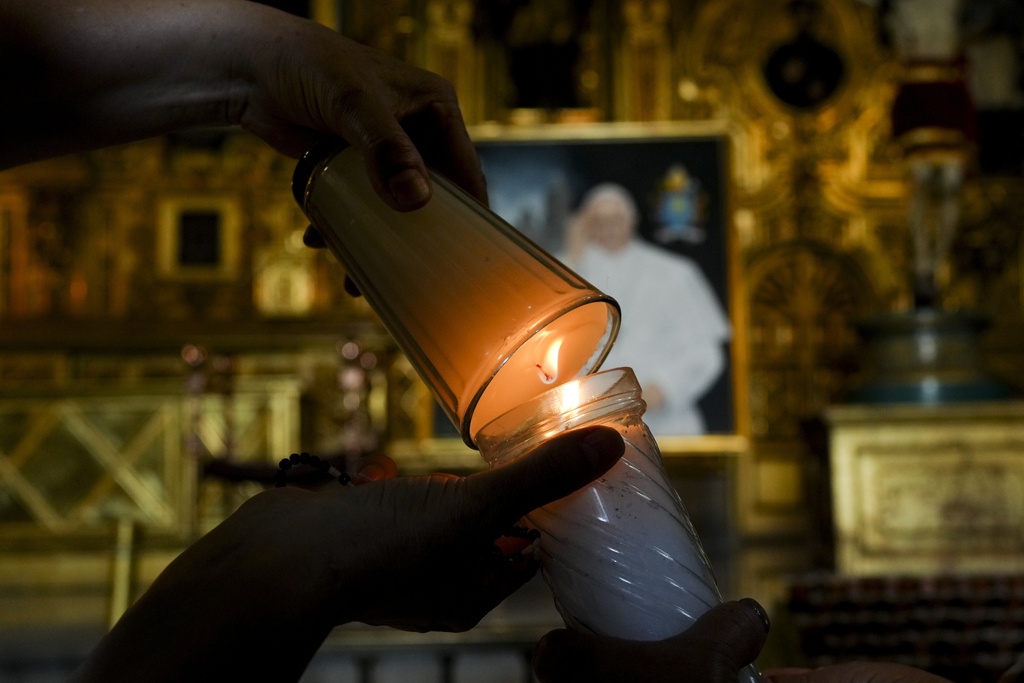
Una oración por Francisco: mexicanos piden por la salud del papa en la catedral capitalina

Feligreses encienden una vela por la salud del papa Francisco en la Catedral Metropolitana en Ciudad de México, el jueves 27 de febrero de 2025. (AP Foto/Marco Ugarte)

Published by The Associated Press, February 2025 (link aquí)

CIUDAD DE MÉXICO (AP) – Cuando Araceli Gutiérrez leyó en redes sociales que la Arquidiócesis de México convocaba a un oración para el papa Francisco, la mujer de 60 no lo pensó ni un segundo. Tomó su rosario, consiguió una veladora y se dirigió a la catedral capitalina. 

“Él es como parte de la familia”, dijo tras el rosario del jueves por la tarde. “Por eso se siente esta preocupación por él». 

Como ella, otras decenas de personas se dieron cita en el templo católico de Ciudad de México para pedir por la recuperación de Francisco, quien ha estado hospitalizado en Roma desde el 14 de febrero tras una infección respiratoria que derivó en neumonía y otras complicaciones. 

El papa de 88 años, a quien se le extirpó parte de un pulmón cuando era joven, padece una enfermedad pulmonar crónica y el sábado sufrió una crisis respiratoria asmática que requirió altos flujos de oxígeno. Desde entonces, el Vaticano ha reportado mejorías leves y constantes, aunque los médicos indicaron el jueves que requiere más días de “estabilidad clínica”. 

Gutiérrez, quien recuerda con nostalgia la visita que Francisco realizó a México en 2016, dice que ha rezado por él desde que se enteró de sus más recientes complicaciones de salud. “En muchos actos en los que yo lo veo en la tele, digo: ‘Es Dios; son los actos que hubiera hecho Jesús si estuviera aquí con nosotros’”.

Poco antes del inicio del rosario, las hermanas María Teresa y María Consuelo Sánchez guardaron unos minutos de silencio y se persignaron frente a una fotografía de Francisco. 

María Teresa, de 72 años, contó que son colombianas y están de visita por México, pero decidieron unirse a la oración porque el papa siempre pide que recen por él. “Es el único papa que ha sido latinoamericano, que no es de tan lejos», dijo. “Eso es como tener un familiar en los altos mandos, con Dios”. 

Tanto ella como su hermana, de 70 años, afirmaron que su pontificado se ha distinguido por su sencillez. “Es un papa humilde, como un amigo”, dijo María Consuelo. 

A pocos metros de ella, hincado sobre el mármol de la catedral, José Carlos Zúñiga mantenía los ojos cerrados y las manos frente al pecho mientras el canónigo Manuel Corral repetía un Avemaría tras otra. 

“He estado al pendiente de su salud”, dijo el mexicano de 56 años. “Me tocó conocerlo en Morelia en una visita que hizo y, para uno como católico, es algo que lo llena porque no es fácil que venga y no es fácil que uno vaya hasta el Vaticano». 

El viaje que Francisco realizó por México en 2016 duró cinco días y recorrió territorios inexplorados por sus predecesores, como Michoacán y Chiapas, donde gran parte de la población se ha visto asolada por el narcotráfico, el crimen organizado y la corrupción. 

En el país de 100 millones de católicos, el pontífice argentino se encontró con familiares de los 43 estudiantes desaparecidos en 2014 y rezó por los migrantes. En la última misa que ofreció en Ciudad Juárez antes de volver al Vaticano, pidió por todos aquellos que han muerto tratando de llegar a Estados Unidos. 

Al finalizar el rosario del jueves, el padre Corral contó a periodistas que le entusiasmaba que los últimos reportes desde Roma refieren que la salud de Francisco ha mostrado ciertas mejoras. 

“Lo queremos mucho porque es un papa que está cercano, que da vida», dijo». “Siempre está sonriente. Dicen que sigue con su gran humor y eso nos alegra mucho”. 

____

La cobertura de noticias religiosas de The Associated Press recibe apoyo a través de una colaboración con The Conversation US, con fondos del Lilly Endowment Inc. La AP es la única responsable de todo el contenido.

Ancient deity, pet and endangered species. Why is axolotl Mexico’s most beloved amphibian?

An axolotl swims in an aquarium at a museum in Xochimilco Ecological Park in Mexico City, Tuesday, Feb. 11, 2025. (AP Photo/Marco Ugarte)

Published by The Associated Press, February 2025 (link aquí)

Spanish story language here

MEXICO CITY (AP) – Legend has it the axolotl was not always an amphibian. Long before it became Mexico’s most beloved salamander and efforts to prevent its extinction flourished, it was a sneaky god.

“It’s an interesting little animal,” said Yanet Cruz, head of the Chinampaxóchitl Museum in Mexico City.

Its exhibitions focus on axolotl and chinampas, the pre-Hispanic agricultural systems resembling floating gardens that still function in Xochimilco, a neighborhood on Mexico City’s outskirts famed for its canals.

“Despite there being many varieties, the axolotl from the area is a symbol of identity for the native people,” said Cruz, who participated in activities hosted at the museum to celebrate “Axolotl Day” in early February.

While there are no official estimates of the current axolotl population, the species Ambystoma mexicanum — endemic of central Mexico— has been catalogued as “critically endangered” by the IUCN Red List of Threatened Species since 2019. And though biologists, historians and officials have led efforts to save the species and its habitat from extinction, a parallel, unexpected preservation phenomenon has emerged.

Axolotl attracted international attention after Minecraft added them to its game in 2021 and Mexicans went crazy about them that same year, following the Central Bank’s initiative to print it on the 50-peso bill. “That’s when the ‘axolotlmania’ thrived,” Cruz said.

All over Mexico, the peculiar, dragon-like amphibian can be spotted in murals, crafts and socks. Selected bakeries have caused a sensation with its axolotl-like bites. Even a local brewery — “Ajolote” in Spanish — took its name from the salamander to honor Mexican traditions.

Before the Spaniards conquered Mexico-Tenochtitlan in the 16th century, axolotl may not have had archeological representations as did Tláloc — god of rain in the Aztec worldview — or Coyolxauhqui — its lunar goddess — but it did appear in ancient Mesoamerican documents.

In the Nahua myth of the Fifth Sun, pre-Hispanic god Nanahuatzin threw himself into a fire, reemerged as the sun and commanded fellow gods to replicate his sacrifice to bring movement to the world. All complied but Xólotl, a deity associated with the evening star, who fled.

“He was hunted down and killed,” said Arturo Montero, archeologist of the National Commission of Protected Natural Areas. “And from his death came a creature: axolotl.”

According to Montero, the myth implies that, after a god’s passing, its essence gets imprisoned in a mundane creature, subject to the cycles of life and death. Axolotl then carries within itself the Xolotl deity, and when the animal dies and its divine substance transits to the underworld, it later resurfaces to the earth and a new axolotl is born.

“Axolotl is the twin of maize, agave and water,” Montero said.

Current fascination toward axolotl and its rise to sacred status in pre-Hispanic times is hardly a coincidence. It was most likely sparked by its exceptional biological features, Montero said.

Through the glass of a fish tank, where academic institutions preserve them and hatcheries put them up for sale, axolotl are hard to spot. Their skin is usually dark to mimic stones — though an albino, pinkish variety can be bred — and they can stay still for hours, buried in the muddy ground of their natural habitats or barely moving at the bottom of their tanks in captivity.

Aside from their lungs, they breathe through their gills and skin, which allows them to adapt to its aquatic environment. And they can regenerate parts of its heart, spinal cord and brain.

“This species is quite peculiar,” said biologist Arturo Vergara, who supervises axolotl preservation efforts in various institutions and cares after specimens for sale at a hatchery in Mexico City.

Depending on the species, color and size, Axolotl’s prices at Ambystomania — where Vergara works — start at 200 pesos ($10 US). Specimens are available for sale when they reach four inches in length and are easy pets to look after, Vergara said.

“While they regularly have a 15-years life span (in captivity), we’ve had animals that have lived up to 20,” he added. “They are very long-lived, though in their natural habitat they probably wouldn’t last more than three or four years.”

The species on display at the museum — one of 17 known varieties in Mexico — is endemic to lakes and canals that are currently polluted. A healthy population of axolotl would likely struggle to feed or reproduce.

“Just imagine the bottom of a canal in areas like Xochimilco, Tlahuac, Chalco, where there’s an enormous quantity of microbes,” Vergara said.

Under ideal conditions, an axolotl could heal itself from snake or heron biting and survive the dry season buried in the mud. But a proper aquatic environment is needed for that to happen.

“Efforts to preserve axolotl go hand in hand with preserving the chinampas,” Cruz said at the museum, next to a display featuring salamander-shaped dolls. “We work closely with the community to convince them that this is an important space.”

Chinampas are not only where axolotl lay its eggs, but areas where pre-Hispanic communities grew maize, chili, beans and zucchini, and some of Xochimilco’s current population grow vegetables despite environmental threats.

“Many chinampas are dry and don’t produce food anymore,” Cruz said. “And where some chinampas used to be, one can now see soccer camps.”

For her, like for Vergara, preserving axolotl is not an end, but a means for saving the place where the amphibian came to be.

“This great system (chinampas) is all that’s left from the lake city of Mexico-Tenochtitlan, so I always tell our visitors that Xochimilco is a living archeological zone,” Cruz said. “If we, as citizens, don’t take care of what’s ours, it will be lost.”

—-

Associated Press religion coverage receives support through the AP’s collaboration with The Conversation US, with funding from Lilly Endowment Inc. The AP is solely responsible for this content.
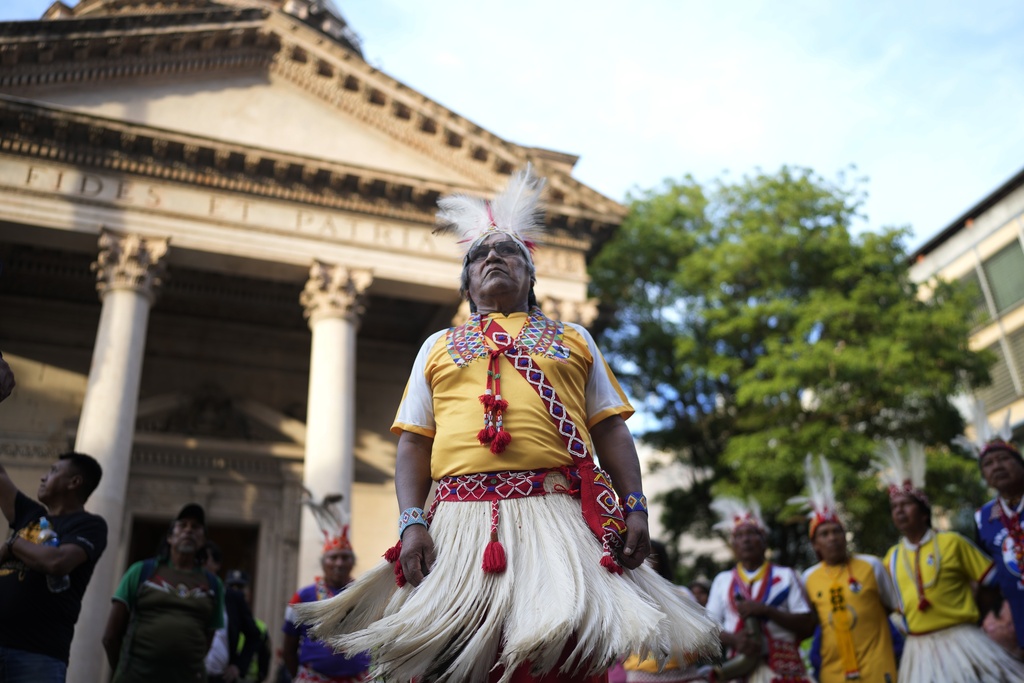
Their sacred land was a gift for their courage. Yet Maká people in Paraguay fight for its ownership

FILE – Maka Indigenous leader Mateo Martinez leads a protest for the recovery of ancestral lands in Asuncion, Paraguay, Feb. 28, 2024. (AP Photo/Jorge Saenz, File)

Published by The Associated Press, February 2025 (link aquí)

Spanish story language here

ASUNCIÓN (AP) – Many Maká traditions have slowly faded. Yet a few elders among these Paraguayan Indigenous people recall how their songs imitated birds. 

“Men used to say that, as they sang, they travelled to Iguazu Falls or to the mountains,” said Gustavo Torres, a Maká teacher based near Paraguay’s capital, Asunción. “Their songs imitated nature.”

Next to him smiled Elodia Servín, who only speaks the Maká language but had Torres help as a translator. Her skin is covered in wrinkles and she has forgotten her age, but a memory sticks: A long time ago, when she was healthy and strong, she loved dancing in Fray Bartolomé de las Casas, a territory her people are now fighting to get back. 

The land in dispute is an 828-acre (335 hectare) terrain that the Maká claim ownership over. Paraguay’s government has rejected most of their arguments, designating part of it to build a bridge connecting two cities across the Paraguay River.

Fray Bartolomé, as the Maká call it, was offered to them through a decree issued in 1944 by strongman Higinio Morínigo, then Paraguay’s president. It was meant as a present, the Maká have said, to acknowledge their courage and the role they played during the Chaco War against Bolivia in the 1930s.  

“That place is sacred for us,” said Maká leader Mateo Martínez, 65. “It was a gift we thanked God for because it was given through people that loved us.”

His ancestors, Martínez said, guided soldiers through the mountains and quenched their hunger and thirst during the war.

“Only the Indigenous people knew where to find water,” he said. “If a Paraguayan soldier had gotten lost there alone, he would have died.”

Aside from the decree, details of the gift were never put on paper. The ownership titles were issued in the 2000s, and once they were, less than half of the promised acres were granted to the Maká.

Officials have said that a piece of land was indeed given to the community by Morínigo, but its size was never determined nor were its coordinates precise. Both sides meet on a regular basis to discuss a potential new agreement, though no consensus has been reached yet.  

“We are open to talking,” Martínez said. “But the government won’t listen to us or tries to deceive us.”

The Maká are one of the 19 Indigenous communities of Paraguay. In the South American country of 6.8 million, more than 140,000 are Indigenous people. The latest census from 2022 estimates that around 2,600 Maká are distributed in both urban and rural areas.

Mariano Roque Alonso, where Servín and 1,600 other Maká live, is located across the Paraguay River, not too far from Fray Bartolomé. Floods forced them to relocate in the 1980s, and they haven’t been able to move back since.

Younger generations have learned Spanish, but their native language remains predominant. A few steps from the Baptist church most of the community attends, the prayers painted on a wall are in Maká.

“Our elders had other beliefs,” Martínez said. “They used to believe in the forces of nature. They prayed to the Venus star. To the moon for good health and crops.”

Among their most treasured traditions, the Maká still make a feast when a young woman transitions from puberty to adulthood. Men drink chicha, made of fermented corn, or fight as part of the celebrations. Women like Servín sing.

“Our songs come from our ancestors,” she said. “I now want to bequeath them to younger generations. To my daughters and granddaughters.”

Many like her — who sell bags and other embroidered products — make a living from craftsmanship. 

Patricio Colman, 63, produces necklaces, bracelets, arrows and bows. He, too, grew up in Fray Bartolomé and recalls his people’s long-gone traditions. 

“When hunters were still alive, they gathered to go hunting and stayed up to three months in the mountains,” Colman said. “But no one does that anymore.”

Back in the day, he said, the Maká had various leaders. One for hunting, one for fishing, one for youth and one for dancing. Now Martínez is the only one left.

“Even then, when officials used to visit, the distribution of the territory was unclear,” Colman said. “There had always been a threat of invasion.”

The Maká not only weep for the loss of the land itself, but the distance keeping them from their loved ones buried in Fray Bartolomé. Among them is Juan Belaieff, a Russian soldier and cartographer who mapped the region during the Chaco War. According to Martínez, then-elders thought of him as a white deity who served as a link between the community and God. 

“They loved him deeply, and he was venerated by our grandparents,” the leader said.

Non-Maká people might find it hard to spot their cemetery. With no tombstones or crosses on-site, officials have doubted their claims.

“We are a different culture, though,” Martínez said. “When a Maká perishes, we don’t use a cross.”

The community does dig graves for loved ones who have recently died. Relatives cover the bodies with a cloak and the person’s belongings, but no other rituals are performed and graves are not marked.

“Relatives feel the absence so profoundly that we don’t do any ceremonies or console each other,” Martínez said. “It’s a moment of respect.”

The Maká now bury their people in Quemkuket, about 11 miles (18 kilometers) from their current settlement, but they hope to eventually get their ancestors’ remains back in one place. 

“The Maká are warriors, courageous warriors,” Martínez said. “We have been fighting for this for five or six years and have no intention of ever giving up.”

____

Associated Press religion coverage receives support through the AP’s collaboration with The Conversation US, with funding from Lilly Endowment Inc. The AP is solely responsible for this content.
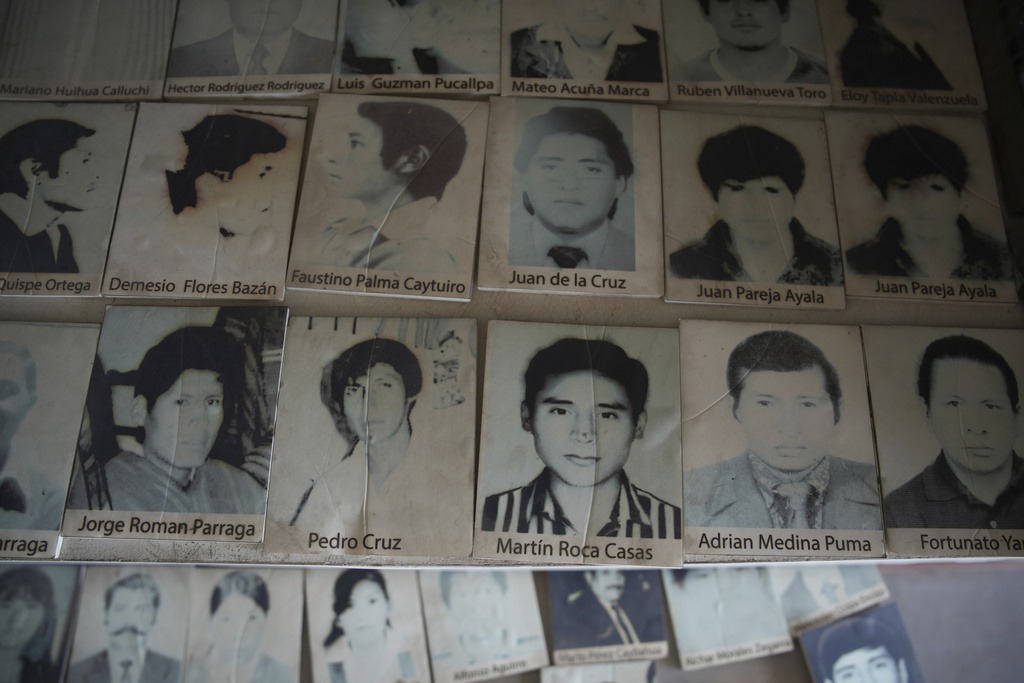
Takeaways from AP’s reporting on the thousands disappeared in Colombia, Peru and Paraguay

Photos of people who disappeared during Peru’s internal armed conflict (1980-2000) lie on display at the House of Memory museum in Lima, Peru, Sunday, Oct. 20, 2024. (AP Photo/Guadalupe Pardo)

Published by The Associated Press, January 2025 (link aquí)

Spanish story language here

Thousands of people have disappeared in Latin America during decadeslong conflicts. Many have never been found, presumed to be the victims of dictatorships, insurgencies or organized crime. 

The most well-known of these mass disappearances occurred in Argentina and Chile during their military dictatorships. There are similarly wrenching but less well-known traumas elsewhere in the region.

In Peru, Colombia and Paraguay, for example, many people are still searching for answers. Loved ones have found comfort in their faith but have faced years of uncertainty and a lack of official justice. 

In Peru, out of 20,000 disappeared people, only 3,200 remains have been found. In Colombia, five decades of war left a staggering death toll and more than 124,000 people missing. Paraguay’s dictatorship left a smaller number of disappeared (500 people), but only 15 bodies have been recovered.

Some key aspects of AP’s reporting from these three countries:A divisive peace in Colombia

Fighting among leftist guerrillas, right-wing paramilitaries, drug lords and government forces left more than 450,000 people killed and 124,000 disappeared. These figures are on par with other conflicts in Latin America, where thousands have vanished under similar circumstances.

In Colombia, though, a peculiar thing happened. Aiming to heal long-time wounds and build new paths toward reconciliation, dozens of former rebels, officials, forensic anthropologists and religious leaders now work side-by-side in finding their country’s disappeared.

A 2016 peace pact with the main rebel group — the Revolutionary Armed Forces of Colombia (FARC) — earned then-President Juan Manuel Santos a Nobel Peace Prize. But neither he nor his successors have fully addressed endemic violence, displacement and inequality — issues that helped spark Colombia’s conflict in the 1960s.

In 2022, Gustavo Petro, a former rebel, was sworn in as the country’s first leftist leader. His goal is to demobilize all rebels and drug trafficking gangs, but even as a ceasefire was carried out, negotiations with Colombia’s remaining guerrilla group, the National Liberation Army (ELN), failed and violence reemerged. Simultaneously, FARC hold-out groups and trafficking mafias continue to affect the country.

The peace pact established three crucial institutions for searching efforts: the Truth Commission; the Special Jurisdiction for Peace, which encourages offenders to confess their crimes and make restitution actions in exchange for not serving any jail time; and the Search Unit for Disappeared Persons, which traces disappearances, conducts exhumations and returns loved ones’ remains to hurting relatives like Doris Tejada, whose son Óscar Morales disappeared in 2007.

“It’s been 17 years and still hurts,” said Tejada, who found Morales’ remains in 2024. “I asked God for help because it was difficult to see his bones. We still mourn.”

Government forces and illegal groups were as responsible for massacres, forced recruitment and disappearances. According to the Truth Commission, paramilitary groups committed 45% of the homicides, while guerrillas — most of them FARC — carried out 27% and the government forces 12%.In Paraguay, a dictator’s sway is felt long after his ouster

Despite being ousted in 1989 after a 35-year reign of terror, during which 20,000 people were tortured, executed or disappeared, some Paraguayans feel as if Gen. Alfredo Stroessner never truly left.

“This is probably the only country in which the political party that supported a dictator, once he is gone, remains in power,” said Alfredo Boccia, an expert on Paraguay’s history. “That’s why scrutiny took so long, most disappeared were never found and there were barely trials.”

Stroessner served as Paraguay’s president, leader of the conservative Colorado Party, commander of the armed forces and chief of police. He was not overthrown by enemies, but by his in-law, and the military members involved were affiliated with his party, which has ruled almost uninterrupted since.

The Colorado Party’s dominance makes accountability elusive. Few of those responsible for crimes have faced trial, and public schools avoid mentioning the dictatorship during history lessons.

“Paraguayans now vote for the party freely,” Boccia said. “For those of us who fight for memory, that battle was lost.”

Rogelio Goiburu, who has searched for his father for 47 years, was named director of historic memory at the Ministry of Justice, but has no budget. By his own means or raising funds, he has filled in the blanks about the fate of his father and other disappeared people, earning the trust of retired police and military officers who confessed to him how bodies were disposed.

Only one major excavation has been done in Paraguay seeking to solve disappearances. It was led by Goiburu between 2009 and 2013. Of the 15 bodies found, only four were identified.

While 30,000 Argentinians disappeared in a less than a decadelong dictatorship, around 500 people vanished in Paraguay amid the 35-year regime. Regardless, relatives argue that searches must continue.

“Every disappearance attacks the right to mourn,” said Carlos Portillo, who interviewed thousands of victims for the Truth Commission. “There’s no culture which doesn’t have a ritual for mourning. A disappearance is the denying of this ritual, and that’s why it’s impossible to let go.”Grim legacy of Peru’s 20-year insurgency

In Peru, an estimated 20,000 people disappeared between 1980 and 2000 during a brutal conflict between the government and the Sendero Luminoso (or Shining Path), a Communist organization that claimed to seek social transformation through an armed revolution.

Founded in the 1970s by Abimael Guzman, the group turned violent a decade later. Older Peruvians still tell tales about donkeys strapped with explosives detonating in crowds, bombs that blew up streetlamps to plunge cities into darkness, and massacres that wiped out entire families.

The terror, though, was not merely unleashed by the insurgents. The armed forces were equally responsible for deaths and human rights violations. 

Hundreds of men — many of them innocent — were captured by the military, often to face torture and execution. Others were slain and buried in mass graves by insurgents seeking to control communities by spreading fear.

Although hundreds of people have disappeared for other motives since then, the Truth Commission said this was the most violent period in Peru’s history. More than 69,000 people are counted as “fatal victims” — about 20,000 classified as “disappeared” and the rest killed by insurgents or the military.

“In many ways, Peru is still dealing with the repercussions of the political violence from the late 20th century,” said Miguel La Serna, a history professor at the University of North Carolina.

“Whole generations of adult men disappeared and that impacted the demographics in these communities. People moved out to escape the violence and some never returned,” he added. “And that’s to say nothing of the social, collective trauma that people experienced.”

Despite the work of forensic doctors, prosecutors and organizations like the International Committee of the Red Cross, only about 3,200 remains have been found. Some now fear that President Dina Boluarte might cut the government’s support to keep searching.

___

Associated Press religion coverage receives support through the AP’s collaboration with The Conversation US, with funding from Lilly Endowment Inc. The AP is solely responsible for this content.