Afro-descendants in Bolivia fight invisibility with dance and memory

A young member of the Afro-Bolivian community dances the “saya,” a traditional dance performed with drums and chants, as part of the celebrations to mark the upcoming National Day of Afro-Bolivian people, in La Paz, Bolivia, Friday, Sept. 19, 2025. (AP Photo/Juan Karita)

Published by The Associated Press, September 2025

Spanish story language here

YUNGAS, Bolivia (AP) – Cielo Torres had always lived in Bolivia. Yet before moving at age 17 to the remote town of Tocaña — where much of the country’s Afro-descendant community lives — she had rarely encountered people who looked like her.

“Back in Santa Cruz, we were the only Afro,” said Torres, now 25. “But when I saw others like me, I told myself: This is where I want to be. Here I feel comfortable and understood.”

Her sense of belonging echoes the experience of many Afro-Bolivians. Although officially recognized in the constitution since 2009, they remain one of Bolivia’s least visible groups, struggling to feel at home in their own land.

“Many think that we are foreigners and we don’t have any rights,” said Carmen Angola, executive director of the Afro-Bolivian National Council (CONAFRO). “But we were born here.”

More than 11.3 million people live in Bolivia. Around 23,000 identified as Afro in a 2012 census, the first and only time they appeared as a distinct category. Most live in Yungas, a region where roads and communications are scarce but coca leaf plantations abound.

“Our Afro communities depend on coca harvesting or honey production,” said Torres, who runs a beekeeping business with her husband.

“We are people used to walking trails instead of paved roads,” she added. “People who learn from the land.”

Symbolic gestures, scarce change

Official information on the community’s history is hard to come by. “We have been made invisible by the state,” said activist Mónica Rey. “There weren’t any written registers reflecting our reality. We wrote that history down ourselves.”

She said some progress was made in 2007, a year after Evo Morales became Bolivia’s first Indigenous president. “By 2009 we were included in the constitution,” she added. “But we have demanded our inclusion and rights to all the past governments.”

Morales supported CONAFRO’s founding in 2011. That same year, Sept. 23 was established as the National Day of the Afro-Bolivian People and Culture. Still, according to Rey, symbolic recognition is not enough to achieve structural change.

“The idea was that this day would serve to reaffirm our identity and that the state would create public policies for the Afro people,” Rey said. “But it turns out we celebrate among ourselves and the government doesn’t do anything.”

She and Carmen Angola contend that promoting their people’s legacy has proven difficult. Angola has tried to convince local authorities to allow a group of Afro-Bolivians to visit schools and share insights of their community. None have agreed so far.

“They just say they’re going to address discrimination, history and racism,” Angola said. “But the people who created the curricula aren’t Black. Their history is not ours.”

From the mines to the ‘haciendas’

CONAFRO joined efforts with another organization to gather testimonies documenting the Afro-Bolivian community’s long-lost past. A comprehensive document was released in 2013.

“We got our history back,” Rey said. “Our experiences, our elders’ tales, our culture, have been retrieved and documented.”

The Afro-Bolivian people descend from the Africans enslaved in the Americas during the European conquest between the 16th and 17th centuries. 

Mostly born in Congo and Angola, they were initially taken to Potosí, a colonial mining city located about 340 miles (550 kilometers) southeast of La Paz.

The high altitude — 13,700 feet (4,175 meters) above sea level — and the extreme weather quickly took a toll. Later on, exposure to mercury and other substances in mining led to severe illnesses — from tooth loss, respiratory disease and death.

Two centuries later, the ancestors of the current Afro-Bolivian population were forcibly relocated to Yungas. There they settled and started working in large estates known as ‘haciendas,’ where coca leaf, coffee and sugar cane were grown.

“The Afro people were dying and that was inconvenient because they were considered investments,” said sociologist Óscar Mattaz. “So people started buying them and taking them away.”

Now Tocaña and neighboring towns are considered the cultural heart of Afro-Bolivians.

A king with no crown

In Mururata lives Julio Pinedo, a symbolic leader regarded as the king of the Afro-Bolivians.

Bolivia’s Black community has recognized kings for centuries. Pinedo’s role carries no political weight within the government, but he is considered a guardian of his people’s rights. Local authorities acknowledge his title and even attended his coronation in 1992.

“The king was a symbolic means to show there’s royalty in the community,” Mattaz said. “He was very influential, worked hard and was respected.”

His position hardly made a difference in his lifestyle. Pinedo, now 83, resides in the same humble home he has always lived. He now relies on his son’s coca harvest for income.

Pinedo welcomes visitors. But engaging in conversation is hard due to his age. According to his wife, Angélica Larrea, his royal ancestry dates back 500 years. 

“I remember his coronation,” she said. “People came from other communities. They danced and there was a procession. A priest came and we celebrated Mass.”

A handful of Afro-Bolivians have tried to decipher what their ancestors’ spirituality was. Yet the community remains overwhelmingly Catholic.

Close to Pinedo’s home, the sole parish of Mururata has no resident priest. Nonetheless, a group of devoted women are welcomed to read the Bible each Sunday. 

Isabel Rey — a distant relative of Mónica — said her ancestors were Catholics. And even without a priest to rely on, the catechist in charge of the church has kept the community’s faith strong.

“She will soon celebrate 40 years sharing the Lord’s word,” Rey said. “I help her, because she can’t keep up the work alone.”

A dance of struggle and love

There might not be an Afro-Bolivian spirituality, but the community’s soul remains bonded through the “saya,” a traditional dance performed with drums and chants.

“Our demands were born through this music,” Rey said. “The saya has become our instrument to gain visibility. We protest with drums and songs.”

Torres recalled dancing saya before moving to Tocaña. Yet her feelings while performing it changed.

“Here it’s danced from the heart,” she said. “I learned how to sing and listen. It’s no ordinary music because we tell our history through it.”

She said each detail in their garments bears meaning. The white symbolizes peace and the red honors the blood shed by their ancestors. Men wear black hats to remember how their predecessors worked endlessly under the sun. And the women’s braids depict the roads they dreamed of to escape.

“It may seem like fashion, but it’s not,” Torres said. “It’s our culture.”

For more than a decade now, she has learned new moves and saya songs. She became fluent in her community’s language — a variation of Spanish that is not officially recognized — and is proud of her identity.

“I used to feel embarrassed for dancing saya,” Torres said. “But when I saw people dancing here, I told myself: ‘This is what I am. I am Black.’”

Committed to raising her daughter to also be proud of her ancestry, she constantly praises her skin color, hair and moves.

“She already dances saya,” Torres said. “I tell her: ‘You are Black. My Black little girl.’”

____

Associated Press religion coverage receives support through the AP’s collaboration with The Conversation US, with funding from Lilly Endowment Inc. The AP is solely responsible for this content.
Mexican churches mark the anniversary of deadly quakes with remembrance and lessons for the future

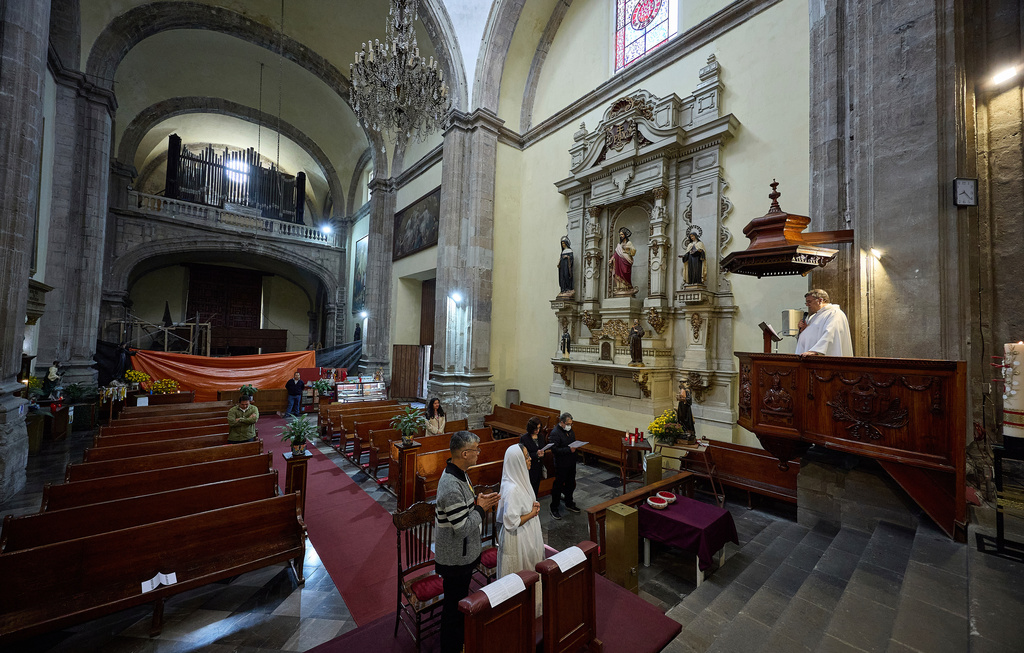
Vinicio Cruz and Carmen Chavez get married during a ceremony by Father Juan Carlos Guerrero inside San Juan de Dios church in Mexico City, Friday, Sept. 19, 2025. The church withstood the 8.0 earthquake of 1985, however, its structure was severely damaged in 2017 and it was forced to shut down and reopened in late 2024 after most of its restoration was completed. (AP Photo/Ginnette Riquelme)

Published by The Associated Press, September 2025

Spanish story language here

MEXICO CITY (AP) – Carmen Chávez has a clear answer for those wondering why she and her partner chose to get married on Sept. 19 — the anniversary of two deadly earthquakes that struck Mexico 32 years apart.

“This was a tragic date for me,” said Chávez, who remembers how buildings collapsed in downtown Mexico City 40 years ago. “So I want to give this day a new meaning. From now on, it will mark the beginning of our life together.”

There is no official consensus on the overall death toll from the 1985 and 2017 earthquakes. Some estimates put the total figure at more than 12,000, but the real number remains unknown.

The coinciding dates fuel anxiety for many, especially after a third, less damaging quake hit the country on Sept. 19, 2022. But seismologists and researchers say there is no physical reason for the concurrence of major earthquakes on a specific date.

As Chávez’s wedding ceremony ended Friday morning, police closed off nearby streets to traffic for an earthquake drill. Meanwhile, exhibits, lectures and Masses took place all over the city to remember the quakes’ victims.

Mexico’s flag was flown at half staff outside Mexico City’s cathedral. A message was posted on its social media channels: “Those days left us wounded, but they also taught us that solidarity is greater than fear.”

Churches still bear scars from quakes

The Catholic venue that Chávez and her partner chose for their wedding carries a deep significance on this particular date.

The San Juan de Dios church withstood the 8.1 magnitude earthquake of 1985. However, its structure was severely damaged in 2017, forcing it to shut down. It reopened in late 2024, after most of its restoration was completed, though some interior work is still pending.

Across the plaza, another sanctuary, Santa Vera Cruz, remains closed to the public. No reopening date has been announced, but Monsignor Juan Carlos Guerrero, in charge of both parishes, hopes it can welcome visitors again by the end of this year.

“We need to keep up the restoration of our buildings,” Guerrero said. “The life of these monuments is closely linked to the people’s identity.”

Chávez said she and her partner chose San Juan de Dios as a wedding venue because her late grandmother used to attend frequently.

“It’s a parish full of history and it’s so beautiful,” she said. “Its paintings, its architecture, I love being here.”

Learning from tragedy

The Rev. Salvador Barba, who became an intermediary between the Catholic church and officials in charge of restoring federal buildings after 2017, said more than 150 churches were damaged by that earthquake in Mexico City alone. Forty were forced to shut down due to structural damage.

Nationwide, more than 3,000 churches were affected. By late 2024, nearly 90% had been restored, along with 4,000 pieces of sacred art, a government press release said.

Barba suggested that the 2017 earthquake was groundbreaking for the Catholic Church. “We raised awareness among priests that we need to take care of our churches,” he said. “An expression that we now frequently use is ’preventive maintenance’.”

That means priests nationwide can reach out to him to report cracks or any details that call for professional attention. Barba then forwards the report to the experts at the federal government and the buildings are inspected.

“We must not wait until it becomes worse,” he said. “That is what caused so much harm.”
____

Associated Press religion coverage receives support through the AP’s collaboration with The Conversation US, with funding from Lilly Endowment Inc. The AP is solely responsible for this content.

Coca leaves remain a source of work, faith and identity in Bolivia

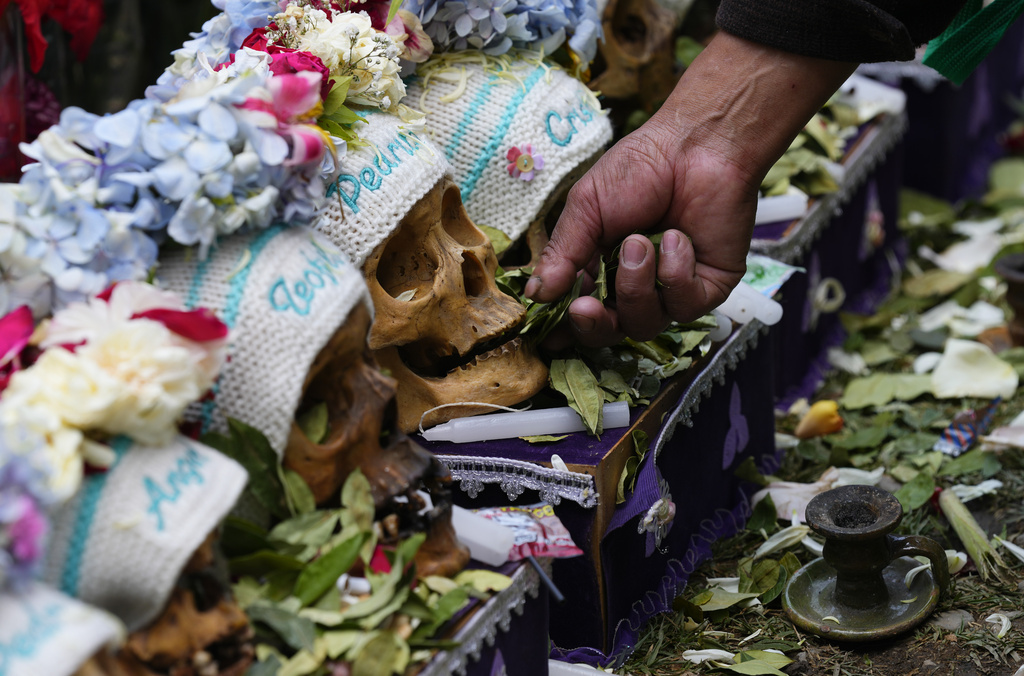
A person puts coca leaves into the mouth of a decorated, human skull on display at the General Cemetery, as an offering during the annual «Natitas» festival, a tradition marking the end of the Catholic holiday of All Saints in La Paz, Bolivia, Nov. 8, 2023. (AP Photo/Juan Karita)

Published by The Associated Press, September 2025

Spanish story language here

LOS YUNGAS, Bolivia (AP) – Tomas Zavala performs a ritual ahead of each workday in his coca field.

Deep in the lush green mountains of Bolivia’s Yungas region, the 69-year-old farmer closes his eyes, faces the soil, and asks Mother Earth for permission to harvest coca leaves.

“The coca leaf is the core of our survival,” Zavala said. “If we work the land without permission, it gets ruined.”

Outside Bolivia, the green leaf is best known as the main ingredient in cocaine. But within the South American country it is widely considered sacred, present in both rituals and everyday life.

“The coca leaf allows us to send our children to school and put food on the table,” said Zavala, who relies on harvesting coca leaves for income. “It’s useful for everything.”

The practice that fuels Bolivia’s workforce

Bolivia recognizes the coca leaf as part of its cultural heritage, allowing cultivation within designated areas. According to the country’s Coca Producers Association, its production employs more than 45,000 people nationwide.

Most Bolivians use coca leaves for “boleo,” a practice recognized as an intangible cultural heritage since 2016. The word has no English translation. It means placing a compact wad of leaves inside the cheek.

Many refer to it as chewing, but the leaves are rarely treated like gum. Instead, people let them slowly release their active compounds. The alkaloids act as stimulants, though producers and government officials insist their effects remain mild — far from those of processed cocaine.

“It slows down our fatigue and takes away our hunger,” said Rudi Paxi, secretary of the producers association. “You’ll always watch the people from Yungas doing boleo as they head to work.”

Neri Argane, 60, works at a coca plantation in Yungas for 11 hours a day, six days per week. “We do this no matter the sun, the rain or the cold,” Argane said.

She eats bananas, rice and corn tortillas to keep up her strength. But only boleo enables her to endure long hours crouching in the fields, she says.

Families pass down coca fields like heirlooms

Bolivia’s government has made several attempts to highlight how the coca leaf is intertwined with its people’s cultural traditions.

Even as coca’s global reputation remains linked to drug trafficking, President Luis Arce sought to highlight its cultural roots. Earlier this year, he performed a public boleo to mark National Coca Chewing Day.

“Our government values the ​​coca because it is a cultural symbol,” he said. “It represents our identity and sovereignty. It has medicinal and ritual values, and is a source of social cohesion.”

In the Yungas region, where Zavala lives about 60 miles (100 kilometers) from the capital city of La Paz, the heritage of dozens of families is tied to these hardy leaves.

“I watched my parents working the land since I was 8,” he said. “Luckily, they entrusted it to me. So I could survive.”

Mónica López also inherited her parents’ coca fields in a neighboring town. “I have been a farmer for as long as I can remember,” she said.

Raising healthy coca leaves is demanding. All work is done by hand, without machinery or animals to help. Farmers prepare the soil by October, sow the land by December and harvest the crops around February.

Most fields are handled by family members. On any given day in Yungas, it’s common to spot children next to their mothers and grandparents while they clean the leaves.

“I’ve been in the coca fields since I was 2 and I can tell you this work is hard,” said 22-year-old Alejandra Escobar. “But the coca leaf brings us plenty of benefits. When we have no money, it’s what we consume.”

Bolivians from rural areas regularly drink coca leaf tea to heal headaches and stomach inflammation. Elsewhere in the country, people use it for pancakes, ice cream and beer.

“The coca is everywhere,” Paxi said. “It unites us as families. It’s our company.”

Coca leaf nourishes both body and spirit

The coca leaf also plays a key role in Bolivians’ spirituality. “It’s used to start most of our rituals,” said anthropologist Milton Eyzaguirre. “Before you start a new job, for example, you set up a ‘mesa’ (or table) and coca leaves around.”

In the worldview of the Aymara, the region’s Indigenous people, ‘mesas’ are offerings for Pachamama (Mother Earth). Built from wooden logs, they are arranged by spiritual leaders who pray for wealth, protection and good health.

“The coca leaf helps us see,” said Neyza Hurtado, who was hired by a family to perform a ritual ahead of the recent Pachamama month. “By deciphering a coca leaf, you can know how a person is.” 

Personal rituals with coca leaves are common. According to Eyzaguirre, bricklayers regularly make a boleo before each workday. And like Zavala, they ask for Mother Earth’s permission to kick off the day.

“People even use it to travel,” Eyzaguirre said. “When you go somewhere by foot, you make coca offerings and consume it, to gather strength.”

Rituals for Pachamama live on in the Yungas

López’s coca leaf rituals start on the first minute of Aug. 1. “We thank Mother Earth, because if she gets tired, nothing sprouts,” she said.

At the mesa inside her home, her spiritual leader places sweets, rice and cinnamon. Before lighting it on fire to complete the offering, López adds 12 coca leaves. “We ask for wishes with the coca,” she said. “We ask for good luck for 12 months, from August to August.”

Just like the Yungas field, her faith in Pachamama was inherited from her parents. Now she performs her rituals alongside her five children, hoping they will keep the tradition alive. 

Zavala’s rituals occur both inside his house and in his field. He, too, encourages his grandchildren to participate. “We need Pachamama in the terrain, to have a good production,” he said.

Aside from asking Mother Earth’s permission to work, Zavala performs an Andean tradition known as “chaya.” The word refers to the custom of spraying alcohol onto the ground as an offering, either for requests or as an act of gratitude that symbolizes giving back to Pachamama.

“It’s what our elders passed down to us», he said. «So we must preserve it.” 

___

Associated Press religion coverage receives support through the AP’s collaboration with The Conversation US, with funding from Lilly Endowment Inc. The AP is solely responsible for this content.