Paraguay is fighting to preserve Guaraní, a language of roots and soul

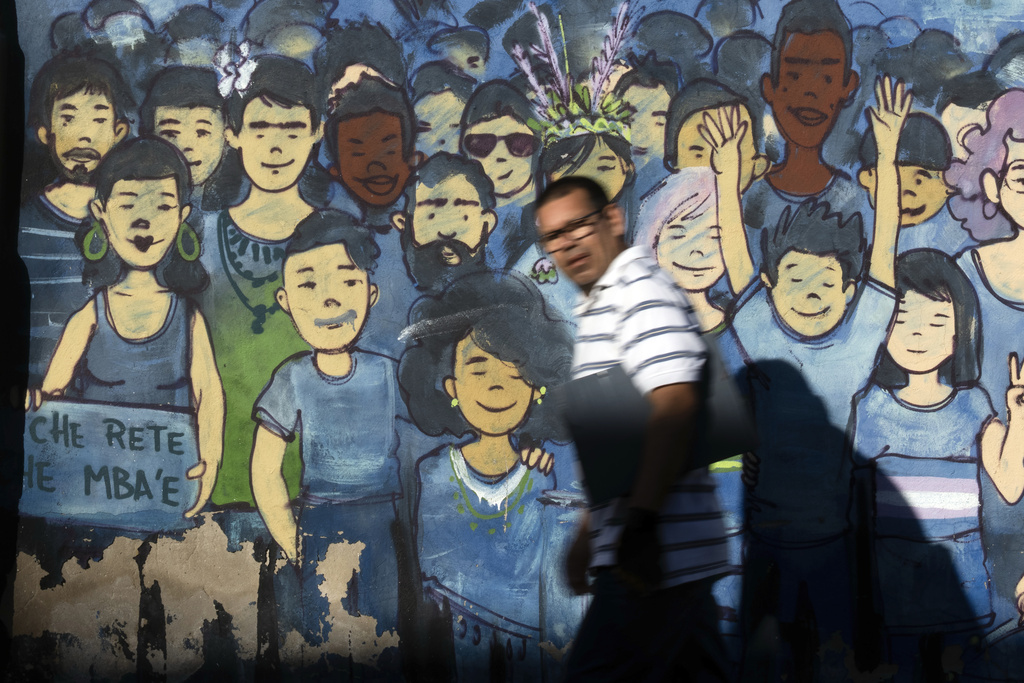
A pedestrian passes a mural that rads in the Indigenous Guarani language «Che rete, che mba’e» which means «My body is mine» in Asuncion, Friday, Aug. 22, 2025. (AP Photo/Jorge Saenz)

Published by The Associated Press, August 2025

Spanish story language here

LOMA GRANDE, PARAGUAY (AP) – When it came time to choose a wedding venue, Margarita Gayoso and her partner Christian Ojeda knew exactly where they wanted to go. 

Despite living in Spain, the couple traveled to their long-missed hometown in Paraguay for a ceremony officiated in their ancestors’ language.

“Everyone was crying because everything feels so profound in Guaraní,” Gayoso said. “It’s as if the pronunciation pours out of your soul.”

Guaraní is one of Paraguay’s two official languages alongside Spanish. But linguists warn that fluency among younger generations is slipping, so nationwide preservation efforts are underway.

Many Paraguayans believe that Guaraní carries a deep emotional significance. Yet because the language’s use remains primarily oral, it rarely appears in official documents, government records and literary works. 

Even finding a Catholic priest who could preside over Gayoso’s wedding ceremony in Guaraní proved difficult. Still, it was worth the extra effort. Some guests told her that it was the first local wedding they had attended that was conducted entirely in their mother tongue.

Why Guaraní remains at the heart of Paraguay

Of the country’s 6.9 million people, about 1.6 million reported Guaraní as their main language, according to Paraguay’s official 2024 data. Whereas, 1.5 million use Spanish, and 2.1 million identify as bilingual. Other Indigenous languages account for the rest. 

The Guaraní spoken today differs from the version that Europeans first encountered during the Latin American conquests in the 1500s. Still, its survival in a region where most countries shifted to Spanish is remarkable. Why has it managed to remain dominant?

“In the Guaraní culture, language is synonymous with soul,” said Arnaldo Casco, a researcher from Paraguay’s Department of Linguistics.

“The word is what the Lord bestowed on men, so we believe that, for the Guaraní people, losing their language was like losing their soul.”

Reflecting this deep connection to their language, the Guaraní people fiercely resisted learning Spanish. That’s why early European missionaries saw no other option but to learn Guaraní for evangelization purposes. 

A language preserved yet punished

Jesuit and Franciscan priests produced Guaraní’s first written records in Paraguay.

The alphabet and dictionary they developed became essential for delivering sermons and helped preserve the language from extinction. Still, those efforts were not enough to shield Guaraní from centuries of marginalization that followed.

Casco said that close to 90% of the population were primarily Guaraní speakers by the early 19th century. But as the country regained its independence from Spain in 1811, efforts to promote its widespread use have been erratic.

While its use was encouraged to promote national unity during wartime in the 1930s, a postwar decree prevented teachers and students from using it in schools. 

“My parents and other parents were tortured for not speaking Spanish,” said Miguel Ángel Verón, a linguistics researcher whose father was beaten in the mouth for communicating in Guaraní. “Why was not speaking Spanish his fault? He and my uncles ended up abandoning school.”

Spanish-Guaraní bilingual education became mandatory in 1992. Both languages are required in classrooms, but the law does not guarantee textbooks in Guaraní or foster widespread awareness of the need to preserve it.

Both Casco and Verón said that dozens of families no longer speak to their children in Guaraní. They fear the use of their mother tongue might hold them back from success, so they encourage them to learn English instead. 

“Paraguay continues to suffer from a deep linguistic wound,” Verón said. “It might be easy to pass a law, but shifting our attitudes requires so much more.”

What language entails

Those working to preserve the language contend there’s more to Guaraní than words.

“The fundamental human values that we Paraguayans hold come from it,” Verón said. “Solidarity, reciprocity and a sacred respect towards nature.”

“Jarýi,” for example, is a Guaraní word that has no Spanish translation. It describes god-like protectors of the land, which according to some people like Verón’s father, needs years of rest in order to regain its wisdom and strength between harvests.

“If you destroy a forest to eat, you won’t be in any trouble. But if you do it just for the sake of it or to earn money, the jarýi will come,” Verón said. 

Casco, too, learned various lessons from a medicine man that cured people in his hometown. “Knowing that prayer can heal is a legacy from the Indigenous people,” he said.

Across Paraguay’s rural areas, hundreds of other testimonies link language with faith. Yet no written records of those beliefs had been produced until now.

To create a register of those collective memories, Casco leads a project to interview Guaraní speakers over 60 years of age. His team has spoken to 72 people so far and the interviews will be published on the Department of Linguistics’ website when the transcripts are done.

“Our goal is to rescue the connection that we have with our roots and history through language,” Casco said.

Rescuing Guaraní

Several interviewees live in Loma Grande, the town where Ojeda and Gayoso wed.

Juana Giménez, 83, possesses a deep understanding of medicinal plants. Desperate parents with crying babies used to take their children to her. And Giménez, with a mix of herbs, smoke and prayer, helped reduce the stomach inflammation that so regularly brought them to tears.

Marta Duarte, 73, learned Spanish and moved to the capital city Asunción to work as a tailor for years. She came back to Loma Grande in her 30s and currently helps at the local church, where attendees read the Bible in Spanish and she discusses the passages in Guaraní.

Carlos Kurt, an 85-year-old descendant of German immigrants, fell in love with Paraguayan ancestral words at a young age. He still laughs as he recalls the day his second-grade teacher sent a note to his German-speaking parents: “Your boy is a good student, but he speaks way too much in Guaraní.”

“I just loved the language,” he said. “I learned it and nothing escaped me. Now my grandson does not speak it. He doesn’t like it.”

Other Paraguayans echoed how their descendants are letting go of the language, but Sofia Rattazzi is an exception. She lives in Asunción with her mother and grandmother, Nancy Vera, to whom she speaks only in Guaraní.

Following Vera’s beliefs in a concept known as “yvyguy» treasure — gold hidden by rich Paraguayans during wartime in the 1800s — the family regularly digs up holes in their backyard.

Vera has always had a particular closeness to the land, Rattazzi said, as it has previously signaled to her where jewelry might be. “She discovered places where the earth and water break and there lay rings and other stuff,” she said. 

Rattazzi said her grandmother doubted participating in the language project, not knowing what good may come from the interviews. But she encouraged her.

“I want her to see how her own history matters,” Rattazzi said. “Now something will be left from her once she is gone.”

___

Associated Press religion coverage receives support through the AP’s collaboration with The Conversation US, with funding from Lilly Endowment Inc. The AP is solely responsible for this content.
How Orthodox Jewish families are finding ways to support their trans children

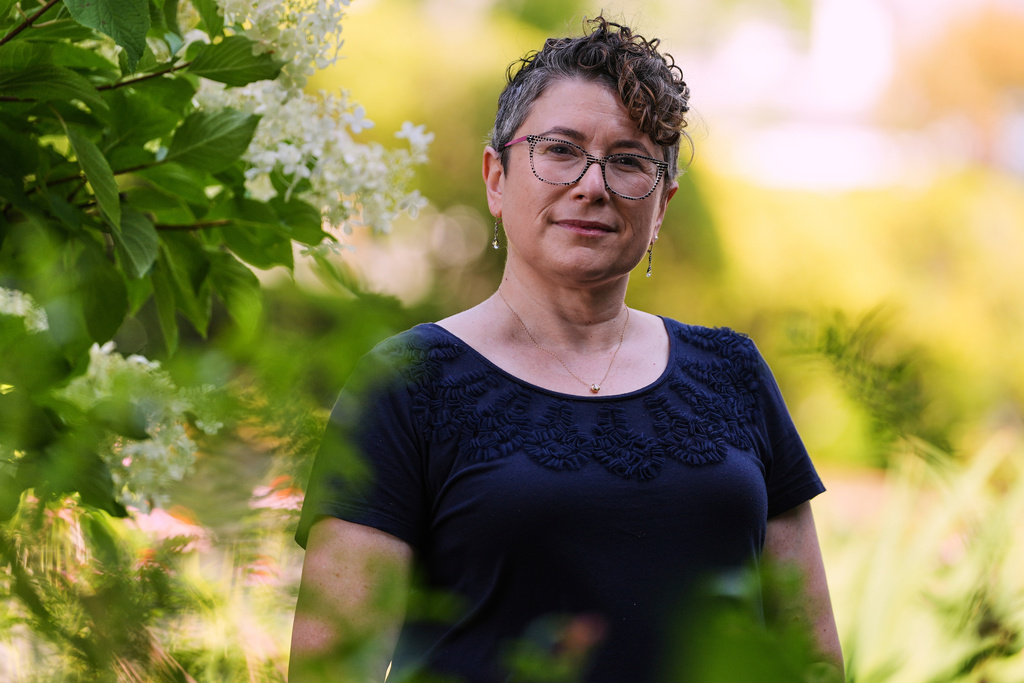
Ziva Mann, mother of a transgender child and member of a welcoming synagogue, poses in her garden, Wednesday, Aug. 13, 2025, in Newton, Mass. (AP Photo/Charles Krupa)

Published by The Associated Press, August 2025

Spanish story language here

Ziva Mann remembers how joyful and smiley her daughter was as a child — the family even gave her the nickname “Giggles.”

“She was just sunshine,” Mann said. That changed around second grade, when her joy began to fade. “She got sadder and sadder,” Mann recalled. “It was like watching someone disappear.”

Mann later realized that her child’s growing sadness was connected to a struggle to reckon with her gender identity

Her daughter came out as transgender at home in Massachusetts four years ago. “Mom, I’m a girl,” Mann remembers hearing her say. Though she was surprised by the news, she quickly came to admire her daughter’s bravery.

Since then, the family has striven to find the best ways to support Ellie within their modern Orthodox community, where tradition and strict gender roles shape daily life. They’ve managed to find emotional and spiritual resources close to home at a time when transgender rights are under attack nationwide.

Raising a trans child in Orthodox Jewish communities

Two of the three biggest branches of Judaism in the U.S. — Reform and Conservative — support the rights of transgender people, but it can still be challenging for trans youth to find an inclusive congregation. 

Schools in Orthodox Jewish communities are typically divided by gender, and most synagogues have separate seating sections for men and women — sometimes on different floors.

“Orthodoxy today is just binary,” said Myriam Kabakov, co-founder and executive director of Eshel, an organization supporting LGBTQ+ people in Orthodox environments. “You’re either male or you’re female. So if a trans person is in between transitioning, very often they will be asked not to come to synagogue.”

She said even after someone has fully transitioned, rabbis should allow them to sit where they feel comfortable. But that acceptance is not guaranteed.

To connect parents and trans children with inclusive synagogues, Eshel developed a program called “Welcoming Shuls,” where people can confide in spiritual leaders who will treat them with respect. 

According to Kabakov, about 300 rabbis and 160 families with trans members have joined their listings. Deslie Paneth is among them. She lives on Long Island and has traveled far to find support for Ollie, her transgender son. 

“One night, I said to my husband ‘I need help, I don’t know how to navigate this,’” Paneth said. “Without Eshel, I don’t know how this would have turned out for any of us.”

Balancing tradition and change

Mann defines herself as modern Orthodox, meaning she strives to uphold Judaic law while embracing the values within her family.

“The only time we break the rules is to save someone’s life,” she said. “Because a life is more important than all of the rules.”

Respecting her daughter’s identity felt akin to saving her life, so Mann didn’t feel the need to talk to God about it. She said who her daughter is as a person mattered more than the gender she thought she had.

Mann has heard of families with trans children who were asked to leave their synagogue, but this didn’t happened to her. Before discussing Ellie’s identity with other relatives, Mann reached out to her rabbi. He assured her that her daughter would be treated with dignity and respect.

“He offered us a blessing,” Mann said. “The strength, the love and the grace to parent a child who’s walking a difficult path.”

Finding a place to belong

Mann feels lucky to have found support, both in religious spaces and among family members, which has helped Ellie be her joyful self again. Some Orthodox families have faced a tougher process.

Paneth recalled her son, before starting his transition around 2017, was deeply religious and they enjoyed sitting together at synagogue. 

“He tells me still today that, especially around the holiday times, it hurts him that he can’t sit next to me in temple,” Paneth said. “He’s probably my child that has the strongest commitment to Judaism from an emotional connection.»

A rabbi told Paneth that Ollie is welcome to come to services, but he would now be expected to sit among the men. This is part of the reason why Ollie has not returned to synagogue since his transition.

Faith and identity at a crossroads

Ollie believes that his relationship with religion splintered as a student in an all-girls Orthodox Jewish high school. As he started raising questions about gender equality, none of the answers sufficed.

“I’m still convinced that if I wasn’t trans, I would still be a religious Jew,” the 27-year-old said.

He initially told his parents he was a lesbian. But since attending a secular college, making LGBTQ+ friends and feeling trapped during the pandemic, he decided to speak with them again. “If I was going to survive this, I had to come out with my parents as trans and start medically transitioning.” 

He had top surgery in 2022 and soon after met his girlfriend at JQY, a program for Jewish LGBTQ+ teens. The couple now lives together in New York.

Ollie doesn’t think of himself as Orthodox, and says he would like to find a new path toward God. Paneth understands and still includes him in the Jewish holidays. Ollie appreciates it.

Because he first connected to God as a girl, it doesn’t feel natural to him to embrace traditions that are typical for Jewish men, like wearing a kippah.

“I don’t do any of the tasks that men do religiously because I’m the same person I always was,” he said. “Even though I look different, my relationship to God didn’t change.”

Making synagogues more inclusive

Kabakov said many LGBTQ+ Jews eventually decide to leave Orthodoxy, but for those who wish to remain, Eshel and some spiritual leaders offer support.

Rabbi Mike Moskowitz, who works at an LGBTQ+ synagogue in New York, thinks of his job as helping people understand how they can be their authentic selves and still feel accepted by their religion. “It’s not that Judaism is the problem,” he said. “Orthodoxy, the people, are the problem.”

The counseling he provides for trans children and their parents is specific to each person, but in general, he offers fresh interpretations of the Hebrew Bible.

“Those who want to be transphobic say the Bible says you can’t wear misgendered clothing,” Moskowitz said. “I think a response is that trans folks are not wearing misgendered clothing. They’re wearing gender-affirming clothing.”

He, like Kabakov, believes there’s a trend in Orthodoxy toward more inclusivity, but there’s more work to do.

“Discrimination is unholy,” he said. “Unity is coping through kindness and being able to replace the weight of oppression with the elevation of love.”

____

Associated Press religion coverage receives support through the AP’s collaboration with The Conversation US, with funding from Lilly Endowment Inc. The AP is solely responsible for this content.
How one man’s dream led to 50,000 pilgrims honoring Our Lady of Copacabana in Bolivia

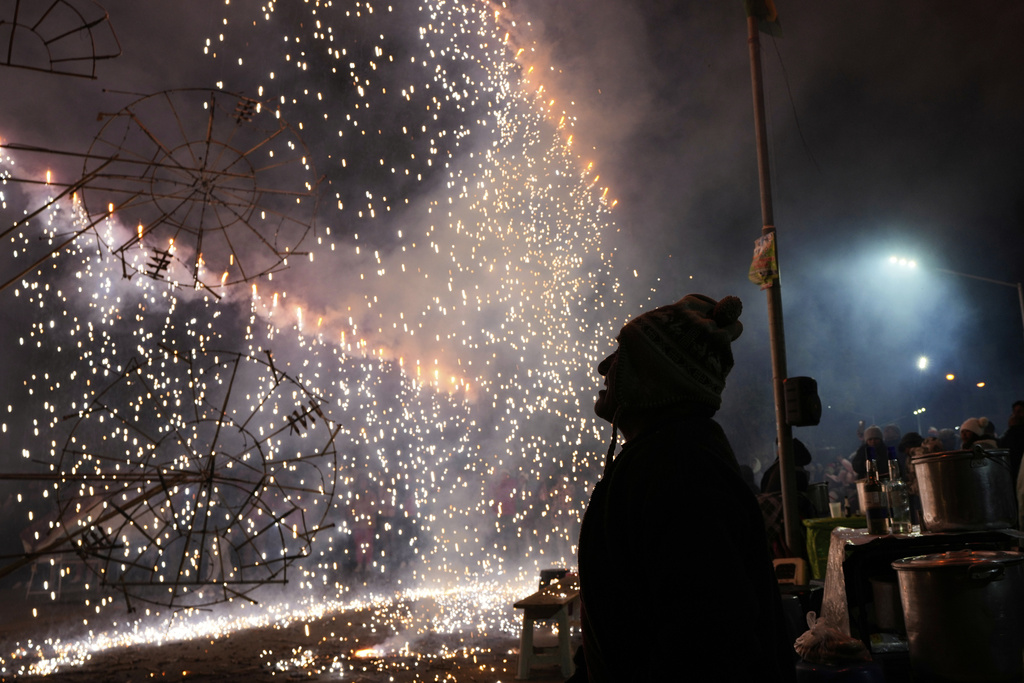
A man is silhouetted against a burst of fireworks during celebrations honoring Bolivia’s patron saint, the Virgin of Copacabana, in Copacabana, Bolivia, Monday, Aug. 4, 2025. (AP Photo/Juan Karita)

Published by The Associated Press, August 2025

Spanish story language here

More than 50,000 people from Bolivia and neighboring Peru make a pilgrimage every August to Copacabana, on the shores of Lake Titicaca, to honor Bolivia’s patron saint, Our Lady of Copacabana. In the main event of the celebration, a replica of the wooden-carved figure of the Virgin Mary leads a procession.

Her official feast is Feb. 2 — coinciding with Candlemas — but Aug. 5 marks the anniversary of her canonical coronation as the patron saint of Bolivia by a papal bull issued by Pius XII in 1925. This year is the 100th anniversary.

“She has granted me various miracles,” said Elizabet Valdivia, who traveled 12 hours by road and boat from the Peruvian city of Arequipa to join the procession. “She gave us our car, the possibility of raising my son, and I always ask her to watch over our jobs.”

The birth of a sacred icon

Our Lady of Copacabana’s basilica has safeguarded this Virgin Mary figure since the late 16th century. Her history dates back to 1583, when Inca descendant Francisco Tito Yupanqui crafted a figure in her honor.

According to Marcela Cruz, a guide at the museum next to the basilica, Yupanqui had a dream about the Virgin and molded a clay figure to depict her. He showed it to the chaplain, but after being rejected and mocked, he went for a walk by the lake.

“There, he encountered the image of the Virgin as an Inca maiden,” Cruz said. “That’s why her image is so simple.”

Inspired by the apparition, Yupanqui set off for the city of Potosí, about 330 miles (530 kilometers) from La Paz, the current capital city. There, he carved the image that is now revered in the basilica from a maguey tree trunk.

When Yupanqui traveled back to Copacabana, the town was under Spanish occupation, and both the Aymara and Quechua Indigenous people — now nationals from Bolivia and Peru — were at the site for evangelization purposes.  

“She arrived at dawn on Feb. 2, and both the Aymara and the Incas bowed down to welcome her,” Cruz said.

A shrine of faith, gratitude and generations of prayer

The museum named after Yupanqui displays hundreds of gifts that devotees have presented over the centuries. These include capes embroidered with gold thread, votive offerings, letters in braille and silver crowns resembling those Simón Bolívar melted down to secure Bolivian independence in 1825.

“Our Lady of Copacabana is the mother who welcomes all of her children regardless of their race or culture,” said Itamar Pesoa, a Franciscan friar residing at the convent adjacent to the basilica. “Within Bolivia, she is the queen.”

According to Pesoa, pilgrims travel from all over South America to present her with offerings. Some women who were unable to have children thank her for enabling them to become mothers. Others praise her for helping them recover from serious illnesses.

Several Masses in her honor are celebrated daily starting Aug. 4.

“This devotion continues to be passed down from generation to generation and inspires many to follow Christ,” Pesoa said.

Yupanqui’s original figure has not left the basilica for a procession since her coronation in 1925, but devotees revere her replicas nonetheless.

In a nearby chapel, parishioners light candles — one per miracle requested — and patiently wait for them to burn out before leaving. 

Sandra Benavides, who traveled from the Peruvian city of Cuzco, lit a candle and prayed for good health. She said some years ago she fell and the accident nearly killed her, but the Virgin interceded.

“Our Lady of Copacabana is miraculous,” Benavides said. “She is as if she were my mother, whom I have never had.”

____

Associated Press religion coverage receives support through the AP’s collaboration with The Conversation US, with funding from Lilly Endowment Inc. The AP is solely responsible for this content.
Burnt offerings, whispering to mountains: Inside Bolivians’ rituals for Mother Earth

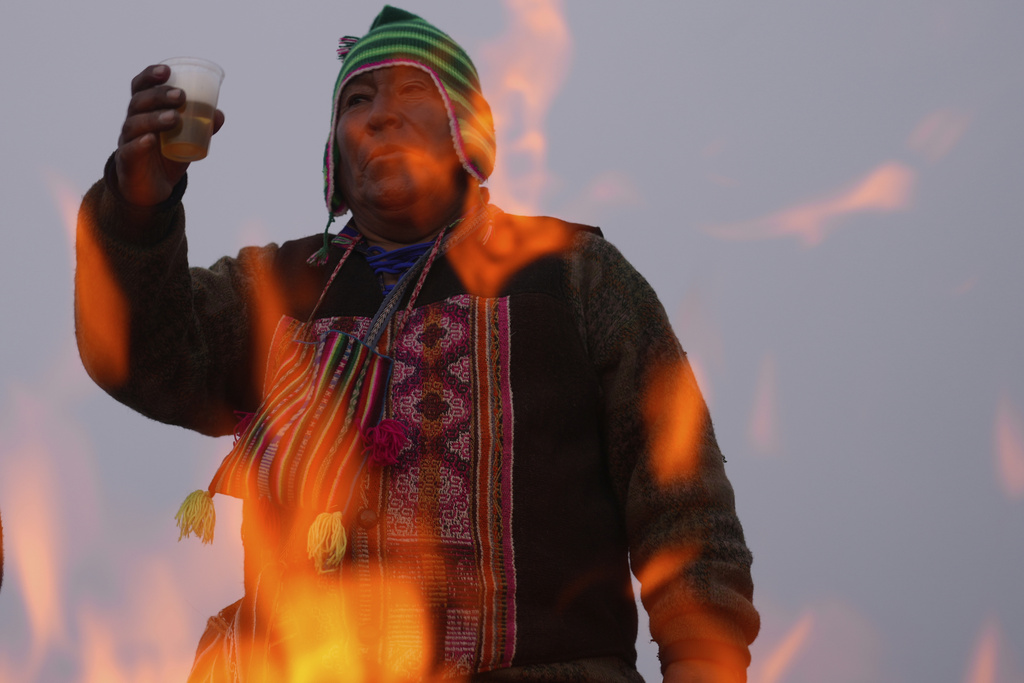
Spiritual leader Eusebio Huanca burns offerings observing the month of Pachamama, or Mother Earth, performing an ancient tradition to ask for a good harvest, on La Cumbre, a mountain considered sacred on the outskirts of La Paz, Bolivia, Friday, Aug. 1, 2025. (AP Photo/Juan Karita)

Published by The Associated Press, August 2025

Spanish story language here

Neyza Hurtado was 3 years old when she was struck by lightning. Forty years later, sitting next to a bonfire on a 13,700-foot (4,175-meter) mountain, her scarred forehead makes her proud.

“I am the lightning,” she said. “When it hit me, I became wise and a seer. That’s what we masters are.”

Hundreds of people in Bolivia hire Andean spiritual guides like Hurtado to perform rituals every August, the month of “Pachamama,” or Mother Earth, according to the worldview of the Aymara, an Indigenous people of the region.

Pachamama’s devotees believe that she awakens hungry and thirsty after the dry season. To honor her and express gratitude for her blessings, they make offerings at home, in their crop fields and on the peaks of Bolivian mountains.

“We come here every August to follow in the footsteps of our elders,” said Santos Monasterios, who hired Hurtado for a Pachamama ritual on a site called La Cumbre, about 8 miles (13 kilometers) from the capital city of La Paz. “We ask for good health and work.”

Honoring Mother Earth

Offerings made to Pachamama are known as “mesitas” (or “little tables”). Depending on each family’s wishes, masters like Hurtado prepare one mesita per family or per person.

Mesitas are made of wooden logs. On top of them, each master places sweets, grains, coca leaves and small objects representing wealth, protection and good health. Occasionally, llama or piglet fetuses are also offered.

Once the mesita is ready, the spiritual guide sets it on fire and devotees douse their offerings with wine or beer, to quench Pachamama’s thirst.

“When you make this ritual, you feel relieved,” Monasterios said. “I believe in this, so I will keep sharing a drink with Pachamama.”

It can take up to three hours for a mesita to burn. Once the offerings have turned to ash, the devotees gather and solemnly bury the remains to become one with Mother Earth.

Why Bolivians make offerings to Pachamama

Carla Chumacero, who travelled to La Cumbre last week with her parents and a sister, requested four mesitas from her longtime spiritual guide.

“Mother Earth demands this from us, so we provide,” the 28-year-old said.

According to Chumacero, how they become aware of Pachamama’s needs is hard to explain. “We just know it; it’s a feeling,” she said. “Many people go through a lot — accidents, trouble within families — and that’s when we realize that we need to present her with something, because she has given us so much and she can take it back.”

María Ceballos, 34, did not inherit her devotion from her family, but from co-workers at the gold mine where she earns a living.

“We make offerings because our work is risky,” Ceballos said. “We use heavy machinery and we travel often, so we entrust ourselves to Pachamama.”

A ritual rooted in time and climate

The exact origin of the Pachamama rituals is difficult to determine, but according to Bolivian anthropologist Milton Eyzaguirre, they are an ancestral tradition dating back to 6,000 B.C.

As the first South American settlers came into the region, they faced soil and climate conditions that differed from those in the northernmost parts of the planet, where winter begins in December. In Bolivia, as in other Southern Hemisphere countries, winter runs from June to September.

“Here, the cold weather is rather dry,” Eyzaguirre said. “Based on that, there is a particular behavior in relation to Pachamama.”

Mother Earth is believed to be asleep throughout August. Her devotees wish for her to regain her strength and bolster their sowing, which usually begins in October and November. A few months later, when the crops are harvested in February, further rituals are performed.

“These dates are key because it’s when the relationship between humans and Pachamama is reactivated,” Eyzaguirre said.

“Elsewhere it might be believed that the land is a consumer good,” he added. “But here there’s an equilibrium: You have to treat Pachamama because she will provide for you.”

Bolivians’ connection to their land

August rituals honor not only Pachamama, but also the mountains or “apus,” considered protective spirits for the Aymara and Quechua people.

“Under the Andean perspective, all elements of nature have a soul,” Eyzaguirre said. “We call that ‘Ajayu,’ which means they have a spiritual component.”

For many Bolivians, wind, fire, and water are considered spirits, and the apus are perceived as ancestors. This is why many cemeteries are located in the highlands and why Pachamama rituals are performed at sites like La Cumbre.

“The apus protect us and keep an eye on us,” said Rosendo Choque, who has been a spiritual guide or “yatiri” for 40 years.

He, like Hurtado, said that only a few select people can do they job. Before becoming masters, it is essential that they acquire special skills and ask Pachamama’s permission to perform rituals in her honor.

“I acquired my knowledge little by little,” Choque said. “But I now have the permission to do this job and coca leaves speak to me.”

Hurtado said she mostly inherited her knowledge from her grandmother, who was also a yatiri and witnessed how she survived the lightning strike.

“For me, she is the holiest person, the one who made me what I am,” Hurtado said.

She said she finds comfort in helping her clients secure a good future, but her close relationship with Pachamama brings her the deepest joy.

“We respect her because she is Mother Earth,” Hurtado said. “We live in her.”

____

Associated Press religion coverage receives support through the AP’s collaboration with The Conversation US, with funding from Lilly Endowment Inc. The AP is solely responsible for this content.

Despite rainy weather, Catholics in a Paraguayan town dress as birds to honor their patron saint

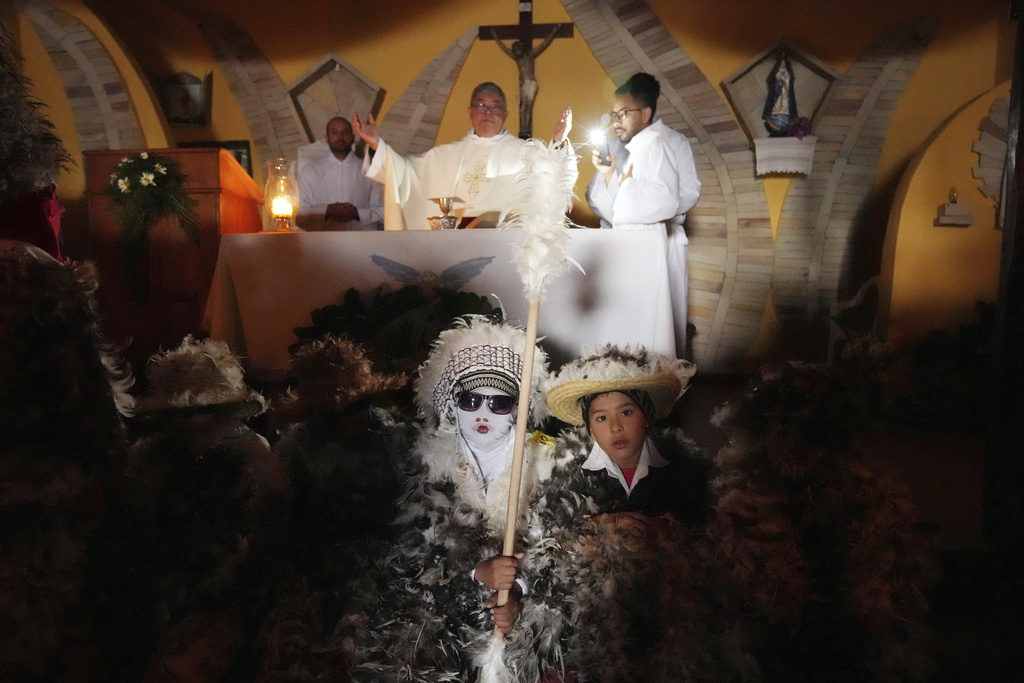
Children dressed in feather costumes attend a Mass celebrating Saint Francisco Solano at his namesake chapel in Emboscada, Paraguay, Thursday, July 24, 2025. Catholic parishioners in Paraguay don bird-like costumes and parade the streets to honor the 16th century saint said to possess miraculous powers. (AP Photo/Jorge Saenz)

Published by The Associated Press, July 2025

Spanish story language here

EMBOSCADA, Paraguay (AP) The rainy weather did not prevent Blanca Servín from dressing her 7-year-old son like a bird. They joined a procession honoring St. Francis Solanus, the patron saint of a town in Paraguay about 20 miles (32 kilometers) from the capital city of Asunción.

Like her child, dozens of Catholics in Emboscada wear elaborate feathered garments each July 24. Dressing up is a ritual aimed at fulfilling promises made to the Spanish friar, who was a missionary in South America during the 16th century and is believed to grant miracles.

“I couldn’t have children,” Servín said. “I underwent several treatments and when I finally got pregnant and my child was born, the doctors said he would barely live for a few days.”

She then prayed to St. Francis Solanus and made a promise many parishioners make: If you do this for me, I will honor you on your feast day for seven years.

“My son is almost 7, and I have kept my promise,” Servín said. “But we will keep coming.”

Dressing in feathers

Participants dressing up in feather garments are known as “promisers.” As part of the rituals, they cover their faces, imitate birds and distort their voices when speaking.

Marcos Villalba said he spent three months crafting his costume. He worked on it every other day and said his father and brothers have also been long-time promisers.

Sulma Villalba — not related to Marcos — devoted six months to the task. Rather than wearing a costume herself, she patiently glued hundreds feathers to her children’s and husband’s clothing. Like Servín, she has already fulfilled the promise she made to St. Francis to protect her family, but she said they still honor him because it has become a tradition they enjoy.

A missionary to Indigenous people

According to Ireneo López, a layperson in charge of recreational activities at the Emboscada parish, St. Francis is remembered as a missionary who evangelized the Indigenous people through music. The first church in his honor was erected in the 1930s. As parishioners increased, a new building was built later.

López said that participants use up to 30 hens, guinea fowls and geese to craft their costumes. 

“These garments represent what people used to wear in ancient times,” he added. “Gala suits were made with what nature provided: birds.”

Jessica López, who attended the festival with her two children and a niece, said she gathered feathers for months. Before crafting the costumes a week ago, her family enjoyed a banquet with a hen they specifically picked for the occasion.

She, too, asked St. Francis for good health, but said parishioners request all sorts of miracles. About 2,500 area residents join the feast every year.

Processions and dances honoring St. Francis start on July 22. The night before the feast day, a local family takes home a wooden figure depicting the friar in order to decorate it for the festivities. 

On July 24, promisers and parishioners attend Mass at the St. Francis chapel, then lead a procession and end up dancing in front of the church.

A tale of land and dispute

According to historian Ana Barreto, the ancient context of the feast is as fascinating as the feast itself. It is celebrated in a territory that was disputed by two Indigenous people — the Guaraní and the Chacoan — before the Spaniards came in the 16th century.

The Europeans eventually subdued the Guaraní, but the Chacoan kept defending the land even after descendants of formerly enslaved people from Africa settled there. 

“The Indigenous people sought to steal young women, take weapons and other valuable objects, and set the ranches on fire,” Barreto said.

Not all current participants in the St. Francis feast are aware of this, but their costumes and celebrations are a remembrance of this historic episode.

According to Barreto, the Guaraní name of the event, “Guaykurú Ñemondé,” translates as “dressing like a barbarian.” Thus Guaraní participants are dressing as their ancestral enemies. 

The reason might be hidden in an ancient Guaraní rite. After battling the Chacoan, the Guaraní people kept their prisoners alive. They provided them with food and energizing drinks, and encouraged them to have sex with their women. Afterwards, they killed the prisoners and cooked them, serving them as a meal at a community banquet.

“In this way, the enemy strengthened the Guaraní,” Barreto said.

____

Associated Press religion coverage receives support through the AP’s collaboration with The Conversation US, with funding from Lilly Endowment Inc. The AP is solely responsible for this content.