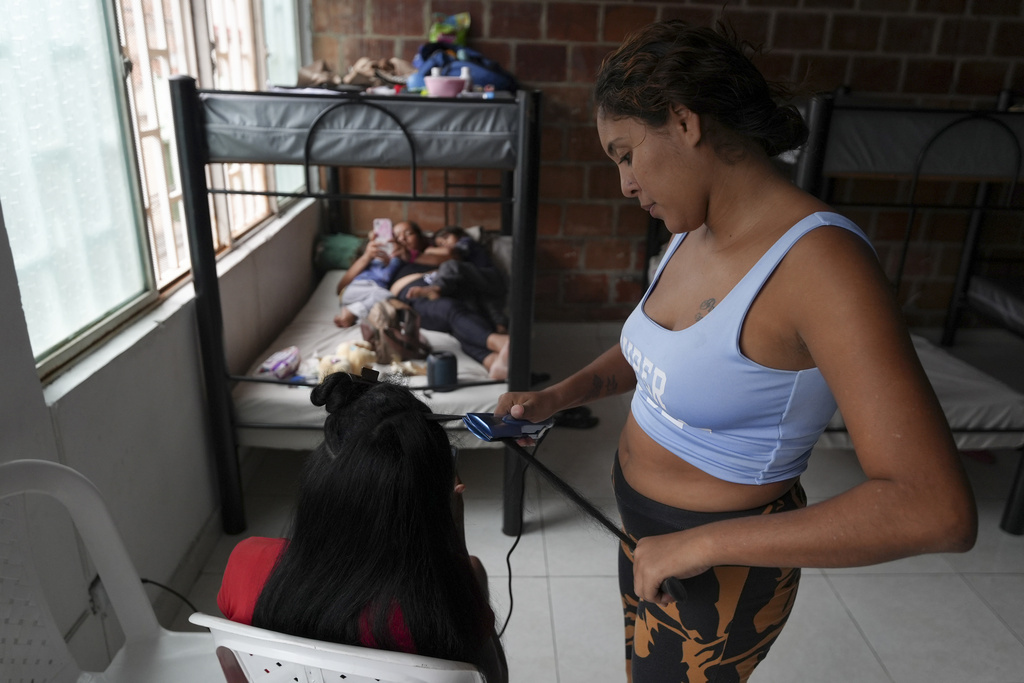
Published by The Associated Press, December 2024 (link aquí)
PALMIRA, Colombia (AP) – It’s been three years since Douarleyka Velásquez abandoned her career in human resources. Her new job is not what she had planned for, but still feels rewarding. As a cleaning supervisor at a migrant shelter in Colombia, she gets to comfort Venezuelans who, just like herself, fled their homes hoping for a better life.
“I feel that in here I can help my brothers, my countrymen who come and go,” said Velásquez, 47, from Pope Francis Migrant Shelter in Palmira, a city in southwestern Colombia.
The U.N. refugee agency, UNHCR, estimates that more than 7.7 million Venezuelans have left their homeland since 2014, the largest exodus in Latin America’s recent history, with most settling in the Americas, from neighboring Colombia and Brazil to more distant Argentina and Canada.
According to the International Organization for Migration, Colombia hosts the highest population of migrants from Venezuela. Colombian records show that as of mid-2024, more than 2.8 million Venezuelans were in the country.
Pope Francis Migrant Shelter was founded in 2020 to address this phenomena, said the Rev. Arturo Arrieta, who oversees human rights initiatives in the Catholic Diocese of Palmira.
The city is mostly a transit point, Arrieta said. Migrants pass through on their way to the Darien Gap, a treacherous route to reach North America. A few others, who found it impossible to keep migrating or yearned for their past life, make a stop before heading back home.
“It’s one of the few shelters en route,” Arrieta said. “The international community has stopped financing places like this, thinking that it would discourage immigration, but that will never happen. On the contrary, this leaves migrants unprotected.”
People reaching the shelter can stay up to five days, though exceptions can be made. Velásquez was welcomed to the team when she settled in Palmira, which was also the case of Karla Méndez, who works in the kitchen and said that cooking traditional Venezuelan meals for her compatriots brings her joy.
According to Arrieta, the shelter is mostly sought out by families, women traveling alone and the LGBTQ+ population. Food, clothing and spiritual counsel are provided to those in need; facilities include showers, a playground for children, and cages for pets.
Aside from this, the team provides information on human trafficking and support to women who have been abused and to children who travel unaccompanied.
“We have also encountered Venezuelan mothers who are looking for their relatives and are coming from or towards the Darien Gap in a never-ending search,” Arrieta said. “Families are searching for loved ones who disappeared while migrating.”
While no official records track the number of migrants who have vanished – in part because some of them traveled illegally – their disappearances have been acknowledged by human rights organizations and Colombian institutions.
“In recent years, we have found unidentified bodies whose clothing or belongings indicate that they are migrants,” said Marcela Rodriguez, who works at a local missing-persons search unit.
Arrieta knows he can’t protect every migrant from stepping into territories controlled by illegal armed groups. But he does his best to comfort migrants at the shelter.
“Our motto is that we are a caress from God,” he said. “We want them to find an oasis here.”
Velásquez, whose husband, two children and a grandson left Venezuela with her, said that leaving everything behind was tough, but her family now feels at home.
“I feel very proud of what I do,” she said. “I always try to provide encouragement and tell people that all will work out wherever they go.”
One floor up, 20-year-old Mariana Ariza faces a dilemma that many migrants share: Where to go next?
After leaving Venezuela in 2020, she arrived in Bogotá with her 2-year-old and became a sex worker to support her child.
“It’s really hard to migrate and not being able to get a job,” said Ariza, now a mother of two. “I would do anything for my children. I would never let them starve.”
She’s undecided about going back to Venezuela to reunite with her family or heading to Ecuador, to look for better opportunities.
“Some people tell me, ‘You have that job because you don’t know how to do anything,’ but that’s not true,” Ariza said. “I learned a lot of things, but I haven’t had the money or the opportunity to move ahead.”
In Bogotá, where she initially arrived, the Rev. René Rey has spent decades supporting Colombian sex workers and LGBTQ+ people with HIV. In recent years his work has broadened to aid Venezuelan migrants.
He noticed an increased influx starting in 2017, when protests flared in Venezuela in reaction to an attempt by the government to strip the National Assembly of its powers.
“It was a strong wave,” Rey said. “Many of them, who were sexually abused or were victims of human and labor trafficking, got here.”
According to Rey, about half of the sex workers in Santa Fe – the neighborhood where he works in Colombia’s capital – are Venezuelan, most of them between 21 and 24 years old.
The building where he teams up with a Catholic organization called Eudes Foundation to provide information on HIV and cook lunches for homeless people is known as “The Refuge.” It’s also a place of prayer, where locals and migrants converge and a few transgender Venezuelan sex workers have found a safe space to practice their faith.
“We just tell them: ‘God is around here, how are you? We would like to be friends’,” Rey said. “I think these honest encounters provoke something new, where the Holy Spirit really is.”
Out of the three prayer groups that he oversees at The Refuge, one is led by Lía Roa, a Colombian transgender woman who became a seminarian before her transition and later struggled for acceptance within the Catholic Church.
Rey initially invited her to participate in activities inclusive of transgender people during Holy Week but later thought: What if she could have a bigger role in our community? So he took his proposal to the cardinal, and he enthusiastically supported it.
The group of half a dozen transgender sex workers – most of them from Venezuela – meet at The Refuge most Saturdays. First, they share a meal. Afterwards, they pray, meditate and talk.
“It’s been a challenge because Santa Fe is like Mecca for trans women,” Roa said. “They carry a rough past that has made them become invisible to the point that they lose their dignity as humans and daughters of God.”
Members of her prayer group often recount that they migrated because they could not find safes spaces for them as trans women in Venezuela. And even if many of them are just passing through Bogotá before heading back home or toward the Darien Gap, Roa feels that their meetings at The Refuge are meaningful and build loving, truthful friendships.
“In their own words, this process becomes spiritual nourishment for their way forward,” Roa said.
“They leave with a new vision, because once you’ve been told that God hates you because you are trans, hearing a priest and another trans telling you that God loves you just the way you are definitely makes a difference.”
____
Associated Press religion coverage receives support through the AP’s collaboration with The Conversation US, with funding from Lilly Endowment Inc. The AP is solely responsible for this content.
 mthernandezr.com