Their churches no longer feel safe. Now Nicaraguans are taking their worship home

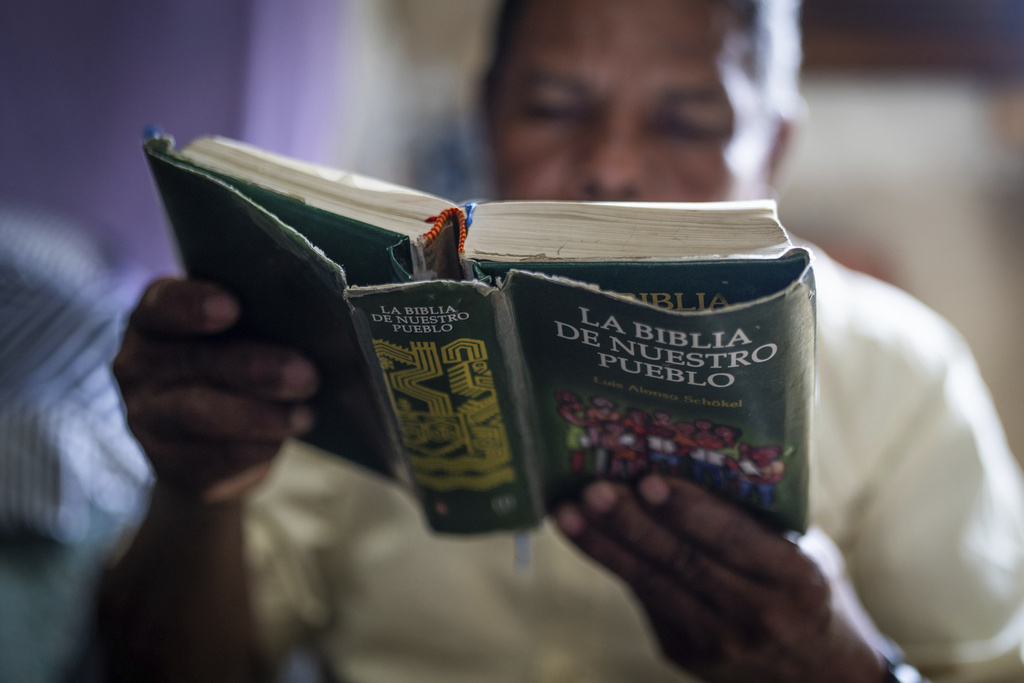
Nicaraguan exile Francisco Alvicio, a deacon of Nicaragua’s Moravian Church, reads a Bible in his rented room in San Jose, Costa Rica, Sunday, Sept. 22, 2024. (AP Photo/Carlos Herrera)

Published by The Associated Press, September 2024 (link aquí)

Spanish language story here

When their church no longer felt safe, deacon Francisco Alvicio and his congregation made a plan. Cautiously, discreetly, they took their worship to their homes.

“If I’m pursued at the church, I still have my Bible,” the 63-year-old Nicaraguan said.

Praying in hiding became his last resort before fleeing his country in 2023.

Like him, several evangelical pastors, Catholic priests and human rights organizations have denounced the surveillance, harassment and the imprisonment of Nicaraguan faith leaders in recent years.

“Arriving with a weapon is not kind-hearted,” Alvicio said from Costa Rica, where he currently lives. “If someone goes into a church wearing a uniform, speaking loudly, it’s to intimidate.”

The relationship between Nicaraguan religious communities and the government has been strained since President Daniel Ortega’s crackdown on massive street protests in 2018.

Ortega asked the Catholic Church to play a role as a mediator when political tensions arose, but the dialogue didn’t last long. After priests sheltered demonstrators inside their parishes and expressed concern about excessive use of force, Ortega targeted them as “terrorists” who backed opposition efforts to overthrow him.

Among evangelicals, relatively few pastors have openly supported the president. Most congregations have refrained from any political participation, though this has not prevented leaders from being imprisoned and hundreds of organizations from being closed.

In northern Nicaragua, where Alvicio was born, most of the Indigenous Miskito people are evangelicals. The Moravian Church — to which the deacon belonged — was established in Nicaragua in 1894. Until its closure alongside more than 1,600 nongovernmental organizations last August, it had about 350,000 members in the country.

For decades, Alvicio said, the Miskitos could profess their faith freely. Services took place every Wednesday, Friday and Sunday. Elders and children alike gathered at the church, where clergy read the Bible and ceremonies ended by singing a Miskito hymn.

Things started shifting when the government imposed new rules on the congregation. First came a tax that its members had never paid. Then, an order to replace their logo. 

“We did not accept,” Alvicio said. “We can’t change something just because the government wants to. The only path we follow is the one of God.”

Before long, black-clad strangers started showing up at his church. 

Those too afraid to attend a public service decided to pray at home. Some read their Bibles in solitude. Others with spare chairs turned their tiny houses into makeshift churches, calling in a few neighbors and leaders like Alvicio.

By changing venues every day, lowering their voices and gathering as early as 4 a.m. to avoid detection, they kept worshipping. How evangelicals have been affected by Ortega’s government

According to CSW, a British-based organization that advocates for religious freedom, violations against the faith practice of Nicaraguan Protestants have been less visible than those against the Catholic Church.

Anna Lee Stangl, CSW’s head of advocacy, noted in a recent publication that the Catholic Church is a single religious organization whose structure spreads geographically and has a clear, public hierarchy.

“The Protestant Church is made up of many different denominations and independent churches, some of which may be dominant in one part of the country and absent in another, and which do not necessarily work together or even communicate,” she said.

In both Catholic and Protestant communities, violations reported by organizations and faith leaders are similar: restrictions on the length, location and frequency of services; prohibition of processions; invasion of masked men into churches; theft or destruction of religious objects and infiltration of informants. 

“The situation has seriously worsened,” said Martha Patricia Molina, a Nicaraguan lawyer who keeps a record of religious freedom violations.

According to her latest report, 870 violations were committed against the Catholic Church between 2018 and 2024, and 100 against Protestants in the same period. 

Additionally, said human rights organization Nicaragua Nunca Más, more than 256 evangelical churches have been closed by the government in the past four years, while 43 Catholic groups have been targeted since 2022.

At least 200 religious leaders have fled Nicaragua, the organization said. More than 20 were stripped from their citizenship and 65 have been indicted for conspiracy and other charges.

The Nicaraguan government did not immediately respond to a request for comment.

An American pastor’s tale

Pastor Jon Britton Hancock didn’t see it coming.

How could he suspect that 11 pastors from his evangelical church could be arrested if Ortega’s government had greenlighted their operations for years?

He and his wife, both Americans and founders of Mountain Gateway, started working in Nicaragua in 2013. Two years later, they sent their first missionaries and began collaborating with local pastors. 

For the next decade, they developed fair-trade coffee practices, offered disaster relief to families affected by hurricanes and organized mass evangelism campaigns. 

But then, it all suddenly changed.

In December 2023, 11 of his church’s pastors and two lawyers were arrested; their families didn’t hear from them for months. It wasn’t until Sept. 5 that they were released on humanitarian grounds.

Hancock wondered why this happened. Though he never engaged in political discourse, he had preached in Congress and to the national police. He had met with officials. Ortega and his wife, Vice President Rosario Murillo, had sent notes congratulating him on his church’s work. 

“I think the real reason is the Gospel is a threat to totalitarian ideas,” Hancock said. “Our perspective is about personal relationship with God and it’s based on love. And love doesn’t thrive if there’s control or coercion.”

With Ortega’s measures against faith communities, he said, not only freedom is lost.

Confiscations by the government have been a blow to church investments. And, in many cases, pastors imprisoned or forced into exile are the providers for their homes.

Mountain Gateways’ local leader, Walder Blandon, was arrested with his wife, so they were both separated from their 2-month-old baby. He and his brother, who is two years older, had to be taken in by their grandmother, who had health issues, until their parents were released in September.

“So, whether or not the Nicaraguan government intends for people to be fearful, I can promise you that there is much fear and people are responding,” Hancock said.

He, too, has heard of multiple people holding house meetings to pray. Parishioners’ modest sound systems are no longer an option, he said, because a guitar or a piano could attract police asking for a registration, so congregations have gone underground. 

“It’s not very known what’s happening with evangelicals in Nicaragua,” he said. “Evangelical pastors don’t take their stands in the same way that Catholic priests do, so it’s kind of gone under the radar, but it’s certainly there.”There’s nothing left but leaving

One pastor had already gotten used to police watching his sermons and strangers listening to his conversations, but when someone told him “they’re after your head,” he decided he should flee.

“The government wants to control everything,” said the evangelical leader, who agreed to an interview on the condition his name and new home base be withheld for safety reasons. “They fear that if one speaks against the government, the people will rise.”

In his hometown, he said, he was targeted by informants who would seek to make his acquaintance, then surreptitiously use their phones to record sounds or video that the government might find of interest.

Now, with him gone, his family no longer goes to church. They worship at home and he joins them from a distance, praying for his people and the government, for justice and peace.

Alvicio, too, has kept his faith strong.

His church might be gone and he yearns to return to his country, but through his prayers, he remains tied to his land.

“We, the Moravians, believe that wherever we are, we can pray to God,” he said. “So I can walk and speak and think bearing that power, knowing that, even if I’m alone, he’ll be with me.”

____

Associated Press religion coverage receives support through the AP’s collaboration with The Conversation US, with funding from Lilly Endowment Inc. The AP is solely responsible for this content.
Catholic leaders raise concerns over judicial reform pushed by Mexico’s president

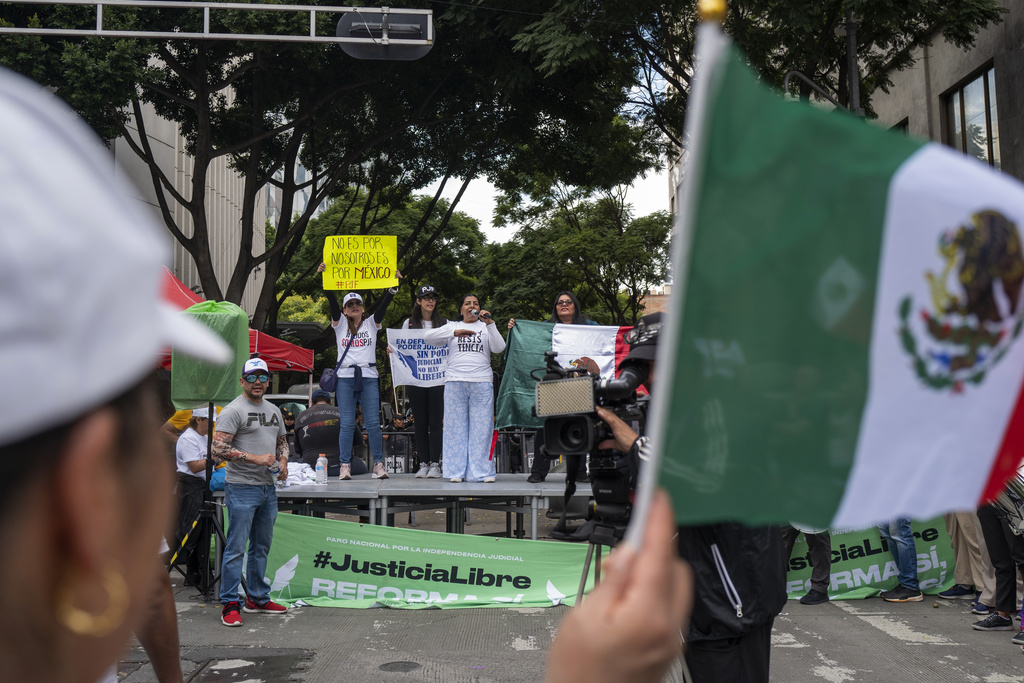
Judicial workers lead a strike to protest the government’s proposed judicial reform, which would make judges stand for election, outside the Senate in Mexico City, Friday, Sept. 6, 2024. (AP Photo/Jon Orbach)

Published by The Associated Press, September 2024 (link aquí)

Spanish language story here

MEXICO CITY – (AP) Mexico’s Catholic leaders said Monday that the judicial reform pushed by President Andrés Manuel López Obrador might not necessarily bring justice for victims of the crime wave that is rampant across the country.

“The proposal promoted by the Executive does not respond to a comprehensive review of the judicial system nor does it guarantee a better and more qualified administration of justice,” said Archbishop Gustavo Rodríguez in a video released by the Catholic bishops conference of Mexico.

López Obrador, who has clashed repeatedly with judges throughout his six-year term, has claimed that the judges in the current court system are corrupt. The governing party’s proposal would make the country’s entire judicial branch — around 7,000 judges — stand for election.

The proposal has fueled a wave of protests and drawn extensive criticism from analysts, judges and international observers. Some of the critics contend that it would compromise the independence of the judiciary and the system of checks and balances.

U.S. Ambassador Ken Salazar warned on Aug. 22 that electing judges is a “risk” for Mexico’s democracy and “threatens the historic commercial relationship” between the two countries. The proposal has also sparked nervousness among investors, while the Mexican peso has plunged.

The lower house of Mexico’s Congress passed the legislation on Sept. 4. It then moved to the Senate, where it is expected to pass by a razor-thin margin.

Bishop Ramón Castro, secretary of the bishops conference, said Monday that Catholic faith leaders are praying for the senators to reflect on the responsibility that’s been laid on them.

“May they contemplate the benefit of the nation beyond unnecessary partisanship, so we can move towards a comprehensive reform that includes prosecutors’ offices, local courts and respect for the judicial career,” Castro said.

This is not the first time that Catholic leaders have voiced their concerns over Lopez Obrador’s decisions and policies.

The church spoke out in 2022, when the murder of two Jesuits priests shook the public opinion and the Catholic hierarchy. Calls for peace have been followed by nationwide meetings to search for solutions to achieve justice and security.

During his address Monday, Castro sent a reminder to Claudia Sheinbaum, who will succeed López Obrador on Oct. 1. As a candidate, Sheinbaum hesitantly signed a peace commitment with the Catholic Church ahead of the June presidential elections.

“The national agenda for peace, presented to those seeking the presidency in the last electoral process, expresses the need of a comprehensive reconstruction of justice at all levels,” Castro said. “It’s a request from Mexico’s society, especially from victims of widespread criminal violence throughout the country.”

Various faith leaders have supported violence victims — both Mexican citizens and migrants — in recent years.

While bishops of Guerrero, one of the most violent states in Mexico, negotiated with criminal groups in an attempt to stop the wave of violence that afflicts its population, several priests have supported relatives of disappeared people.

On Aug. 30, after nationwide protests demanded justice and the safe return of 150,000 people who vanished under unclear circumstances, Catholic Bishop Javier Acero joined a group of mothers searching for their disappeared children during a news conference at Our Lady of Guadalupe’s Basilica in Mexico City.

Many of these mothers, he said, have tried to approach government officials, but the doors have remained closed for them. Now, with Sheinbaum soon to be in power, he hoped for a change and sent a message to her: “I ask this on their behalf: As a mother, listen to these moms.”

____

Associated Press religion coverage receives support through the AP’s collaboration with The Conversation US, with funding from Lilly Endowment Inc. The AP is solely responsible for this content.
Temple or museum? How Diego Rivera designed a place to honor Mexico’s pre-Hispanic art

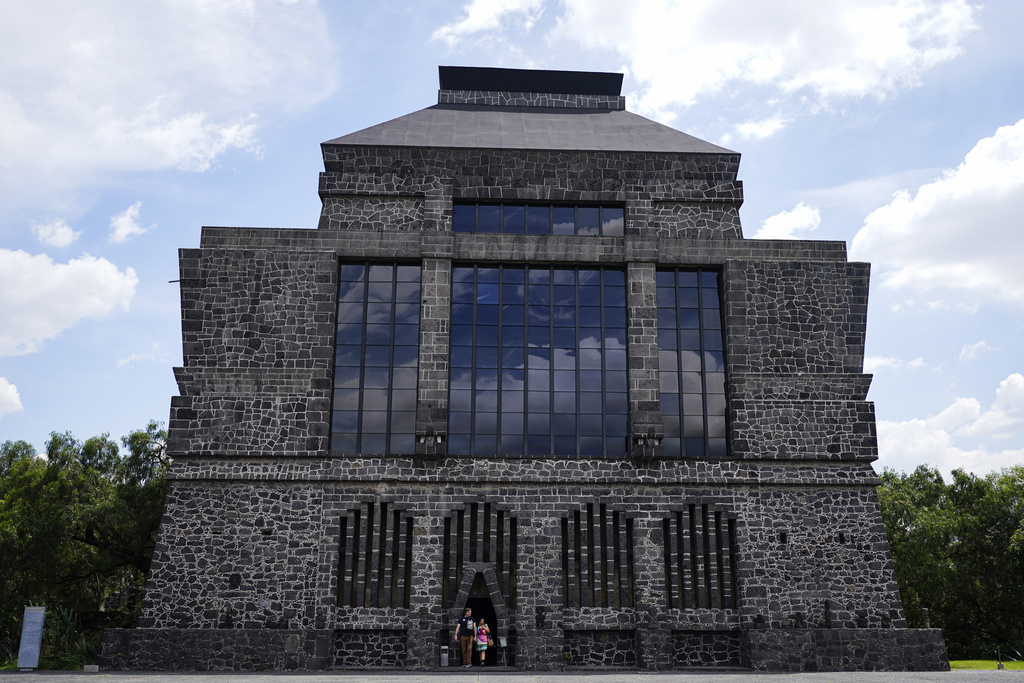
Visitors exit the Anahuacalli Museum in Mexico City, Tuesday, Aug. 20, 2024. Built by Mexican artist Diego Rivera, its name, Anahuacalli, translates from the Nahuatl language as «house surrounded by water.» (AP Photo/Eduardo Verdugo)

Published by The Associated Press, September 2024 (link aquí)

Spanish language story here

MEXICO CITY (AP) – In the 1940s, Mexican artist Diego Rivera had a dream: to build a sacred place to preserve and display his lifelong collection of pre-Hispanic art.

The Anahuacalli Museum in Mexico City, which celebrates its 60th anniversary this month, is everything he hoped for.

Inch by inch, its pyramid structure honors the Mexica worldview. Among its 60,000 archeological pieces, dozens represent ancient deities. And though foreigners visit on a regular basis, its workshops and year-round activities aim to connect the local communities to their historic roots. 

“This is Diego Rivera’s dream come true: a space in which art, nature and the public coexist,” said María Teresa Moya, director of the Anahuacalli.

The Mexican muralist was aligned with a Communist ideology. He and his wife — renowned artist Frida Kahlo — openly criticized the Catholic Church. But their fascination with Mexico’s pre-Hispanic spirituality is palpable through their work.

In Rivera’s case, he bought and collected archeological pieces, depicted them on his murals and designed the Anahuacalli for their exhibition.

“Diego had a great respect, affection and admiration for our ancestors,” Moya said. “Everything he designed or created was inspired by our origins.”

Mexico’s pre-Hispanic worldview was so important to him that it even influenced the Anahuacalli’s architecture. While its main floor represents the underworld — and feels dimly lit and cold — the second and third levels were inspired by the earthly and celestial worlds, which makes them seem warmer and flooded by light.

Though Mexica heritage is dominant in the museum’s design, visitors can also appreciate other Mesoamerican influences, said Aldo Lugo, a researcher who points out the Mayan, Toltec and Teotihuacan elements through guided tours of the museum. 

The three-story pyramid was inaugurated in September 1964, seven years after Rivera died. Its name, Anahuacalli, translates from the Nahuatl language as “house surrounded by water.”

According to a recent government publication, the Anahuacalli is distinctive among Mexican museums in being situated in an ecological reserve of about six acres (2.6 hectares) protecting nearby flora and fauna. The museum itself was built with volcanic rock to fuse with its natural surroundings. 

Rivera and Kahlo first thought of the place as an oasis where they could move away from the buzz of the city. Later, even as their plans changed and Rivera decided to build the museum, the couple desired to be buried in the Anahuacalli’s underworld.

The adjoining niches of the main floor are currently empty. Kahlo’s remains are located in her “Blue House” and Rivera was buried in the Rotunda of Illustrious Persons, a national cemetery site that honors those who made major contributions to Mexico’s history and culture. “But we keep the niches, just in case they end up here,” Lugo said.

During a one-hour visit through the Anahuacalli, its various rooms and cabinets can be read as a book.

From the start, Coatlicue, mother of the gods, greets all visitors from the ceiling. Her myth was special for the pre-Hispanic understanding of the world: a battle between her son and daughter — the sun and the moon — explained the origins of day and night.

The Anahuacalli’s main floor is focused on rituals and burials. The first level displays archeological pieces depicting everyday life, while the second level — representing the celestial world — is devoted to the gods.

The museum’s walls and stairs bear meanings too. Each of the Anahuacalli’s four corners depict a natural element — earth, wind, water and fire — and their respective pre-Hispanic deities. The stairs represent the transition between the stages of one’s existence.

“The Anahuacalli is a temple,” Moya said. “And one of a kind.”

To celebrate its 60th anniversary, the museum planned various activities reflecting on Mexico’s artistic and cultural landscape.

Aside from a gastronomic festival in June and monthly lectures on Rivera’s legacy — which the public can attend through December — neighbors who knew the artist are working on a video to preserve the oral collective memory of the museum and the neighborhood where it’s located.

“We want the community to keep feeling that this space belongs to them,” Moya said. 

Contemporary artists are often invited to host exhibitions at Anahuacalli. “Atomic amnesia,” by Mexican sculptor Pedro Reyes, will be on exhibit from Sept. 13 through January 2025.

His 20 works on display, a press release said, were inspired by one of Rivera’s murals, which was highly controversial and mysteriously disappeared, though its sketch is preserved: “The Nightmare of War, The Dream of Peace. A Realist Fantasy (1952).”

Like Rivera, Reyes’ art reflects society. His works are meant to express the current political landscape and, following in Rivera’s footsteps, he regards his art as a platform to protest and raise awareness.

“Diego was quite controversial,” Moya said. “On the one hand, he had a huge interest in rescuing our pre-Hispanic heritage, but he also adhered to socialism in an unwavering way.”

“He wanted us to look at our past to understand our present and plant something for the future.”

____

Associated Press religion coverage receives support through the AP’s collaboration with The Conversation US, with funding from Lilly Endowment Inc. The AP is solely responsible for this content.

«¡Hasta encontrarles!», gritan familias en México en el Día de las Víctimas de Desaparición

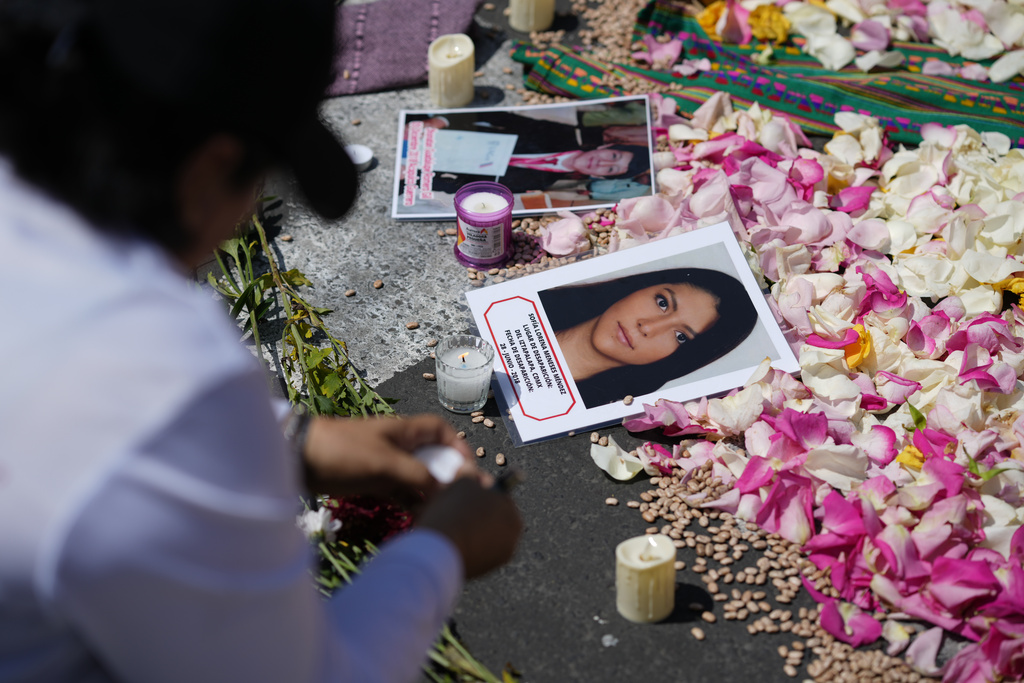
La foto de una persona desaparecida yace en un mandala creado por familias que protestan para que el gobierno ayude a localizar a sus familiares desaparecidos en el Día Internacional de los Desaparecidos en la Ciudad de México, el viernes 30 de agosto de 2024. (AP Foto/Eduardo Verdugo)

Originalmente publicado en The Associated Press, agosto de 2024 (link aquí)

CIUDAD DE MÉXICO (AP) – “Estamos en una reunión que no debería de existir”, dijo el viernes por la mañana el sacerdote anglicano Arturo Carrasco durante una misa ecuménica celebrada en Ciudad de México en el marco del Día Internacional de las Víctimas de Desapariciones Forzadas.

A su alrededor, decenas de familiares portaban mantas y camisetas con las fotos, nombres y fechas de desaparición de sus seres queridos. 

Al menos 115.000 personas han sido víctimas de este flagelo en el país desde 1952, reportan cifras oficiales, aunque diversas organizaciones estiman que la cantidad podría ser mayor. Trata de personas, secuestros, represalias y reclutamiento forzado a manos del crimen organizado están entre las motivaciones detrás de las desapariciones. 

Marcela González, de 58 años, viajó desde Jalisco para exigir respuestas sobre el paradero de su hijo, Alan, que tenía 33 años cuando salió a trabajar y no volvió a casa en 2017. Junto a otras 30 familias, la madre integra la organización “Por Amor a Ellxs” en un estado que registra más de 15.000 desapariciones. 

«Venimos a ver si así nos hacen caso, porque la empatía no existe en el gobierno», dijo la mujer. “Merecemos que el gobierno voltee y se haga presente, nada más en señal de solidaridad». 

Angelina Banda, de 65, se movilizó desde Estado de México, vecino a la capital, para manifestarse por la desaparición de su hijo Roberto, a quien vio por última vez en 2021. 

“Las madres buscadoras andamos en campo pegando volantes, buscando en situación de calle, SEMEFOS (servicios médicos forenses), psiquiatrías, hospitales, vamos a donde uno pueda y le digan”, explicó la madre buscadora que forma parte del colectivo “Uniendo Esperanzas”

Amnistía Internacional señaló el día anterior, durante la presentación de un informe que enlista estándares para proteger a las madres buscadoras en todo el continente, que los Estados son los que deberían encabezar las búsquedas con debida diligencia y aplicando enfoques diferenciales y de género acordes a casa caso, así como garantizar que los familiares puedan participar en condiciones adecuadas sin que se les discrimine o peligren sus derechos humanos. 

Según la organización, ésta es la región más peligrosa para la defensa de los derechos humanos en el mundo y las madres buscadoras reciben amenazas de violencia física que en ocasiones interrumpen sus labores búsqueda. También hay varias que han sido asesinadas o desaparecidas. 

El Comité Internacional de la Cruz Roja (CICR) se sumó a la exigencia de responsabilizar al Estado de las búsquedas y agregó en un comunicado que los gobiernos deben coordinarse para mitigar las consecuencias de la violencia armada, la migración y el desplazamiento en la región, pues también suelen impactar las desapariciones.

“Establecer políticas de Estado coordinadas y sostenibles que aborden las causas profundas de las desapariciones para prevenirlas y erradicarlas debe ser un compromiso político a largo plazo, sostenido a pesar de cambios de gobierno o instituciones”, dijo Marianne Pecassou, asesora regional de protección del CICR. 

Las actividades del viernes arrancaron en México con la pegada de boletines a manos de familiares que recorrieron diversos puntos del país. A lo largo del día se sumarían protestas, conferencias, presentaciones de libros y celebraciones religiosas de distintas confesiones. 

En la Glorieta de los Desaparecidos, antes de la misa celebrada por miembros del “Eje de Iglesias” —organización que agrupa a religiosos anglicanos, metodistas, evangélicos y católicos—, familiares y líderes de fe crearon un mandala, representación espiritual que proviene del budismo e hinduismo. 

Sobre el suelo colocaron velas, fotos de sus familiares y flores. Cada pétalo, dijo la religiosa católica Paola Clerico, representa a uno de los 116.000 desparecidos en el país.

____

La cobertura de noticias religiosas de The Associated Press recibe apoyo a través de una colaboración con The Conversation US, con fondos del Lilly Endowment Inc. La AP es la única responsable de todo el contenido.