Mexican devotion to the Virgin of Guadalupe blends into national identity

Un peregrino, que carga con una imagen de la Virgen de Guadalupe, pasa caminando por delante del Popocatepetl, en Paso de Cortés, de camino a la Ciudad de México, el 10 de diciembre de 2025. (AP Foto/Claudia Rosel)

Published by The Associated Press, December 2025

Spanish story language here

MEXICO CITY (AP) – There’s a saying in Mexico: “Not all Mexicans are Catholic, but all are Guadalupan.”

The phrase conveys the deep connection between Our Lady of Guadalupe and the country’s identity. In the nation of 130 million people — the majority of whom identify as Catholic — this apparition of the Virgin Mary carries a symbolic force that often surpasses religious belief.

“After Mexico emerged as an independent nation, she came to embody not just religious devotion but a sense of national identity,” said Nydia Rodríguez, director of a museum dedicated to the Virgin at Mexico City’s Basilica. The sanctuary draws up to 12 million pilgrims during her feast day each Dec. 12. 

Mexico’s official emblem is an eagle perched on a cactus while devouring a serpent. The Virgin’s likeness is often on display alongside it in government buildings, banners and portraits of political leaders.

“Mexico is a secular state, but in its history there has always been religion,” Rodríguez said. “Our pre-Hispanic ancestors and Spanish society were deeply religious and there’s a point where both traditions meet.”

Among the pieces on display at the museum is a 19th-century painting known as the “Virgin of Congress.” It stands at the center of the main hall, flanked by two golden eagles and framed by Mexican flags.

“This was a gift for the first Constitutional Congress,” Rodríguez said. “In a way, it legitimized those political leaders as if Our Lady of Guadalupe was backing up that Congress.”

Where belief begins

The museum’s “Virgin of Congress” is no ordinary painting. It belongs to a group of artworks classified as “touched by the original,” a term used by Mexican scholars to describe a devotional copy of the original image.

According to the Catholic Church, that very first icon is considered a miracle. Its backstory describes the Virgin’s apparition on a cold December night in 1531.

Under that belief, an Indigenous man named Juan Diego saw Our Lady of Guadalupe near Tepeyac Hill, where the current Basilica stands. She is said to have asked for a temple to be built to honor her son, Jesus Christ, but the local bishop was skeptical.

Guided by her instruction, Juan Diego placed flowers in his cloak. And when he later opened it, a colorful image of the Virgin appeared.

That cloth hangs in the center of the Basilica. Pilgrims travel from across Mexico all year long to give thanks for the miracles they believe the Virgin has granted them.

Teresa Morales is among them. The 85-year-old made a recent visit to the shrine ahead of Dec. 12 to show gratitude for her good health.

She said she felt tormented by knee pain that barely allowed her to walk. But as she prayed to an image of Our Lady of Guadalupe that she keeps at home, her suffering stopped.

“The other day I came for confession and the priest told me to spread the word,” she said. “To tell everyone that her miracles are real.”

The Virgin’s civic power

Our Lady of Guadalupe’s power to bring people together was key when Mexico’s movement for independence began in 1810.

The fight against Spanish rule was led by a priest called Miguel Hidalgo y Costilla. Now considered the father of the nation, he rose up in arms one early morning in September carrying an image of the Virgin.

It was originally a painting that hung in a sanctuary in central Mexico. Aware of its symbolic force, Hidalgo tied it to a lance and used it as his banner.

“The priest was leading the people against the bad government,” said Salvador Rueda, historian and director of Mexico’s National Museum of History, where the iconic canvas is on display. “And why did everybody follow? Because Our Lady of Guadalupe represents us all.”

Multiple galleries within the museum convey how the Virgin has played a double function in recent centuries. Her presence in private lockets, a mural by modernist architect Juan O’Gorman and medals granted by Mexico’s first emperor to praise patriotic services show how it has been both a devotional image and a civic symbol.

According to Rueda, some visitors cross themselves when they spot the first painting at the exhibition. However, their reaction shifts as they approach Hidalgo’s banner. “One is followed by devotion,” he said. “The other is a flag.”

Further armies embraced the Virgin’s image in their causes. While details differ, both the Cristeros and the Zapatistas depicted her in their flags during the early 20th century.

“What started as a devotion ended up becoming a public image,” Rueda said. “A reference to one’s identity not as Catholic, but as Mexican.”

While several experts have wondered whether the cloth at the Basilica is a painting rather than a miraculous object, Rueda said that historians should not care.

“Why would that matter?” he asked. “It’s real because it’s part of reality, of history. Because it shapes an entire world.”

___

Associated Press religion coverage receives support through the AP’s collaboration with The Conversation US, with funding from Lilly Endowment Inc. The AP is solely responsible for this content.
Mexican composer turns fire and ritual into a musical journey of renewal

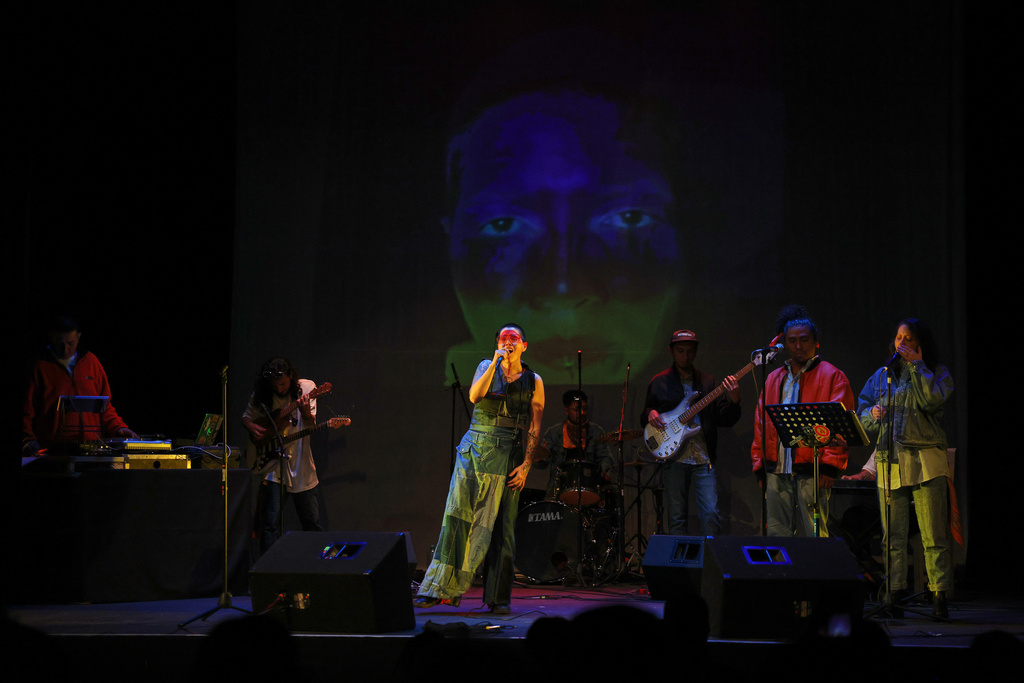
Mexican composer Maria Leonora performs her series she calls “Through All the Fire,” at the Sergio Magaña Theater in Mexico City, Friday, Nov. 28, 2025. (AP Photo/Claudia Rosel)

Published by The Associated Press, December 2025

Spanish story language here

MEXICO CITY (AP) – Mexican composer María Leonora prepares for each concert as if she’s gearing up for battle.

Her makeup has a tribal edge. Her clothes are arranged in layers she sheds as the show unfolds. An amulet over her belly button serves as protection.  

“I look into the mirror and I sort of go to war,” she said prior to a recent presentation in Mexico City. “I brace myself to walk through the fire and whatever happens happens.”

Her 2025 performances were conceived as chapters connected by a common thread. She called the series “Through All the Fire,” believing that both music and flames carry a powerful renewal quality.

“A fire can burn and destroy,” she said. “But if you make it through, you can be reborn.”

That same idea of heat and renewal is present in the ambience of her shows. Her concerts draw inspiration from a pre-Hispanic steam bath known as a “temazcal,” which played a significant role in Mesoamerican social and religious life.

“You may suffer as you enter a temazcal, but you put up with it,” she said. “You sweat and your ego cracks. Even if you don’t want to, heat breaks you.”

Temazcales had a ritual function and a cosmological significance for Mesoamerican cultures, wrote archaeologist Agustín Ortiz in a publication from Mexico’s National Institute of Anthropology and History.

Built in stone or adobe structures, each bath could hold dozens of people and produced steam by heating stones before dousing them with water.

“The temazcal was seen as the Earth’s interior and as a passageway between the world of the living and the underworld,” Ortiz wrote. “It was conceived as an entrance to the ‘beyond.’”

Most of them were located near ceremonial ballcourts, underscoring their connection to the game’s ritual dimension.

Temazcales remain in use today, but their earliest forms have been found in Maya cities such as Chichén Itzá and Palenque, and in sites like Tlatelolco and Teotihuacán in central México.

Path to renewal

María Leonora encountered music’s healing power at age 16.

She embraced punk rock as an adolescent going through a rough patch. And after learning how to play the drums, she first set foot on a stage.

“I was able to transform so many things just by playing and standing in front of an audience,” she said. “I can honestly say it saved my life.”

From then on, she spent years playing with other musicians and engaging in different genres.

In “Through All the Fire,” she interprets a wide variety of songs in an attempt to make her audiences move from darkness into a sense of renewal.

“Music is a powerful tool that can connect you to Earth, to life, to the universe and to other people,” she said. “It’s a means for you to dig up and find things about yourself.”

She describes her shows as “immersive concerts,” meaning that sound, lights and visuals play a role in shaping the attendees’ involvement.

“We want the audience to feel enveloped in the experience of each song,” said producer Diego Cristian Saldaña. “In the emotions and specific sensations the music triggers and that we’re intentionally seeking.”

That intention comes through in how audiences describe the experience.

In a video released by Mexico City’s Ministry of Culture in late November, a young man who had seen María Leonora’s performances on three occasions said each experience had felt deeply gratifying. Another woman mentioned she felt exhausted ahead of the show but left full of energy, wishing to get on with her life.

“We constantly encourage people to actively participate,” she said. “To dive into an internal journey.”

Ritual onstage

“Through All the Fire” starts with her voice inviting the audience into crossing the “salt circle,” which means to leave behind the outside world.

As the lights remain warm and subtle, her first song talks about love. Then the repertoire moves to a breakup. The pain brought by separation reflects on the stage.

As the show evolves, María Leonora explores deeper emotions, and she gradually removes her makeup and takes off layers of clothes. Then the climax comes.

“As my character is exhausted, to the ground, it starts to breathe again,” she said. “The moment comes to walk through the fire, as you would do in a temazcal.”

To liberate themselves with her, attendees are encouraged to howl, scream or engage in whatever ritual they feel they need. Once free from what weighs on them, they sing.

“Our last song is like a first ray of light,” she said. “You can look back into your life and move forward toward luminosity.”

____

Associated Press religion coverage receives support through the AP’s collaboration with The Conversation US, with funding from Lilly Endowment Inc. The AP is solely responsible for this content.
A Christmas tree in Mexico carries the faces of loved ones who never came home

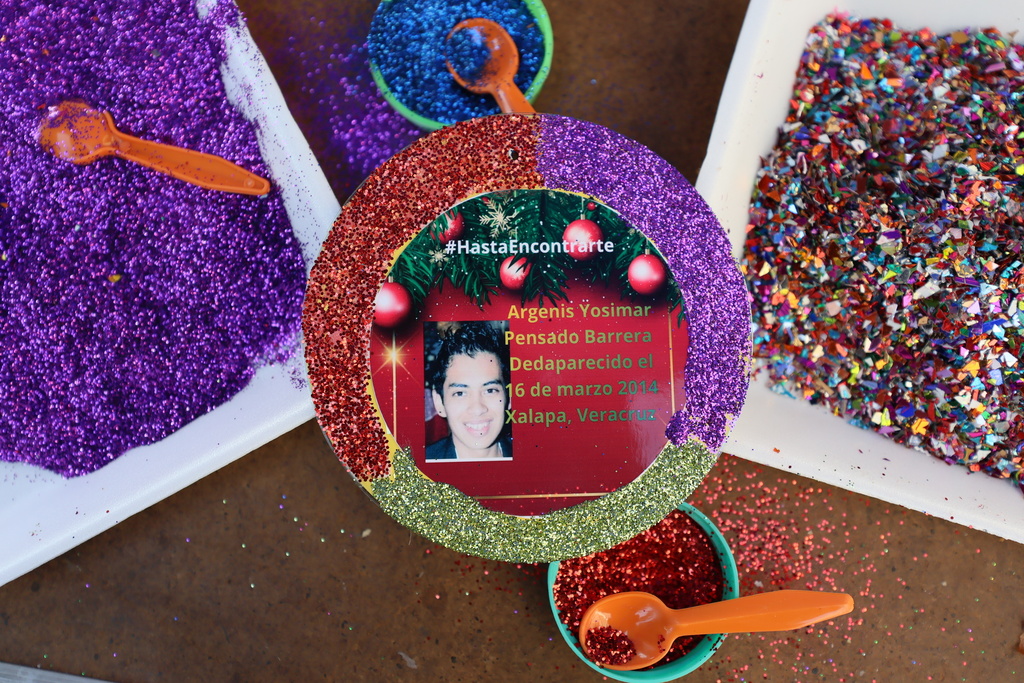
A photograph of Argenis Yosimar Pensado Barrera, who disappeared on March 16, 2014 in Xalapa, Veracruz state, covers a Christmas ornament to hang on the Tree of Hope, during an event organized by the diocese of Ecatepec at the Church of the Sacred Heart of San Cristobal in Ecatepec, State of Mexico, Monday, Nov. 17, 2025. (AP Photo/Ginnette Riquelme)

Published by The Associated Press, November 2025

Spanish story language here

MEXICO CITY (AP) – It’s been 10 years since Verónica Rosas set up a Christmas tree. The sorrow brought on by the disappearance of her son in 2015 has been too overwhelming.

Before the 16-year-old vanished in a Mexico City suburb, mother and son yearned for the winter season. They loved buying natural Christmas trees. To brighten them up, they hung Diego’s favorite decorations: figurines of Mickey and Minnie Mouse.

“It’s been too hard and I have not been able to set up a tree,” said Rosas, who recently met with other grieving relatives to make Christmas ornaments in remembrance of missing loved ones.

The gathering was hosted by the Catholic Diocese of Ecatepec, near the capital, where residents endure robbery, femicide and other crimes.

Rosas and a dozen more families showed up carrying pictures of their relatives. For a few hours, they pasted the images onto old CDs and circles of cardboard, and sprinkled them with glitter.

A priest celebrated Mass and blessed their work. Afterward, the ornaments were hung from a “tree of hope” inside the cathedral, where they will remain until Feb. 2.

“We want to draw attention to the crisis that we’re living,” said Rosas, who founded an organization providing support for Mexicans sharing her pain. “It’s a symbolic gesture that keeps what’s happening in plain sight.”

The mark of a disappearance

Official figures indicate that more than 133,000 people have disappeared in Mexico since 1952. Human trafficking, kidnapping, acts of retaliation and forced recruitment by cartel members are among the causes.

The phenomenon has affected Latin America for decades. In each country, many mothers, sons and sisters have made life-altering choices to search for their relatives — often because authorities fail to act or deliver answers.

“This has been a Way of the Cross,” said Marisol Rizo, referencing the biblical account of Jesus carrying the cross before his crucifixion. She has searched for her mother since 2012. “Thirteen years have passed and we can’t make authorities do their jobs.”

She said her children were little when her mother vanished, and juggling motherhood while searching for her took a toll.

“My mom always told me to take care of them,” she said. “But as I searched for her, I forgot about my children.”

Rizo believes her father was responsible for her mother’s disappearance in a country where at least 10 women or girls are killed because of their gender every day. He has denied any involvement.

Like numerous other relatives of the disappeared, Rizo navigates the winter season with sorrow rather than joy. She still remembers how, years ago, she spent days round Christmas posting flyers on the streets.

It’s a common practice among people with disappeared relatives in Mexico. Each poster contains contact information, as well as the photo, name, distinguishing features and the date a person went missing.

“On Dec. 24, I used to cry a lot,” Rizo said. “I could see happy people pouring out of shopping centers while I was posting flyers, dragging my sorrow.”

Rizo’s daughter, now 17, joined her in crafting round ornaments at the Ecatepec cathedral. Yet the memories sparked by seeing photos of her vanished mother felt almost unbearable.

“These spheres represent a deep sadness to me,” Rizo said. “This is not the place where I would have wished to see a picture of my mom.”

A long wait for compassion

In some cases, relatives of the disappeared have been dismayed by lack of support from religious leaders.

Catholic mothers like Rosas, overwhelmed with fear, sought comfort at their local parishes after their children vanished. But long-trusted priests sometimes rebuffed them.

“I remember when I arrived in a church five years ago, requesting a Mass for my daughter, and I was told ‘We don’t celebrate Mass for disappeared people,’” said Jaqueline Palmeros, who recently found her child’s remains in Mexico City.

“But I believe that the Church, which closed its doors to us for a long time, is an alternative path to access truth, justice, memory and repair,” she added.

During a recent encounter with relatives of the disappeared, Bishop Javier Acero asked for forgiveness. Representing Mexico City’s archdiocese, he has publicly supported victims of disappearances and holds a monthly meeting with relatives in need of spiritual support.

“As church leaders, we recognize that at times we have not acted as we should — out of fear or out of not knowing how,” Acero said. “If we failed to receive you with the care you needed, if we did not pray as you asked us to, please forgive us.”A ministry of presence

Rosas attended the meeting alongside members of an ecumenical group that has offered spiritual shelter for years. Known as “the church circle,” it brings together nuns, an Anglican priest and several other pastors from different denominations.

Holding the mothers’ hands, the faith leaders routinely celebrate Mass in public squares ahead of protests demanding answers from the government. They dress up in gloves and rubber boots to dig up pits where human remains may be. All year round, they post flyers of missing sons and daughters throughout Mexico’s streets.

The Rev. Luis Alberto Sánchez is among them. With open arms, he welcomed relatives at the Ecatepec cathedral. There they shared breakfast and he sprayed lacquer on the newly made ornaments.

“We can’t remain silent,” said Sánchez, whose own brother was kidnapped and killed. “The voice of the disappeared, of those who have perished, needs to resound and say ‘no more.’”

Rosas treasures his blessings and regards all members of the church circle as friends. She, too, has spent mournful Christmases searching for Diego, and they have supported her the whole time.

“I wish for people belonging to all faith communities to congregate and replicate our model everywhere,” she said. “In that way, all families could get this constant presence of the church and the hope that we carry within our hearts.”

___

Associated Press religion coverage receives support through the AP’s collaboration with The Conversation US, with funding from Lilly Endowment Inc. The AP is solely responsible for this content.

An ancient Maya myth finds new life in a Mexican circus company’s performance

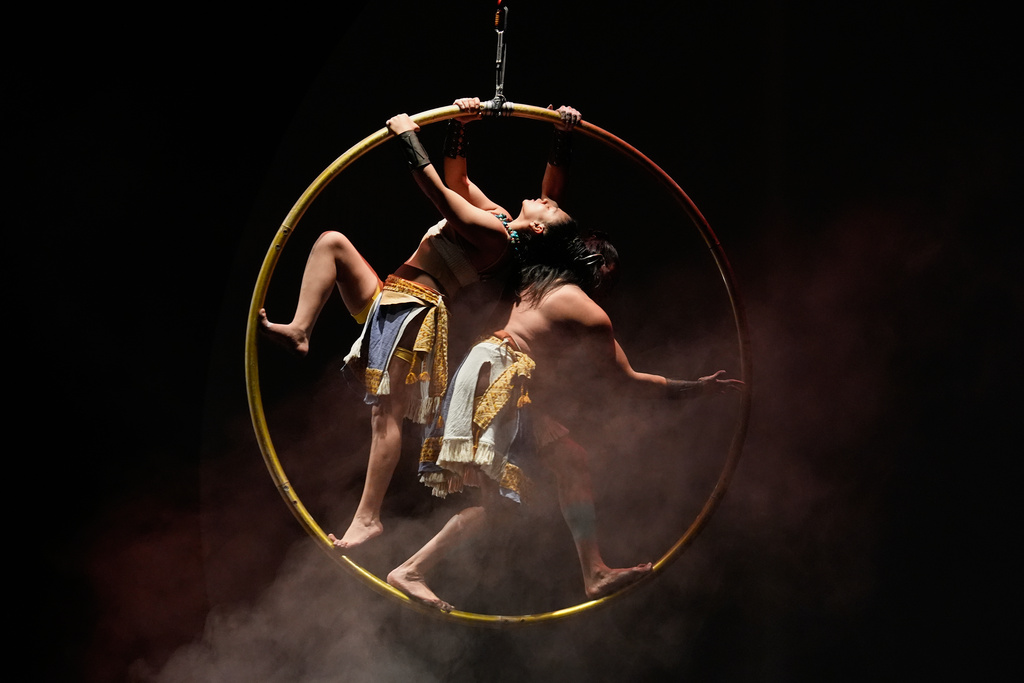
Acrobats from a Mexican theater company perform the show titled «Mortal Leap into Xibalba,» which reinterprets a myth from a sacred Mayan book about creation and the journey to the underworld, in Mexico City, Saturday, Nov. 22, 2025. (AP Photo/Marco Ugarte)

Published by The Associated Press, November 2025

Spanish story language here

MEXICO CITY (AP) – Mexican artistic director Jorge Díaz used to have a unique selection of bedtime stories for his son. 

Setting aside well-known books like “Pinocchio,” they read tales closer to home. Among their favorites was the Popol Vuh, a compendium of sacred Maya myths.

“Recalling those stories is important,” said Díaz, whose grandmother told him legends from her Indigenous lineage as a child. “We have plenty of beautiful, pre-Hispanic tales. But we sometimes forget.”

The one he enjoyed with his son recounts the story of hero twins Ixbalanqué and Hunahpú.

In the Popol Vuh, the brothers embark on a perilous journey to the Maya underworld. There, they outwit death, confront its lords and ultimately rise transformed.

The myth inspired Díaz’s adaptation, “Mortal Leap into Xib’alb’a.” Blending circus arts with theater, the piece employs acrobatics and ritual to reimagine the ancestral story on stage.

“We sought to give the piece its own identity through circus, but I didn’t want the work to rely only on tricks or spectacle,” Díaz said. “The idea was for the techniques to blend with the story and the characters, creating atmospheres rather than just showcasing skills.”

The show has returned to the stage periodically since its debut in 2023. New performances were held in Mexico City in late November.

Circus as storytelling

The troupe behind “Mortal Leap into Xib’alb’a” was founded 20 years ago by Díaz and fellow artist Jessica González. Initially a theater company, “Tránsito Cinco” evolved into a group devoted to circus arts.

“Fresh out of university, we searched for tools that would allow us to grow as actors,” said González, who also performs as a narrator in the Maya myth piece. “We wanted to find something that could connect theater with dance and the circus became a meeting place.”

Their current repertoire includes 16 productions. There’s not a shared theme among them. Yet Díaz and González aim to create pieces with a clear narrative thread.

“Our shows are built around a theme or storyline,” she said. “We believe that circus arts can also be a way to say something, whether it’s about social issues or any other subject.”

How they work hand in hand with artists is reflected in “Somnia,” a documentary about Tránsito Cinco’s history and vision.

“This is one of the most influential art forms I’ve ever witnessed,” said director Arely Cantellano during a recent showing of her film. “It opens those doors to many different arts and invites us all to take part.”

Circus as ritual

Aside from adapting the Maya myth and directing fellow artists, one of Díaz’s jobs in “Mortal Leap into Xib’alb’a” is rigging work. That is, as Yareli Reyes performs while being suspended from a rig by her hair, Díaz oversees her safety

Her performance is close to Díaz’s heart. She plays one of the Maya twins, a role the director once envisioned for himself.

His brother — also an actor — plays the main character in the Maya-inspired piece and Díaz dreamed of performing alongside him. “I love that fragment of the Popol Vuh,” he said. “It felt important to me to create it onstage together.”

He let go of the role so he could avoid overloading himself. But watching his beloved sacred story from a distance provides him with a fresh understanding of his art.

“Circus has the power to astonish and play with risk,” he said. “When I’m holding the performer who does hair suspension, there are moments when I see the light, the atmosphere, and it feels like a ritual.”

Several scenes feel full of energy to him. The way the music, the light and the artists’ bodies fuse into stagecraft creates an immersive environment for audiences, he said.

“It’s fantastic,” said marketing strategist Alba Vida about Tránsito Circo’s work after the recent showcase of their documentary. “I love circus arts because, within them, the frontier with entertainment shifts.”

A tale of rebirth

Díaz’s son is now 14. However, the work inspired by their nights delving into the Maya underworld is still aimed at children and families.

For an hour, “Mortal Leap into Xib’alb’a” depicts the twins’ journey between the living realm and the underworld. The performance kicks off, portraying how the brothers are born after their mother becomes pregnant when the skull of their father spits into her hand, a symbolic transfer of life.

The twins are raised among humans. Yet as they learn to play a pre-Hispanic ritual sport that infuriated the Xib’alb’a lords, several fights take place and the pair eventually perishes — only to return transformed in the myth’s final cycle.

“Under the Mayan worldview, death is not an ending, but a chance to be reborn,” Díaz said. “So even as they throw themselves into the fire as a sacrifice, they become the Sun and Moon.”

Conveying how the ancient Maya perceive death as a possibility to reinvent oneself is as important to Díaz as taking care of every detail in his colleagues’ risky, brilliant acts.

“There are many elements from pre-Hispanic Indigenous traditions that can be brought into circus performance,” he said. “Ways to use them, reinterpret them and give them new meaning onstage.”

____

Associated Press religion coverage receives support through the AP’s collaboration with The Conversation US, with funding from Lilly Endowment Inc. The AP is solely responsible for this content.

Experts lead tours uncovering Mexico’s hidden ancient sites

Tourists raise their arms at the Great Basement in the Cuicuilco Archaeological Zone during a tour organized by the National Institute of Anthropology and History in Mexico City, Sunday, Oct. 5, 2025. (AP Photo/Ginnette Riquelme)

Published by The Associated Press, October 2025

Spanish story language here

MEXICO CITY (AP) – Amid the constant blare of car horns in southern Mexico City, it’s hard to imagine that Cuicuilco was once the heart of a thriving ancient civilization. Yet atop its circular pyramid, now surrounded by buildings and a shopping center, a pre-Hispanic fire god was revered.

“This is incredible,” said Evangelina Báez, who spent a recent morning at Cuicuilco with her daughters. “In the midst of so much urbanization, there’s still this haven of peace.”

Her visit was part of a monthly tour program crafted by the National Institute of Anthropology and History, known by its Spanish initials as INAH.

Aside from overseeing Mexico’s archaeological sites and museums, the institute safeguards the country’s cultural heritage, from restoring damaged monuments and artworks to reviewing construction projects to ensure they don’t harm archaeological remains.

Its historians and archeologists also lead excursions like the one in Cuicuilco. Each academic expert picks a location, proposes a walking itinerary to the INAH and, once approved, it’s offered to the public for about 260 pesos ($15).

“I joined these tours with the intention of sharing our living heritage,” said archaeologist Denisse Gómez after greeting guests in Cuicuilco. “Our content is always up to date.”

According to Mónica de Alba, who oversees the tours, the INAH excursions date back to 1957, when an archaeologist decided to share the institute’s research with colleagues and students.

“People are beginning to realize how much the city has to offer,” said De Alba, explaining that the INAH offers around 130 tours per year in downtown Mexico City alone. “There are even travel agents who pretend to be participants to copy our routes.”

María Luisa Maya, 77, often joins these tours as a solo visitor. Her favorite so far was one to an archaeological site in Guerrero, a southern Mexican state along the Pacific coast.

“I’ve been doing this for about eight years,” she said. “But that’s nothing. I’ve met people who have come for 20 or 25.”

Traces of a lost city

Cuicuilco means “the place where songs and dances are made” in the Nahua language.

Still, the precise name of its people is unknown, given that the city’s splendor dates back to the pre-Classic era from 400 to 200 B.C. and few clues are left to dig deeper into its history.

“The Nahuas gave them that name, which reveals that this area was never forgotten,” said archaeologist Pablo Martínez, who co-led the visit with Gómez. “It was always remembered, and even after its decline, the Teotihuacan people came here to make offerings.” 

The archaeological site is a quiet corner nestled between two of Mexico City’s busiest avenues. Yet according to Martínez, the settlements went far beyond the vicinity and Cuicuilco’s population reached 40,000.

“What we see today is just a small part of the city,” he said. “Merely its pyramidal base.”

Now covered in grass and resembling a truncated cone, the pyramid was used for ritual purposes. The details of the ceremonies are unknown, but female figurines preserved at the site’s museum suggest that offerings were related to fertility.

“We think they offered perishable objects such as corn, flowers and seeds,” Gómez said. “They were feeding the gods.”

Echoes of living heritage

According to official records, Mexico’s most visited archaeological sites are Teotihuacán and Chichén Itzá. The first is a pre-Aztec city northeast of the capital known for its monumental Sun and Moon pyramids. The latter is a major Mayan site in the Southeast famed for its 12th-century Temple of Kukulkán.

The INAH oversees both. But its tours focus on shedding light on Mexico’s hidden gems.

During an excursion preceding Cuicuilco’s, visitors walked through a neighborhood in Ecatepec, on the outskirts of Mexico City, where open-air markets, street food and religious festivals keep local traditions alive. A few days prior, another tour focused on La Merced market, where flowers, prayers and music filled the aisles during the feast of Our Lady of Mercy.

October’s schedule takes into account Day of the Dead traditions. But tours will feature a variety of places like Xochimilco, where visitors can take a moonlit boat tour through its canals and chinampas, and Templo Mayor, the Aztec empire’s main religious and social center in ancient Tenochtitlán.

“These tours allow the general public to get closer to societies that are distant in time and space,” said historian Jesús López del Río, who will lead an upcoming tour on human sacrifices to deities in Mesoamérica.

“Approaching the pre-Hispanic past is not only about how the Maya used zero in their calculations or how the Mexica built a city on a lake,” he added. “It’s about understanding how those societies worked — their way of seeing and relating to the world.”

___

Associated Press religion coverage receives support through the AP’s collaboration with The Conversation US, with funding from Lilly Endowment Inc. The AP is solely responsible for this content.